Chaos spreads from Suvarnabhumi baggage belts to the Thai Airways flight schedule as 5,600 bags pile up. Capacity is slashed by up to 40%, 37 more flights are cancelled, while Tourism Minister Surasak challenges unwilling airline executives to resign.
Thai Airways was fighting a major operational crisis at Suvarnabhumi Airport on Tuesday as 5,600 bags piled up and dozens of flights were cancelled. Almost every flight was delayed during the worst two days, with fewer than 3% leaving on time. The flag carrier slashed capacity by up to 40% as staff shortages crippled ground operations and luggage overflowed into passenger areas. Meanwhile, military personnel were drafted in as anger mounted at Government House. Tourism and Sports Minister Surasak Phancharoenworakul blamed poor operational readiness and challenged executives to resign if they could not fix the crisis. Thai Airways Chief Executive Officer Chai Eamsiri admitted the airline initially misjudged the impact and pledged to clear the baggage within 72 hours.
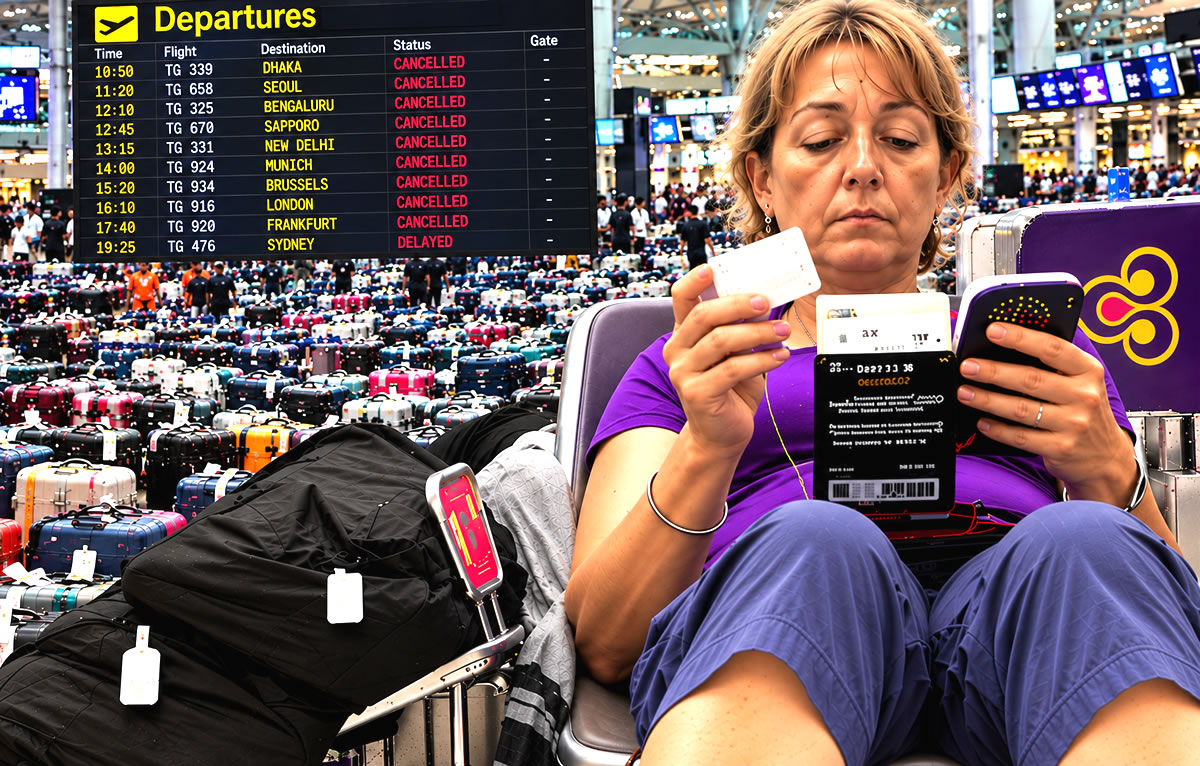
Thai Airways faced a deepening crisis Tuesday as 5,600 stranded bags overwhelmed its operation at Suvarnabhumi Airport. Luggage overflowed conveyor belts and spread across passenger areas as the airline struggled with severe staff shortages.
At the same time, hundreds of flights were disrupted across its domestic and international network. Almost every Thai Airways flight was delayed during the worst two days. Fewer than 3% departed on time.
By Tuesday night, the national flag carrier had cut operating capacity by 30–40%. The airline cancelled flights, combined services and transferred passengers as it tried to regain control. Notably, a later announcement listed another 37 cancellations between September 29 and October 1. Domestic, Asian, European and Australian services were affected. The disruption had therefore spread far beyond the original baggage breakdown.
Government anger grows as Thai Airways baggage chaos spreads across Suvarnabhumi passenger areas
The crisis also triggered open anger inside the government. Tourism and Sports Minister Surasak Phancharoenworakul sharply criticised Thai Airways management on Tuesday. He accepted that flooding had prevented some employees from reaching work.
However, he blamed inadequate operational readiness and management preparation for worsening the breakdown. Mr Surasak also experienced the disruption personally after returning from Japan. His own luggage failed to arrive.
Separately, Deputy Transport Minister Siripong Angkasakulkiat delivered a direct warning to the national flag carrier. “If Thai Airways chooses not to look after its passengers, the business repercussions and damage will ultimately rebound on the company itself,” he said. Mr Surasak went further and challenged the airline’s senior management. He suggested executives should resign if they were unwilling to resolve the problems.
Inside Suvarnabhumi, the scale of the breakdown was clearly visible. Thousands of bags accumulated after overflowing from conveyor belts. Subsequently, luggage spread across the second floor of the passenger terminal. Normal baggage areas became emergency sorting and storage zones. It came as Thai Airways and Airports of Thailand began separating luggage according to flight and date.
Thai Airways chief admits impact was misjudged as severe shortages hit ground crews and loadmasters
Thai Airways Chief Executive Officer Chai Eamsiri apologised as the disruption entered its third day. Crucially, he acknowledged that the airline’s initial assessment of the impact had been inaccurate. The carrier was missing hundreds of ground workers. It had also lost access to many specialised employees holding licences needed for aircraft operations.
Thai Airways normally requires about 45 licensed loadmasters each day. During the disruption, only around 20 were available. As a result, licensed executives were sent to supervise aircraft operations themselves. The broader ground workforce was also severely depleted. Thai Airways normally requires more than 500 workers. Yet only about 200–300 were available.
Mr Chai blamed flooding around employees’ homes for the staffing collapse. Many workers could not reach Suvarnabhumi. Others were dealing with problems affecting their homes and families. Nevertheless, he specifically rejected suggestions of industrial action or employees refusing duty. Instead, Thai Airways introduced incentives to encourage skilled workers to return.
Staff shortages were only one part of the breakdown. Cargo had accumulated inside warehouses because outside contractors could not collect it. Consequently, goods and hauling equipment became trapped within the cargo system. Equipment needed for baggage operations was therefore unavailable. That shortage further slowed luggage arriving aboard aircraft.
Thai Airways cuts capacity by up to 40% as delays spread and domestic cancellations hit key routes
In parallel, delays accumulated throughout the Thai Airways network. On September 27 and 28, almost 100% of its flights were delayed. Fewer than 3% departed on schedule, according to Mr Chai. About 330 flights were reported affected during the wider disruption. By September 28, accumulated delays had become too extensive for the existing schedule.
Thai Airways responded that night with a major reduction in capacity. The carrier cut operations by approximately 30–40%. Some services were cancelled, while others were combined. Passengers were transferred to alternative flights where possible. Other operators were also asked to handle airlines normally receiving Thai Airways ground services.
The aim was to free staff and equipment for the airline’s own operation. However, cancellations then spread across its domestic and international schedules. Five international departures were listed for cancellation on September 29. These included TG339 from Bangkok to Dhaka and TG658 to Seoul. TG325 to Bengaluru was also listed. TG670 to Sapporo and TG331 to New Delhi were included.
The September 30 schedule faced much heavier cuts. Domestic cancellations included TG201, TG205 and TG217 from Bangkok to Phuket. In addition, TG102 to Chiang Mai was affected. TG040 to Khon Kaen was listed for cancellation. TG020 to Ubon Ratchathani and TG002 to Udon Thani were also included.
International cancellations spread across Europe and Asia as 5,600 stranded bags swamp Suvarnabhumi
On another front, international cancellations reached major European and Asian destinations. European services affected included Munich, Brussels, Copenhagen, Zurich, Amsterdam, London and Frankfurt. Asian cancellations included Hong Kong, Taipei, Osaka and Seoul. Tokyo Narita and Tokyo Haneda services were also listed.
Other affected destinations included Kuala Lumpur, Singapore and Manila. New Delhi and Mumbai services were also on the cancellation list. Sydney was included as well. Thus, the operational cuts reached short-haul, regional and long-haul services.
The disruption was also set to continue into October. TG930 from Bangkok to Paris was listed for cancellation on October 1. TG934 to Brussels was also included. Likewise, TG940 to Milan and TG960 to Stockholm were affected. The cancellations therefore extended beyond the original three-day disruption.
At Suvarnabhumi, the immediate challenge remained approximately 5,600 stranded bags. Mr Chai set a 72-hour target to clear the backlog. Doing so required a large emergency operation inside the terminal. Thai Airways began working with Airports of Thailand to remove luggage from overloaded conveyor belts.
As part of this, bags were transferred into designated areas and sorted according to flight and date. Passengers could then identify their luggage using baggage tags. Newly arriving bags were separated from the existing backlog. That measure was intended to prevent fresh luggage from joining the accumulation.
Thai Airways expands baggage delivery operation as passengers arrive hours early amid flight delays
Thai Airways also expanded its baggage delivery operation. Passengers registering through a QR code could request delivery to homes or hotels. The carrier increased the number of delivery providers from two to three. Thailand Post joined the operation. Even so, thousands of bags remained inside Suvarnabhumi on Tuesday.
For departing passengers, the uncertainty created another problem. Many began arriving several hours early because they feared delays or cancellations. At approximately 4 pm, large crowds had formed around Thai Airways check-in counters. Some travellers had seen reports about the disruption before leaving home. Accordingly, they allowed several additional hours before their scheduled departures.
Queues stretched around the airline’s service area. Some passengers remained standing for extended periods. Others eventually sat because they could no longer remain on their feet. Meanwhile, airport information screens continued showing numerous Thai Airways delays.
Among those listed were TG661, TG931, TG308, TG344, TG260, TG637 and TG103. TG551, TG204, TG206, TG302 and TG659 were also displayed as delayed. Some other flights remained confirmed. Others had already arrived.
Passengers waited hours for missing bags before being sent home and told to return the following day
Arriving passengers encountered a different problem. One tour company representative landed at Suvarnabhumi at approximately 6.15 pm on September 28. He had returned from Guangzhou with clients. Initially, passengers were instructed to collect their luggage from conveyor belt 12.
Their bags never appeared. The passenger approached staff and asked when the luggage would arrive. He was told to continue waiting. Consequently, he remained inside the baggage collection area for another three to four hours. His flight details initially remained visible on the baggage screen. Later, they disappeared.
Eventually, passengers were told to leave the airport without their luggage. They were instructed to return the following day. No additional documentation was required. However, passengers were told to retain their passports and boarding passes.
The tour representative returned to Suvarnabhumi on Tuesday. By then, his luggage was waiting on a conveyor belt. He presented his boarding pass and was escorted inside. His clients also had to return personally because each held an individual boarding pass.
The group had already encountered disruption before returning to Bangkok. Their outbound flight had previously been cancelled. Fortunately, their eventual departure went ahead. Their return journey, however, ended with another lengthy baggage delay.
Thai Airways cites its Suvarnabhumi hub exposure as military personnel join the baggage recovery effort
Compounding the problem, reaching Suvarnabhumi again proved difficult. The representative travelled from Bangkok’s Ramintra area with friends. They had to wade through floodwater while travelling to the airport. At first, he believed flooding and staff shortages explained the baggage problems.
After observing operations, he questioned why other airlines appeared able to handle luggage normally. Thai Airways subsequently offered its explanation for the disparity. Mr Chai said Bangkok was the airline’s principal production base. Its exposure at Suvarnabhumi was therefore much greater than that of foreign carriers.
Thai Airways conducts baggage handling at the airport. Its cargo warehousing operation is also based there. Furthermore, catering operations are centred at Suvarnabhumi. Foreign airlines generally conduct their principal activities at their home airports. Mr Chai said they could therefore turn aircraft around faster after arriving in Thailand.
Even so, Thai Airways faced simultaneous problems across several operations at its home base. Ground handling was disrupted by missing staff. Cargo operations became congested. Baggage equipment was tied up elsewhere. Catering also required additional personnel.
In response, government agencies were drawn directly into the recovery effort. Around 100 Royal Thai Air Force and Ministry of Defence personnel were deployed. They assisted with catering, cargo operations and baggage sorting. Thai Airways headquarters employees were also transferred into operational roles.
Government assistance sparks dispute as Surasak criticises Thai Airways over support for military staff
Airports of Thailand personnel joined the effort as well. They helped match baggage tags with passenger information. AOT also provided additional space for the expanding baggage operation. Yet the deployment of government personnel produced another dispute between ministers and Thai Airways.
Mr Surasak said several government agencies had offered assistance. He accused Thai Airways of failing to respond adequately. More pointedly, he said the airline failed to provide food or accommodation for deployed military personnel. The soldiers consequently had to return to their units for meals.
“Every agency tried to step in and help, yet there was no positive response or cooperation from Thai Airways,” Mr Surasak said. He then demanded a more proactive response from the airline’s executives.
“I believe Thai Airways executives need to adopt a more proactive approach,” he said. The minister then delivered a direct challenge to management.
“If they feel their term is ending and are unwilling to resolve these issues, they should consider resigning so that others who are truly committed can step in to manage the situation.”
Surasak questions ground-handling priorities as Thai Airways shortages deepen despite airport staying open
Mr Surasak also raised questions about Thai Airways’ ground-handling contracts with other airlines. Thai Airways provides ground services to several carriers at Suvarnabhumi. He suggested its personnel continued servicing those customers during the crisis.
According to Mr Surasak, this may have been done to avoid contractual penalties. He said Thai Airways passengers consequently suffered particularly severe delays. Subsequently, the carrier arranged for other operators to share ground-handling work involving its airline customers.
That change allowed Thai Airways to redirect more resources towards its own services. Still, Mr Surasak rejected flooding as a complete explanation for the breakdown. He acknowledged that employees had been prevented from travelling normally. He instead pointed to operational readiness and management preparation.
Significantly, Mr Chai had already acknowledged that the airline’s initial impact assessment was inaccurate. Suvarnabhumi Airport itself also remained operational throughout the disruption. Aircraft continued arriving and departing. The central problem was therefore not closure of the airport.
Instead, Thai Airways’ ground operation suffered severe shortages. The airline was missing hundreds of workers. It had fewer than half its normal number of licensed loadmasters. Cargo congestion also trapped equipment required for baggage handling.
Thai Airways launches compensation response as baggage backlog and reduced flight programme continue
In turn, luggage accumulated faster than available workers could process it. Thousands of bags then backed up through the airport. Flight delays spread across the network. Ultimately, Thai Airways cut capacity by as much as 40%. Dozens of cancellations followed.
Government agencies then became part of the recovery operation. Military personnel helped sort and move luggage. AOT supplied additional space and personnel. Thai Airways headquarters staff were reassigned to airport duties. Extra delivery companies were also recruited.
Beyond the operational response, Thai Airways began preparing compensation arrangements for affected passengers. Mr Chai said dedicated service points would handle delayed baggage and flight claims. The centres were scheduled to open Tuesday afternoon. They were being established inside and outside the passenger terminal.
Thai Airways apologised to affected passengers and customers. Its immediate priority was restoring operations at Suvarnabhumi. Yet it was attempting that recovery while operating a sharply reduced flight programme.
The baggage backlog remained substantial. Approximately 5,600 bags still required sorting, collection or delivery. Thai Airways had also imposed a 72-hour deadline on itself to clear them. Its flight schedule remained under heavy pressure.
Government criticism grows as passengers face cancellations, missing bags and long queues
Domestic routes had been cancelled. Asian routes were affected. Long-haul European services were cut. Australian flights were also included. Furthermore, cancellations stretched into October.
Against that backdrop, government criticism became increasingly direct. Mr Surasak questioned management preparation and the deployment of ground-handling staff. He also criticised the airline’s response to government assistance. Deputy Transport Minister Siripong separately warned about the commercial consequences of failing passengers.
For travellers, the effects remained visible throughout Suvarnabhumi. Queues persisted around Thai Airways counters. Flight information screens continued displaying delays. Thousands of bags remained stacked across parts of the terminal.
Some passengers had waited hours after landing before being sent home without luggage. Others returned through floodwater the following day to retrieve their belongings. Departing passengers arrived hours early because they feared further cancellations.
By Tuesday night, Thai Airways was fighting problems across much of its Suvarnabhumi operation. It had 5,600 stranded bags to clear and hundreds of missing ground workers. It also needed to release equipment trapped by the cargo backlog.
Thai Airways battles continuing delays as military personnel assist and 5,600 bags await clearance
At the same time, the carrier had to stabilise a network already hit by extensive delays. Dozens of cancellations extended into October. Capacity had been reduced by 30–40%. During the worst two days, fewer than 3% of flights departed on time.
Government personnel were now directly involved in the recovery. Military officers were working inside the operation. Airports of Thailand staff were assisting with stranded baggage. The Tourism and Sports Minister was publicly challenging Thai Airways management.
Suvarnabhumi itself remained open throughout the disruption. Thai Airways’ ground operation, however, remained under severe pressure. The carrier aimed to clear the 5,600 stranded bags within 72 hours. Reduced flight operations would continue while staffing, equipment and baggage handling recovered.
Thai Airways CEO apologises for ongoing flooding crisis issues with defective carts and delayed flights
Military operations are expanded at Suvarnabhumi Airport as crisis is still not brought under control
For passengers, the disruption had already moved beyond the weekend flooding. Flights had been delayed or cancelled. Thousands of travellers had been separated from their luggage. Some were sent home after waiting hours beside baggage belts.
Others faced another journey to Suvarnabhumi simply to retrieve their belongings. Departing passengers confronted crowded counters and uncertain schedules. Dozens of flights had disappeared from the programme.
By Tuesday night, Thai Airways was still cutting services while clearing thousands of bags from Thailand’s principal international gateway. At Government House, ministers were simultaneously turning their attention towards the airline’s management and its handling of the crisis.
Join the Thai News forum, follow Thai Examiner on Facebook here
Follow Thai Examiner on Google here
Receive all our stories as they come out on Telegram here
Follow Thai Examiner here
Further reading:
Bangkok airports open and flights running but there are delays and baggage issues at Suvarnabhumi
Engineers work through night after Sunday’s fire on Bangkok’s Blue Line saw more damage than thought
Italian Thai boss and 16 others arrested on Thursday charged with Auditor General building deaths
Arrested man linked with Chatuchak building collapse now tells police he is a Chinese state employee