Poland in turmoil. Thailand’s Warsaw embassy warns 664 Thai residents to avoid protests as riot police move in. Three detained, two senior judges suspended and President Nawrocki returns from an overseas trip to confront Tusk over the court.
Thailand’s embassy in Warsaw issued an urgent security warning on Saturday as Poland’s constitutional crisis erupted into street confrontations. Riot police clashed with protesters, three people were arrested and two senior judges suspended. President Karol Nawrocki abandoned an overseas visit, accusing Prime Minister Donald Tusk’s government of seizing the Constitutional Tribunal. Meanwhile, the justice minister sought criminal investigations as a decade-long battle over judicial independence and EU law intensified. With Poland’s president, government and judiciary locked in confrontation, another showdown looms on Tuesday. The Thai Embassy warned 664 Thai nationals living in Poland to avoid Warsaw’s protest areas.
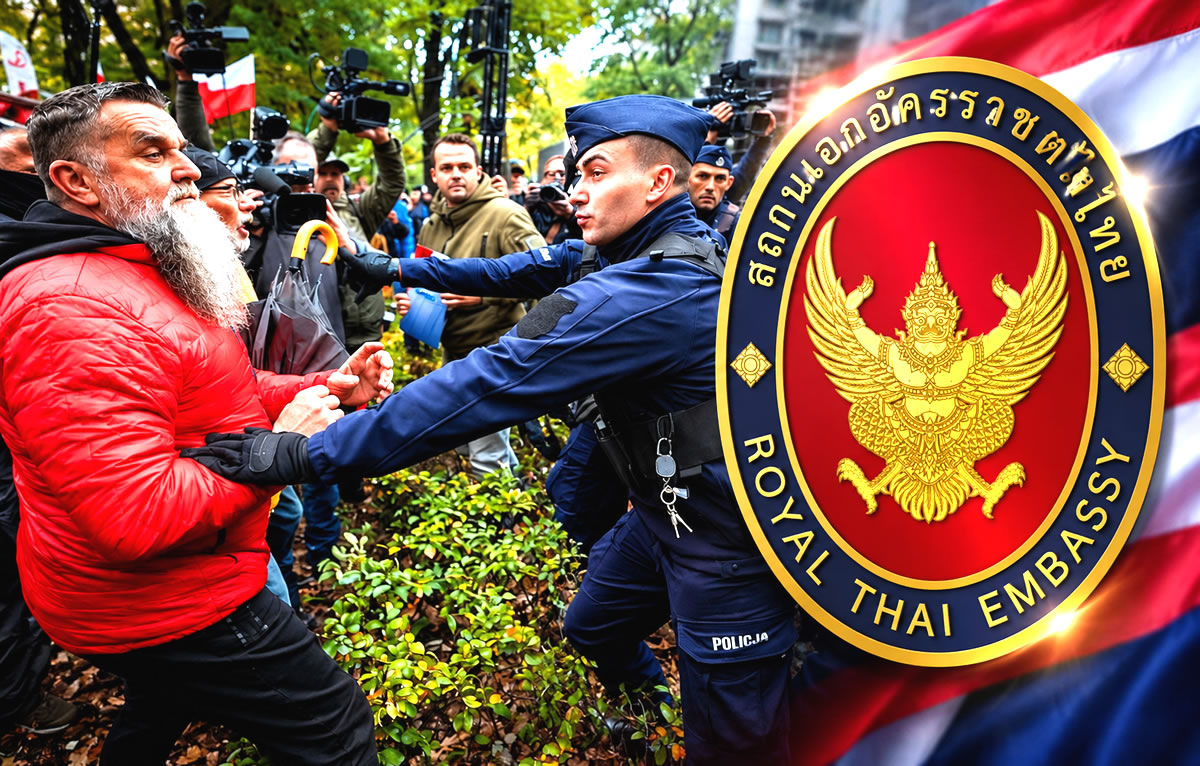
Thailand’s embassy in Warsaw issued an urgent security warning on Saturday as Poland’s constitutional crisis spilt onto the capital’s streets. Riot police confronted protesters outside the Constitutional Tribunal after rival judges claimed control of the country’s highest constitutional court.
Three demonstrators were detained. President Karol Nawrocki abandoned an overseas visit and returned to Poland, accusing the government of seizing the tribunal. Meanwhile, Prime Minister Donald Tusk’s administration defended its judicial reforms as necessary to restore constitutional legality.
The confrontation has reopened Poland’s bitter dispute over judicial independence and its obligations under European Union law. Hundreds of Thai nationals live and work in the country.
Thai embassy warns nationals to avoid Warsaw protests as official figures identify 664 Thais in Poland
The Royal Thai Embassy issued its warning on Saturday, 31 October, following demonstrations that began on Friday evening. It instructed Thai nationals to avoid protest locations throughout Warsaw, including surrounding streets and nearby areas.
In addition, citizens were advised to monitor announcements from Polish authorities and follow local security instructions. Those requiring emergency assistance were directed to the embassy’s hotline on +48 880 828 312. Thai newspaper Siam Rath reported the announcement at 6.22 pm Thai time on Saturday.
The warning marked a formal diplomatic response to the rapidly escalating confrontation. Thailand’s ambassador to Poland is Sira Swangsilpa, who presented his credentials to President Nawrocki on 27 March 2026.
The embassy operates from Ul. Willowa 7 in Warsaw and provides consular assistance to Thai citizens. Its responsibilities cover workers, residents, students and visitors. The latest disturbances have therefore brought the safety of Thailand’s expatriate community into immediate focus.
According to Thailand’s National Intelligence Agency, 664 Thai nationals were living in Poland in February 2025. Earlier Foreign Ministry records counted 830 in 2024 and 920 in 2019.
However, these figures cover residents generally rather than employees alone. Many Thais work in restaurants, hospitality, traditional massage and spa services. Chefs, cooks and massage therapists feature prominently in earlier official records. Separately, Poland employs substantial numbers of foreign workers across manufacturing, logistics and services. A verified population figure for Thais living specifically in Warsaw has not been established.
Rival judges claim control of Poland’s Constitutional Tribunal as opposition supporters gather outside
The constitutional confrontation intensified on Friday, 30 October, inside Poland’s Constitutional Tribunal. Judge Anna Korwin-Piotrowska announced the suspension of tribunal president Bogdan Święczkowski and deputy president Bartłomiej Sochański.
Both were suspended for one month amid a dispute over judicial appointments and the court’s membership. Korwin-Piotrowska asserted authority over the institution, accusing its leadership of unlawfully obstructing judges elected by Parliament. Święczkowski rejected the suspension and challenged her power to remove him. As a result, rival groups of judges claimed control of the same constitutional institution.
The confrontation followed months of disagreement over parliamentary appointments and the president’s role in administering judicial oaths. On Friday, judges elected by Parliament entered the tribunal’s headquarters, accompanied by officers from the State Protection Service. Their arrival intensified the struggle over control of the court.
Outside, demonstrators gathered as police established a security perimeter. The protesters included supporters of the opposition Law and Justice party, widely known as PiS. The party governed Poland between 2015 and 2023 and remains closely associated with Nawrocki.
Senior opposition figures joined the demonstration, including PiS leader Jarosław Kaczyński and former Prime Minister Mateusz Morawiecki. The gathering subsequently became confrontational as protesters challenged the police cordon.
Police detain three protesters as President Nawrocki abandons Senegal visit and confronts court judges
Some breached a security fence, while objects were thrown towards officers. Police detained three people during the disturbances. Riot police remained deployed around the Constitutional Tribunal as tensions continued. Thus, a longstanding judicial dispute had developed into a direct confrontation involving police, protesters and rival constitutional authorities.
The crisis took another dramatic turn when Nawrocki abandoned an official visit to Senegal. The president was already airborne when news of the confrontation reached him. He ordered his aircraft to return to Poland, cancelling the overseas journey. After landing, he met Supreme Court First President Zbigniew Kapiński.
He then travelled to the Constitutional Tribunal, where tensions intensified. Video footage showed Nawrocki pushing past a group of judges while attempting to enter the building.
Justice Minister Waldemar Żurek criticised the president’s conduct and called for prosecutors to examine the incident. In response, Nawrocki maintained that he was defending Poland’s constitutional institutions against an unlawful takeover.
He accused Tusk’s government of forcibly seizing the tribunal. On Saturday, the president declared that Poland’s constitutional order had been violated. He demanded the withdrawal of security forces from the court and summoned parliamentary representatives for urgent consultations. Nawrocki cited threats to Poland’s internal security arising from the confrontation.
Tusk and Nawrocki clash over judicial authority as Poland’s constitutional battle stretches back to 2015
The president’s intervention brought Poland’s highest political offices into direct conflict. Tusk’s government maintains that its judicial reforms are necessary to restore constitutional legality. It accuses the former PiS administration of undermining judicial independence through politically motivated appointments.
By contrast, the opposition argues that Tusk’s coalition is using disputed procedures to seize control of the judiciary. Both sides accuse their opponents of violating the constitution while claiming to defend it. The latest confrontation has therefore become a struggle over which institutions possess lawful authority.
The dispute stretches back to 2015, when the outgoing Civic Platform-led coalition elected five Constitutional Tribunal judges. The tribunal subsequently ruled that only three appointments were legally valid.
The remaining two vacancies had been filled prematurely. After winning power, PiS appointed five replacement judges, including candidates for the three lawfully filled seats. President Andrzej Duda, politically aligned with PiS, accepted the new appointments. However, he refused to administer the oath to the three judges previously elected through the valid procedure.
That decision triggered years of confrontation over the tribunal’s membership, authority and independence. Subsequently, the PiS government introduced further changes affecting judicial appointments, court administration and disciplinary procedures.
Judicial reforms trigger confrontation with European courts over Poland’s obligations under EU law
Critics accused the administration of placing the judiciary under political influence. PiS insisted its reforms were necessary to improve accountability and address longstanding institutional problems. The disagreement spread beyond the Constitutional Tribunal into the wider court system. Eventually, Poland’s judicial changes brought the country into serious conflict with the European Union.
European institutions challenged several reforms, arguing that they undermined judicial independence and European legal obligations. The European Commission launched proceedings concerning Poland’s judicial arrangements.
European courts also questioned aspects of the tribunal’s composition and the legality of judicial appointments. In 2021, the European Court of Human Rights ruled against Poland over a tribunal panel containing a disputed appointee. It concluded that the panel failed to satisfy the requirement for a tribunal established by law.
On another front, disagreements widened over the relationship between Poland’s constitution and European Union law. The dispute produced legal proceedings, financial penalties and growing friction between Warsaw and Brussels.
Poland’s EU membership became central because European law imposes obligations concerning judicial independence. PiS maintained that Poland retained constitutional authority over the organisation of its courts. Accordingly, the confrontation extended beyond domestic appointments into the interpretation and enforcement of European legal obligations.
Tusk’s return to power fails to end tribunal deadlock as new president blocks government court reforms
Donald Tusk returned to power in December 2023, leading a coalition promising to restore judicial independence. His administration sought to reverse changes introduced during eight years of PiS government.
Yet the coalition inherited a Constitutional Tribunal containing judges appointed under the previous administration. The government questioned the legality of several appointments and proposed reforms intended to restore the institution’s legitimacy. President Duda resisted those efforts, including by referring judicial legislation to the Constitutional Tribunal.
At the same time, Tusk’s administration restricted publication of certain tribunal judgments. The government argued that the court’s composition remained legally defective. The tribunal’s leadership rejected that position and insisted its decisions remained binding.
Consequently, Poland entered an extraordinary constitutional deadlock. The government disputed the tribunal’s legitimacy, while the tribunal challenged the government’s treatment of its judgments. Neither institution accepted the other’s interpretation of constitutional authority. The conflict remained unresolved when Nawrocki succeeded Duda as president in August 2025.
Nawrocki had been supported by PiS during the presidential election. He subsequently opposed significant elements of Tusk’s judicial reform programme. The political division became particularly important because Poland’s president possesses substantial constitutional powers.
Presidential veto powers frustrate judicial reforms as four elected judges are denied their court seats
These include the ability to veto legislation passed by Parliament. Although Parliament can override a presidential veto, doing so requires a three-fifths majority under constitutional voting rules. Tusk’s governing coalition lacks that majority. Presidential opposition can therefore obstruct legislation, including measures intended to reform the judiciary.
The dispute intensified in March 2026 when Parliament elected six judges to the Constitutional Tribunal. Nawrocki administered the oath to two appointees but refused to swear in the remaining four.
He questioned the appointment procedure, citing concerns about voting requirements and deadlines. Tusk’s government insisted that Parliament had lawfully elected all six judges. On 9 April, the four disputed appointees took their oaths before a notary in Parliament. The presidential office rejected the procedure, maintaining that judicial oaths had to be administered in the president’s presence.
Tribunal president Święczkowski supported that interpretation and prevented the four judges from participating in hearings. Subsequently, the European Court of Human Rights issued an interim measure concerning obstruction of the appointees.
European legal bodies challenge oath restrictions as tribunal dispute threatens court authority
The Council of Europe’s Venice Commission also maintained that the president’s role in administering judicial oaths should be ceremonial. Nevertheless, the tribunal’s leadership continued disputing the appointments. Further disagreements during October increased pressure on the institution. Friday’s suspension of Święczkowski and Sochański finally brought the confrontation to a head.
The Constitutional Tribunal is one of Poland’s most powerful judicial institutions. It determines whether legislation and other legal measures comply with the country’s constitution. Its decisions can invalidate legislation and restrict government action.
Disputes over its membership therefore directly affect Parliament, the government and the presidency. The court’s composition becomes particularly important when the president and parliamentary majority represent opposing political camps. Furthermore, the tribunal can rule on legislation affecting Poland’s relationship with European Union law.
The present confrontation concerns both domestic constitutional authority and Poland’s European legal obligations. Competing authorities dispute which judges are lawfully entitled to serve. In turn, that disagreement affects the legitimacy of tribunal decisions.
Disputes over the publication and enforcement of judgments also affect the implementation of legislation. Beyond the appointments dispute, the conduct of senior judicial officials has come under direct scrutiny. Justice Minister Żurek has sought to remove judicial immunity from Święczkowski and Sochański, potentially permitting criminal proceedings concerning their conduct.
Judges face possible criminal proceedings as rival factions prepare for another tribunal confrontation
Opposition politicians accuse the government of attempting to criminalise judicial decisions it opposes. Conversely, the government maintains that judicial officials remain accountable for unlawful conduct.
The legality of the leadership suspensions has itself been questioned. Some legal commentators critical of earlier PiS reforms have challenged the legal basis for the latest intervention. The dispute therefore involves competing interpretations of judicial authority, parliamentary appointments and constitutional procedure. Rival factions continue rejecting each other’s claims to control the tribunal.
On Saturday, Święczkowski announced that he and the remaining judges would attempt to regain control of the institution. Korwin-Piotrowska maintained her competing claim to leadership. She has called a General Assembly of tribunal judges for Tuesday, 3 November.
The planned meeting could produce another confrontation over which judges are entitled to participate. In parallel, Nawrocki’s emergency consultations have brought the dispute directly before Poland’s parliamentary leadership. Opposition politicians continue demanding the reinstatement of the suspended tribunal officials. Tusk’s government insists its judicial reform programme must proceed.
The confrontation has also attracted international diplomatic attention. US Ambassador to Poland Tom Rose publicly warned against violence and further escalation. Poland remains a major European Union and NATO member, with an important role in supporting Ukraine.
US envoy warns against violence as Thailand’s embassy urges nationals to avoid Warsaw protest areas
Its judicial confrontation has renewed attention to longstanding disputes with European institutions. For the moment, however, the immediate disturbances remain a domestic constitutional and political confrontation. The reported police operation and arrests centred on the Constitutional Tribunal and surrounding streets in Warsaw.
For Thailand, the immediate concern is the safety of its nationals living and working in Poland. The Royal Thai Embassy’s Saturday warning specifically addressed demonstrations in the capital. It did not announce a nationwide emergency or changes to Polish employment and residence regulations.
Instead, the embassy urged Thai nationals to avoid all protest areas and nearby locations. The instructions apply to residents, workers, students and visitors who could encounter demonstrations or police security operations.
Thailand’s National Intelligence Agency had already identified Poland’s political divisions as a significant concern. In an assessment updated on 28 December 2025, the agency highlighted tensions between Nawrocki and Tusk.
It identified presidential vetoes and disagreements over judicial reform as obstacles to effective government. Separately, the assessment warned about security threats involving Russia and Belarus, including cyberattacks and hostile information operations. Those external concerns were distinct from the domestic constitutional confrontation unfolding in Warsaw.
Thai embassy publishes emergency contacts as Poland braces for another round of court disputes
The agency’s assessment recorded Poland’s political deadlock before Friday’s confrontation. The Thai Embassy’s latest warning placed immediate attention on demonstrations and police activity in the capital.
Thai citizens requiring consular assistance can contact the embassy at Ul. Willowa 7 in Warsaw. Its main telephone number is +48 22 849 2655. The consular section also maintains contact numbers on +48 22 849 6414 and +48 22 849 1406. For emergencies, the designated hotline is +48 880 828 312.
Poland now faces another decisive stage in its constitutional confrontation. Nawrocki’s consultations have brought the dispute directly into the country’s political leadership. Meanwhile, rival tribunal authorities continue rejecting each other’s claims.
Massive cannabis seizure from Thailand by Polish and German officials piles further pressure on Bangkok
Tourist chiefs forge a key partnership with Poland and Polish LOT Airways to boost foreign tourism arrivals
The planned judges’ meeting on Tuesday could produce fresh disputes over membership and control. The confrontation has revived unresolved disagreements concerning judicial appointments, presidential powers and constitutional judgments. It has also renewed the conflict over the relationship between Polish courts and European Union law.
More than a decade after the original judicial appointments dispute, the confrontation has reached Warsaw’s streets. Police have detained protesters, the president has abandoned an overseas visit, and senior judges face suspension. Rival political leaders accuse each other of violating Poland’s constitution.
The struggle now involves the president, government, Parliament and the Constitutional Tribunal, with European legal obligations also at issue. For hundreds of Thai nationals living in Poland, the embassy’s security warning remains the immediate official instruction. They have been advised to avoid demonstrations, monitor Polish authorities and contact the embassy’s emergency hotline when necessary.
Join the Thai News forum, follow Thai Examiner on Facebook here
Receive all our stories as they come out on Telegram here
Follow Thai Examiner here
Further reading:
Bungling French drug dealer arrested at Phuket Airport after cocaine sachets found on concourse
Phuket Airport Immigration Chief rebuts UK tabloid coverage linked with the arrest of a UK tourist
24 year old New Zealand tourist arrested. Cocaine found inside his passport clearing Phuket Airport