Thailand passes its first OECD test, but deep economic weaknesses loom large. Governor Vitai Ratanakorn slams failures to curb the shadow economy. Falling productivity, excessive regulation and harsh foreign investment restrictions face global scrutiny.
Thailand’s ambitious bid for OECD membership by 2028 faces formidable hurdles despite Monday’s regulatory breakthrough in Bangkok. On November 24, Bank of Thailand Governor Vitai Ratanakorn slammed government failures as the underground economy remains equivalent to 48% of GDP. Meanwhile, Organisation for Economic Co-operation and Development (OECD) Secretary-General Mathias Cormann highlighted collapsing productivity growth and demographic decline. Public debt is approaching its 70% ceiling. Furthermore, Thailand’s sweeping restrictions on foreign investors and intensifying crackdown on established businesses face international scrutiny. Prime Minister Anutin Charnvirakul’s membership drive will be forced to confront decades of deep-rooted weaknesses.
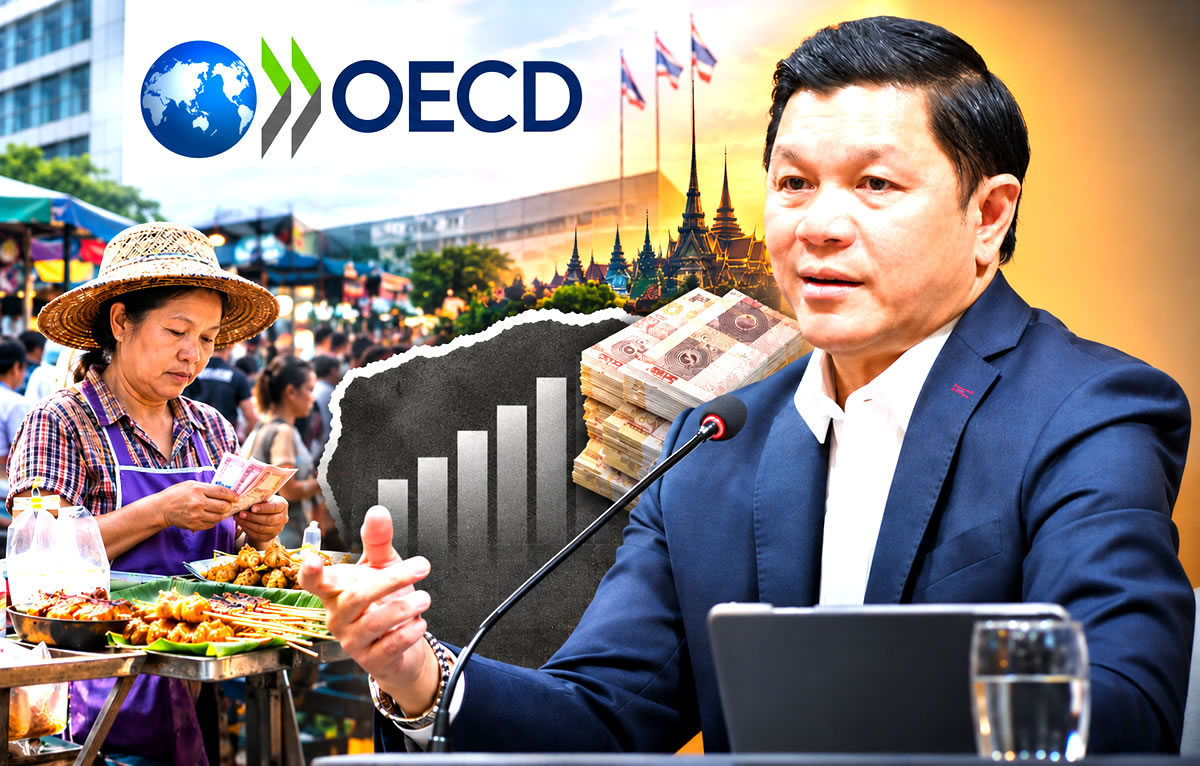
Bank of Thailand Governor Vitai Ratanakorn on Tuesday exposed the kingdom’s continuing failure to rein in its enormous underground economy. Speaking at the central bank’s annual economic symposium on Tuesday, November 24, Vitai cited a staggering World Bank estimate.
Thailand’s informal economy remains equivalent to 48% of GDP. In particular, the governor criticised government agencies responsible for combating grey money, corruption and illegal gambling.
Too many announce policies, while too few deliver results. His intervention came just 24 hours after Prime Minister Anutin Charnvirakul celebrated a breakthrough in Thailand’s OECD membership campaign.
Thailand targets OECD membership by 2028 despite decades of economic informality exceeding global norms
Bangkok wants admission to the Organisation for Economic Co-operation and Development by 2028. However, the organisation has already identified serious deficiencies in Thailand’s economic framework, including extensive restrictions on foreign investors.
The scale of Thailand’s underground economy remains extraordinary by international standards. According to World Bank research cited by Vitai, Thailand ranks 14th among 158 countries surveyed for economic informality.
The international average stands at approximately 33%. By comparison, Thailand’s figure is 15 percentage points higher. The kingdom’s shadow economy has historically exceeded half its GDP, despite successive government campaigns targeting unregulated commercial activity.
Indeed, historical research documents a structural problem stretching back more than three decades. On January 24, 2018, the International Monetary Fund published a comprehensive working paper examining underground economies worldwide.
Economists Leandro Medina and Friedrich Schneider examined economic informality between 1991 and 2015. Their research placed Thailand’s average shadow economy at 50.63% of GDP during that period.
In 1991, Thailand’s shadow economy stood at an estimated 55.72% of GDP. Subsequently, it reached 55.43% in 1998 before climbing to 56.64% in 1999. Researchers estimated its value at 54.17% of GDP in 2001.
Central bank governor attacks government agencies over failure to curb Thailand’s vast underground economy
Separately, research compiled in 2016 placed Thailand’s informal economy at between 40% and 60% of GDP. The World Bank estimate cited on Tuesday uses a different research basis. Its underlying reference year remains unspecified.
Against this backdrop, Vitai acknowledged that Thai authorities had discussed economic informality for more than a decade. Yet the kingdom continues to struggle with its consequences.
The governor directed his criticism towards agencies responsible for combating illicit economic activity. Specifically, he highlighted the disparity between official policy announcements and effective implementation.
He demanded sustained cooperation between government departments, regulators, financial institutions and businesses. Monetary policy alone cannot resolve these structural deficiencies.
Meanwhile, Thailand faces heightened scrutiny over international criminal networks, illegal gambling operations, nominee businesses and mule bank accounts. These operations facilitate financial transactions that escape effective regulatory supervision.
They also undermine legitimate commercial competition and deprive the government of revenue. Businesses operating within Thailand’s legal framework face competition from operators avoiding regulatory obligations and associated costs.
Research distinguishes legitimate informal businesses from criminal money circulating in registered firms
Importantly, Vitai distinguished between two fundamentally different components of Thailand’s underground economy. The first encompasses legitimate economic activities conducted outside formal administrative, employment or taxation systems.
These include farming, independent trading, self-employment and small commercial enterprises. The second encompasses criminal operations, corruption, illegal gambling and illicit financial activity. Research from the Puey Ungphakorn Institute for Economic Research estimates legitimate informal activity at between 21% and 35% of GDP.
In contrast, research published by Havoscope in 2012 estimated Thailand’s narrower grey economy at approximately 13% of GDP. That historical estimate does not measure the entire shadow economy. No updated figure exclusively measuring criminal economic activity emerged from Tuesday’s presentation.
Furthermore, Thailand’s official national accounts already capture some legitimate informal production. The 48% estimate therefore does not represent entirely unrecorded criminal revenue.
Earlier in November, the Puey Ungphakorn Institute for Economic Research published fresh research examining grey capital. Entitled Grey Capital: The Informal Economy Within the Formal Economy, the study examined illicit financial activity inside registered enterprises.
Crucially, researchers distinguished conventional informal businesses from criminal proceeds circulating through formally established companies. Their findings extend the examination of Thailand’s underground economy beyond unregistered businesses and undocumented workers.
Cash transactions of ฿5 million face scrutiny as Thailand’s vast informal economy strains public finances
Registered companies can also provide channels for illicit financial activity. Accordingly, regulatory supervision extends to business ownership, investment funding and commercial transactions.
Formal registration alone does not establish the legitimacy of a company’s operations. As part of the response, Vitai identified greater scrutiny of cash transactions worth ฿5 million or more. The measure targets financial activity that can escape conventional oversight.
On the legitimate side of the underground economy, the figures presented by Vitai were equally striking. Approximately 2.5 million businesses operate informally throughout Thailand. Estimates suggest between 70% and 80% of Thai enterprises operate outside formal systems.
In addition, the governor cited a broader estimate of approximately 26 million informal workers nationwide. These figures encompass substantial sections of Thailand’s commercial and agricultural economy.
From a fiscal perspective, the underground economy presents an increasingly serious problem for Bangkok. Thailand’s public debt is approaching the government’s ceiling of 70% of GDP.
Consequently, the administration has diminishing financial flexibility as expenditure commitments increase. The kingdom’s rapidly ageing population is placing additional demands on public finances. These include healthcare, pensions, welfare payments and other essential public services.
Informal economy restricts government revenue while only 21% of smaller Thai businesses have credit access
At the same time, successive governments must finance infrastructure development and economic stimulus programmes. Extensive economic informality restricts the revenue available to support those commitments.
Registered businesses and formally employed workers consequently shoulder a disproportionate share of the taxation burden. However, millions of legitimate traders depend on informal commercial activity for their livelihoods. Vitai’s proposals therefore extend beyond taxation and regulatory enforcement.
On another front, the governor identified a glaring disparity in access to commercial financing. Approximately 70% of large businesses have access to credit. Among small and medium-sized enterprises, the corresponding figure stands at approximately 21%.
Informal businesses frequently lack reliable accounts and documented earnings. As a result, financial institutions struggle to assess their creditworthiness and commercial performance.
Limited access to affordable financing restricts the capacity of smaller enterprises to modernise. Businesses face difficulties purchasing equipment, adopting technology and expanding operations.
Equally, restricted financing limits their ability to improve productivity and increase earnings. According to the Office of Small and Medium Enterprises Promotion, informal financing remains widespread among indebted businesses. It accounts for approximately 34% of indebted SMEs’ funding sources.
Vitai seeks incentives for productive informal firms as Anutin celebrates first OECD regulatory breakthrough
Despite these restrictions, official research has identified considerable commercial potential among Thailand’s informal businesses. The kingdom’s 2022 business census identified approximately 230,000 highly productive informal enterprises.
Remarkably, these operations ranked among the top fifth of businesses in their respective industries. Vitai advocated stronger commercial incentives to encourage such enterprises to formalise. He also supported lending arrangements that more accurately reflect individual borrowers’ financial risks.
The governor’s intervention comes at a critical moment for Thailand’s international economic ambitions. On Monday, November 23, Prime Minister Anutin Charnvirakul welcomed OECD Secretary-General Mathias Cormann to Government House in Bangkok.
Following their meeting, Anutin announced a significant breakthrough in the kingdom’s membership campaign. Thailand had successfully completed its initial examination by the OECD’s Regulatory Policy Committee. The prime minister indicated that no further conditions or questions had been raised.
Formal confirmation is expected before the end of December 2026. The following day, the Thai government issued an official statement confirming the development. Anutin reiterated his determination to secure full OECD membership by 2028.
Previously, Thailand had been working towards admission by 2030. The government regards accession as a national priority, linking membership to investment, institutional reform and international competitiveness.
Thailand faces 25 OECD technical committee tests and must secure approval from all 38 members
Nevertheless, Monday’s breakthrough concerned only one component of Thailand’s extensive accession process. The kingdom formally became an OECD accession candidate in June 2024. On July 10, 2024, the OECD Council adopted Thailand’s formal accession roadmap.
Later, on December 8, 2025, Thailand submitted its Initial Memorandum. That submission paved the way for detailed technical examinations across numerous areas of government policy.
More recently, on November 13, 2026, Anutin ordered accelerated coordination between government departments responsible for the membership application. Thailand faces comprehensive examinations involving 25 OECD technical committees. Their assessments extend beyond the wording of existing legislation.
They encompass government policies, institutional practices and the effectiveness of regulatory enforcement. Ultimately, admission requires unanimous approval from the organisation’s 38 existing members.
Former Thai ambassador to Washington Pisan Manawapat has previously indicated that Thailand’s accession process could take five to seven years. His assessment contrasts sharply with the government’s accelerated timetable.
Bangkok has approximately two years remaining before its targeted admission date. Further technical examinations and domestic reforms are expected throughout 2027. There is no guaranteed accession date.
OECD identifies excessive regulation as a major obstacle with 21.1 million Thai workers employed informally
Significantly, the OECD has already documented extensive economic informality as one of Thailand’s principal structural weaknesses. On December 8, 2025, the organisation published its comprehensive Economic Survey of Thailand.
An entire chapter addressed the kingdom’s informal economy. The examination covered employment protection, business regulation, productivity, taxation and administrative barriers. Its findings provide an extensive assessment of the regulatory problems confronting Bangkok.
The OECD identified 21.1 million informal workers in Thailand during 2024. Under its measurement, they represented 52.7% of the kingdom’s workforce. That figure differs from the broader measure cited by Vitai. Within agriculture, informal employment exceeded 90%. The organisation also documented pronounced geographical disparities across the kingdom.
In Bangkok, approximately 26% of workers operated informally. Outside the capital, the corresponding figure stood at 53%. Beyond municipal areas, informal employment reached 63%. These figures highlight the concentration of informal employment outside Thailand’s principal urban centres. The agricultural sector recorded particularly extensive employment outside formal arrangements.
Of particular significance, the OECD identified excessive regulation and complicated licensing requirements as factors contributing to economic informality. Complex administrative procedures discourage smaller businesses from entering formal systems.
OECD calls for simpler business regulations as Thailand intensifies its crackdown on foreign-linked firms
Occupational restrictions also push foreign migrant workers towards informal employment. Moreover, the organisation identified circumstances where excessive enforcement can create unemployment rather than secure regulatory compliance.
In response, the OECD recommended simpler business regulations, expanded social protection and better-targeted enforcement. It identified selective legalisation of prohibited economic activities as another means of improving regulatory oversight.
Its findings extend the examination beyond criminal investigations, taxation and financial supervision. Thailand’s existing regulatory framework is itself among the factors identified as contributing to economic informality.
In parallel, Thailand’s extensive restrictions on foreign investment face detailed examination during the accession process. The issue has become increasingly significant following a nationwide crackdown on foreign-linked businesses throughout 2026.
The OECD’s December 2025 economic survey identified Thailand’s foreign investment regulations as considerably more restrictive than its members’ average. The organisation specifically examined restrictions imposed under Thailand’s Foreign Business Act of 1999.
Thailand tightens restrictions affecting established foreign investors despite OECD calls for liberalisation
These restrictions affect construction, retail, restaurants, hotels and numerous other commercial services. Over several decades, many smaller Western investors have established businesses in precisely these sectors.
The OECD identified the exclusion of potentially high-performing foreign competitors as a weakness in Thailand’s domestic economy. To address this, it recommended selective liberalisation to strengthen competition, attract investment and improve productivity.
Yet throughout 2026, Thai authorities have intensified enforcement of existing foreign ownership restrictions. The crackdown encompasses company ownership, property holdings, investment funding and effective control of registered commercial enterprises.
Investigations have extended to established businesses operating in hospitality, wellness and property services. These are sectors where foreign entrepreneurs have invested substantial sums over many years.
The enforcement campaign gathered momentum in March. On March 16, authorities announced measures targeting companies appointing foreign directors or adding foreign business partners. Mandatory investment declarations subsequently came into force on April 1.
On May 25, the Department of Lands issued nationwide guidelines targeting suspected nominee arrangements involving property ownership.
Foreign ownership crackdown intensifies with 2,200 companies suspected of breaching land ownership laws
Further measures followed during the second half of the year. Additional financial disclosure requirements affecting companies with foreign participation took effect on August 1.
On August 25, provincial authorities received instructions to intensify investigations into suspected foreign nominee landholdings. The measures extend well beyond newly established companies. Existing commercial enterprises, property holdings and changes in corporate management are also subject to scrutiny.
Under the expanded requirements, even entirely Thai-owned companies can face additional documentary obligations when appointing foreign authorised directors. Authorities are examining the financial resources of Thai shareholders.
Investigators are also scrutinising the origins of investment funds and effective managerial control. The examination extends beyond the nationality of individuals appearing in company registration documents.
By October, international law firm Nishimura & Asahi had identified approximately 2,200 companies suspected of breaching land ownership restrictions. Its analysis highlighted the scale of the investigations and the potential consequences confronting affected businesses.
These include criminal prosecution and compulsory disposal of property. For established enterprises, the investigations can therefore involve both corporate ownership and substantial property investments.
Foreign investors face prison and ฿1 million fines while Thailand offers incentives to promoted businesses
Under Section 36 of the Foreign Business Act, prohibited nominee arrangements carry substantial criminal penalties. Those convicted can face imprisonment of up to three years. Financial penalties can reach ฿1 million.
The provisions apply to unlawful ownership arrangements, including those involving otherwise legitimate commercial activities. Criminal liability under these provisions does not require a business to be engaged in money laundering or illegal gambling.
Western investors have faced investigations alongside Chinese and Israeli-linked businesses. Comprehensive prosecution figures broken down by nationality have not been established.
On September 23, the Thai government confirmed that combating unlawful nominee businesses constituted an urgent national priority. Conversely, it insisted that legitimate foreign investment remained welcome. The government acknowledged that foreign participation alone did not constitute evidence of unlawful nominee activity.
The enforcement campaign comes as Thailand maintains extensive incentives for foreign enterprises qualifying for government promotion. Through the Board of Investment, qualifying companies can secure substantial commercial advantages.
These include potential tax incentives, exemptions from foreign ownership restrictions and special land ownership provisions. Government facilitation is available to qualifying investors operating within the promoted investment framework.
Smaller foreign investors face extensive restrictions as OECD prepares to examine Thailand’s investment laws
Outside that framework, smaller foreign investors face substantially different commercial conditions. Their enterprises remain subject to ordinary taxation, extensive ownership limitations and licensing requirements.
Special exemptions available to promoted enterprises do not automatically extend to these businesses. The distinction creates markedly different regulatory conditions for foreign investors operating across Thailand’s domestic economy.
Even so, Bangkok has introduced selective reforms affecting certain foreign investment activities. In August 2026, authorities relaxed licensing requirements covering telecommunications, certain financial services and corporate support services.
The changes addressed specific areas of commercial activity. They did not constitute a general liberalisation of Thailand’s domestic economy. Extensive restrictions remain across sectors identified in the OECD’s December 2025 economic survey.
For the government, the treatment of foreign investors is an explicit component of the OECD accession roadmap. The document adopted on July 10, 2024, contains detailed principles governing international investment.
Its Investment Committee will examine Thailand’s adherence to non-discrimination and transparency in investment regulation. It will assess restrictions on foreign direct investment, international capital movements and cross-border services.
OECD demands open investment regimes as earlier review exposes weaknesses in investor protections
Beyond market access, the examination encompasses predictable regulation and the accountability of authorities administering investment restrictions. National security restrictions also fall within its scope.
The roadmap envisages an open investment regime. Remaining restrictions should concentrate on sectors where comparable OECD countries commonly maintain them. Thailand’s protected industries and extensive foreign ownership restrictions therefore face detailed international examination.
The organisation’s concerns about Thailand’s investment framework considerably predate the current enforcement campaign. As early as 2020, the OECD identified significant deficiencies in its Investment Policy Review of Thailand.
The examination covered the Foreign Business Act and the Investment Promotion Act. Neither law established a general principle guaranteeing non-discrimination between domestic and foreign investors.
Additionally, the OECD identified limited statutory protection against expropriation. It documented limited legislative guarantees concerning the free transfer of investment funds.
Its examination compared Thailand’s domestic investment protection framework with those of Vietnam, Malaysia and Indonesia. The findings revealed significant differences between the legal protections available to foreign investors across these Southeast Asian economies.
Thailand lags regional rivals on investor protections as OECD recommends equal treatment under domestic law
At that time, Vietnam and Indonesia offered general post-establishment non-discrimination guarantees under domestic legislation.
Thailand and Malaysia did not provide equivalent general guarantees. Vietnam and Indonesia also offered general protections against expropriation and statutory guarantees concerning the transfer of funds. Malaysia provided general legislative protections in both areas. Thailand’s corresponding protections were classified as limited.
Consequently, the OECD recommended that Thailand consider incorporating the national treatment principle into its domestic legislation.
Under that principle, foreign-controlled enterprises receive treatment comparable to domestic businesses operating under equivalent circumstances. Recognised exceptions can still apply. The principle is particularly relevant to investors who have already established commercial operations within a country.
Membership itself would not automatically invalidate Thailand’s existing foreign ownership restrictions or overturn criminal prosecutions. Nor would admission confer unrestricted property ownership rights on foreign nationals.
OECD membership would not establish a general right for foreign investors to sue the Thai government. Existing member countries retain restrictions affecting national security, aviation, media, electricity and strategic infrastructure.
Thailand’s extensive foreign ownership restrictions and regulatory enforcement face detailed OECD scrutiny
Nonetheless, an OECD report published on October 8, 2026, identified significant differences between advanced economies and other countries. Advanced economies generally concentrate foreign ownership restrictions within fewer commercial sectors.
Elsewhere, such restrictions frequently extend across substantially broader areas of economic activity. Thailand’s accession examinations will address both the scope of its restrictions and their administration.
Among the relevant issues are investment protection, dispute resolution, legal certainty and consistent regulatory enforcement. Established foreign-linked businesses face particular exposure where authorities intensify enforcement of longstanding ownership restrictions.
Previous tolerance of unlawful arrangements does not make them legal. However, predictable regulation and transparent administration are explicit principles covered by the OECD’s accession framework.
The investment examination also has direct relevance to Thailand’s efforts to reduce economic informality. The OECD has identified complicated licensing requirements and excessive regulation as barriers to formal commercial activity.
Its recommendations encompass both domestic business regulation and restrictions on foreign participation. Selective liberalisation, stronger competition and more effective supervision form part of its published economic recommendations for Thailand.
OECD chief highlights Thailand’s falling productivity growth and looming 29% contraction in its workforce
During his Bangkok visit, OECD Secretary-General Mathias Cormann delivered a sobering assessment of Thailand’s economic performance. He highlighted the kingdom’s deteriorating labour productivity growth and mounting demographic challenges.
Between 2010 and 2015, annual labour productivity growth averaged 4.8%. Between 2015 and 2023, it fell to just 2.1%. That represents a relative decline of approximately 56.3%.
Equally striking, Thailand’s GDP per capita has remained at approximately 40% of the OECD average for more than a decade. The kingdom’s progress towards advanced-economy living standards has stalled.
Meanwhile, Thailand faces a projected 29% contraction in its working-age population by 2060. Cormann identified investment, innovation and technological advancement as essential responses to these economic and demographic challenges.
The productivity figures highlight the importance of commercial investment and access to financing. Smaller Thai enterprises face substantial difficulties obtaining funds to modernise their operations.
Foreign investors encounter extensive restrictions across numerous domestic commercial sectors. Both issues feature in published assessments of Thailand’s economic performance. They also concern the government’s capacity to strengthen competition, investment and commercial productivity.
Beyond investment policy, the OECD’s accession examinations encompass taxation, financial transparency, competition policy, corporate governance and anti-bribery measures. Public administration and the effectiveness of institutions responsible for implementing government policies also fall within their scope.
Thailand must demonstrate effective economic reforms before securing OECD status under Anutin’s timetable
The organisation has not established a specific numerical threshold for economic informality as a condition of Thailand’s admission. Existing OECD members also have informal economic sectors.
The examinations nevertheless extend to institutional weaknesses associated with economic informality. Thailand must demonstrate effective implementation of reforms rather than simply adopt internationally recognised legislation.
Regulatory enforcement, financial supervision and the treatment of legitimate commercial enterprises form part of that examination. The process involves technical assessments before the organisation’s members consider Thailand’s admission.
From stalls to smartphones: Thai Revenue pulls in growing cohort of small online traders in new economy
Top banker calls for reining in Thailand’s black economy
Monday’s announcement at Government House represented progress in one area of regulatory policy. It did not constitute approval of Thailand’s wider economic framework or existing foreign investment regime.
Separate examinations covering investment, competition, taxation and institutional integrity remain part of the accession process. The government’s accelerated timetable requires these examinations and associated reforms to advance substantially during 2027.
Prime Minister Anutin Charnvirakul has given his administration until 2028 to secure membership of the international economic organisation. Bank of Thailand Governor Vitai Ratanakorn has publicly challenged government agencies over their longstanding failure to deliver results.
His intervention places Thailand’s enormous underground economy squarely alongside the structural deficiencies already documented by the OECD. The kingdom must complete extensive technical examinations and obtain unanimous international approval before its ambitious membership campaign can succeed.