Bangkok targets Burma’s toxic mines as China pledges cooperation. Deputy Prime Minister Yotsanan Wongsawat demands a six-month mining halt, strict environmental controls and compensation as Thailand battles its chronic northern river poisoning crisis.
Thailand has demanded a six-month shutdown of mines poisoning its northern rivers, securing Chinese and Burmese cooperation. On Tuesday, November 24, Deputy Prime Minister Yotsanan Wongsawat led high-level talks in Bangkok targeting mines in Burma’s Shan State. Crucially, all three countries identified mining operations as the source of arsenic contamination. Yotsanan confirmed that most rare-earth minerals extracted in Burma are shipped to China. Chinese Ambassador Zhang Jianwei responded positively to proposals for tracing shipments and verifying environmental standards. Thailand wants offending mines identified, their owners exposed and continuous upstream monitoring. Meanwhile, Prime Minister Anutin Charnvirakul has ordered action on raw material exports, with chemical bans under consideration. Bangkok is also seeking compensation while expanding emergency water supplies and agricultural safeguards. With arsenic levels reaching 30 times permitted limits, a solution is taking shape. Crucial negotiations on November 25–26 will address mining shutdowns, inspections and binding environmental controls.
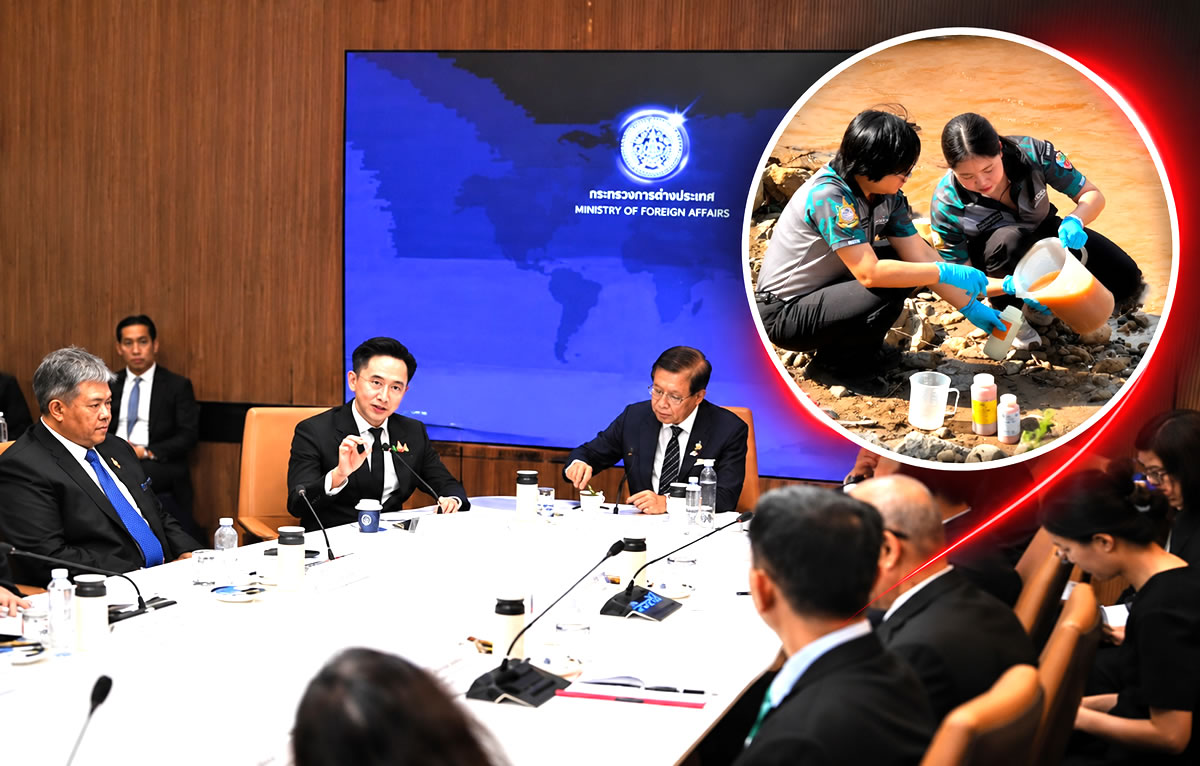
Thailand has demanded a six-month shutdown of polluting mines in Burma’s Shan State during high-level talks in Bangkok. The proposal emerged on Tuesday, November 24, at a meeting involving senior Thai ministers, Burmese officials and Chinese representatives.
Deputy Prime Minister Yotsanan Wongsawat is leading the drive to stop arsenic contamination poisoning northern Thailand’s rivers. Crucially, he confirmed that most rare-earth minerals extracted in Burma are subsequently exported to China.
Bangkok wants Beijing to trace those minerals to individual mines and verify environmental standards. In parallel, Thailand is seeking comprehensive mine inspections, continuous upstream water monitoring and tighter controls on hazardous discharges. Chinese Ambassador Zhang Jianwei responded positively, confirming China’s willingness to participate in the initiative.
Three countries identify Shan State mines as the source of arsenic poisoning in northern Thai rivers
Tuesday’s meeting established a common understanding of the industrial activities responsible for northern Thailand’s environmental emergency. Participants identified mining operations in Shan State as the source of arsenic contamination.
Moreover, all sides agreed that tackling the problem at its source offered the best solution. The discussions focused particularly on contamination affecting the Kok and Sai rivers. Recent monitoring detected arsenic concentrations reaching 30 times Thailand’s applicable standard.
Consequently, Thai authorities are implementing emergency measures to protect drinking water supplies, agricultural production and riverside communities. However, permanent protection requires intervention at mining sites beyond Thailand’s borders. Tuesday’s discussions established the foundations for that intervention.
Deputy Prime Minister and Minister of Higher Education, Science, Research and Innovation Yotsanan Wongsawat outlined the proposed scientific framework. Deputy Prime Minister and Minister of Foreign Affairs Sihasak Phuangketkeow handled the diplomatic discussions.
Alongside them was Minister of Natural Resources and Environment Suchat Chomklin. The three ministers received the foreign delegations at the Ministry of Foreign Affairs in Bangkok.
Burma pledges to develop an action plan as Chinese experts join two days of crucial Bangkok negotiations
Burma sent its Permanent Secretary of the Ministry of Natural Resources and Environmental Conservation. Its ambassador to Thailand also attended, accompanied by representatives from Shan State.
Notably, Chinese Ambassador Zhang Jianwei brought technical specialists from Yunnan province into the discussions. Their participation provides direct access to regional scientific expertise.
The meeting preceded two days of detailed negotiations scheduled for November 25–26. These will involve the Joint Working Group on Water Quality Management in Boundary and Transboundary Rivers.
Significantly, Burma has already expressed its readiness to formulate an action plan. Its representatives also indicated their willingness to establish a continuing working group if required. Sihasak welcomed the development and stressed the urgency of establishing effective operational cooperation.
He emphasised that the environmental emergency was not exclusively a Thai problem. Burma also faces the consequences of contamination originating within its territory. Accordingly, the negotiations will examine the entire process, from mineral extraction to contaminated water entering downstream rivers.
Xi Jinping and Min Aung Hlaing back cooperation as Thailand targets government and privately run mines
Political backing for the initiative has already been secured at leadership level. During his visit to Thailand, Burmese leader Senior General Min Aung Hlaing confirmed his readiness to cooperate.
Similarly, Prime Minister Anutin Charnvirakul discussed the pollution crisis with Chinese President Xi Jinping during the APEC summit. Beijing subsequently reaffirmed its commitment to assisting both countries.
China has also clarified its position concerning privately operated mines in Shan State. Chinese representatives stated that Beijing would not support illegal operations or activities causing harmful environmental consequences. Against that background, Tuesday’s meeting brought diplomatic representatives and technical specialists together to establish practical working arrangements.
At the centre of Yotsanan’s strategy is a distinction between government-controlled mines and privately operated facilities. Each category requires different inspection and enforcement arrangements.
For government-controlled operations, Thailand envisages direct cooperation with Burmese authorities. Thai and Chinese scientists would contribute technical expertise and establish appropriate environmental safeguards. By contrast, privately operated mines require additional verification mechanisms.
Thailand wants China to trace rare-earth imports to individual Burmese mines and verify their standards
Some operate in territories beyond the effective control of Burma’s central government. In response, Yotsanan has asked China to establish a standardised framework for scientific verification and mineral traceability. This would assist Burmese authorities in determining whether individual mining operations comply with acceptable environmental requirements.
China’s commercial relationship with Burma’s mining industry featured prominently in the Bangkok discussions. Yotsanan identified the destination of extracted rare-earth minerals as a critical component of the proposed solution.
Chinese authorities have the capacity to trace imported minerals back to their original suppliers. As part of this, Beijing could verify the quality and production standards associated with individual shipments.
Thailand wants environmental compliance incorporated into that verification process. Assessments would examine mining practices, wastewater management and the discharge of hazardous substances.
Nevertheless, no precise percentage of Burma’s rare-earth production destined for China was disclosed. A binding Chinese import certification system has also yet to be established.
Handshake with Chinese ambassador seals cooperation as Yotsanan seeks to identify mines and their owners
Yotsanan presented the proposal directly to Chinese Ambassador Zhang Jianwei during Tuesday’s meeting. Afterwards, he confirmed that the ambassador understood Thailand’s concerns and had responded constructively.
The Deputy Prime Minister described a handshake confirming their intention to cooperate. Chinese representatives would also participate in site visits. “We proposed it, and there was a handshake just now,” Yotsanan told reporters.
The Deputy Prime Minister stressed China’s commitment to joining the initiative. Implementation will require cooperation between government agencies, scientific institutions and commercial operators. Even so, Tuesday’s discussions brought the principal overseas customer for Burma’s rare-earth minerals directly into the environmental negotiations.
Thailand’s proposed inspection programme seeks comprehensive coverage of mining operations across the affected upstream territories. Initially, officials want to establish the precise locations and identities of individual mines. The next requirement is identifying the companies and individuals responsible for their operations.
Investigators must also determine which authorities exercise control over each mining area. That information will establish who can facilitate inspections and enforce environmental requirements.
In particular, Yotsanan favours publicly identifying the mines following official discussions and inspections. He sees no justification for concealing their identities. Thailand’s proposed approach places individual mining operations at the centre of the investigation, rather than treating upstream contamination collectively.
Chinese assistance sought for mines beyond Burmese government control as Thailand demands six-month halt
Access to mining areas remains one of the principal operational challenges. Ethnic armed organisations exercise authority over parts of Shan State, including territories under Wa control. Consequently, Burmese government officials cannot necessarily secure unrestricted access to every mining operation.
Yotsanan acknowledged those difficulties during Tuesday’s discussions. Despite this, he wants on-site inspections established as the standard procedure for assessing individual mines.
Where Burmese authorities cannot facilitate access, Thailand will request assistance from China. The participation of Shan State representatives provides an additional channel for establishing local arrangements. Comprehensive inspection rights remain an objective of the negotiations rather than an agreement already secured.
Meanwhile, Yotsanan confirmed that he had personally requested a six-month suspension of mining operations responsible for pollution. The Deputy Prime Minister wants production halted while authorities address the contamination.
He identified the suspension as consistent with the demands of affected Thai communities. Wednesday’s working group meeting will begin determining which mines can be targeted immediately.
In the first instance, Burmese authorities will examine operations falling within their existing powers. Other facilities will require separate arrangements involving private operators and potentially Chinese authorities.
Anutin orders action on raw material exports as ministries examine trade restrictions on Burmese mines
The working group will establish priorities and determine where intervention is feasible. The proposed six-month shutdown has not yet received formal approval from all parties.
On another front, Bangkok is preparing trade measures targeting materials supplied to mining operations across the border. Prime Minister Anutin Charnvirakul has instructed the National Security Council to take action concerning raw material exports.
The Ministry of Industry and the Ministry of Commerce are examining existing regulations. Specifically, officials will determine which materials can be subjected to export prohibitions. These could include chemicals supplied to mining operations responsible for contamination entering Thailand.
Potential restrictions involving mineral imports and exports have also entered government discussions. Yotsanan wants trade measures considered alongside direct intervention at mining sites. The ministries will assess where prohibitions are necessary to prevent further harm to Thai citizens.
Scientific investigations will form another major component of the proposed action plan. Thai researchers are developing chemical fingerprinting techniques to identify the origins of contaminants detected inside the kingdom.
Chemical fingerprinting and continuous upstream monitoring to link toxic pollution to individual mines
These methods involve examining the chemical characteristics of pollutants collected from different locations. Scientists will compare substances detected in Thai rivers with samples collected from upstream mining areas.
Through this process, researchers aim to establish links between specific mining activities and downstream contamination. Such evidence could support environmental enforcement and future compensation claims.
It would also help authorities identify which mining operations require immediate intervention. Individual assessments are particularly important given the extensive scale of mining activity across the border.
In conjunction with these investigations, Thailand wants continuous water quality monitoring stations installed at upstream locations in Burma. Existing assessments inside Thailand provide information about contamination after polluted water enters the kingdom.
Upstream monitoring would extend that scientific coverage beyond the border. Equipment installed at appropriate locations would continuously assess water quality and record contamination levels.
China proposes Chiang Rai laboratory as scientists develop filtration systems to protect irrigation water
Burmese cooperation is required to establish the stations and secure access for technical personnel. At the same time, scientists need samples collected directly from individual mining operations. The proposed monitoring network and mine inspections would provide complementary sources of scientific evidence. Detailed arrangements will require agreement during the forthcoming negotiations.
China has also proposed establishing a laboratory at Mae Fah Luang University in Chiang Rai. Chinese scientific institutions would contribute specialist expertise to the facility. In addition, laboratories in Thailand and China will assist with developing filtration methods targeting particular contaminants.
Yotsanan stressed that different toxic substances require different treatment processes. Therefore, scientists must establish the precise characteristics of pollutants before designing appropriate filtration systems.
Direct sampling at mining sites will form an important part of that work. The findings will also guide the construction of sediment traps. Thai authorities are preparing these facilities ahead of the release of irrigation water in December.
The sediment control programme has particular significance for agricultural communities dependent on river water. Authorities want appropriate safeguards established before irrigation supplies are released to farmers.
Thailand prepares safeguards for rice farmers as financing for private mine pollution controls is sought
To that end, researchers must identify the contaminants present and determine which treatment methods are suitable. Yotsanan emphasised the importance of conducting individual assessments rather than applying identical filtration systems across affected locations.
Scientific findings from mining inspections will help determine those requirements. The government is pursuing this work alongside existing agricultural testing programmes. It also wants clearer information available to farmers regarding the conditions affecting their individual rice-growing areas. Preparations are proceeding ahead of the next irrigation period.
Separately, Tuesday’s discussions addressed the financial requirements of introducing environmental controls at privately operated mines. Yotsanan acknowledged that the scale of mining activity exceeds Thailand’s capacity to manage independently.
Private operators will require technical guidance, scientific expertise and potentially access to financing. The Mekong-Lancang Cooperation framework could contribute to designing those arrangements.
Sihasak highlighted China’s established leadership role in regional water management under that framework. However, the sources of loans and other financial assistance have yet to be determined.
The forthcoming discussions must distinguish between designing environmental programmes and financing their implementation. No comprehensive funding arrangement was announced following Tuesday’s meeting.
Yotsanan rules out Thai funding for foreign mine improvements and presses for compensation
Importantly, Yotsanan ruled out using Thai government funds to finance environmental improvements at privately operated foreign mines. Instead, he maintained that Thailand should be entitled to compensation.
The Deputy Prime Minister wants financial responsibility incorporated into the wider framework under negotiation. This includes addressing the costs associated with controlling contamination and repairing environmental damage.
Thailand is already committing resources to protecting its own communities and agricultural areas. Financing improvements at foreign mining operations would require separate arrangements.
For private operators, access to technical expertise and potential loans remains under consideration. The financial component will therefore require further discussions involving relevant authorities and commercial interests.
Beyond the regional negotiations, Yotsanan has raised the issue with the Organisation for Economic Co-operation and Development. He discussed the matter on Monday, November 23, one day before the Bangkok meeting. Thailand wants stronger international standards governing the sourcing of rare-earth minerals.
International mineral buyers face scrutiny as Thailand expands emergency water supplies and toxin testing
Under that approach, environmental accountability would extend beyond mining operators to companies purchasing their production. Yotsanan also stressed the importance of raising international awareness of environmental damage associated with mineral extraction.
He identified a role for the wider international community in establishing appropriate standards. The initiative complements Thailand’s direct request for Chinese assistance with tracing minerals imported from Burma.
Domestically, emergency protection measures are advancing across Chiang Rai and Chiang Mai. The Ministry of Natural Resources and Environment has added ten groundwater drilling locations. Simultaneously, officials are developing community water supply systems to protect residents from contaminated river water.
Authorities have also established a one-stop information centre covering water resources and agricultural activities. The service will provide information about conditions affecting communities during different periods.
Additionally, scientists are deploying sensors and conducting tests for toxic contamination in aquatic animals. These measures are proceeding independently of the timetable for negotiations with Burma and China. Immediate protection of affected Thai communities remains an operational priority.
Rice samples pass arsenic tests but 81 square kilometres face risks as 150km pollution zone is planned
Agricultural testing has produced important findings concerning rice cultivation in affected areas. None of the 140 rice samples examined exceeded the applicable standard for inorganic arsenic. Nonetheless, researchers have identified approximately 81 square kilometres of Chiang Rai facing moderate to critical agricultural risks.
Yotsanan said officials were working to clearly delineate areas suitable for off-season rice cultivation. Farmers need information specific to their individual growing areas before making production decisions.
With this in mind, authorities are preparing an integrated risk map covering agricultural land and affected communities. Its official launch is scheduled for Friday, November 27. The information will support agricultural planning, water management and public protection measures.
A further domestic initiative involves establishing a 150-kilometre pollution control zone along the Kok River. The relevant pollution control committee is expected to consider the proposal on Friday, November 27. Thereafter, it is scheduled for submission to the National Environment Board on December 2.
Suchat says Thailand is worst affected as technical negotiations precede joint inspections in Chiang Rai
Minister of Natural Resources and Environment Suchat Chomklin stressed on Tuesday that Thailand was suffering the most severe consequences. He welcomed the participation of senior Burmese officials and Chinese Ambassador Zhang Jianwei in the Bangkok discussions.
Suchat identified their involvement as evidence of a shared commitment to addressing the problem at its source. His ministry will coordinate key elements of the forthcoming technical negotiations.
The next stage begins on Wednesday under the leadership of senior environmental officials. Raweewan Phuridej, Permanent Secretary of the Ministry of Natural Resources and Environment, will co-chair the working group meeting.
The November 25–26 negotiations will focus on exchanging information and establishing practical arrangements for cooperation. Among the immediate priorities is securing permission for Thailand to undertake specific activities in affected areas.
Officials will also examine which measures can proceed immediately within Burma’s existing administrative arrangements. Following those negotiations, a joint Thai-Burmese delegation will undertake field inspections in Chiang Rai on November 28–29. The visit will examine conditions inside the affected Thai province.
Sihasak and Yotsanan to lead inspections as Bangkok presses for binding standards and mining shutdowns
Deputy Prime Minister and Minister of Foreign Affairs Sihasak Phuangketkeow will jointly lead the inspection with Deputy Prime Minister Yotsanan Wongsawat. The visit will bring Burmese representatives directly into the assessment of conditions affecting northern Thailand.
Tuesday’s preliminary discussions have established the principal components of a potential solution. The next requirement is converting those proposals into an operational programme with defined responsibilities and implementation deadlines.
Dr Cheng heads north as PM orders elevated response to northern river poisoning crisis, China talks
China’s President Xi Jinping promises help in effort to respond to chronic river poisoning in the North
Burma’s forthcoming action plan will be central to that process. Binding environmental standards, comprehensive inspection rights and the proposed mining shutdown still require agreement. Bangkok’s immediate objective is unequivocal. Thailand wants the toxic discharges stopped at their source before they reach its rivers, agricultural land and communities.
Join the Thai News forum, follow Thai Examiner on Facebook here
Follow Thai Examiner on Google here
Receive all our stories as they come out on Telegram here
Follow Thai Examiner here
Further reading:
Dr Cheng heads north as PM orders elevated response to northern river poisoning crisis, China talks
River Kok in Chiang Rai poisoned with arsenic from Wa state-controlled gold mining across the border
Rangsiman Rome MP calls for stiffer response to Myanmar’s junta over the jailing of Thai sailors
Myanmar Junta meltdown threatens to end Bangkok’s condominium sales boom as Kyat currency fails