Thailand’s Election Commission suffers a major court defeat as judges refuse to block Senate election cases. Secretary-General Sawaeng Boonme faces a misconduct hearing on Thursday as two dissenting commissioners could turn witnesses against colleagues.
Thailand’s embattled Election Commission suffered a crushing legal defeat in Bangkok on Wednesday, November 25. The Constitutional Court unanimously rejected its bid to block Supreme Court scrutiny of three disputed Senate election cases. Meanwhile, Election Commission Secretary-General Sawaeng Boonme and five commissioners face criminal misconduct proceedings at 9 am on Thursday. Two dissenting commissioners could become crucial witnesses over the rejection of financial evidence. People’s Party deputy leader and MP Parit Wacharasindhu demanded the immediate submission of the principal Senate collusion case. He accused the commission’s majority of shielding senior Bhumjaithai Party figures by restricting proceedings to 77 individuals. Crucially, Supreme Court judges can demand previously rejected evidence and order further investigations. With all seven commissioners also facing an anti-corruption complaint, judicial scrutiny could ultimately reach senior politicians and election officials themselves.
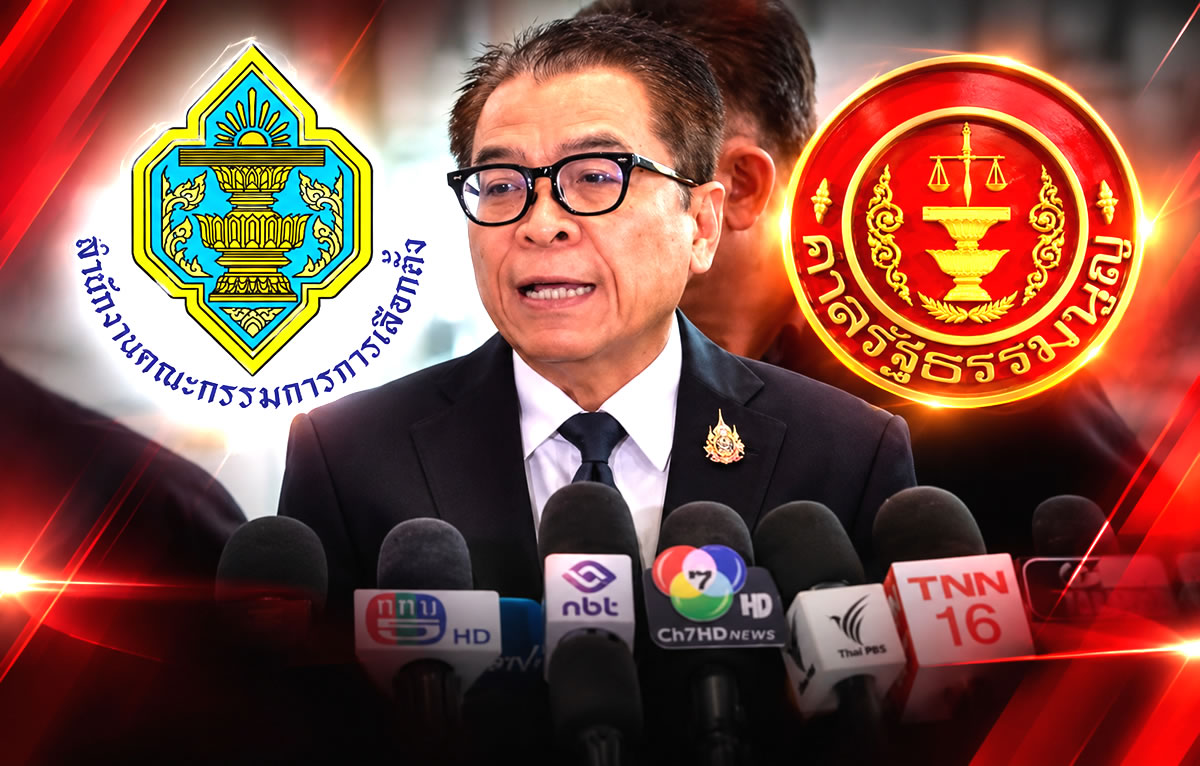
Thailand’s embattled Election Commission suffered a major legal defeat at the Constitutional Court in Bangkok on Wednesday, November 25. Judges unanimously rejected its bid to challenge the Supreme Court’s authority over three disputed Senate election cases.
The controversial petition followed a bitterly divisive 5–2 vote by election commissioners. Meanwhile, Election Commission Secretary-General Sawaeng Boonme faces a separate criminal misconduct lawsuit on Thursday morning.
Five election commissioners are also defendants. Significantly, two dissenting commissioners have been removed from the lawsuit and could become crucial witnesses against their colleagues.
Parit demands immediate Supreme Court action as Election Commission faces criticism over its 77 cases
The developments mark a dramatic escalation in the controversy surrounding the June 2024 Senate election. More than two years of investigations have produced sharply divided decisions within the Election Commission.
The wider investigation encompassed 427 accused individuals. Subsequently, the commission’s central investigative committee recommended proceedings against 229 people. Yet the commissioners ultimately approved legal action against just 77 individuals, including 26 serving senators.
In response to Wednesday’s ruling, People’s Party deputy leader and party-list MP Parit Wacharasindhu demanded immediate action. He urged the commission to dispatch its entire Senate collusion case file to the Supreme Court.
Parit accused the commission’s majority of attempting to obstruct judicial scrutiny of the scandal. Additionally, he claimed its September decision was designed to prevent investigators from reaching senior Bhumjaithai Party figures.
Supreme Court powers could expose senior politicians as judges reject the Election Commission’s petition
Notably, the opposition MP highlighted constitutional provisions empowering Supreme Court judges to order further investigations. Those powers extend to obtaining evidence previously rejected by the Election Commission.
Parit warned that additional evidence could implicate politicians at the highest levels of government. He specifically referred to prime ministers, ministers and members of parliament. Even election commissioners could face additional proceedings if evidence established their involvement in concealing electoral wrongdoing, he said.
Wednesday’s Constitutional Court decision was announced shortly before 3 pm. All judges agreed that the Election Commission’s petition failed to satisfy constitutional requirements. At issue were three separate cases accepted by the Supreme Court’s Election Division.
Each challenges an Election Commission determination concerning the qualifications of successful Senate candidates. The commission maintained that its decisions were final and sought constitutional recognition of that position.
The dispute originated with the royal decree authorising the Senate election on May 11, 2024. Voting subsequently took place in June through the statutory selection process. On July 10, 2024, the Election Commission formally announced the results.
Three Senate candidates took their complaints to the Supreme Court after Election Commission rejection
As part of that announcement, officials published a list of 99 reserve candidates. Three Senate candidates subsequently challenged the qualifications of certain successful candidates through complaints submitted to the commission.
After examining those complaints, the Election Commission determined that the successful candidates met the necessary statutory requirements. The complainants then took their cases directly to the Supreme Court.
They sought the annulment of the commission’s decisions concerning the disputed qualifications. All three petitions were accepted for consideration and judgment by the Supreme Court’s Election Division.
Faced with those proceedings, the Election Commission voted to challenge the court’s authority. Its subsequent petition invoked Section 210, paragraph one (2), of the Constitution. The Constitutional Court registered the matter as case number 30/2569.
Specifically, the commission sought a ruling concerning its constitutional duties and powers over the completed Senate election process.
The commission argued that accepting the three petitions affected its authority to administer the election. It also maintained that the Supreme Court’s actions departed from previous judicial precedents.
Underlying the petition were two principal arguments concerning the commission’s statutory powers. Both concerned the circumstances under which decisions affecting Senate candidates could subsequently face judicial review.
Election Commission argued its decisions were final but Constitutional Court rejected its legal challenge
Firstly, the commission maintained that decisions accepting candidates at district, provincial and national levels were final. Those decisions included formal announcements identifying candidates who satisfied statutory qualification requirements.
Under its interpretation, such determinations could not subsequently be reviewed. The commission acknowledged exceptions established under Section 63 of the 2018 Organic Act on the Acquisition of Senators.
Those exceptions, the commission argued, fell specifically within the Constitutional Court’s authority. Secondly, it sought recognition that its decisions under Sections 60 and 62 of the legislation were final.
This interpretation would prevent complainants from petitioning the Supreme Court to review or overturn those decisions. Both arguments directly concerned matters already awaiting adjudication.
Instead, the Constitutional Court rejected the commission’s petition on jurisdictional grounds. Judges examined Section 210 of the Constitution alongside relevant provisions of the Constitutional Court Procedure Act.
They specifically considered Section 44 in conjunction with Section 7(2) of the 2018 legislation. These provisions establish the conditions governing disputes over the constitutional duties and powers of specified institutions.
Constitutional Court finds no jurisdiction to interfere with ongoing Supreme Court proceedings on senators
Among those institutions are the House of Representatives, Senate, Parliament, Cabinet and independent constitutional organisations. Moreover, the disputed exercise of constitutional authority must already have occurred.
The powers concerned must arise directly from the Constitution or relevant organic legislation. The Supreme Court, however, is not among the institutions specified under Section 210, paragraph one (2).
After examining the petition and supporting documents, judges identified the substance of the commission’s challenge. It directly concerned the Supreme Court’s exercise of judicial authority. More importantly, the disputed matters were already undergoing judicial examination.
The Constitutional Court therefore determined that the commission’s request fell outside the jurisdiction established under the cited constitutional provisions.
In reaching that conclusion, judges referred specifically to Section 194 of the Constitution. That provision establishes the judicial authority exercised by Thailand’s courts of justice. Granting the commission’s request would affect the Supreme Court’s determination of its own jurisdiction. It would also interfere with ongoing proceedings before that court. Accordingly, the Constitutional Court unanimously refused to entertain the petition.
Sawaeng Boonme faces Thursday misconduct hearing as Supreme Court retains three disputed Senate cases
Wednesday’s decision removes the immediate challenge mounted by the Election Commission against those proceedings. The Supreme Court remains free to examine the three disputed qualification cases. Nevertheless, the Constitutional Court has not determined the merits of the complaints against individual senators. Those matters remain for adjudication through the separate proceedings already underway.
In parallel, another major legal confrontation awaits the Election Commission on Thursday, November 26. The Criminal Court for Corruption and Misconduct Region 1 has scheduled proceedings for 9 am.
Election Commission Secretary-General Sawaeng Boonme is the first defendant. The plaintiff is lawyer Pongsakorn Tangkittrakul, who participated in the 2024 Senate election.
Mr Pongsakorn contested the election in the law and justice occupational group. He finished fourth on that group’s reserve list. His subsequent lawsuit targeted eight senior Election Commission officials.
They comprised Sawaeng Boonme, Election Commission Chairman Narong Klanwarin and six other election commissioners. The accusations concern their performance of statutory responsibilities arising from the disputed Senate election.
Appeal Court ruling recognises citizens’ right to sue officials over suspected corruption in Senate elections
Originally, Mr Pongsakorn filed his lawsuit with Nonthaburi Provincial Court under case number A1018/2569. He accused the officials of improperly performing or neglecting their statutory duties. A jurisdictional dispute subsequently arose concerning the appropriate court to examine those accusations. The matter eventually reached the President of the Court of Appeal for a formal determination.
That determination, registered under ruling number VT.27/2569, addressed the legal standing of citizens affected by electoral corruption. In particular, it examined their right to initiate proceedings directly against responsible officials.
The ruling considered political rights recognised under the Universal Declaration of Human Rights. It also examined the International Covenant on Civil and Political Rights.
Underpinning the determination was the Thai Constitution’s recognition that sovereign power belongs to the Thai people. Unlawful conduct affecting the acquisition of Senate seats could constitute a deprivation of those sovereign rights.
On that basis, citizens affected by electoral corruption could qualify as injured parties. They could consequently initiate proceedings directly before an appropriate court of first instance.
Misconduct lawsuit transferred to specialised criminal court as two dissenting commissioners are removed
The President of the Court of Appeal established that the misconduct court had jurisdiction over Mr Pongsakorn’s lawsuit. Following that determination, Nonthaburi Provincial Court transferred the proceedings on November 10.
It also revoked its previous order removing the case from its docket. Importantly, procedural steps already completed before the original court remain legally valid.
The transfer places the accusations against senior Election Commission officials before a specialised criminal court. Thursday’s appointment represents a preliminary procedural hearing rather than a trial or judgment.
Judges must determine whether the lawsuit should proceed to further adjudication. No findings of criminal misconduct have yet been made against the defendants.
Of particular significance is a subsequent change in the composition of those defendants. Mr Pongsakorn requested the withdrawal of proceedings against Election Commissioners Sitthichot Intharawiset and Chai Nakhonchai.
Both commissioners had taken dissenting positions during deliberations concerning the Senate investigation. Their disagreement concerned the commission’s handling of important evidence supplied by the Department of Special Investigation (DSI).
Dissenting commissioners could become witnesses over controversial 4–3 vote rejecting crucial DSI evidence
Both supported consideration of financial evidence gathered by the department. The court subsequently permitted their removal as defendants in the misconduct lawsuit. As a result, the two commissioners could instead provide evidence concerning the commission’s internal deliberations.
Their formal appearance as witnesses has not yet been confirmed. Their participation in the disputed decisions gives them direct knowledge of the proceedings.
Central to the misconduct lawsuit is the commission’s controversial rejection of investigative material supplied by the DSI. Department investigators examined suspected organised voting arrangements during the June 2024 Senate election.
Their inquiries covered voting lists, financial transactions and possible coordination between election participants. The department also investigated potential criminal association and money-laundering offences arising from the suspected operation.
Among the material gathered were financial transaction records potentially linking individuals to electoral manipulation. Investigators also obtained scientific evidence concerning suspected coordinated voting. Despite the department’s findings, election commissioners voted 4–3 against admitting disputed DSI evidence. Independent legal academic Was Tingsamit has identified that decision as a central issue facing the misconduct court.
Election Commission’s controversial 5–2 vote excluded 152 people identified for action by its investigators
Separately, the Election Commission’s own central investigative subcommittee produced recommendations concerning the suspected electoral operation. Known as Committee 26, the body proposed legal proceedings against 229 individuals.
Its recommendations emerged from the commission’s wider investigation into the Senate election. The investigative committee’s proposed cases extended considerably beyond those ultimately approved by the commissioners.
On September 14, 2026, the Election Commission voted 5–2 to restrict the proposed legal proceedings. Its determination excluded 152 individuals previously identified by Committee 26 for legal action. Of those remaining, 51 were individuals connected to the election but were not serving senators. The decision came after more than two years of investigations into the disputed election.
The two controversial commission votes present distinct issues for the misconduct court. One concerns the rejection of investigative material supplied by another government agency.
The other concerns the reduction of cases recommended by the commission’s own investigative body. Mr Pongsakorn’s lawsuit challenges whether officials properly discharged their statutory responsibilities when dealing with those matters.
Misconduct court can demand investigative evidence as plaintiff seeks punishment and daily compensation
Crucially, the Criminal Court for Corruption and Misconduct operates under an inquisitorial system. Judges can actively seek evidence rather than relying exclusively on material presented by the parties.
This gives the court authority to request relevant documentation concerning the DSI investigation. It could also examine Committee 26’s findings and the records surrounding the commission’s subsequent decisions.
Mr Pongsakorn seeks punishment under four provisions of the Organic Act on the Acquisition of Senators. His lawsuit cites Sections 32, 58, 69 and 88 of the legislation.
The accusations concern corruption in office, improper performance of official responsibilities and omissions of statutory duties. Beyond the criminal accusations, the original lawsuit also sought financial compensation from each defendant.
Mr Pongsakorn requested compensation of ฿5,000 daily from each official until a final judgment. The lawsuit therefore encompasses both accusations concerning statutory misconduct and a claim for compensation.
Thursday’s preliminary proceedings will determine the next procedural steps in the case. The court must still decide whether the accusations warrant further adjudication.
Parit highlights voting lists naming over 100 senators and accuses the blue network of blocking scrutiny
On another front, the People’s Party has challenged the evidential basis for excluding numerous senators from legal proceedings. On November 10, Parit Wacharasindhu highlighted voting lists containing the names of more than 100 senators.
Those lists also contained their respective candidate numbers. The opposition MP questioned the commission’s treatment of evidence concerning the preparation and use of those lists.
As part of his criticism, Parit cited meetings concerning the preparation of voting lists before the Senate election. He also highlighted a subsequent gathering at the Pullman Hotel. The opposition MP maintains that investigators must examine the relationships between participants in the suspected voting operation.
His criticism extends to suspected connections between the Senate’s powerful blue faction and the Bhumjaithai Party.
Speaking on Wednesday, Parit accused a political network associated with the blue faction of obstructing judicial scrutiny. He referred to the network as the “blue regime”.
The opposition MP identified several controversial cases that he claimed the network had attempted to protect from examination. Among them were the Senate election scandal and the controversy concerning barcodes on election ballot papers.
Parit cites Section 226 as Supreme Court has constitutional authority to demand further evidence
Parit also cited the share concealment case involving Saksayam Chidchob. He described the Election Commission’s Constitutional Court petition as another attempt to prevent judicial examination.
In his account, the commission had appealed to its “blue fellows” at the Constitutional Court. Wednesday’s unanimous rejection brought that particular legal challenge to an end.
For Parit, the central issue remains what he described as the “main case” concerning suspected Senate election collusion. He accused the commission’s majority of restricting proceedings to avoid establishing connections with senior Bhumjaithai Party figures.
Nonetheless, he identified a constitutional mechanism that could allow Supreme Court judges to examine the investigation more extensively.
Under Section 226 of the Constitution, the Supreme Court can order additional investigations into facts and evidence. Parit highlighted the provision stating that the court “has the power to order further investigation of facts and evidence.” He argued that this authority could prove particularly significant once the commission formally submits its principal case.
Financial and telephone records could implicate more politicians and election commissioners, says Parit
Among the evidence Parit identified were financial transaction records previously rejected by the Election Commission. He also pointed to telephone records potentially establishing connections between additional individuals.
Such material, he argued, could help investigators establish the relationships between participants in the suspected electoral operation. The commission’s September determination would not necessarily prevent judges from examining that evidence.
Indeed, Parit specifically raised the possibility of evidence identifying a 78th, 79th or 80th suspect. He maintained that the number could extend considerably further.
Should additional evidence establish wrongdoing, he argued that the commission would have a legal obligation to pursue those individuals. His remarks extended to politicians suspected of organising or directing electoral manipulation.
The opposition MP also raised the possibility of evidence implicating officials responsible for facilitating or concealing wrongdoing. In that event, he maintained that election commissioners themselves could face further proceedings.
These remain accusations and potential legal consequences identified by Parit. No court has established criminal responsibility against senior political figures in the Senate collusion scandal.
January filing deadline looms as opposition demands immediate court action and pursues misconduct case
Against this backdrop, the Election Commission published its formal determination on November 13. The document, numbered 1526/2569, sets out the commissioners’ September 14 decision. Publication marked another procedural stage in the commission’s handling of the investigation. Its outstanding responsibility involves submitting petitions to the Supreme Court seeking the revocation of electoral rights.
The statutory filing deadline is January 12, 2027. That gives the commission 60 days following publication of its determination. Officials have cited the need to verify documentation and establish the individual offences involved. They must also organise supporting evidence and prepare the necessary petitions for submission to the Supreme Court.
Parit insisted on Wednesday that officials should not wait until the deadline expires. Instead, he demanded the immediate submission of every petition, investigative record and supporting case file.
He accused the commission of previously attempting to use the Constitutional Court to impede Supreme Court proceedings. Following Wednesday’s ruling, he warned against further delays through the administrative handling of the principal case.
Beyond the court proceedings, the commission faces scrutiny from the National Anti-Corruption Commission (NACC). On September 25, People’s Party leader and parliamentary opposition leader Natthaphong Ruengpanyawut led a delegation to submit a complaint.
The opposition requested an investigation into the conduct of all seven election commissioners. Its complaint directly concerns the commission’s September decision.
Sawaeng Boonme faces scrutiny over handling of election complaints as opposition cites Section 157 offences
The opposition also challenged the treatment of evidence suggesting organised electoral manipulation. It identified potential offences under Section 157 of the Criminal Code. Other statutory provisions governing the conduct of public officials were also cited.
Among the matters raised were electoral regulations, candidate qualification checks and the commission’s handling of witness testimony.
The People’s Party maintains that examining individual offences separately could obscure evidence of coordination between suspects. Its complaint consequently addresses the broader investigative approach adopted by the commission.
Election Commission Chairman Narong Klanwarin previously defended the investigation. In June, he insisted that officials were complying with statutory requirements and denied deliberately delaying proceedings.
For Election Commission Secretary-General Sawaeng Boonme, the misconduct lawsuit carries particular significance. His responsibilities differ from those of commissioners voting on formal determinations. Sawaeng heads the administrative machinery responsible for implementing the commission’s statutory functions. Mr Pongsakorn’s lawsuit specifically identifies him as the official who received the original complaint.
That places the administrative handling of electoral complaints among the matters potentially facing judicial examination. The lawsuit could address how officials processed complaints and subsequently dealt with investigative material.
Election Commission faces mounting legal challenges. Constitutional powers of 200-member Senate at stake
It also raises issues concerning the implementation of statutory responsibilities following disputed election results. Those matters extend beyond the individual votes cast by election commissioners.
At stake are important constitutional responsibilities exercised by Thailand’s 200-member Senate. The upper chamber plays a significant role in appointments to independent institutions. It also exercises important powers concerning constitutional amendments.
The disputed June 2024 election therefore has implications extending beyond the parliamentary positions of individual senators.
More than two years after that election, the commission faces simultaneous judicial, administrative and anti-corruption challenges. Its attempt to challenge the Supreme Court’s authority has failed. Its secretary-general and five commissioners face separate misconduct proceedings.
Constitutional crisis as Election Commission to petition court to block Supreme Court on Senate cases
Election Commission creates more questions than answers as it finally refers 77 people to the Supreme Court
At the same time, officials must complete outstanding electoral enforcement proceedings within the statutory deadline.
The immediate confrontation comes at 9 am on Thursday before the Criminal Court for Corruption and Misconduct Region 1. Sawaeng Boonme and five election commissioners face accusations directly challenging their discharge of statutory responsibilities.
The court must determine the next steps in the lawsuit. Meanwhile, the Election Commission must prepare its principal Senate collusion case for submission to the Supreme Court. Once filed, that case could expose previously rejected investigative material to further judicial examination under Section 226 of the Constitution.
Join the Thai News forum, follow Thai Examiner on Facebook here
Follow Thai Examiner on Google here
Receive all our stories as they come out on Telegram here
Follow Thai Examiner here
Further reading:
Serving Election Commissioner again voicing his concerns about the probe into the 2024 Senate poll
Election Commission exposed based on Monday’s sweeping decisions and judgments warns opposition
Election Commission creates more questions than answers as it refers 77 people to the Supreme Court
Ex Pheu Thai minister warns Commission members that soon they could be judged as crunch vote looms