Veteran Yellow Shirt leader Sondhi is back on Bangkok’s streets, using Israeli influence and foreign grey capital to open a wider attack on corruption, the Senate scandal and Anutin’s government, with September 14 shaping up as the crucial flashpoint.
Veteran protest leader Sondhi Limthongkul has returned to Bangkok’s streets with a campaign that could become far bigger than Thursday’s Israeli Embassy protest. His new movement is tying foreign influence, suspected nominee businesses and land ownership to corruption, political power and the disputed 2024 Senate selection. Prime Minister Anutin Charnvirakul is increasingly in its sights, while the Election Commission’s September 14 decision on a case involving 229 people could provide the next major trigger. For now, the crowds are small and peaceful. However, Thailand has seen modest street movements grow quickly before, and Sondhi is again trying to unite separate grievances under one political banner.
Thailand faces the prospect of renewed political instability after veteran protest leader Sondhi Limthongkul returned to Bangkok’s streets on Thursday. His first mobilisation targeted Israeli influence, foreign-linked businesses and suspected nominee structures. Yet the campaign already reaches far beyond Israel.
Sondhi is tying foreign influence to corruption, land ownership, political power and the disputed 2024 Senate selection. For now, the demonstration remains small and peaceful. Even so, September 14 could provide a much stronger domestic trigger. The Election Commission is expected to consider a case involving 229 people over suspected Senate collusion.
Sondhi has threatened wider mobilisation if the outcome fails to satisfy him. For foreigners, investors and visitors, the development carries an uncomfortable warning. Foreign influence itself is now being used to harness public anger against Thailand’s political establishment. The match has been struck. However, the political fire it could ignite may become much harder to control.
Sondhi takes new campaign to Israeli Embassy as veteran political activists return to Bangkok streets
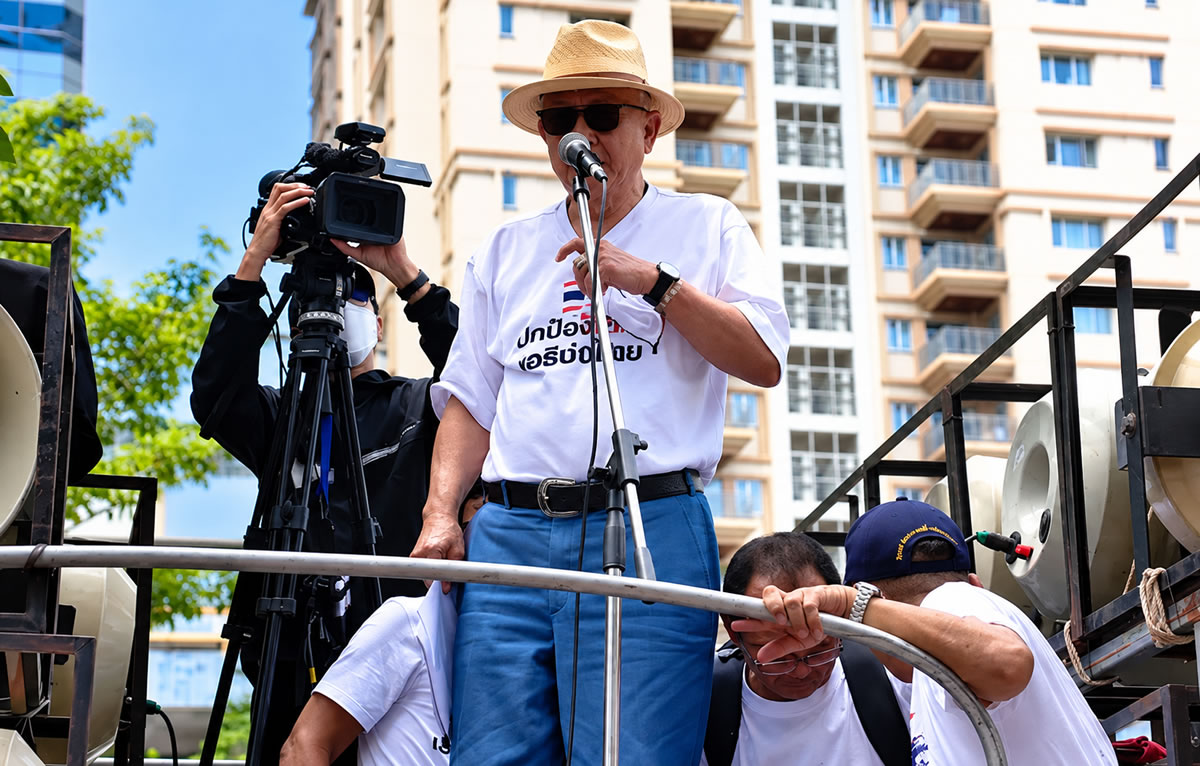
Sondhi, 79, appeared outside the Israeli Embassy in Bangkok on Thursday morning with activists and supporters. The group assembled from around 9 am outside Ocean Tower II on Sukhumvit Soi 21.
Sondhi formerly led the People’s Alliance for Democracy, widely known as the Yellow Shirts. Alongside him stood several veteran figures associated with nationalist political activism. Professor Panthep Pua-pongpun, chairman of the Guardians of the Land Foundation, joined the gathering. Nitithorn Lamluea, widely known as Lawyer Nok Khao, also attended. Meanwhile, Pichit Chaimongkol represented the Network of Students and People for Thailand Reform. Sai Siranat carried the Thai flag as supporters gathered outside.
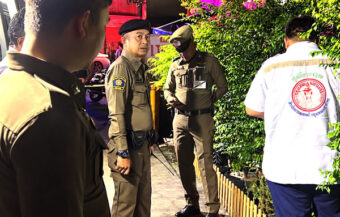
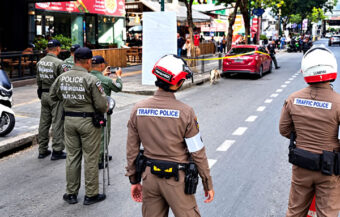
Police were ready before the demonstration developed. Roughly one company of officers was deployed around the location. In addition, Explosive Ordnance Disposal personnel were present.
Despite those precautions, the gathering remained orderly and no clashes were reported. The importance of Thursday instead lay in its political purpose. It marked the first physical mobilisation under Sondhi’s newly announced “Take Our Thailand Back” campaign. He unveiled the movement at Baan Phra Athit on September 7. Three days later, he brought it onto Bangkok’s streets.
Israeli Embassy protest opens wider campaign spanning corruption, nominee companies and Senate case
The Israeli Embassy became the campaign’s first physical target, but Israel is only one part of Sondhi’s agenda. His movement now touches several of Thailand’s most sensitive political controversies. These include suspected foreign nominee companies and foreign-linked property ownership.
At the same time, he is targeting corruption, political influence and relationships between business and government. Sondhi has also raised the local-government recruitment examination scandal and the Khao Kradong land controversy. Separately, controversial personnel movements involving the Department of Special Investigation have entered his case. Data-centre approvals and broader complaints about law enforcement have also been raised.
Above all, Sondhi is watching the Election Commission’s investigation into the 2024 Senate selection. That dispute could determine whether Thursday remains a modest demonstration. Alternatively, it could provide the foundation for something substantially larger.
Sondhi has already made the expected September 14 decision a political test. Therefore, Thursday may prove more important for what follows than for the crowd assembled outside the embassy.
Sondhi’s open letter targets Israeli visitors, nominee businesses, land holdings and Chabad centres
Sondhi delivered an open letter addressed to Israeli Ambassador Alona Fischer-Kamm during the gathering. Its language was uncompromising. The statement declared that the time for soft diplomatic language had ended.
Instead, it demanded concrete action from Israel. Sondhi said Thailand traditionally welcomed foreign visitors with considerable hospitality. However, his letter warned that “kindness is not weakness”. It added that “hospitality is not a concession to oppression”. Furthermore, politeness was not permission for foreigners to disregard Thai law.
The letter accused some Israeli visitors of breaking laws and creating disturbances. It also cited disrespect for Thai culture, payment fraud and scams. According to Sondhi, such incidents had occurred repeatedly in several areas. He declared that Thai patience had limits. From there, however, his statement moved rapidly beyond individual tourist behaviour. Israeli-linked investment, suspected nominee businesses and property ownership became central parts of the attack.
In particular, Sondhi demanded scrutiny of land acquisitions and organisations associated with Israeli nationals. Chabad centres occupied a prominent place in his criticism. He disputed their role and called for closer examination under Thai law. As part of this argument, his statement referred to land in Chachoengsao. It cited property connected with cemeteries, religious sites or meditation facilities. Sondhi portrayed those developments as evidence of expanding Israeli influence inside Thailand.
Sondhi widens Israeli accusations to territorial influence, geopolitics, China and military visitors
His allegations then went considerably beyond established investigations into nominee structures. Sondhi accused Israeli groups of seeking long-term influence and territorial control.
Moreover, his statement claimed similar activities were occurring in Argentina, Colombia, Sri Lanka and the Philippines. He portrayed Israeli settlement overseas as something more substantial than tourism or ordinary migration. Those were claims contained in Sondhi’s statement, rather than findings established in the supplied material.
From there, Sondhi expanded his argument into regional geopolitics. He alleged links between Israeli strategic interests, the United States and competition with China. Specifically, he claimed Washington wanted Thailand used as a strategic point against Beijing. He also connected that argument with American involvement in the Indo-Pacific. According to Sondhi, Israeli interests were operating within the same strategic framework.
Notably, his statement singled out Pai district in Mae Hong Son. Sondhi claimed Israeli visitors there included retired soldiers and military reservists. He described some as “warriors in tourist disguise”. Furthermore, he claimed they possessed advanced military skills acquired through military training. His accusations went further still. Sondhi claimed Mossad personnel were scattered throughout Thailand.
Sondhi links wider Israeli claims to nominee probes as his campaign turns towards Thai government
Sondhi’s accusations went far beyond Thailand’s established investigations into nominee companies and foreign-linked property holdings. He claimed Israeli intelligence operatives and military-trained visitors were active across the country.
He also accused Israeli groups of pursuing long-term territorial influence in Thailand. However, those claims were presented by Sondhi as part of Thursday’s campaign. Meanwhile, Thai investigators are separately pursuing documented cases involving nominee structures, land holdings and foreign-controlled businesses.
Nevertheless, the breadth of his statement shows how his political message is developing. The campaign is no longer limited to complaints about individual foreign visitors. Instead, foreign investment, sovereignty, nationalism, corruption and geopolitics are being placed within one political argument. More significantly, the conduct of the Thai government is being pulled into that argument.
Sondhi also raised the naturalisation of Rabbi Joseph Shime Kantor. His statement said Kantor received Thai citizenship during General Anupong Paochinda’s tenure as Interior Minister.
Sondhi argued that citizenship could subsequently be revoked. Elsewhere, he criticised the Ministries of Education, Interior and Culture over their handling of Chabad centres. He disputed their status and claimed they functioned as organisational hubs for Israeli communities. Again, those claims came directly from Sondhi’s statement.
Sondhi demands tougher Israeli controls, land scrutiny and action while condemning Gaza operations
His formal demands to Israel were considerably more specific. First, Sondhi demanded tighter controls on Israeli citizens travelling to Thailand. He called for visitors to receive firm instructions about Thai laws, customs and culture. Second, he demanded cooperation when Israeli nationals face criminal investigations. His statement said offenders should receive no protection from prosecution. It declared that “no nationality is above Thai law”.
Third, Sondhi demanded transparency concerning Israeli-linked land ownership and organisations. He specifically called for scrutiny of property holdings in Chachoengsao. Chabad centres and related organisations were also included. Fourth, he moved directly into the Middle East conflict.
Sondhi called on the embassy to relay his condemnation to the Israeli government. His statement referred to Palestinian civilians, hospitals, schools, women and children. It also condemned Israeli military action in Gaza and Iran.
The letter directly attacked senior Israeli government figures, including Security Minister Itamar Ben-Gvir. Sondhi used particularly forceful language concerning Gaza. His statement declared: “Genocide is not a victory”.
It described events there as a stain involving “tears and blood”. Consequently, Thursday’s demonstration combined several fundamentally different disputes. Tourist conduct, foreign investment, nominee companies, land ownership and religion all appeared. Middle Eastern geopolitics was then added to the same platform.
Foreign grey capital becomes wider political target as Sondhi turns pressure towards Anutin government
Yet the most consequential part of the campaign for Thailand may ultimately be entirely domestic. Sondhi has made clear that Israel is not his final target. Instead, he wants action against what he describes as foreign “grey capital”.
That includes foreign investors suspected of using Thai nominees to circumvent ownership restrictions. Such cases are already receiving extensive scrutiny from Thai agencies. Sondhi, however, is attempting to move the argument beyond individual investigations.
His political case links foreign capital with political influence. From there, it links political influence with corruption and weak enforcement. Eventually, that argument reaches Prime Minister Anutin Charnvirakul and his government. Sondhi has attacked what he calls the “blue regime”, referring to the colour associated with Bhumjaithai. He has compared it with the Thaksin Shinawatra political machine he fought more than two decades ago.
Anutin therefore sits increasingly close to the centre of Sondhi’s political attack. Moreover, the prime minister also serves as Interior Minister. That portfolio overlaps with several areas raised by the campaign. In response, Anutin has so far avoided a direct confrontation. He initially dismissed the “Take Thailand Back” slogan, arguing that Thailand already belonged to Thai people. Nevertheless, he recognised Sondhi’s constitutional right to demonstrate within the law.
Anutin avoids showdown as Sondhi eyes regional mobilisation and draws on his Yellow Shirt history
Reporters later questioned Anutin about Sondhi’s threatened mobilisation over the Senate case. The prime minister said he had not listened to Sondhi’s September 7 announcement. When pressed further, he offered little public reaction. For the moment, therefore, the government is refusing to give Sondhi a direct showdown. Sondhi has likewise stopped short of demanding Anutin’s resignation. Instead, he says he intends to pressure the government into taking action.
The campaign may also spread geographically. Sondhi has indicated that meetings or mobilisation could follow in other regions. Accordingly, Thursday looks more like the construction phase of a protest movement than mass mobilisation.
There is currently no evidence of a nationwide uprising. Nor does the embassy crowd demonstrate broad national support. Political analysts have questioned whether conditions are mature for another major street movement.
Still, Sondhi cannot be judged solely by the size of his first gathering. His political history guarantees closer scrutiny. His campaign against Thaksin began more than two decades ago. It subsequently developed into the People’s Alliance for Democracy. The Yellow Shirts then became a formidable street force. PAD mobilisation became central to the political confrontation preceding the September 2006 military coup.
Sondhi’s protest history returns to focus as corruption scandals offer stronger domestic political fuel
Thaksin-aligned political forces later returned to government through elections. By 2008, however, PAD had returned to Bangkok’s streets. The confrontation subsequently intensified. Protesters occupied Government House before later occupying Suvarnabhumi and Don Mueang airports. Thailand consequently suffered severe political and economic disruption.
Thursday’s demonstration bears no comparison with those events. There is no factual basis for describing the current situation as another 2008 confrontation. Even so, Sondhi’s history establishes one relevant point. He has previously turned comparatively modest political agitation into sustained street mobilisation. This time, his campaign also rests on several different grievances rather than one issue.
Foreign influence provides the opening target. However, corruption may provide the stronger domestic fuel. The local-government recruitment examination scandal is one obvious example. Investigators have identified 5,925 altered examination results. Of those, 5,145 candidates had originally failed. In addition, 3,404 appointments face cancellation. Claims have also emerged that candidates paid up to ฿700,000 for positions.
People’s Party MP Pakamon Nunanan has raised further accusations involving powerful families. She says politicians, governors and senior officials helped relatives and protégés secure jobs. According to her claims, manipulated examination scores were used to achieve those appointments. Meanwhile, financial transactions exceeding ฿300 million have emerged in the Si Sa Ket investigation. Five agencies are investigating aspects of the scandal, while two DSI officials have faced scrutiny.
Senate collusion case involving 229 people emerges as immediate test for Sondhi’s protest campaign
The affair therefore reaches directly into questions of public-sector corruption and political influence. However, the Senate collusion investigation presents the more immediate political flashpoint. The Election Commission is expected to consider the matter on September 14. That comes only four days after Thursday’s embassy demonstration.
The investigation concerns 229 people linked to suspected collusion during the 2024 Senate selection. They include 138 serving senators and 91 political figures, executives and others. Crucially, two investigative processes have produced radically different conclusions. Committee 26 worked alongside DSI investigators and examined extensive documentary evidence. Investigators also questioned more than 700 witnesses.
Committee 26 subsequently concluded there were grounds for action involving all 229 people. Another committee later reached the opposite conclusion. Committee 36 voted 5-2 that the case lacked sufficient grounds. Consequently, the full Election Commission faces two sharply conflicting recommendations.
Sondhi has turned that contradiction into a direct political test. He has threatened escalation if the EC dismisses the case. He has also warned against proceedings involving only a small number of those investigated. As a result, September 14 could prove substantially more important than September 10. Thursday provided the first street mobilisation. Monday could provide a powerful domestic trigger.
September 14 EC decision could unite separate grievances under Sondhi’s expanding political campaign
An EC decision viewed by Sondhi’s supporters as a whitewash could strengthen his campaign. More importantly, it could help him place several separate controversies beneath one political banner. Nominee investigations concern foreign capital and ownership. The examination scandal concerns corruption and political patronage. Meanwhile, the Senate case concerns political institutions and electoral credibility.
Land controversies bring property rights and powerful interests into the same argument. Sondhi is presenting these issues as parts of a broader political problem. That does not establish that they are factually connected. They remain separate investigations, disputes and controversies. Politically, however, his campaign is deliberately placing them together.
That strategy potentially gives Sondhi access to several different constituencies. Some Thais are concerned about foreign ownership. Others oppose illegal nominee structures. Another group is angered by public-sector corruption. Some oppose Bhumjaithai, while others distrust the Senate selection process. Older PAD and nationalist networks provide another potential source of support.
Foreign influence gives those groups a sovereignty issue. Domestic corruption gives them a political one. For foreigners, investors and visitors, that combination carries particular significance. Thailand remains heavily dependent on international tourism, investment and trade. Israeli visitors alone number in the hundreds of thousands annually.
Foreign business scrutiny joins sovereignty debate as Sondhi builds broader street political campaign
At the same time, genuine investigations into foreign-linked business structures are expanding. Nominee arrangements are receiving intense scrutiny. Foreign-linked land and condominium holdings are also being examined. Those enforcement cases remain distinct from Sondhi’s broader allegations. Yet Thursday placed both themes on the same political platform.
Illegal nominee ownership is one issue. Criminal conduct by individual foreigners is another. Political campaigning against wider foreign influence is something different. Increasingly, however, all three are appearing inside the same public debate. Sondhi is then connecting them with accusations of corruption and political protection inside Thailand.
That development marks a potentially important shift for foreign businesses. A law-enforcement issue can acquire a different character when linked publicly with sovereignty. Thailand has repeatedly suffered damaging street confrontations during the past two decades. Governments have been destabilised, transport disrupted and tourism damaged. In 2008, protesters even occupied Bangkok’s two main airports.
Nothing approaching that scale is happening now. Thursday’s demonstration remained peaceful and Bangkok functioned normally. Nonetheless, several elements of a broader political confrontation have appeared. Sondhi has returned to street politics and launched a named national campaign. Foreign influence provides its opening rallying issue. Corruption and government conduct are increasingly being added.
Sondhi eyes Senate decision as next trigger while misleading protest images cloud movement’s strength
Most importantly, Sondhi has identified a domestic political trigger only days away. The government therefore enters a sensitive period. Anutin has so far chosen restraint and limited engagement. Sondhi, meanwhile, continues expanding the grievances attached to his campaign.
There is also reason for caution when assessing the movement’s actual strength. Misleading photographs have already circulated online claiming to show large current Sondhi demonstrations. Thai PBS Verify found that some images came from a June 2025 mobilisation. Consequently, contemporary crowd sizes require verification. Social-media imagery alone cannot establish the movement’s present strength.
Thursday established something narrower but still significant. Sondhi’s new campaign has moved from speeches into physical mobilisation. Its first target was a foreign embassy. Yet its next major confrontation could be entirely domestic. The Election Commission’s handling of the Senate case now hangs over the campaign.
If September 14 passes quietly, Sondhi may struggle to widen his movement. A controversial outcome could instead hand him another major rallying point. His political infrastructure is already being assembled, while his slogan is established. His supporters have also returned to the streets. More importantly, his list of grievances already extends far beyond Israel.
Foreign influence and corruption converge as September 14 becomes first major test of Sondhi campaign
For Thailand’s foreign community, the immediate warning remains political rather than physical. There is no evidence of widespread disorder or threats against foreigners generally. Yet foreign influence is now an explicit theme inside a developing street campaign. Simultaneously, major corruption controversies are bearing down on Thai political institutions.
Sondhi is seeking to bring those issues onto the same political battlefield. Thursday may therefore prove more consequential than its modest crowd suggests. Israel and foreign influence have provided the opening match. Thailand’s unresolved domestic controversies could provide considerably more political fuel.
PM Anutin laughs off what political pundits see as rising threats to the stability of his government
Thailand’s Manager Online newspaper to print its last edition on July 31st as business has moved online
The examination scandal remains unresolved, while the Senate investigation approaches a decisive moment. Nominee-company investigations continue, and land controversies remain politically charged. Above all, Sondhi is again positioning himself as the organiser connecting those grievances.
The first serious test arrives on September 14. Until then, Bangkok’s streets remain calm. However, the ingredients for another period of political instability are becoming increasingly visible.
Join the Thai News forum, follow Thai Examiner on Facebook here
Follow Thai Examiner on Google here
Receive all our stories as they come out on Telegram here
Follow Thai Examiner here
Further reading:
PM Anutin laughs off what political pundits see as rising threats to the stability of his government
Opposition alleging a potential whitewash by Election Commission on Friday over Senate election case
Ex PM and Democrat Party leader urges politicians implicated in Senate Collusion files to come clean
Opposition and People’s Party leader attacks ‘blue regime’ on the 12th anniversary of the 2014 coup
Thammasat University legal scholar and 1992 protest leader warns another coup cannot be ruled out