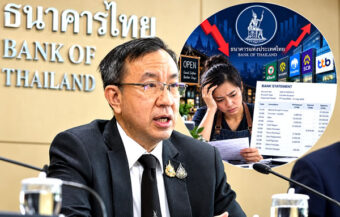
Bank of Thailand Governor Vitai Ratanakorn orders financial ‘bottlenecks’ as 11 bodies target scams, gambling and illicit cash, tracking money through bank transfers, withdrawals, money changers, gold, foreign currency and digital assets across banks.
Thailand has launched a sweeping crackdown on illicit money across its financial system. Bank of Thailand Governor Vitai Ratanakorn has brought 11 financial bodies into the drive, targeting scams, online gambling, illegal businesses and corruption. Banks, payment firms and money changers will track deposits, transfers and withdrawals through to gold, foreign currency and digital assets. Suspect accounts face faster freezes and blocks, while financial data will increasingly reach the Anti-Money Laundering Office, police, anti-corruption investigators and securities regulators. Indeed, Vitai Ratanakorn, Governor of the Bank of Thailand, has set a goal of creating ‘bottlenecks’ to control and screen the flow of funds.

Thailand’s central bank has opened a wider front against illicit money moving through the country’s financial system. The Bank of Thailand (BOT) joined 11 financial sector bodies in the initiative on September 10. Crucially, the framework moves beyond the long-running crackdown on mule accounts. It targets money linked to online gambling, scams, illegal businesses and corruption.
Under the new framework, financial institutions will scrutinise money throughout its journey across the system. Checks will start when funds enter an account. From there, banks will examine transfers, withdrawals and subsequent asset conversions. Foreign currencies, gold and digital assets are specifically within the scope.
At the same time, banks will move faster against accounts linked to wrongdoing. Funds reaching implicated accounts must be frozen or blocked promptly. Accounts should also be closed quickly when suspicious transfers get through. The aim is to stop money before it moves further through the financial chain.
Vitai brings finance sector together as crackdown expands beyond mule accounts to illicit money flows
BOT Governor Vitai Ratanakorn said the initiative consolidates measures previously pursued separately. “What we have done over the past 11 months may have looked like separate pieces, but what we are doing today is bringing the whole industry connected with finance together,” Mr Vitai said.
The initiative is formally called the Framework for Safeguarding the Financial Sector from Illicit Activities. Its scope covers banks and other financial providers. Notably, it also brings payment companies and money changers into the operation. The BOT wants to prevent financial services from becoming conduits for illegal transactions.
Until now, continued screening of mule accounts has formed a major part of the response. Mr Vitai said that work had helped reduce losses and the frequency of offending. Yet the central bank identified a wider challenge. Money can move through several financial stages after entering an account.
For example, funds can pass through transfers before being withdrawn as cash. They can then be converted into foreign currency or gold. Alternatively, money can move into digital assets. As a result, the BOT wants controls operating throughout that chain rather than at one point.
One priority involves accounts connected with online gambling. The central bank wants to prevent those accounts receiving money obtained through deception. If transfers still reach them, banks should close or block the accounts quickly. In turn, this would obstruct further transfers and withdrawals.
Payment firms tighten merchant checks as banks target cash withdrawals, gold and digital asset flows
On another front, payment providers are being drawn more deeply into financial monitoring. They must prevent scammers and illegal businesses receiving funds through their services. The requirement covers transfers and other payment methods. Additionally, providers will strengthen ongoing checks on merchants using their systems.
Those merchant checks form another layer of the new framework. Payment providers will continue scrutinising businesses after they enter their systems. Separately, they will share data that can support analysis of financial trails. This extends monitoring beyond conventional bank accounts into other payment channels.
Cash withdrawals are another major focus. Once suspect money leaves an account as cash, it can move into other assets. In response, banks will make withdrawals from implicated accounts more difficult. Mr Vitai specifically highlighted cash used to buy gold or acquire digital assets.
“We have to make it difficult to withdraw money from those accounts, especially cash withdrawals used to convert it into other assets, such as gold or USDT,” Mr Vitai said.
USDT is among the digital assets specifically identified by the governor. Foreign currency and gold were also cited as destinations for funds. Accordingly, scrutiny will continue after money leaves its original account. The financial trail will be followed towards its eventual conversion.
Banks plan five measures as wider information sharing breaks barriers across Thailand’s financial sector
Banks plan five measures under the framework. However, the bulletin did not detail those five measures individually. The broader strategy centres on blocking receipt, transfer, withdrawal and conversion of illicit funds. Information sharing will underpin much of that work.
In parallel, the BOT plans to break down information barriers between financial institutions. Individual banks have previously depended largely on information available within their own systems. That creates limitations when money moves between separate institutions. The new framework therefore seeks broader visibility across the financial sector.
Commercial banks will participate in that information-sharing network. State-owned financial institutions will also be involved. Furthermore, foreign banks operating in Thailand are included. Non-bank financial providers, payment firms and money changers complete the wider network described by the BOT.
As part of this, institutions will be better positioned to examine money moving between different financial services. One bank may see only the first transfer. Another institution could handle the next movement. A payment provider or money changer might subsequently become involved.
Financial data will flow to AMLO, police and regulators as BOT widens scrutiny across transaction networks
The BOT wants those separate financial movements connected. Consequently, information held by individual institutions will feed into broader financial-trail analysis. The approach widens scrutiny from individual accounts towards networks of transactions. It also creates more points where suspicious money can be blocked.
Beyond the financial sector, relevant information will be shared with enforcement and regulatory bodies. The Anti-Money Laundering Office (AMLO) is among them. The National Anti-Corruption Commission will also receive relevant information. Police and the Securities and Exchange Commission (SEC) are included as well.
Each organisation will use the information under its respective responsibilities. Thus, financial institutions will concentrate on transactions and financial barriers. Police and other agencies will retain their enforcement roles. Anti-money laundering and anti-corruption bodies will act within their existing mandates.
Mr Vitai acknowledged clear limits on the Bank of Thailand’s powers. The central bank cannot directly suppress crime or arrest suspects. Instead, he said the financial sector would create “bottlenecks” throughout the movement of illicit money. “We may not have the power to suppress crime or make arrests directly, but we can create difficulties, create bottlenecks and make these transactions more complicated, reducing their volume substantially,” Mr Vitai said.
Banks move faster to block suspect funds as framework targets transfers, withdrawals and asset conversion
In practice, those obstacles begin when funds attempt to enter an implicated account. Where possible, institutions should prevent the money from arriving. Otherwise, the account should be blocked quickly after suspect funds arrive. The funds themselves should also be frozen or blocked promptly.
Thereafter, attention shifts towards onward movement. Banks will seek to make further transfers more difficult. Withdrawals provide another intervention point. Ultimately, controls will extend towards conversion into gold, foreign currencies or digital assets.
Speed is particularly important under the framework. Money can move from an account through transfers, withdrawals and asset conversion. Delays can therefore allow funds to reach another financial channel. Faster action against implicated accounts is a central element of the September 10 initiative.
Likewise, payment providers are expected to stop illegal recipients before funds move further. Their role covers scammers and other illegal businesses. Continuing merchant checks will provide another source of information. Data sharing can then help trace transactions across separate payment channels.
Previously, a bank’s view was largely confined to activity within its own system. A transaction could therefore appear as one isolated movement. Under the wider framework, participating institutions can share relevant information. This allows separate stages of a financial trail to be examined together.
BOT stresses supervisory role as wider framework makes illicit financial channels harder to exploit
For its part, the BOT is coordinating financial-sector measures rather than assuming law-enforcement powers. The distinction was stressed by Mr Vitai. The central bank and financial institutions cannot arrest people. They can, however, make financial channels harder to use.
That approach begins with accounts receiving money connected with wrongdoing. It then moves through transfers between accounts. After that, controls target cash withdrawals. The final stage involves efforts to prevent conversion into other forms of value.
Gold is one such destination identified by the governor. Foreign currencies provide another route. Digital assets, including USDT, form another part of the financial chain. Hence, the framework reaches well beyond ordinary bank transfers.
Meanwhile, the inclusion of money changers broadens the operation further. Foreign banks and state-owned institutions also sit inside the same framework. Payment firms add another layer outside conventional banking. Together, the 11 financial sector bodies cover several stages through which money can move.
The crackdown also broadens the type of activity under scrutiny. Mule accounts remain part of the operation. However, online gambling, scams, illegal businesses and corruption are now explicitly within the wider framework. The financial sector is therefore being asked to examine several sources of illicit money.
BOT targets both entry and exit points as crackdown follows illicit funds through the financial system
Significantly, the BOT is targeting both entry and exit points. Banks will seek to prevent implicated accounts from receiving funds. They will also restrict money leaving those accounts. Between those stages, transfers will face closer examination.
Asset conversion then becomes another pressure point. Cash withdrawals used to purchase gold fall within the governor’s stated concerns. So do movements into foreign currency or digital assets. The BOT wants barriers before suspect funds can complete that journey.
The September 10 agreement therefore brings previously separate measures under one financial-sector structure. It also widens information sharing beyond individual institutions. Relevant data can then move to AMLO, police, anti-corruption investigators and securities regulators.
More broadly, the framework changes the focus from a suspect account towards the complete financial trail. A mule account can represent only one stage. Money may subsequently move through other accounts, payment systems or cash withdrawals. It can then be converted into assets outside conventional deposits.
New structure follows deposits, transfers and merchants as BOT keeps its financial supervisory role
Under the new structure, scrutiny follows those successive movements. Banks will examine deposits and transfers. Payment providers will strengthen merchant monitoring. Money changers and other financial institutions will also participate in wider information sharing.
Finally, the BOT will remain within its supervisory role. Criminal suppression and arrests remain outside its direct powers. Its financial-sector partners will instead block, freeze and obstruct suspect money where applicable. Enforcement agencies will receive relevant information for their own responsibilities.
New Bank of Thailand regulatory plan may impinge on foreigners’ dealings with tougher, intrusive actions
Bank of Thailand cracking down on grey capital. New five million baht limit on funds without source details
Thailand’s September 10 framework consequently expands the crackdown from mule accounts towards the full movement of illicit funds. It covers deposits, transfers, withdrawals and asset conversion. It also links banks, payment providers, money changers and enforcement agencies through wider information sharing.
Join the Thai News forum, follow Thai Examiner on Facebook here
Follow Thai Examiner on Google here
Receive all our stories as they come out on Telegram here
Follow Thai Examiner here
Further reading:
Bank of Thailand Governor orders monitoring of cash withdrawals amid widespread vote buying fears
High powered, secretive meeting chaired by PM agrees robust action against Cambodian networks
Thailand and Cambodia face danger from ‘Dragon Head’ the Chinese mafia leader behind the scams
Cyber police and Money Laundering agency seek UK and US co-operation targeting Cambodian networks
United States, South Korea and United Kingdom act against Cambodian scam industry with Thai tie-ins
Ben Smith affair & allegations of links to Cambodian scam centres continues to rage in parliament