Thailand’s economy is booming on paper but cracking underneath. Record exports and stronger growth forecasts collide with a soaring trade deficit, an 8% baht slump, weak consumer spending and warnings that Thailand is becoming a transit hub for Chinese and Taiwanese exports across the world, especially to the U.S. and Europe.
Thailand’s economy has delivered its strongest export surge in years, prompting the Bank of Thailand to raise growth forecasts and the Commerce Ministry to predict record overseas sales. Yet behind the upbeat headlines lies a far more troubling picture. A soaring trade deficit, an 8% slide in the baht, weak household spending and mounting debt are raising fresh doubts about the strength of the recovery, while a leading economist warns Thailand may be becoming a transit hub for Chinese and Taiwanese exports rather than creating lasting economic value of its own.
Thailand’s economy offered two very different stories this week. Official figures pointed to stronger growth, surging exports and renewed industrial momentum. Yet the view from households and businesses appeared far less encouraging.
Debt continues suppressing consumer spending. Purchasing power remains weak. Meanwhile, the country’s trade deficit has reached levels that are prompting fresh questions about the strength of the recovery.
The Bank of Thailand strengthened the optimistic narrative on Wednesday. It raised its economic growth forecast for 2026 to 2.3%, up from the previous estimate of 2.0%. At the same time, the Monetary Policy Committee left the benchmark policy rate unchanged at 1.00%.
Bank of Thailand upgrades 2026 growth outlook as exports and AI investment strengthen confidence
Policymakers cited stronger exports, expanding investment and continued demand for high-technology products. In particular, the central bank expects artificial intelligence projects and global data centre investment to remain important drivers of growth. It also forecast exports would increase by 14% this year.
On paper, those figures suggest an economy regaining momentum. However, they tell only part of the story. Across Thailand, consumers continue facing rising living costs and historically high debt.
Businesses also report subdued domestic demand despite improving external markets. Consequently, stronger headline growth has yet to produce a broad recovery across the wider economy. Inflation is expected to rise this year. As a result, many households remain under increasing financial pressure even as official forecasts improve.
That disconnect has become more pronounced in 2026. The export sector continues to outperform expectations. Domestic spending, by contrast, remains constrained. Hard-pressed households are struggling to keep pace with rising prices.
Likewise, many businesses continue operating in a difficult trading environment. The revised growth forecast, therefore, reflects strength in selected sectors rather than a broad improvement across the economy.
Strong export growth masks persistent debt pressures and weaker household spending across the economy
Against that backdrop, the Ministry of Commerce released another set of robust export figures on Thursday. The data reinforced Thailand’s position as one of the region’s strongest export performers. Exports reached US$34.33 billion in May, equivalent to approximately 1.095 trillion baht.
That represented annual growth of 10.6%. Moreover, it marked the twenty-third consecutive month of export expansion. Although the figure fell slightly short of analysts’ expectations, it nevertheless confirmed that overseas demand remains resilient.
Imports, however, expanded much faster. They climbed 35.1% to US$40.04 billion during May. Consequently, Thailand recorded a monthly trade deficit of US$5.71 billion. Reuters had surveyed economists who expected export growth of around 12% and a trade deficit of approximately US$6.12 billion.
Even so, the actual deficit remained exceptionally large by historical standards. More importantly, it continued a pattern that has become increasingly difficult to dismiss.
The longer-term figures paint an equally striking picture. During the first five months of 2026, Thailand exported goods worth US$162.09 billion. That represented annual growth of 17%. Over the same period, imports surged to US$187.30 billion, increasing by 35.6%. Consequently, the cumulative trade deficit widened to US$25.21 billion. Those figures underline the growing gap between export growth and Thailand’s external balance.
Exports surge for twenty-three straight months but swelling imports drive Thailand’s trade deficit higher
For its part, the Commerce Ministry remains confident that exports will continue supporting the economy. Mr Nantapong Chiralerspong, Director of the Trade Policy and Strategy Office, said recent performance had exceeded earlier expectations.
At the beginning of the year, officials projected export growth of around 3%. That estimate sat within an original forecast range stretching from a contraction of 3% to growth of 8%. Since then, export momentum has consistently surprised on the upside.
In response, the ministry has revised its outlook sharply higher. Officials now expect exports to expand by as much as 8% during 2026. If achieved, Thailand would record exports worth approximately US$366.8 billion, or around 11.7 trillion baht.
That would establish a new annual record. According to Mr Nantapong, Thailand now needs to maintain a strong export performance throughout the remaining seven months to achieve that target.
Several factors continue to support that optimism. Notably, global demand for technology products remains exceptionally strong. Artificial intelligence has accelerated investment across advanced manufacturing, semiconductor production and digital infrastructure.
At the same time, expanding data centre construction continues to generate demand for sophisticated electronic equipment. Thailand’s manufacturing sector has benefited directly from those trends, particularly producers supplying international technology supply chains.
Technology exports power export growth, while agriculture loses momentum amid fierce competition
The composition of exports reflects that changing landscape. Industrial products expanded by 14.4% during May. Radio and telecommunications equipment delivered the strongest performance, surging 188.2% from a year earlier.
Computer equipment increased 26.8%, while plastic pellets rose 17.4%. Together, those industries drove much of Thailand’s export growth. Without them, the overall performance would have looked considerably weaker.
Agriculture presented a very different picture. Agro-industrial exports contracted by 13.2%, while agricultural exports fell 3.1%. Rice exports declined 16.4% amid intense global price competition. Fresh and frozen chicken shipments dropped 26.2%.
Meat exports fell 42.2%, while rubber declined 5.3%. Consequently, traditional agricultural products made only a limited contribution to overall export growth despite their continuing importance to the wider economy.
Separately, export destinations also revealed important changes. The United States remained Thailand’s strongest major market, with shipments increasing by 33.5%. Switzerland expanded even faster, recording growth of 58.2%. Exports to the five principal ASEAN economies climbed 29.7%, while shipments to the European Union rose 18.4%. Latin America also recorded growth of 18%. Those markets more than offset weakness elsewhere.
China weakens as US demand surges and exporters accelerate shipments ahead of possible tariff changes
By contrast, exports to China declined 2.5%. Shipments to Hong Kong fell sharply by 26.8%, while exports to the Middle East contracted 4.4%. Those contrasting results illustrate how Thailand’s export performance has become increasingly concentrated in selected overseas markets. They also underline the growing importance of the United States as Thailand’s principal engine of export growth during 2026.
Commerce Ministry officials also identified another important factor. Many exporters accelerated shipments to the United States ahead of possible tariff changes. That front-loading boosted export values during recent months.
However, officials expect that effect to moderate during the second half of the year. Even then, they believe exporters can adjust successfully to future US trade measures while maintaining positive overall growth.
Nevertheless, several risks remain firmly on the horizon. Production costs continue facing upward pressure. In parallel, conflict in the Middle East continues disrupting logistics and shipping routes. Purchasing power also remains weak across many overseas markets. Those pressures could slow export growth later this year. Even so, the ministry believes demand for technology products will remain sufficiently strong to support continued expansion.
Record exports cannot hide widening trade deficits, weaker baht and mounting external pressure
Yet the strongest export figures tell only one side of Thailand’s economic story. Beneath the headline numbers, another trend has become increasingly difficult to ignore. Imports continue rising much faster than exports. As part of this, the country’s trade deficit has widened sharply despite record shipments overseas. That contradiction now sits at the centre of an increasingly important economic debate.
The latest figures illustrate the scale of the imbalance. May’s trade deficit reached US$5.71 billion after imports climbed 35.1%. Although that figure was slightly lower than economists expected, it remained exceptionally large.
More significantly, it followed another substantial deficit in April. Consequently, Thailand’s current account has remained under sustained pressure despite continuing export growth.
That trend has also been reflected in financial markets. The Thai baht has weakened steadily in recent months. Since reaching a relatively strong level in late January, the currency has fallen by around 8% against the US dollar. Currency traders generally view persistent trade deficits as a source of pressure on exchange rates. While several factors influence the baht, the deterioration in Thailand’s external accounts has become increasingly difficult to overlook.
Bank of Thailand remains optimistic as an economist challenges the official view of economic resilience
On another front, the Bank of Thailand continues expressing confidence in the broader economy. Policymakers argue that stronger exports and investment will support growth throughout the year.
The central bank also expects technology industries to remain a major source of expansion. Nevertheless, the divergence between external strength and domestic weakness has become increasingly apparent.
Many households have yet to experience the benefits of stronger exports. Debt continues to restrict consumer spending. Businesses serving the domestic market also face subdued demand. Therefore, the revised 2.3% growth forecast has not yet translated into a widespread improvement in economic conditions. Instead, much of the momentum remains concentrated in export-oriented manufacturing.
Against this backdrop, freelance economist Dr Chartchai Parasuk has offered a markedly different interpretation of the latest figures. Writing in the Bangkok Post, he argues Thailand’s widening trade deficit is not a temporary development.
Instead, he believes it reflects a structural change in the country’s export model. His analysis directly challenges the view that lower oil prices alone will eventually restore Thailand’s traditional trade surplus.
Economist says the trade deficit reflects structural change rather than temporary impact of higher oil prices
Dr Chartchai begins with Thailand’s longer economic history. For roughly two decades, the country consistently generated trade surpluses. Even during the Russia-Ukraine war, annual exports continued to exceed imports.
Although soaring energy prices reduced that surplus in 2022, Thailand still maintained a positive trade balance. Once oil prices eased, the surplus recovered. According to Dr Chartchai, today’s situation differs fundamentally.
He argues the comparison with 2022 is revealing. Oil prices briefly reached around US$115 per barrel during that period. Even so, Thailand still recorded a modest trade surplus. By comparison, oil prices stood close to US$101 per barrel in April this year. Nevertheless, the country posted one of its largest trade deficits in decades. According to Dr Chartchai, that difference cannot be explained by fuel costs alone.
After examining the available data, he concluded that higher energy imports accounted for only part of the deterioration. According to his calculations, fuel represented around 41% of the widening deficit. However, increased imports from China accounted for approximately 28%. A further 26% reflected higher imports from Taiwan. In his view, those figures point towards a structural rather than temporary problem.
Growing dependence on Chinese and Taiwanese components is reshaping Thailand’s export model
That conclusion forms the centrepiece of his argument. Dr Chartchai believes Thailand’s export base has changed significantly. Rather than exporting predominantly domestic products, the country increasingly assembles imported components before shipping finished goods overseas. Consequently, exports continue growing strongly. However, imports rise even faster, eroding Thailand’s traditional trade surplus.
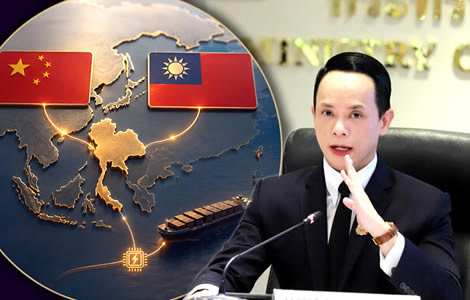
Notably, he argues Thailand has become a larger transit point for products originating in China and Taiwan. Components arrive for processing and assembly before final export, particularly to the United States.
That manufacturing model supports export growth and industrial activity. At the same time, it also increases the value of imported intermediate goods. According to Dr Chartchai, that helps explain why trade deficits continue widening despite impressive export figures.
He pays particular attention to Taiwan. Although Taiwan’s economy is significantly smaller than China’s, Thailand’s bilateral trade imbalance has expanded rapidly. Dr Chartchai argues that the pattern deserves closer scrutiny. In particular, he suggests transfer pricing within multinational companies may contribute to the unusually large deficit.
Transfer pricing and regional supply chains are worsening the trade imbalance with Taiwan and China
He illustrates the argument with an example involving electronic components. Integrated circuits may enter Thailand at relatively high declared values before local assembly. The completed products are then exported at lower margins because international market prices remain competitive.
Under that arrangement, Thailand records expensive imports but comparatively modest export earnings. According to Dr Chartchai, that structure benefits overseas parent companies while weakening Thailand’s trade balance.
Beyond Taiwan, his analysis also highlights China. Chinese manufacturers continue exporting large volumes of competitively priced goods into international markets. Thailand has consequently imported increasing quantities of those products.
Dr Chartchai argues that the trend has displaced parts of domestic production while expanding Thailand’s bilateral deficit with China. He describes the development as part of a broader structural adjustment rather than a temporary market cycle.
His research also identifies another unusual pattern. Export growth slowed noticeably during February. Dr Chartchai attributes that decline to the Chinese New Year holiday, when factories across mainland China and Taiwan temporarily closed.
Thailand’s export performance weakened at the same time. By contrast, Thailand’s Songkran holiday produced no similar effect because production in China continued normally. According to his analysis, that illustrates how closely Thailand’s manufacturing sector now follows regional supply chains.
Officials defend export outlook as economists debate Thailand’s changing trade structure and prospects
Neither the Commerce Ministry nor the Bank of Thailand has endorsed those conclusions. Instead, both continue emphasising strong export performance and expanding technology investment. Officials also maintain that exporters can adapt to future changes in global trade. Furthermore, they expect demand for artificial intelligence-related products to remain resilient throughout the remainder of the year.
Even so, the latest figures present an economy moving in two different directions. Export growth remains impressive. Industrial production continues benefiting from technology investment. Official forecasts have become more optimistic.
At the same time, imports are accelerating faster than exports. Trade deficits remain unusually large. The baht continues weakening, while domestic demand remains subdued.
For policymakers, the challenge is becoming increasingly clear. Strong export growth alone has not produced a broad domestic recovery. Households continue facing debt pressures. Businesses dependent on local spending remain under strain.
Meanwhile, Thailand’s external accounts are showing signs of growing structural pressure. Whether those trends narrow during the second half of 2026 will determine whether stronger exports ultimately deliver a broader and more durable economic recovery.
Export growth is expected to slow even as technology investment continues to support manufacturing sector
Whether that happens will depend on several developments unfolding simultaneously during the second half of the year. Export momentum remains strong. However, officials acknowledge it is unlikely to match the pace recorded during the opening months. Instead, the Commerce Ministry expects monthly export growth to settle into single digits as temporary factors begin to fade.
Much of this year’s exceptional performance has been supported by unusually strong shipments to the United States. Exports to America’s largest consumer market jumped 33.5% in May alone. According to the ministry, part of that increase reflected exporters accelerating deliveries before possible changes to US tariff policy. That strategy has supported manufacturers throughout the first half of 2026. However, officials expect the effect to weaken over the coming months.
Even so, the ministry believes exporters remain well-positioned. Officials expect demand for technology products to continue supporting overseas sales. Artificial intelligence remains one of the strongest investment themes across the global economy.
Likewise, spending on digital infrastructure continues to expand rapidly. New data centres require sophisticated communications equipment, semiconductors and computer hardware. Thailand’s manufacturers have become important suppliers to those international production networks.
Technology industries offset weak agriculture, but imports continue expanding far faster than exports
The changing composition of exports reflects that transformation. Technology-related industries are now providing much of Thailand’s export momentum. Radio and telecommunications equipment recorded an extraordinary growth of 188.2% during May.
Computer equipment expanded 26.8%, while plastic pellets rose 17.4%. Those sectors comfortably outperformed more traditional export industries. They also illustrate how global investment trends are reshaping Thailand’s manufacturing base.
Agriculture continues moving in the opposite direction. Rice remains under pressure from intense international competition. Meat exports declined sharply, while chicken shipments also weakened significantly.
Rubber exports slipped despite remaining an important source of foreign income. Consequently, industrial production has increasingly compensated for weaker agricultural performance. That shift represents one of the defining features of Thailand’s export sector this year.
At the same time, import growth continues overshadowing those gains. During the first five months of 2026, imports increased by 35.6%, more than double the pace of exports. That imbalance explains why Thailand has accumulated a trade deficit exceeding US$25 billion despite recording one of its strongest export performances in years. The figures also explain why several economists remain cautious despite improving headline data.
Officials stay upbeat as debate shifts from export growth to Thailand’s widening trade deficit
Officially, confidence remains intact. The Bank of Thailand expects exports to expand by 14% this year and drive overall economic growth. Likewise, the Commerce Ministry believes exports could increase by as much as 8%, reaching a record value of approximately 11.7 trillion baht. Those forecasts reflect continued confidence in Thailand’s manufacturing sector and its ability to benefit from expanding global technology investment.
Separately, officials continue monitoring several external risks. Conflict in the Middle East remains a concern because it affects shipping routes and logistics costs. Production expenses also remain elevated across many industries.
In addition, purchasing power has weakened in several overseas markets, limiting demand for some consumer goods. Those factors could influence export performance during the months ahead.
Nevertheless, the strongest debate no longer centres on export growth alone. Instead, attention has shifted towards the quality of that growth and its impact on Thailand’s wider economy. That is where Dr Chartchai Parasuk’s analysis has generated particular interest. His argument does not dispute the strength of exports. Rather, it questions whether Thailand is retaining sufficient economic value from those exports as imports continue rising even faster.
Economist argues trade balance reveals deeper structural pressures beneath Thailand’s strong exports
According to Dr Chartchai, headline export values can create a misleading impression if viewed in isolation. He argues that the trade balance provides a more complete picture because it captures both exports and imports together.
Under that measure, Thailand’s position has deteriorated markedly during 2026. His conclusion is that rising export values alone no longer guarantee higher national income if imported components continue absorbing much of the value created.
His analysis also highlights how Thailand’s manufacturing sector has become increasingly integrated into regional supply chains centred on China and Taiwan.
Imported components arrive for processing before finished goods leave for final markets, particularly the United States. That model supports industrial production and employment. However, according to Dr Chartchai, it also reduces the net gains reflected in Thailand’s trade balance.
Importantly, he distinguishes between temporary and structural influences. Oil prices may fluctuate over time. Energy costs may also decline. However, he argues that greater dependence on imported components from China and Taiwan represents a more permanent change. If that assessment proves accurate, Thailand’s trade deficits may persist even if fuel prices moderate.
Official data highlight stronger exports, weaker domestic demand and questions over economic direction
The official data released this week neither confirms nor rejects that conclusion. They do, however, establish several clear facts. Export growth remains exceptionally strong. Imports are increasing even faster. The trade deficit has widened substantially. The baht has weakened by around 8% since late January. At the same time, domestic demand remains constrained by heavy household debt and weaker purchasing power.
Taken together, those figures explain why Thailand’s economy currently presents two contrasting realities. One reflects the resilience of exporters benefiting from global demand for advanced technology products. The other reflects continuing pressure on households, domestic businesses and the country’s external accounts. Both stories are supported by this week’s data.
Weakening baht falls below 33 to the US dollar as industry leaders warn borrowing costs will also rise
Thailand sets out game plan to escape the middle income trap to an advanced economy in 12 years
For investors, policymakers and businesses, the coming months will reveal which trend proves more durable. If exports remain strong while imports moderate, pressure on the trade balance could begin easing. If imports continue outpacing exports, however, the debate over Thailand’s changing economic structure is likely to intensify.
For now, the official message remains optimistic. Growth forecasts have been upgraded. Export targets have been raised. Industrial production continues expanding, supported by artificial intelligence and digital infrastructure investment.
Yet the latest figures also show widening trade deficits, a softer currency and subdued domestic demand. Reconciling those opposing trends may become the defining economic challenge facing Thailand during the remainder of 2026.
Join the Thai News forum, follow Thai Examiner on Facebook here
Receive all our stories as they come out on Telegram here
Follow Thai Examiner here
Further reading:
US Ambassador Seán O’ Neill briefed Prime Minister Anutin Charnvirakul at Government House on War
Visa waivers, discounted hotel stays and 2,000 baht a person per day for stranded tourists announced
Liquidity crisis or shortage of cash on the ground is shrinking Thailand’s economic growth prospects
Thai Minsters engage with US trade chief Jamieson Greer in Paris at global OECD ministerial meeting