Fury as drug kingpin Laota Saenli leaves prison after serving under nine years of a life sentence. Six royal pardons, age benefits and “excellent prisoner” status cut decades from his sentence, forcing ministers to review the rules for serious offenders.
Former drug kingpin Laota Saenli walked free after serving under nine years of a life sentence for major drug trafficking. Six royal pardons, age benefits and “excellent prisoner” status cut decades from his punishment. His release has exposed weak promotion rules inside overcrowded prisons and triggered a government review. However, Minister of Justice Police General Rutthaphol Naowarat says the completed case cannot be reversed. Officials are now considering tougher rules for killers, rapists, major drug traffickers and other high-security prisoners. The reform drive has intensified after a recently released convict admitted to five brutal murders in Chonburi, including a family of three and two Russian siblings.
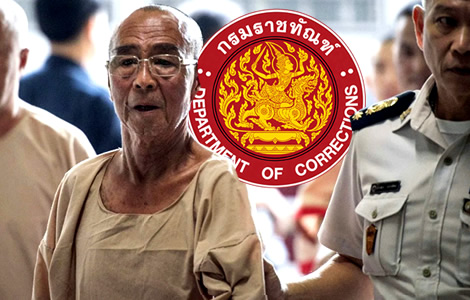
Former drug kingpin Laota Saenli left Bang Kwang Central Prison on August 14 after serving less than nine years. The 85-year-old had received the death penalty for major drug trafficking and weapons offences. However, his confession reduced that punishment to life imprisonment and a ฿2.5 million fine. Six royal pardons then opened the prison gates.
Laota served eight years, three months and 28 days under the sentence. His release under the 2026 Royal Pardon Decree triggered anger and demands for answers. In response, the government began reviewing prisoner promotions, sentence reductions and pardon criteria. Officials have since identified shortcomings within the existing regulations.
At the centre of the controversy is a system that links prison benefits to prisoner classifications. Higher classifications provide greater access to parole, sentence reductions and other benefits. Consequently, routine prison promotions can eventually remove decades from severe court sentences. Laota had reached “excellent prisoner” status by 2022.
Former corrections chief says weak prison rules turned Laota’s life sentence into an early release
Krit Krasaedhibaya, a former deputy director-general of the Department of Corrections, has now challenged that system. On August 17, he published a detailed assessment on his Facebook page. Notably, he identified overcrowding and weak promotion standards as central problems. He also called for separate controls covering prisoners serving the harshest punishments.
The Department of Corrections maintains that Laota’s release followed the law. Nevertheless, it has promised an urgent review of sentence enforcement rules for serious offences. Mr Krit said that commitment amounted to an admission of longstanding regulatory problems. In his assessment, those weaknesses had persisted across eras and successive leaderships.
More fundamentally, Mr Krit questioned whether sentence administration respected the courts’ original decisions. A life sentence reflects a finding that the defendant committed an exceptionally serious crime. Accordingly, the court intends to remove that person from society permanently. The punishment already represents leniency when compared with a death sentence.
Yet repeated reductions can transform the practical effect of that judgment. A prisoner can move through classifications while receiving pardons and age-related benefits. Taken together, those measures can reduce a life term to less than a decade. Laota’s release brought that process into public view.
Laota’s major drug conviction and six royal pardons cut decades from his original life prison sentence
Police arrested Laota during an undercover operation in Chiang Mai on October 11, 2016. The case involved approximately 20 kilogrammes of crystal methamphetamine and military-grade weapons. Additionally, investigators seized assets linked to his trafficking network worth more than ฿1 billion. The scale of the case placed him among Thailand’s most prominent drug offenders.
Laota was also well established in northern Thailand. He had been an anti-communist fighter and a village headman in Chiang Mai. Furthermore, narcotics officers linked him to leading Golden Triangle drug producers operating from Myanmar. They also connected him with powerful traffickers using Thailand’s northern border routes.
The Criminal Court initially imposed the death penalty. Following his confession, the court reduced that punishment to life imprisonment and imposed the fine. The Appeal Court upheld his conviction on December 12, 2019. Even so, his effective sentence continued falling through successive royal pardons.
Laota received two sentence reductions during 2020 and another two during 2021. Subsequently, further reductions followed during 2025 and 2026. His life term first became a 50-year prison sentence. Later reductions then brought his release forward by several decades.
Age benefits and excellent prisoner status accelerated Laota’s release from a life prison term
Age also became an important factor. Special provisions covering prisoners aged over 70 substantially reduced his remaining punishment. Meanwhile, the Department of Corrections said Laota committed no disciplinary offences in prison. He therefore continued advancing through the formal classification system.
By 2022, Laota had secured “excellent prisoner” status. That classification increased the benefits available under the applicable rules. As a result, his prison behaviour directly affected the time remaining on his sentence. The severity of his original crimes did not prevent his rapid advancement.
Former narcotics police chief Rewat Klinkesorn strongly disputed that outcome. In particular, he said good conduct inside prison could not erase Laota’s criminal history. He also rejected the classification of a major drug trafficker as an exemplary prisoner. His criticism highlighted the difference between the judicial sentence and the punishment served.
Mr Krit examined that difference from inside the correctional system. Importantly, he did not accuse corrections officials of unlawfully releasing Laota. Officials had administered the sentence under the correctional rules then operating. Instead, he identified the rules governing prisoner classification as the main weakness.
Almost every significant prisoner benefit is tied to classification. These benefits include parole, royal pardons and ordinary sentence reductions. They also cover transfers or placements in temporary prisons. Thus, each promotion can carry consequences far beyond conditions inside prison.
Automatic promotions and basic prison tests propel inmates rapidly towards the highest prisoner class
Mr Krit described the current promotion system as close to automatic. Prisons conduct cyclical reviews covering behaviour, education and moral training. In practice, inmates face limited requirements before moving to a higher class. Avoiding disciplinary offences may be sufficient to maintain steady advancement.
Attendance at one or two prison courses can also support promotion. Thereafter, inmates may advance through the classification system every six months. The process gives limited consideration to the seriousness of the original offence. It can also give insufficient weight to the sentence imposed by the court.
Mr Krit recalled his own service on prisoner promotion committees as a junior officer. During those reviews, inmates appeared individually before committee members. Rather than facing rigorous examinations, they often completed simple memorisation tasks. Prisoners could be asked to recite the Five Precepts and Five Virtues.
They might also recite the pledge delivered before prison meals. By comparison, foreign prisoners were sometimes required to sing the Thai national anthem. Successful inmates could then move rapidly towards the “excellent” classification. Mr Krit said the basic process still consumed considerable staff time.
Large prisons can hold thousands of convicted prisoners. Inevitably, individual promotion interviews require substantial staffing and administrative work. Prison overcrowding makes that burden far heavier. Officers must first maintain security and control over crowded facilities.
Overcrowding and legal pressures make rigorous individual prisoner assessments increasingly difficult
Prisons have inmate records and formal behavioural scoring systems. They can also deduct points following misconduct or disciplinary violations. Despite this, detailed individual assessments require time, staffing and sustained observation. Those resources remain scarce inside heavily overcrowded prisons.
Mr Krit said the immediate priority was controlling the prison population. Otherwise, any loss of control could create a major security problem. Against that background, demanding quality-based assessments becomes difficult to operate. Routine behaviour and course attendance therefore assume greater importance.
Legal pressures further shape promotion decisions. Mr Krit said prisoners denied advancement without sufficient justification would almost certainly sue. For that reason, officials must make decisions capable of surviving legal examination. They cannot simply block promotions because an inmate’s crime was particularly grave.
Existing regulations encourage promotion once prisoners satisfy the stated requirements. Later, those classifications determine access to much larger benefits. At that point, a routine promotion becomes critical when a royal pardon decree takes effect. Higher-ranking prisoners can automatically receive greater sentence reductions.
Mr Krit proposed a separate track for prisoners serving exceptionally severe sentences. Specifically, it would cover death sentences, life terms and other lengthy punishments. The court judgment would become the primary consideration within that system. Officials would then set an appropriate minimum period based on the sentence’s severity.
Separate classification route proposed for prisoners facing death, life or other severe sentences
Afterwards, each high-penalty prisoner would follow an individual classification route. This approach would prevent rapid movement towards the highest prisoner class. In turn, basic six-month reviews would no longer determine the effective duration of life sentences. Mr Krit said this area required immediate examination.
Separately, he distinguished sentence administration from the constitutional character of royal pardons. A royal pardon is an act of royal clemency exercised under established law. His proposed changes instead concern the executive work preceding a pardon decree. That process begins before any document reaches His Majesty the King.
The executive branch prepares the draft royal decree granting pardons. Cabinet then considers it before presenting it to His Majesty. Therefore, the drafting stage remains an executive and administrative responsibility. Mr Krit said officials should examine every possible impact during that stage.
Such consideration should cover the offences, punishments and prisoner categories included. Likewise, officials should examine how repeated pardons interact with age provisions and classification benefits. The process can still provide opportunities for suitable prisoners to reform. Yet each decision should account for the sentence imposed by the court.
Executive scrutiny of royal pardon decrees urged before sentence reductions receive final approval
Once published in the Royal Gazette, Mr Krit said criticism of the Royal Decree becomes inappropriate. Hence, detailed examination must occur during its preparation. He said stronger executive guidelines could prevent another controversy like Laota’s release. “If such guidelines are in place, I can assure you that there will be no more problems that cause public panic like the case of Laota’s release.”
Minister of Justice Police General Rutthaphol Naowarat addressed the controversy at Government House on August 18. He acknowledged the impact but ruled out reopening Laota’s punishment. “Probably not, because the decision has already been made,” he said. The new committee will instead improve future case considerations.
When questioned again, the minister said Laota’s case was closed. The prisoner had already been released under the old regulations. Those rules had applied throughout his imprisonment following his detention in 2016. Accordingly, the working group cannot reverse his release or impose another punishment.
The Ministry of Justice has responded in two areas. First, it ordered the Department of Corrections to explain every stage of the process. That inquiry covers Laota’s classification, sentence reductions and inclusion in royal pardon proposals. It also covers the official documents supporting those decisions.
Justice Minister rules out reopening Laota case as officials examine his release and sentence cuts
Second, the ministry established a working group to review pardon criteria. Initially, officials identified several inappropriate aspects within the existing regulations. Police General Rutthaphol nevertheless said officers appeared to have followed those rules. The investigation will now determine precisely where those rules failed.
The minister stressed that pardon decisions do not rest with one individual. Instead, the Pardon Committee considers cases under the regulations operating at that time. Committee members and corrections officers must comply with those requirements. Failure could expose officials to legal or disciplinary action.
On another front, the minister requested clarification of regulations applied from 2020 onwards. He also sought details covering the period when officials submitted Laota’s pardon requests. Supporting documents must be verified before the Department of Corrections director-general signs them. The ministry will examine that full administrative chain.
Questions have also emerged about possible differences between Laota and other Thai prisoners. In reply, Police General Rutthaphol said he believed the same regulations had applied. He added that Laota’s age appeared to be an important factor. However, he requested additional time to verify the official records.
Corrections Department considers tougher benefit restrictions for Thailand’s most serious offenders
The opposition may raise the controversy during a no-confidence debate. In preparation, the minister said he could explain every relevant year and regulation. He rejected suggestions that corrections officials intended to commit corruption. Nonetheless, he promised corrections wherever the review identified weaknesses.
In parallel, the Department of Corrections is examining changes to the regulations governing prisoner benefits. The review centres on ministerial regulations issued during 2019. Those regulations operate under the Corrections Act of 2017. They cover prisoner benefits and release conditions following sentence reductions or suspended sentences.
Officials are focusing particularly on the second chapter of the 2019 regulations. That chapter governs normal and special prisoner promotions. As part of this, the department is considering tighter restrictions for prisoners convicted of extremely serious crimes. Those restrictions could extend across several categories.
Potential categories include murder, rape, sexual offences and ransom cases. They could also include particularly brutal offences and major drug trafficking. Beyond that, the restrictions could cover prisoners serving death sentences or life terms. Other offenders serving exceptionally long sentences could also face separate controls.
New rules could force prisoners spared execution to serve full life terms without parole or reductions
One proposal concerns prisoners whose death sentences are reduced to life imprisonment. Under that approach, royal clemency would still remove the death penalty. After that, the prisoner could be barred from receiving another sentence reduction. Parole could also become unavailable.
The offender would then serve the full life sentence created through royal clemency. Currently, the Department of Corrections lacks a clear legal basis for imposing that restriction. Officials must award prisoner benefits according to existing regulations. Failure could bring complaints accusing them of dereliction of duty.
Accordingly, officers cannot deny promotions solely because a release might cause public criticism. They need specific legal authority for treating serious offenders differently. To address this, the department is considering a new ministerial regulation. It would operate alongside the existing 2019 measure.
The proposed regulation would define restricted prisoner categories and tighten access to benefits. At the same time, the drafting process would involve several interested groups. The Department of Corrections plans to seek comments from academics and the Corrections Committee. Human rights specialists and civil society organisations would also participate.
Fresh regulations would tighten prison benefits as five Chonburi killings deepen release concerns
In addition, any final regulation must comply with international law and human rights principles. The department said it was ready to consider all relevant submissions. Officials believe the proposal could produce sentences more closely matched to serious offences. It would also give prison officers clearer legal instructions.
Laota’s release has coincided with another case involving a recently freed prisoner. Thana Kertthong, known as Pong, became a suspect in five Chonburi killings. Investigators initially linked him to the deaths of two Russian siblings. Their bodies were buried in Huai Yai subdistrict, Bang Lamung district.
Later, investigators discovered three additional Thai victims from one family. They were two parents and their child. That discovery brought the total number of deaths to five. Mr Thana had previously served a prison sentence.
Moreover, officials had placed him under surveillance for two years following his release. Even so, the five killings occurred only two months after he left prison. The case increased scrutiny of sentence reductions and post-release supervision. It also intensified attention on the treatment of high-security offenders.
Ministry review traces Laota’s six royal pardons and rapid route from a death sentence to freedom
Meanwhile, Thailand continues intercepting huge methamphetamine shipments along its northern borders. Laota’s links with Golden Triangle drug producers sharpened the reaction to his freedom. His former status and the original death sentence remain central to the controversy. Still, the government review cannot change his present legal position.
Laota remains free after serving eight years, three months and 28 days. Local officials will monitor him following his return home. Going forward, the Ministry of Justice working group will reconstruct his complete sentence reduction history. That examination will include six royal pardons and age-based benefits.
It will also examine his movement through the prisoner classification system. Crucially, the review must establish how those separate mechanisms operated together. The Department of Corrections maintains that each stage complied with the law. Police General Rutthaphol has reached the same preliminary conclusion.
Corrections Department insists Thaksin’s parole in May 11th is entirely lawful and within regulations
Corrections boss dismisses guard for affair with inmate’s wife and extorting money from family
Even so, both have acknowledged shortcomings within the regulations. The government will now decide whether severe offenders require a separate classification route. It will also consider new limits on parole and repeated sentence reductions. Any changes would apply to future cases rather than Laota.
Ultimately, the review concerns the route from a severe court sentence to early release. Laota entered prison facing death before his confession secured life imprisonment. He then obtained six royal pardons and “excellent prisoner” status. Less than ten years after his arrest, he walked out of Bang Kwang Central Prison.
Join the Thai News forum, follow Thai Examiner on Facebook here
Receive all our stories as they come out on Telegram here
Follow Thai Examiner here
Further reading:
Attorney General’s move to appeal Thaksin acquittal on lèse-majesté charge to impact 2026 election
Trump brokered peace pact between Thailand and Cambodia suspended after landmine attack this week