A landmine blast injures four Thai soldiers, costing one his leg, forcing Prime Minister Anutin to suspend the Trump-brokered Thailand-Cambodia peace deal signed in Kuala Lumpur on October 26, putting the agreement on the brink of collapse.
A landmine blast that wounded four Thai soldiers and cost one his leg has thrown the Thai-Cambodian peace deal into jeopardy, putting the accord signed in Kuala Lumpur on October 26th on the brink of collapse. Within hours of the reports reaching Bangkok on Monday, Prime Minister Anutin Charnvirakul ordered the suspension of the deal and all related operations, halting the withdrawal of heavy weapons and military equipment from the border. Officials said Tuesday’s meeting of the Prime Minister and the National Security Council could go further and scrap the agreement outright.
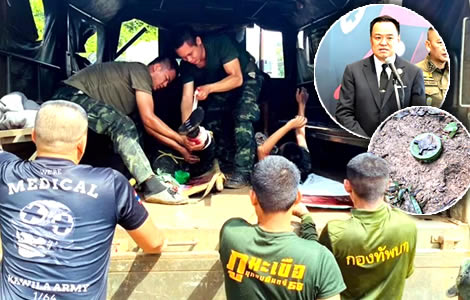
Tensions between Thailand and Cambodia have escalated sharply after a new landmine blast on the border in Si Sa Ket province. Four Thai soldiers were injured on Monday morning when a device exploded during a patrol. One soldier lost his right foot. The incident occurred in the Huai Ta Maria area of Kantharalak district, opposite Cambodia’s Preah Vihear Temple. It was the seventh such case since July.
The Royal Thai Army confirmed the explosion at around 9:30 a.m. It said the device was a Russian-made PMN-2 landmine newly planted inside Thai territory. The mine went off as the patrol entered a section where barbed wire barriers had recently been removed.
The blast was powerful and threw one soldier several meters. Others were hit by fragments and dust.
Thai soldiers injured by landmine after triggering newly planted PMN-2 device in Si Sa Ket border area
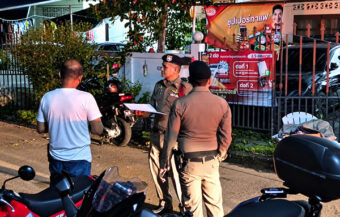
According to army spokesman Major General Winthai Suwaree, the team was on a regular patrol route. The area had been demined earlier and fenced. However, on Sunday, November 9, troops discovered that sections of wire had been secretly cut. The following morning, the patrol went to inspect the site and triggered the explosion.
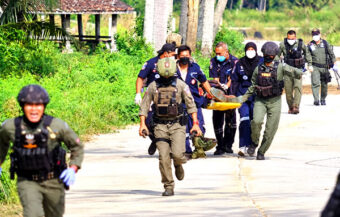
The injured soldiers were identified as Sergeant Major First Class Therdsak Samaphong, who lost his right foot; Private Wachira Panthana, who suffered chest injuries from the shock wave; Private First Class Aphirak Srichomchai, who was struck in the leg by shrapnel; and Private First Class Anucha Sujaree, who suffered eye irritation from dust and chemicals. They were treated in the field before being airlifted to Sunpasitthiprasong Hospital in Ubon Ratchathani.
Later that day, Thai military engineers, forensic police, and provincial officers reached the scene. They found a crater 55 centimetres wide and 18 centimetres deep. Inside were fragments of a PMN-2 mine. Three more devices of the same type were discovered within one meter of the crater. Evidence pointed to recent placement.
Maj. Gen. Winthai said the Second Army Region concluded that Cambodian troops had crossed into Thai soil, removed the wire, and replanted the mines. He said this act breached the Joint Declaration signed between both countries in Kuala Lumpur on October 26. The declaration had been witnessed by U.S. President Donald Trump and Malaysian Prime Minister Anwar Ibrahim.
Cambodia breached joint declaration by removing wire and placing mines on Thai territory in Si Sa Ket
By Monday afternoon, Thai military sources confirmed that the mines were newly placed and targeted regular patrol routes. They said this demonstrated deliberate action and undermined the peace process. The Royal Thai Army described the act as a serious violation of agreements.
At 1:15 p.m. the same day, reports emerged of small-arms fire from the Cambodian side near Ta Muen Thom Temple in Surin province. Cambodian troops allegedly fired five rifle rounds toward Thai positions. Thai soldiers did not return fire. The shots came only hours after the mine blast, further heightening tension along the frontier.
Witnesses said Cambodian forces had recently increased their presence near the temple. Over the previous three days, additional troops were deployed and patrols intensified. Local commanders ordered all Thai positions to full alert. Despite the provocation, Thai units were told to hold fire and await orders from Bangkok.
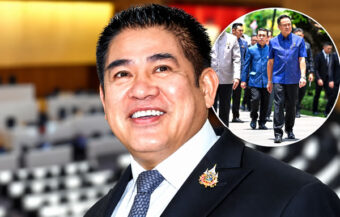
Prime Minister Anutin Charnvirakul responded swiftly. He suspended all peace deal implementation measures that were underway. The suspension halted the removal of heavy weapons and delayed further troop withdrawals from the border. He said Thailand could not continue the process while its soldiers were being attacked.
Prime Minister suspends all border peace deal measures after landmine incident raises tension sharply
Anutin ordered the Ministry of Defence to issue a formal protest to Cambodia and report the incident to the United States and Malaysia. Both nations had acted as witnesses to the peace accord. The Prime Minister also directed the National Security Council to convene on Tuesday to review the next steps.
Thailand’s Ministry of Foreign Affairs confirmed that formal complaints were filed with both Washington and Kuala Lumpur. Officials said the explosions violated the terms of the 2025 peace declaration, which required both sides to withdraw heavy weapons and cooperate on mine clearance.
Defence Minister Nattaphon Narkphanit said the blast occurred between Phu Makua and the Preah Vihear Temple, where Thai troops had previously driven out Cambodian soldiers. He said the government was reconsidering plans to return 18 captured Cambodian troops from earlier clashes. The repatriation was suspended indefinitely. “A protest letter will be sent immediately,” he said.
Thailand suspends prisoner return and files formal complaints following new mine explosion on border
This was not the first such incident. Six Thai soldiers had previously lost limbs to mines in the same sector since mid-year. Monday’s blast made Sergeant Major Therdsak the seventh amputation case. In total, eighteen Thai soldiers have been injured by mines since the border conflict resumed.
General Manas Chandi, Chief of Staff of the Royal Thai Armed Forces, had earlier warned that another mine injury would provoke a military response. “If there is a seventh leg, artillery will be fired,” he told troops in August. Monday’s explosion met that threshold, but the army has so far shown restraint.
The Royal Thai Army’s investigation confirmed the use of PMN-2 mines, a Soviet-era design banned under international conventions. The devices appeared recently buried and freshly armed. Forensic photographs released by the army showed sharp-edged fragments and intact detonator parts, indicating recent deployment.
Field officers from the 3rd National Security Operations Command, Bueng Malu Police Station, and Sisaket forensic units inspected the site. They collected debris and recorded GPS coordinates. All findings were transmitted to the Border Affairs Division in Bangkok for assessment.
Newly planted PMN-2 mines targeted Thai patrols and were confirmed by forensic teams at the scene
The army said Cambodia’s actions “displayed a lack of sincerity” and “clearly contravened the peace declaration.” Thai officials said such conduct directly affected confidence in ongoing cooperation. They also noted that joint mine-clearance projects had stalled due to Cambodian obstruction.
Indeed, earlier reports from the Thailand Mine Action Centre indicated that Cambodia had blocked clearance teams in at least 13 areas. Those operations were agreed upon at the October 31 Regional Border Committee meeting. The joint work was designed to clear long-contaminated zones along the frontier.
The situation worsened as news of the mine blast spread. Crowds gathered outside the army headquarters in Si Sa Ket, demanding stronger action. Soldiers were seen reinforcing checkpoints and bringing in armoured vehicles. Medical teams prepared additional evacuation routes for possible new incidents.
At 3:50 p.m., combined teams from the army, police, and the 3rd National Security Operations Command revisited the scene. They photographed the crater and surrounding damage. Investigators concluded the mines had been freshly planted and arranged in a pattern targeting foot patrols. The findings were forwarded to Bangkok within hours.
Thai army confirms mines were freshly placed in pattern targeting patrols and forwarded evidence to HQ
Later in the evening, Prime Minister Anutin announced that Thailand had “suspended all cooperation under the peace deal.” The statement confirmed that all joint military and administrative activities were frozen. ASEAN supervision in the border zone was also halted.
Meanwhile, the Cambodian government denied involvement. Phnom Penh issued a statement rejecting all accusations and insisted that Thai forces were operating in disputed territory. It called the incident a “misunderstanding” and urged restraint.
However, Thai officials said the evidence was clear. Photographs and fragments matched previously identified Cambodian stockpiles. Thai authorities said that since October 17, when Cambodian units withdrew from the area, the Thai army had maintained control and fenced the sector. They said the fence had been intact until it was removed sometime between November 8 and 9.
Thailand suspends all cooperation and rejects Cambodian denial after confirming evidence from mine blast
By Monday night, the situation along the border was tense but quiet. Thai troops strengthened positions at Ta Kwai Temple and along the Huai Ta Maria line. Reinforcements were dispatched from Ubon Ratchathani. Artillery units remained on standby but were ordered not to fire without approval from Bangkok.
In the capital, the government also suspended a separate plan to extend work permits for Cambodian labourers in Thailand. The program aimed to regularise the status of thousands of workers. Officials said the suspension was temporary but necessary. Cambodian workers are a key part of the Thai economy, particularly in construction and agriculture.
As of late Monday, the total number of Thai casualties from border mines stood at eighteen, including seven amputations. Six previous explosions occurred between July and August. Each took place in areas supposedly cleared under the bilateral agreement.
Thailand’s Ministry of Defence said it would compile all evidence and forward it to the Joint Boundary Commission once talks resume. Officials said the incident would also be reported to ASEAN and the U.S. government as witnesses to the Kuala Lumpur declaration.
Thai forces reinforce border as labour permits are cancelled. Full reports for ASEAN and US diplomats
Security forces were instructed to maintain constant patrols with expanded mine-detection coverage. Engineers began scanning additional sectors using ground-penetrating radar and trained dogs. The army said the operation would continue until the entire zone was verified as safe.
At 6:00 p.m., no further gunfire was reported, but intelligence units described the border as “highly volatile.” Thai commanders warned that any renewed aggression would trigger an immediate and proportionate response.
Prime Minister Anutin signs accord with Cambodia, witnessed by US President Trump, in Kuala Lumpur
Trump to oversee groundbreaking new deal between Thailand and Cambodia on Saturday to map border
Thai Deputy Minister of Defence explains Cambodia broke the Trump-brokered ceasefire on Sunday morning
At this time, the events of Monday, November 10, appear to have reignited tension and possibly hostilities between Thailand and Cambodia. A single explosion on a quiet morning in Si Sa Ket has already suspended an international peace deal, disrupted labour cooperation, and raised the risk of new clashes. The Royal Thai Army continues its investigation as border units brace for further escalation.
Bangkok will also be awaiting word from the U.S. administration, which is expected to view this as a particularly negative development.
Join the Thai News forum, follow Thai Examiner on Facebook here
Receive all our stories as they come out on Telegram here
Follow Thai Examiner here
Further reading:
Prime Minister Anutin signs accord with Cambodia witnessed by US President Trump in Kuala Lumpur
Trump to oversee ground breaking new deal between Thailand and Cambodia on Saturday to map border
High powered, secretive meeting chaired by PM agrees robust action against Cambodian networks
Thailand and Cambodia face danger from ‘Dragon Head’ the Chinese mafia leader behind the scams
Cyber police and Money Laundering agency seek UK and US co-operation targeting Cambodian networks
United States, South Korea and United Kingdom act against Cambodian scam industry with Thai tie-ins
Ben Smith affair & allegations of links to Cambodian scam centres continues to rage in parliament