Scott Bessent’s “Operation Economic Outcast” puts Thailand’s banks and businesses on notice as nearly 60 Iran-linked targets face sanctions. Payments, shipping, aviation, gold and cryptocurrency now fall under Washington’s widening financial net too.
Washington’s war against Iran has reached Bangkok’s banking system after Scott Bessent launched “Economic D-Day” and sanctioned nearly 60 global targets. Thai banks, exporters, shippers, airlines, cryptocurrency exchanges and gold dealers now face an immediate compliance countdown. Any Iran-linked payment, vessel or hidden intermediary could trigger frozen transfers, lost banking access or American secondary sanctions. Thailand’s US$138 million export trade is exposed, while the US$20 million SCG Plastics settlement shows the financial danger is real. Although the measures are not automatically Thai law, Bangkok cannot ignore Washington’s control over dollar clearing and correspondent banking.
The war against Iran entered a new financial phase on Monday with Washington’s announcement of “Economic D-Day.” The move followed sustained United States military operations against Iran. It also followed American efforts to blockade Iranian ports. United States Treasury Secretary Scott Bessent called the campaign “Operation Economic Outcast.”
Washington sanctioned nearly 60 people, companies and vessels operating across several jurisdictions. The targets support Iranian oil, shipping, aviation, technology, gold and cryptocurrency activities. They also include nuclear procurement networks, missile technology operations and cyber groups. In addition, the measures target channels generating revenue from Iranian oil.
Some observers scoffed at Monday’s announcement. However, Thailand’s banks and major commercial operators will study every detail. Thailand is deeply connected to the United States financial system. Its banks depend on dollar clearing, American correspondent accounts and international payment networks.
Washington’s financial leverage puts Thai banks and Iran-linked businesses under pressure
As a result, Washington possesses substantial financial leverage over Thai companies dealing with Iran. Thai institutions cannot risk exclusion from critical American banking channels. Iranian trade remains too limited to justify that exposure. The first impact in Bangkok will therefore be financial and commercial.
The sanctions do not create an immediate Thai prohibition on every transaction with Iran. Nevertheless, banks, exporters and transport companies face an urgent compliance test. Iran-linked transfers will receive stronger scrutiny. Payments could consequently be delayed, rejected or frozen.
More importantly, Washington has widened the potential reach of secondary sanctions. These restrictions can strike foreign companies maintaining significant Iranian dealings. They can operate outside American territory through financial pressure. Accordingly, Bangkok businesses face risks without breaching Thai law.
The five newly targeted sectors are digital assets, technology, gold, aviation and shipping. Earlier American restrictions already covered Iran’s financial, petroleum and petrochemical industries. Taken together, the measures reach services, payments, transport, insurance and technology. A company does not need to purchase Iranian oil directly.
Bessent warns countries face deadlines as Thai banks prepare for rapid sanctions enforcement in Thailand
Bessent warned that Iranian money-laundering facilitators could lose access to the United States dollar system. He also declared: “The clock is ticking.” Meanwhile, American officials are approaching governments across the world. These teams include Treasury, State Department and military personnel.
Washington said each country would receive a defined timetable for action. The United States could act unilaterally if identified activities continued. Against that backdrop, Thailand may receive direct requests concerning Iranian companies or payments. Bangkok could also face demands involving ships, aircraft or commercial intermediaries.
In response, several Thai agencies would need to coordinate the formal government position. Private banks and businesses must act much sooner. They cannot wait for new Thai legislation. Nor can they delay screening until a government announcement arrives.
Commercial banks will form Thailand’s first line of enforcement. Compliance officers must examine customers, recipients, intermediaries and correspondent banks. They must also identify every company’s ultimate beneficial owner. A registration certificate alone will provide little protection.
Beyond that, banks must establish each transaction’s commercial purpose. Customers may face demands for contracts, invoices and shipping documents. Customs records and ownership evidence may also be required. Incomplete paperwork could stop otherwise ordinary transfers.
Thai banks trace owners and intermediaries as Iran-linked transfers face deeper compliance checks
At the same time, banks will screen names against American, Thai and United Nations sanctions lists. A direct match could immediately stop the transaction. Yet a direct match may not be necessary. Ownership or control by a sanctioned person can create comparable exposure.
For that reason, banks must examine the people behind corporate structures. They must identify directors, shareholders and effective controllers. Complex ownership arrangements will attract greater attention. Repeated payments through different companies may also trigger deeper checks.
Notably, foreign intermediaries will receive particular scrutiny. Iranian commercial networks frequently operate through companies registered elsewhere. A Thai exporter might sell lawful goods through Dubai, Hong Kong or Singapore. The final purchaser could still belong to a sanctioned Iranian network.
Similarly, payment might arrive from an apparently unrelated foreign business. Its financier or beneficial owner could have Iranian connections. Banks must trace the entire commercial chain. That includes the buyer, financier, recipient and ultimate beneficiary.
Dollar clearing risks now threaten Thai exporters as banks tighten controls on Iran-linked payments
Alongside those checks, banks must examine vessels and cargo routes. They also need to trace each payment channel. A weakness anywhere could halt the transaction. Exporters may face extensive questions before receiving their money.
United States dollar transfers carry the greatest immediate danger. Such payments usually pass through correspondent banks exposed to American jurisdiction. Major Thai banks cannot realistically sacrifice their dollar-clearing access. Losing it could disrupt thousands of unrelated international transactions.
On that basis, Thai banks may impose controls exceeding domestic legal requirements. Some may refuse Iranian transactions which remain technically lawful. Iranian companies and individuals in Bangkok may also face account reviews. That could occur without their names appearing on American lists.
In practice, banks often apply wider controls around high-risk countries. Account holders may face requests for additional documents. Transfers may remain pending during ownership checks. Some relationships could be terminated entirely.
Thailand exported approximately US$138 million in goods to Iran during 2025. The shipments included rubber, processed fruit, vehicles, machinery and electrical equipment. Those exporters now face a serious collection problem. Iranian customers may struggle to obtain trade finance.
Shipping firms face sanctions exposure across vessels, cargoes, insurance and routine port services
As part of this pressure, Iranian buyers may lose access to acceptable payment channels. A completed shipment might not produce a usable payment. The products themselves are not automatically prohibited. Instead, risk attaches to the people and systems surrounding the transaction.
For example, an exporter could produce lawful goods under a valid Thai contract. A sanctioned financier could still stop payment. Alternatively, a listed vessel could prevent delivery. An insurer or correspondent bank might also refuse involvement.
Shipping businesses face a particularly demanding screening burden. Washington’s latest designations include shadow-fleet vessels carrying Iranian crude and petroleum products. Thai ship operators must check ownership, management and chartering arrangements. Freight forwarders must examine cargo origins and final destinations.
In parallel, port operators must screen vessels requesting services in Thai waters. Marine insurers must investigate owners, charterers and cargo interests. They must also review each vessel’s operating history. Ordinary maritime services can create sanctions exposure.
Bunkering represents one immediate danger. Repairs, insurance, cargo handling and financing can create others. Payment processing may also expose a Thai provider. The United States Treasury specifically identified companies supporting Iranian-linked vessels with fuel and related services.
Vessel identity checks widen as Thai aviation companies screen Iranian aircraft and suppliers in Bangkok
Consequently, a Thai company could face exposure without owning the vessel or cargo. Routine port work may become financially dangerous. Every service provider must identify all connected parties. The same requirement applies before accepting payment.
Another complication involves changes in vessel identity. Ships can change names, flags and registered owners. Their International Maritime Organisation numbers remain attached to them. Checking only the current vessel name will therefore be inadequate.
Shipping companies must trace each identification number and operating history. They must also examine previous names and ownership structures. The latest measures include five newly sanctioned tankers. Other associated vessels and businesses were also targeted.
On another front, aviation companies face comparable pressure. Washington widened secondary-sanctions exposure across Iran’s aviation sector. Thai airlines must examine Iranian carriers, aircraft owners, agents and suppliers. Ticketing businesses and payment processors require similar checks.
Maintenance companies must review aircraft records and contractual counterparties. Ground handlers must identify the operator behind each request. Spare parts and technical services carry additional risks. Some equipment may also face American export controls.
Digital-asset operators face tighter scrutiny over Iranian cryptocurrency transfers and hidden owners
Under those conditions, an ordinary aviation contract can produce several forms of exposure. The aircraft itself may trigger concern. The airline, supplier or payment bank may also appear on a list. Each connection requires separate verification.
Bangkok’s digital-asset industry faces another immediate challenge. Bessent identified cryptocurrency as a channel for moving Iranian money. Thai exchanges must examine customer identities and wallet activity. They must also scrutinise transaction destinations and connected accounts.
Separately, brokers and payment-service providers must monitor unusual transfers. Iran-linked activity outside conventional banking will attract particular attention. Cryptocurrency does not remove the need to identify beneficiaries. Less transparent routes may instead produce stronger scrutiny.
The Securities and Exchange Commission supervises Thailand’s regulated digital-asset businesses. Exchanges, brokers and dealers must maintain effective customer checks. They also need reliable transaction-monitoring systems. Weaknesses could expose both operators and their banking partners.
Gold dealers and lawful Thai businesses face secondary sanctions through American financial channels
Gold and precious-metal dealers carry another compliance burden. Washington identified gold as a channel for storing value and moving Iranian funds. Dealers must examine buyers, sellers and payment sources. They must also establish the ownership behind corporate customers.
In particular, large cross-border transactions may receive deeper examination. Deals involving cryptocurrency or foreign intermediaries could raise several concerns. Documentation must show where the assets originated. It must also identify the final recipient.
Legally, the American measures do not automatically become Thai law. Thailand remains governed by its legislation and binding United Nations sanctions. Unless Bangkok adopts matching restrictions, secondary sanctions will provide Washington’s main enforcement tool. Commercially, that distinction offers limited protection.
A Thai company may argue that its transaction remains lawful domestically. Even so, an American correspondent bank can refuse payment. An international insurer could reject the risk. A foreign supplier might also cancel its contract.
SCG Plastics settlement exposes the heavy cost of Iranian links inside payments and supply chains
Through those channels, commercial isolation can occur without a Thai criminal prohibition. Washington’s leverage rests on access to dollars and international finance. It also reaches insurers, shipping services and technology suppliers. Few major Thai businesses can operate without those connections.
Thailand has already experienced this exposure directly. In April 2024, Bangkok-based SCG Plastics agreed to pay US$20 million. The payment settled potential American civil liability involving Iranian-origin products. The case covered 467 apparent sanctions violations.
According to American officials, the transactions occurred during 2017 and 2018. They involved Iranian-origin polyethylene resin produced by an Iranian joint venture. SCG Plastics caused American banks to process US$291 million in wire transfers. Those dollar payments brought the transactions within American enforcement reach.
Crucially, the company belonged to a multinational enterprise headquartered in Bangkok. The case provided a direct warning to other Thai businesses. Exposure arose without direct purchases of Iranian crude. Iranian products and dollar payments created the liability.
Thailand’s main immediate danger does not involve direct Iranian crude supplies. The kingdom does not meaningfully purchase Iranian oil. Instead, the threat lies inside supply chains, payments and shipping structures. Iranian interests may remain hidden behind foreign intermediaries.
Energy costs and financial checks threaten Thailand as regulators move against risky Iranian dealings
To illustrate, a Thai business might believe it is trading with another Asian company. The final purchaser could still be Iranian or sanctioned. A foreign bank might process the initial transfer. An American correspondent could then handle the dollar portion.
There is also a broader economic risk. Further restrictions on Iranian oil exports could increase international energy prices. Shipping and insurance costs may also rise. Longer routes and tighter screening could add further expense.
Thailand remains heavily dependent on imported energy. Higher prices could affect transport, manufacturing and wider business costs. This impact would occur without direct purchases of Iranian crude. For now, though, Bangkok’s first concerns remain banking and commercial compliance.
Ordinary residents will see no immediate legal change. Affected banks and businesses must respond at once. Responsibility will fall mainly on commercial institutions and private companies. It will not rest with one Thai government ministry.
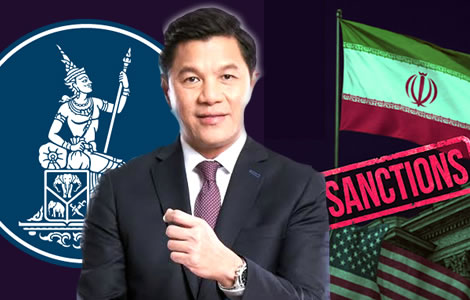
The Bank of Thailand, led by Governor Vitai Ratanakorn, will supervise banks and payment-service providers. It can examine compliance systems and demand stronger controls. It may also pressure institutions to end risky relationships. Its function will be regulatory rather than political.
Thai regulators prepare tighter bank controls while agencies divide oversight of Iranian transactions
Already, the central bank works with the Anti-Money Laundering Office on high-risk countries. Their joint guidance requires stringent checks on ultimate beneficial owners. Financial institutions must use evidence beyond customer-supplied documents. They must also investigate transaction purposes and correspondent-bank relationships.
In December 2024, both agencies said many Thai banks exceeded minimum legal requirements. They also confirmed joint monitoring of high-risk international transactions. Thus, the framework for tighter action already exists. Banks can intensify checks and review existing customer relationships.
The Anti-Money Laundering Office handles suspicious transaction reports. It also investigates possible money laundering and sanctions evasion. Its designated-person lists include an Iran category. Its responsibilities extend to terrorism financing and proliferation financing.
Within that remit, the agency will play a central role in any Iranian network inquiry. Banks can report questionable patterns through established channels. Account activity may then face further investigation. Transactions could also be linked across several institutions.
Other agencies carry narrower responsibilities. The Securities and Exchange Commission will oversee regulated digital-asset operators. Customs and the Department of Foreign Trade will examine goods and controlled technology. The Marine Department and port agencies will handle vessels and maritime services.
Elsewhere, aviation agencies may become involved with aircraft, carriers or technical support. The Ministry of Foreign Affairs would manage diplomatic coordination. The Ministry of Commerce would address trade implications. Their roles would increase following any specific American deadline.
Thai companies face frozen payments and lost banking access as Washington’s sanctions clock starts
Despite that official structure, companies cannot rely on government coordination alone. Each business remains responsible for its counterparties and cargoes. It must also trace every payment route. American enforcement can proceed despite delays inside Bangkok.
From this point, affected Thai companies must identify who owns their trading partners. They must establish which banks handle their money. They must know which vessels carry their goods. They must also determine each cargo’s real origin and destination.
Failure could produce frozen payments and cancelled contracts. Businesses could lose banking facilities or insurance coverage. International partners may terminate relationships to avoid American exposure. Continued significant Iranian dealings could ultimately trigger secondary sanctions.
Deal breakthrough between Iran and the United States as oil ships cross the Strait of Hormuz and new ‘final’ talks begin
Thai Foreign Minister lashes out at the United States over Iran War as ships remain stuck in the Strait
In practical terms, Thai banks will impose the first commercial barriers. The Bank of Thailand and Anti-Money Laundering Office will oversee the domestic response. Exporters, shippers, airlines and digital-asset operators must examine their own networks. Operation Economic Outcast has now started a compliance countdown in Bangkok.
Ultimately, the campaign’s immediate force lies outside Thailand’s criminal law. It rests on dollars, correspondent banks, insurers and international trade channels. Washington has placed those connections directly behind its sanctions threat. For Bangkok’s financial sector, “The clock is ticking.” It is time to close off exposure to the Islamic Republic of Iran.
Join the Thai News forum, follow Thai Examiner on Facebook here
Receive all our stories as they come out on Telegram here
Follow Thai Examiner here
Further reading:
Trump counters Iran with tougher terms and a warning. Tehran now says it does not trust the US
Anxiety about oil supplies and prices as economic growth in 2026 now dependent on the US Iran War