US Navy seizes Iranian ship in Gulf clash after blockade breach, drone retaliation follows as ceasefire nears collapse, oil surges 7.5% and Thai-linked shipping faces rising risk amid fears of renewed all-out war across the Middle East breaking out this week.
The US Navy firing on an Iranian cargo vessel in the early hours of Monday morning, Bangkok time, has confirmed the worst fears of Thai government planners. The naked show of power from the United States comes as Iran publicly denies any intention of attending peace talks scheduled in the coming days in Islamabad. At the same time, Wednesday marks the expiry of a two-week ceasefire. Both the US President and sources in Israel suggest that if no deal is reached within 48 hours, all-out war will resume in the region.
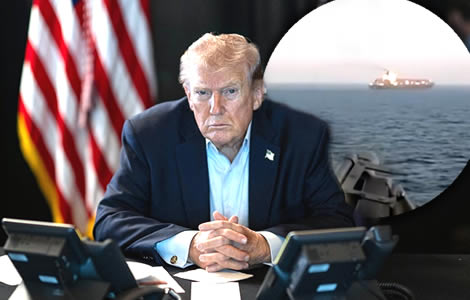
The United States has fired on, disabled, and boarded an Iranian-flagged cargo vessel in the Gulf of Oman, sharply escalating tensions along a critical global shipping route. The action enforced a naval blockade imposed last week by Donald Trump. Consequently, the incident marks a direct confrontation at sea following days of mounting pressure.
According to US Central Command, the guided-missile destroyer USS Spruance intercepted the Iranian vessel Touska as it sailed toward an Iranian port.
Therefore, US forces determined the ship was violating the blockade. Officials stated that repeated warnings were issued over a six-hour period. However, the crew failed to comply with those instructions. As a result, US officers ordered the evacuation of the engine room before opening fire.
US Navy disables Iranian cargo ship after blockade breach as tensions surge in Gulf waters
Subsequently, multiple rounds were fired into the engine compartment to disable the ship’s propulsion system. The strikes created openings that halted movement. Then, US Marines boarded the vessel and took control.
Moreover, the US military confirmed the sequence and described it as an enforcement action under the blockade. Officials also stated that 25 commercial vessels have been turned back since the blockade began. Therefore, maritime traffic in the region is already under strain.
President Trump confirmed the operation in a social media post. He stated that the Touska ignored warnings and attempted to pass through the blockade. Consequently, US naval forces intervened with force. He described the vessel as nearly 900 feet long and comparable in weight to an aircraft carrier. Furthermore, he confirmed that the engine room was targeted to disable the ship.
Meanwhile, Iranian media reported a retaliatory response shortly after the seizure. A drone strike was launched targeting a US warship operating in the same area. However, reports indicate the drone was shot down before impact. There are no confirmed details on casualties or damage. Nevertheless, the exchange highlights the speed at which the situation is escalating.
Thai vessel clears the Strait safely as diplomatic coordination contrasts with sudden military escalation
Earlier, a Thai-owned cargo vessel operated by Siam Cement Group passed through the Strait of Hormuz under coordinated assistance. This movement occurred just hours before the US engagement. However, that passage required diplomatic coordination with both Oman and Iran. At this time, the tension between the two protagonists is immediate and stark.
The Thai Ministry of Foreign Affairs confirmed that the SCG-linked vessel has now exited the Strait safely. This followed direct coordination initiated during a recent visit by Deputy Prime Minister and Foreign Minister Sihasak Phuangketkaew to Oman.
During that visit, which took place from April 15 to April 17, Thai officials requested Oman’s assistance. Specifically, they asked for coordination with Iran to support Thai vessels stranded in the area. As a result, one vessel has departed, although others remain.
Meanwhile, authorities in Bangkok continue to monitor the situation closely. The proximity of the US-Iran confrontation to Thai shipping routes has raised concern. Therefore, officials are assessing risks to both maritime operations and the broader economy. The sequence of events unfolded within hours, moving from coordinated passage to direct military engagement. Consequently, the volatility of the corridor has been clearly exposed.
Ceasefire deadline nears as Iran rejects talks and risks of renewed US-Israel strikes sharply increase
At the same time, the broader geopolitical context remains unstable. The ceasefire between Iran, the United States, and Israel is set to expire on Wednesday. Therefore, the timing of the incident increases the risk of renewed hostilities. Meanwhile, Iran has refused to attend proposed talks in Islamabad scheduled for the coming days. As a result, diplomatic avenues for de-escalation are narrowing.
In the absence of negotiations, military planning is advancing. The United States and Israel may resume coordinated bombing operations targeting Iran’s critical infrastructure. Moreover, US policy continues to demand that Iran abandon any vestige of a nuclear programme. In addition, Washington is seeking an end to proxy warfare across the region.
These proxy groups include the Houthis in Yemen, Hezbollah in Lebanon, and Hamas in Gaza. Consequently, regional tensions remain elevated across multiple fronts. The maritime confrontation in the Gulf of Oman is therefore linked to a wider strategic conflict.
The Strait of Hormuz remains central to these developments. It serves as a key artery for global oil shipments. Therefore, any disruption has immediate economic consequences. Markets reacted quickly to reports of military activity. Oil prices rose by 7.5 per cent on Monday. This increase reflects concerns over supply disruptions and shipping risk.
Oil surge and rising risks highlight economic fallout as conflict threatens the stability of global supply routes
In Thailand, the economic implications are already being assessed. The tourism sector remains vulnerable to global instability. Therefore, a renewed conflict in the Middle East could reduce international arrivals. At the same time, manufacturing faces rising costs linked to higher energy prices. Consequently, supply chains and production planning may be affected.
Consumer confidence is also under pressure. Ongoing geopolitical tensions create uncertainty for households and businesses. As a result, spending and investment may weaken in the near term.
The US blockade represents a significant escalation in policy. It shifts from deterrence to active enforcement at sea. Therefore, direct confrontation with Iranian vessels has become more likely. Iran’s reported drone response reinforces that risk. Moreover, it demonstrates the potential for rapid retaliation.
There are still no confirmed reports of casualties from the latest incidents. However, limited information leaves uncertainty about the full impact. Nevertheless, international observers are monitoring developments closely. Both military and diplomatic channels remain active.
Ceasefire countdown intensifies as military options remain and risks of wider regional conflict rises
The coming days are critical as the ceasefire deadline approaches. Iran’s refusal to attend talks reduces immediate diplomatic options. Therefore, tensions may continue to rise. The United States and Israel remain aligned on key security objectives. Consequently, military options remain under consideration.
Any renewed bombing campaign would likely target infrastructure linked to Iran’s military and nuclear capabilities. Therefore, the potential for further escalation remains high. Shipping activity through the Strait of Hormuz continues under heightened risk. Meanwhile, commercial operators face uncertainty in routing and insurance.
The earlier transit of the SCG vessel demonstrated that coordinated passage remains possible. However, the Touska incident showed that enforcement actions can escalate without warning. This dual pattern now defines the situation in the region. On one side, diplomacy enables movement. On the other hand, military force enforces restrictions.
Bangkok monitors fallout as energy security, tourism risks and market volatility remain in sharp focus
For Bangkok, the priority remains the safety of Thai vessels and crews. Diplomatic coordination continues with regional partners. Meanwhile, authorities are tracking developments in real time. For global markets, attention remains fixed on energy supply and price stability. Consequently, volatility is expected to persist.
State oil firm has plan to stabilise oil prices even if war again breaks out between the United States and Iran
Consumer confidence plummets over US Iran war. Oil prices stay volatile with economic outlook uncertain
The situation remains fluid, with further developments expected. Military actions, diplomatic signals, and market reactions continue to evolve. Therefore, the risk of escalation remains present as the deadline for the ceasefire draws closer.
Indeed, US President Donald Trump has strongly suggested there will be no extension of the ceasefire, which expires on Wednesday. Furthermore, Israeli sources are strongly suggesting that the war will resume to force Tehran’s acceptance of rigid US terms designed to ensure the safety of the region, and in particular the Israeli state.
Join the Thai News forum, follow Thai Examiner on Facebook here
Receive all our stories as they come out on Telegram here
Follow Thai Examiner here
Further reading:
Anxiety about oil supplies and prices as economic growth in 2026 now dependent on the US Iran War
US Ambassador Seán O’ Neill briefed Prime Minister Anutin Charnvirakul at Government House on War
Visa waivers, discounted hotel stays and 2,000 baht a person per day for stranded tourists announced