Hormuz erupts as Iran fires on ships as the US blockade tightens, sending oil markets into chaos. PTT Plc vows to secure a reliable supply. Nonetheless, Thailand’s economy has been left reeling as prices surge, inflation rises and factory closures spike amid a deepening international crisis.
As naval hostilities and gunfire erupted around the Strait of Hormuz on Saturday, the state oil conglomerate PTT Plc unveiled plans to diversify Thailand’s crude oil sourcing if the US-Iranian war erupts again next week. On Saturday, this appeared increasingly likely as a war of words intensified between Washington and Tehran, while Iranian forces attacked ships in the tense Strait of Hormuz. Thailand’s economy has been left reeling since the war erupted on February 28th, with higher government borrowing, elevated inflation, and a sharp rise in factory closures.
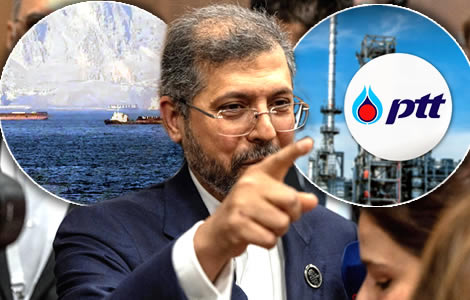
PTT Plc, the vast Thai state oil conglomerate, moved to secure Thailand’s energy supply as Iranian forces opened fire on vessels in the Strait of Hormuz on Saturday night. At the same time, the company confirmed it can guarantee full access to oil and gas even if the strait is closed.
The twin developments emphasise a sharp escalation in both military and economic risk. Meanwhile, maritime security deteriorated sharply on Saturday in one of the world’s most critical energy corridors.
Earlier, Iranian forces targeted multiple commercial vessels operating in or near the strait. The incidents included an Indian oil tanker and several cargo ships. In addition, maritime sources reported sustained gunfire during the attacks.
Iranian attacks on ships escalate tensions in the Strait of Hormuz as maritime security rapidly deteriorates
Furthermore, the United Kingdom Maritime Trade Operations confirmed that two Iranian gunboats opened fire on a tanker. Separately, a container ship was struck by an unidentified projectile near Oman’s northeastern coast.
As a result, several containers were damaged during the incident. Moreover, at least two merchant vessels reported being hit by gunfire while attempting to transit the strait.
Shortly before the attacks, Iranian authorities issued a direct warning on navigation. They stated that the strait would again be closed to commercial traffic. Moreover, they warned that any vessel approaching the waterway would be treated as cooperating with hostile forces.
Consequently, the Islamic Revolutionary Guard Corps ordered ships to remain at anchorage. It stated that no vessel should move within the Persian Gulf or the Sea of Oman. The restriction will remain until the United States lifts its naval blockade of Iranian ports.
US blockade of Iranian ports drives escalation as Tehran halts Strait access and restricts vessel movement
Hours earlier, the United States had reaffirmed that blockade. US President Donald Trump said it would remain in force until a peace deal is signed with Tehran. The measure has been enforced since April 13. In response, Iran described the blockade as a violation of the current ceasefire arrangement.
Therefore, Tehran said it would halt any reopening of the strait while the blockade continues. According to US officials, 23 vessels have already been turned away under enforcement measures.
At present, a two-week ceasefire remains in place. However, it is due to expire on April 22. Donald Trump said on Saturday that he may not extend it. At the same time, he stated that discussions with Tehran are ongoing.
He described those discussions as progressing well. However, no agreement has yet been reached between the two sides. Consequently, uncertainty continues to dominate the diplomatic landscape.
Iran rejects direct US talks, citing maximalist demands. Uncertainty surrounds possible Islamabad meeting
In contrast, Iranian officials have signalled resistance to direct negotiations. Deputy Minister of Foreign Affairs Saeed Khatibzadeh, on Saturday, said Tehran is not ready for face-to-face talks. He cited what he described as maximalist demands from Washington.
Furthermore, he rejected claims regarding enriched uranium transfers. He said Iran would not hand over such material under any circumstances. Additionally, the fiery minister of the isolated regime suggested further demands. He stated that Iran requires a framework agreement before direct talks can begin. Mr. Khatibzadeh also called on the United States to address core concerns, including sanctions.
Meanwhile, diplomatic contacts are continuing behind closed doors. There are suggestions that talks could take place in Islamabad on Monday. However, both sides have indicated that such a meeting may not occur.
As a result, the path toward de-escalation remains unclear. The combination of military escalation and stalled diplomacy has increased uncertainty across global markets.
Strait of Hormuz closure drives global oil prices, hitting Thailand’s economy with inflation and closures
The Strait of Hormuz remains central to the crisis. It normally carries about 20% of global oil and liquefied natural gas shipments. Therefore, any disruption has immediate global consequences. Recently, vessel traffic through the strait has declined sharply.
Tracking data shows that only limited movement occurred during brief reopening periods. Consequently, several ships were forced to reroute or delay transit.
The current conflict began on February 28. On that date, the United States and Israel launched strikes on Iran. Since then, maritime security conditions have steadily deteriorated. As a result, global oil prices have surged during the crisis. At several points, prices exceeded $100 per barrel. This reflects both supply risks and reduced shipping volumes.
In turn, the economic impact has spread beyond the Middle East. Thailand is among the countries most affected. The country depends heavily on imported oil. Specifically, rising oil prices are feeding inflationary pressure. At the same time, disrupted shipping is affecting supply chains and trade flows. Together, these factors are slowing economic activity.
Data shows a 58% rise in Thai factory closures during early 2026. This increase reflects higher energy costs and reduced production output. Meanwhile, inflation is projected to rise to at least 3.5%. This follows a previous contraction of 0.54% before the conflict. Therefore, the shift highlights the scale of economic disruption.
PTT accelerates oil diversification plan to cut Middle East reliance and secure Thailand’s energy supply stability
At the outset of the crisis, Thailand sourced 51% of its oil from the Middle East. This included imports from Iran. Consequently, the current disruption has exposed structural vulnerabilities in energy supply. In response, PTT Plc has activated a detailed contingency plan.
Under normal conditions, about 70% of Thailand’s crude oil imports come from the Middle East. However, PTT is prepared to reduce that share to 30% if the conflict escalates further. Instead, it will increase imports from alternative regions. These include the United States, South America, and Africa. Together, these sources could account for more than 60% of the total supply.
Moreover, PTT emphasised its extensive global supplier network. The company works with more than 1,600 partners across 80 countries. This allows rapid sourcing of crude oil in emergency conditions.
At the same time, its international trading unit monitors global oil markets continuously. It tracks price changes and supply disruptions in real time. In addition, it uses forward contracts to manage exposure to volatility.
Alternative routes and real-time tracking ensure oil supply continuity despite Strait of Hormuz disruptions
To mitigate transport risks, PTT has identified alternative shipping routes. These routes bypass high-risk areas near the conflict zone. For example, the company can receive oil via Yanbu in Saudi Arabia. It can also use Fujairah in the United Arab Emirates. Therefore, shipments can continue even if key waterways are restricted.
Furthermore, PTT has deployed real-time vessel tracking technology. This system monitors tanker movements continuously across global routes. As a result, the company can respond immediately to disruptions. The system provides full visibility over cargo status. Consequently, operational decisions can be made without delay.
PTT has also sought to reassure consumers. It stated there is no need for concern over shortages. The company confirmed that reserves are sufficient to meet national demand. Nevertheless, the broader situation remains volatile.
Ongoing US-Iran standoff fuels market anxiety as ceasefire deadline nears and global energy risks intensify
Military actions continue alongside uncertain diplomatic efforts. The approaching ceasefire deadline adds further pressure on both sides. Iran continues to link its actions to US policy. Meanwhile, the United States maintains its blockade strategy. As a result, both sides remain entrenched.
Consumer confidence plummets over US Iran war. Oil prices stay volatile with economic outlook uncertain
Anxiety about oil supplies and prices as economic growth in 2026 now dependent on the US Iran War
The events of Saturday night mark a significant escalation in the conflict. Direct attacks on vessels have increased operational risk for global shipping. Consequently, energy markets remain on edge. At the same time, the closure of the strait has intensified supply concerns worldwide.
For now, the Strait of Hormuz remains the focal point of the crisis. Its status continues to shape global energy supply and pricing. Meanwhile, countries such as Thailand are moving quickly to contain the economic fallout.
Join the Thai News forum, follow Thai Examiner on Facebook here
Receive all our stories as they come out on Telegram here
Follow Thai Examiner here
Further reading:
Anxiety about oil supplies and prices as economic growth in 2026 now dependent on the US Iran War
US Ambassador Seán O’ Neill briefed Prime Minister Anutin Charnvirakul at Government House on War
Visa waivers, discounted hotel stays and 2,000 baht a person per day for stranded tourists announced