Thai foreign minister blasts US as Hormuz blockade traps ships, drives up fuel costs, and forces Bangkok to seek help from China and Russia amid deepening fallout from Iran war.
Thailand’s foreign minister has delivered a rare, blunt rebuke of the United States, warning that an American blockade in the Strait of Hormuz has trapped Thai vessels, driven up energy and fertiliser costs, and pushed Bangkok to seek urgent help from China and Russia. Speaking in Krabi while hosting Chinese Foreign Minister Wang Yi, Sihasak Phuangketkeow pointed to mounting economic damage from the US-linked war with Iran, criticised Washington for failing to respond, and signalled a shift in Thailand’s geopolitical stance as uncertainty over US policy deepens and key trade routes remain under strain.
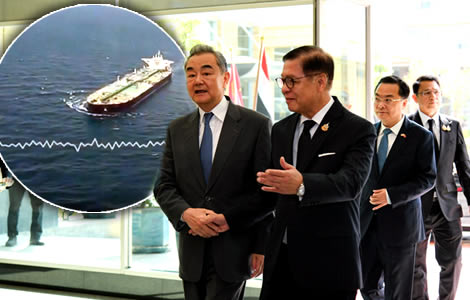
Thailand’s foreign minister delivered unusually pointed criticism of the United States while hosting China’s top diplomat in the Andaman Sea province of Krabi, a setting that contrasted with the tone of his remarks.
As he received Chinese Foreign Minister Wang Yi, Sihasak Phuangketkeow raised concerns over blocked Thai shipping. At the same time, he detailed widening economic damage linked to the war involving the United States and Iran.
Earlier, he described Thailand’s immediate difficulty in moving vessels through a critical global route. “We asked China for help to get our 8 ships through Hormuz, and they told us they are struggling to free 70 of their own ships,” he was quoted as saying by The War Reporter.
Thai minister raises alarm over blocked ships in Hormuz and growing economic strain at Krabi meeting
As a result, Thai vessels have been unable to pass through the Strait of Hormuz. According to the report, an American blockade on the seaway has restricted access. Consequently, supply lines have tightened, and costs have increased.
Meanwhile, the comments were reinforced in an interview with The Washington Post published on Monday. The interview took place in Krabi during Mr Wang’s visit. In that setting, Mr Sihasak broadened his criticism of Washington.
“This war should not have taken place,” he said. He repeated the position in direct terms. “Our position is that this war should not have taken place in the first place,” he added. “We don’t want to condemn the US directly. But this is something that should not have started.”
At the same time, he linked the conflict to rising economic strain in Thailand and across Southeast Asia. Fuel and fertiliser prices have increased sharply. These increases follow disruption to shipping routes in the Middle East. Consequently, economies reliant on imported energy and agricultural inputs have been heavily affected. As a result, the impact has been immediate and widespread.
Sihasak criticises Washington’s response and outlines Thailand’s turn to China and Russia
However, Mr Sihasak criticised the United States for failing to respond to these consequences. He said Washington had not engaged directly with Bangkok. “I think they’re aware that there are consequences from the war,” he said, referring to US officials. “But they haven’t come out to talk to us about how they can help.” Moreover, he described a lack of direct outreach. “They haven’t approached us directly, saying, ‘Oh, we understand that you have to endure the impact, and we can help you out,’” he added.
As pressure has mounted, Thailand has turned to alternative partners. Mr Sihasak confirmed that Bangkok has approached both China and Russia. These efforts are aimed at easing supply constraints and stabilising costs.
In parallel, Agriculture Minister Suriya Jungrungreangkit travelled to Moscow to secure fertiliser supplies. At the same time, Thailand is attempting to procure Russian crude oil. However, these efforts face constraints. Thai banks have raised concerns about potential violations of US sanctions. As a result, progress on energy transactions has slowed.
Minister warns of prolonged disruption, shifting US policy and uncertain outlook for regional trade routes
Meanwhile, Mr Sihasak has also engaged with Middle Eastern partners. He travelled to Oman to advocate for safe passage through the Strait of Hormuz. However, he said discussions there offered little optimism. He indicated that prospects for a ceasefire remain uncertain. As a result, disruption to shipping routes may continue in the near term.
In addition, Mr Sihasak pointed to broader concerns with US policy direction. “There’s a lot of unpredictability in the US government policy,” he said. He noted that US objectives in the conflict have shifted. At one stage, the focus appeared to be regime change.
PM said to be considering a petrol station curfew in Thailand. Fears it may dent consumer confidence
Three Thai seamen were killed aboard the Mayuree Naree when Iran crippled the vessel on March 11th last
More recently, attention has turned to Iran’s nuclear programme. Moreover, he referred to wider US actions, including tariff measures and cuts to aid programmes. According to Mr Sihasak, such actions have created uncertainty among allies.
In contrast, he described China as more consistent in its approach. “It doesn’t mean that China doesn’t also behave as a superpower when it comes to core interests, right?” he said. “But we know what those core interests are.”
However, he emphasised that Thailand is not aligning itself with any side. “This is not about us taking sides in the geopolitical competition,” he said. Instead, he framed the response as a direct reaction. “It’s about what the US is doing, which is forcing us to rethink some relationships.”
Join the Thai News forum, follow Thai Examiner on Facebook here
Receive all our stories as they come out on Telegram here
Follow Thai Examiner here
Further reading:
PM said to be considering a petrol station curfew in Thailand. Fears it may dent consumer confidence
Anxiety about oil supplies and prices as economic growth in 2026 now dependent on the US Iran War
US Ambassador Seán O’ Neill briefed Prime Minister Anutin Charnvirakul at Government House on War