Toyota publicly denies plans to leave Thailand as Indonesia targets its factories and suppliers. Meanwhile, CP moves to abandon the ฿224.5 billion three-airport railway without laying a track, leaving Anutin fighting two major economic fires at once.
Prime Minister Anutin Charnvirakul faces two stark tests of Thailand’s economic credibility as pressure mounts on industry and infrastructure. Indonesia is courting Toyota and its supplier network while Bangkok scrambles to answer Japanese demands for fairer vehicle taxes. Meanwhile, CP Group’s consortium wants to abandon the ฿224.544 billion three-airport railway before construction has even started. The clash threatens Airport Rail Link services after September 30 and leaves Anutin fighting to protect two pillars of Thailand’s economic future.
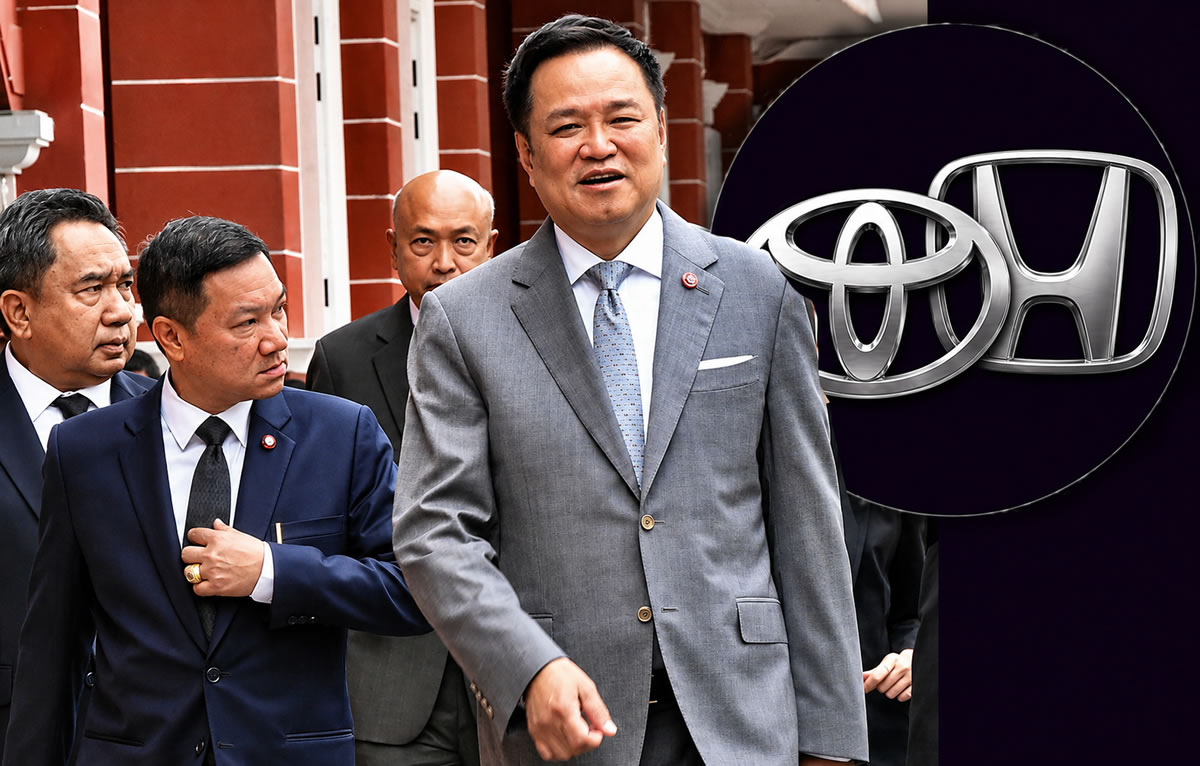
Prime Minister Anutin Charnvirakul begins the week with two major problems threatening Thailand’s long-term economic plans. Toyota faces renewed questions about its future production base. Separately, CP Group’s railway consortium wants to surrender a landmark government contract. Both disputes concern investment, manufacturing capacity and confidence in Thailand’s economic direction.
First, reports continue circulating that Toyota could shift future operations away from Thailand. The company denies planning a withdrawal. Even so, Indonesia has publicly invited Toyota to transfer its principal regional manufacturing operations. Jakarta also wants Toyota’s extensive supplier network.
On another front, the three-airport high-speed railway remains unbuilt almost seven years after contracting. The CP Group-led consortium has reaffirmed its request to terminate the agreement. Construction has never started. The dispute could also disrupt Airport Rail Link operations after September 30.
Anutin sends Toyota fears to finance chief as Indonesia courts the Japanese carmaker and suppliers
Mr Anutin addressed the Toyota reports at Government House on Friday, August 28. He said Finance Minister Ekniti Nitithanpraphas had prepared a response. In response, the Prime Minister directed detailed questions to Mr Ekniti. He did not disclose the plan himself.
At the same time, Mr Anutin ordered Mr Ekniti to coordinate meetings with Japanese business representatives. Those discussions could occur during the Prime Minister’s forthcoming visit to New York. He is expected to attend the United Nations General Assembly. The exact business schedule remains unconfirmed.
Later that day, Mr Anutin was scheduled to have lunch with the Japanese Ambassador to Thailand. That meeting would also cover preparations for Mr Anutin’s planned Japanese visit. In parallel, the government is reviewing vehicle taxes and industrial incentives. Japanese investment remains central to Thailand’s manufacturing economy.
The current concern followed an unusually direct offer from Indonesia. On August 4, Indonesian Finance Minister Purbaya Yudhi Sadewa publicly courted Toyota. He invited the company to move its main Southeast Asian manufacturing operations from Thailand. He also promised whatever incentives Toyota required.
Notably, Mr Purbaya extended the invitation beyond Toyota’s assembly plants. He called for component manufacturers and supporting industries to follow. These include steel, electronics, chemicals and automotive parts. His offer therefore targeted much of Toyota’s Thai production network.
Indonesia targets Toyota and its supplier network as Japanese carmakers demand fairer Thai taxes
For its part, Indonesia wants to reduce imported automotive components. It also wants to become Southeast Asia’s leading vehicle manufacturing centre. The country has more than 280 million residents. Accordingly, its domestic market offers considerable room for vehicle sales and investment.
Toyota already produces vehicles in Indonesia. In addition, it is discussing a possible Indonesian bioethanol project. Still, Toyota Motor Thailand has reaffirmed its commitment to the kingdom. No transfer decision has been announced.
Toyota Motor Thailand Senior Vice-President Supakorn Rattanavaraha said the company was not preparing to leave. Crucially, that assurance came with demands for policy changes. Toyota wants fairer tax treatment for locally manufactured vehicles. It also wants changes covering imported electric vehicles.
Honda has raised similar concerns about Thailand’s tax structure. Like Toyota, Honda has maintained factories and supplier relationships inside Thailand for decades. Together, Japanese manufacturers helped build the kingdom’s automotive production system. Today, that position faces heavy pressure from Chinese electric vehicle companies.
Over recent years, Thailand has offered substantial incentives to Chinese manufacturers. These packages include tax advantages, investment privileges and consumer subsidies. As a result, Chinese brands have rapidly increased their domestic market share. Several have also opened major Thai production plants.
Japanese carmakers face Chinese EV pressure as Thai output falls and household debt crushes demand
By contrast, established Japanese manufacturers carry the costs of older factories and extensive local networks. They employ Thai workers and purchase parts from domestic suppliers. Their representatives have questioned the treatment of fully built Chinese electric vehicles. Some imports receive favourable treatment under existing arrangements.
Against this backdrop, Toyota and Honda have demanded revisions to excise taxes and import duties. Their intervention follows a severe decline across Thailand’s automotive industry. Annual production has fallen by more than 400,000 vehicles since 2022. Domestic demand and several export segments have weakened.
At home, high household debt has damaged purchasing power. Thai banks have also tightened lending requirements for vehicle buyers. Consequently, many consumers cannot secure financing for cars or pickup trucks. Factories have responded with lower output and adjusted production plans.
Meanwhile, Chinese electric vehicle companies have entered the weakened market with aggressive pricing. Government subsidies have reduced prices for qualifying models. Tax measures have further supported the transition towards battery-powered transport. Japanese manufacturers have consequently faced rising pressure across several vehicle segments.
Thailand prepares tax changes to defend local factories as Toyota and Honda demand a fairer regime
Despite that pressure, Thailand remains an important centre for one-tonne pickup trucks. That segment continues supporting factory output and export activity. Elsewhere, passenger vehicle sales and exports remain weak. Honda has already consolidated Thai vehicle production at its Prachinburi plant.
More broadly, other Japanese manufacturers have adjusted employment, output and investment plans. Indonesia’s Toyota invitation therefore landed during a period of industrial retrenchment. However, no evidence confirms an imminent Toyota departure. The reports reflect regional competition, weaker Thai production and Toyota’s policy demands.
In response to those demands, the government is preparing changes favouring genuine domestic manufacturing. Mr Ekniti plans lower excise rates for companies operating substantial Thai factories. The proposed rates would also reward locally sourced parts and raw materials. Fully built imports would face higher rates.
As part of this effort, officials are considering lower duties on imported production components. The Finance Ministry expects to finalise the excise changes during September. These measures would reduce costs for manufacturers retaining Thai plants. They would also address complaints from Toyota and Honda.
Toyota’s vast Thai network anchors 13,000 jobs, but Indonesia competes for its future investment
The National Economic and Social Development Council remains confident Toyota will stay. In support, it points to Thailand’s extensive supplier network and experienced workforce. Toyota has operated in the kingdom for more than six decades. It currently runs three plants and employs approximately 13,000 people.
Beyond those jobs, Toyota supports numerous component producers, contractors and logistics businesses. Thailand also has ports, roads and export systems supporting large-scale vehicle production. Replicating that network would require major investment and considerable time. A complete and immediate transfer would therefore be difficult.
Yet the government’s concern extends beyond existing factories. Vehicle manufacturers distribute new models and technologies across several countries. Future investment could involve engines, batteries, electric vehicles or research facilities. Thailand must therefore compete for each new allocation.
In practice, Toyota could maintain current Thai factories while expanding Indonesian investment. Such expansion would not automatically represent a Thai withdrawal. Nonetheless, it could redirect additional capacity and new technology. Toyota has announced no such allocation.
For now, Toyota has disclosed no plan to close its three Thai plants. Its public position remains supportive of continued operations. Simultaneously, it is pressing Bangkok for a fairer tax regime. Indonesia’s offer has sharpened the importance of those negotiations.
CP-led consortium renews bid to quit three-airport railway as Airport Rail Link deadline approaches
The railway dispute presents a more immediate contractual crisis. Asia Era One has reaffirmed its request to end the three-airport high-speed railway agreement. The consortium is led by the Charoen Pokphand Group. Its request arrived before any construction began.
Initially, Asia Era One sent a termination notice to the State Railway on July 6. The company invoked provisions covering unresolved contractual obligations. At that stage, it denied immediately cancelling the project. Instead, it said the letter preserved its contractual rights.
The State Railway later asked Asia Era One to withdraw the notice. Rather than complying, the company sent another letter in August. That letter reaffirmed its wish to terminate the agreement. The second move hardened the consortium’s position.
More urgently, the request extends to temporary Airport Rail Link operations. Asia Era One has indicated it may stop running the service after September 30. The line connects central Bangkok with Suvarnabhumi Airport. Thousands of passengers depend upon its daily operation.
To prevent disruption, Deputy Transport Minister Siripong Angkasakulkiat has ordered urgent negotiations. The State Railway is also preparing to assume operations. Such a takeover would require staff, technical arrangements and operating funds. Responsibility for those costs remains unsettled.
Anutin warns CP cannot easily abandon state contract or escape higher replacement costs and penalties
Mr Anutin addressed the contract dispute at Government House on August 28. He said he had not received every detail. For clarification, he will summon Eastern Economic Corridor Policy Committee Secretary-General Chula Sukmanop. That meeting is expected this week.
According to Mr Anutin, several project matters still require government action. Other proposals have received Eastern Economic Corridor committee approval. Some are also being prepared for legal consideration. Nevertheless, he rejected suggestions that the contractor could simply leave.
In particular, Mr Anutin warned that government contracts cannot be cancelled easily. Possible consequences include blacklisting and findings of project abandonment. The contractor could also face liability for additional procurement costs. Those costs could arise through a replacement tender.
For example, a new contractor could demand a higher price. Under procurement regulations, the departing contractor could face responsibility for the difference. The precise liability would depend upon the contract and termination grounds. Any established government failures would also require consideration.
Anutin calls EEC chief as State Railway faces strict procurement rules over CP’s disputed contract
Mr Anutin described his immediate position directly.
“I think this isn’t something that can be done easily. I’ll invite the EEC Secretary-General to meet with me first. But actually, the contracting party should also be the State Railway of Thailand, which is an agency under the Ministry of Transport and must follow the Prime Minister’s Office regulations on procurement,” said Mr Anutin.
Legally, the State Railway remains the government contracting party. The agency operates under the Ministry of Transport. Thus, it must handle the dispute through procurement rules and the partnership agreement. It must also maintain uninterrupted Airport Rail Link services.
The railway dates from a Cabinet approval issued in March 2018. Soon afterwards, bidding began under the Eastern Economic Corridor development programme. A consortium led by CP Group won the competition. The government approved its proposal in May 2019.
Alongside CP Group, the consortium included four major partners. They were Ch. Karnchang, Bangkok Expressway and Metro, Italian-Thai Development and China Railway Construction Corporation. Subsequently, the State Railway and the consortium signed the agreement. The signing took place on October 24, 2019.
฿224 billion railway promised 250 km/h links across eastern Thailand but construction never started
Under its terms, the agreement created a 50-year concession. Five years were allocated for construction. Another 45 years covered commercial operations. Almost seven years later, main construction has not started.
The planned railway carries an investment value of ฿224.544 billion. Its 220-kilometre route would connect Thailand’s three principal eastern airports. Those airports are Don Mueang, Suvarnabhumi and U-Tapao. The service would also reach several major urban and industrial centres.
Specifically, the route would serve Bangkok, Chachoengsao, Chonburi, Si Racha and Pattaya. Trains were designed to reach 250 kilometres per hour. The project would incorporate the existing Airport Rail Link. That line currently runs between Phaya Thai and Suvarnabhumi.
Northwards, new track would extend from central Bangkok to Don Mueang Airport. Eastwards, another section would run from Lat Krabang to U-Tapao. This route would cross the core Eastern Economic Corridor provinces. It was designed to connect factories, cities and aviation projects.
Additionally, the agreement included development rights over State Railway land. Those rights covered valuable sites at Makkasan and Si Racha. The project therefore combined rail construction, passenger operations and commercial property development. The government promoted it as the corridor’s transport backbone.
Asia Era One seeks new payment terms after paying only 10% of ฿10.671 billion Airport Rail Link fee
Financially, Asia Era One accepted responsibility for financing and building the railway. The government would contribute approximately ฿117 billion towards eligible construction costs. Under the original terms, payments would begin after the completed railway opened. Initial construction and financing risks therefore rested with the consortium.
That condition formed an important part of the competitive tender. Every bidder prepared its offer under the same payment requirements. Asia Era One accepted those terms when it won. Years later, it requested a fundamentally different payment structure.
Separately, Asia Era One had to pay ฿10.671 billion for Airport Rail Link operating rights. The full payment became due on October 24, 2021. Importantly, the company did not pay the entire fee. It paid only a 10% deposit of approximately ฿1.067 billion.
At the time, Asia Era One cited the coronavirus pandemic. Airport Rail Link passenger numbers had collapsed during travel restrictions. Fare income therefore fell far below earlier forecasts. The company requested permission to pay the remaining fee through instalments.
Following that request, Asia Era One began operating the Airport Rail Link under a temporary memorandum. The State Railway never formally transferred the operating rights. Under this arrangement, Asia Era One carried operating expenses and paid interest. Fare revenue continued returning to the State Railway.
COVID crisis, delayed land and route conflicts leave three-airport railway without construction notice
In effect, the temporary arrangement did not complete the original transfer. Even so, it has continued for almost five years. The memorandum now approaches its September 30 expiry. Asia Era One’s termination move places the service under immediate pressure.
The wider high-speed project faced trouble soon after signing. To begin with, the coronavirus crisis destroyed passenger forecasts and altered commercial assumptions. International travel restrictions reduced airport traffic. Airport Rail Link revenue also fell sharply.
Commercially, expected passenger, property and development income became less certain. The State Railway then struggled to deliver an entirely construction-ready route. Problems involved land acquisition, public utilities and encroaching structures. Other railway projects also conflicted with the proposed alignment.
According to the State Audit Office, some land arrangements suffered major delays. Several handover matters ran approximately two years and eight months late. Problems also remained around the Prachasuk 6 community. Parts of the route therefore missed the original delivery timetable.
Compounding matters, changes at U-Tapao Airport affected the planned station and railway alignment. Overlapping railway construction around Don Mueang created another obstacle. The government says most of the 220-kilometre corridor was eventually delivered. Still, the formal construction notice never arrived.
Funding failure drives ‘build and pay’ demand that would shift construction risk towards the state
Without that notice, Asia Era One could not begin the principal building works. Costs also increased following COVID-19 and the Russia-Ukraine war. Materials, labour, imported rail systems and financing became more expensive. The original financial calculations consequently weakened.
On financing, Asia Era One failed to secure sufficient project backing. Banks required certainty over land delivery, contractual terms and investment privileges. The consortium’s Board of Investment promotion certificate expired during negotiations. Asia Era One says a valid replacement remains necessary.
Facing those conditions, the consortium sought major changes to the financial structure. Its central proposal became known as “build and pay.” Under the signed agreement, state contributions would follow completion and opening. The proposed amendment would release government money during construction.
Under the revised model, payments would follow verified building progress. The state would therefore pay before receiving a completed railway. Asia Era One also requested seven instalments for the outstanding Airport Rail Link fee. These changes would reduce its immediate financing burden.
From a procurement standpoint, the proposals raised serious questions. Other bidders competed under completion-based payment rules. The successful consortium accepted those rules when securing the project. Revised financial terms would therefore differ from the original competition.
Years of talks fail as 2028 construction plan gives way to termination and unresolved liabilities
Equally important, the amendments would transfer more financing risk to the state. Successive governments nevertheless continued negotiations with Asia Era One. Proposals circulated among the State Railway and Eastern Economic Corridor Office. They also reached the Attorney General, Cabinet and supervisory bodies.
After repeated reviews, no final amendment emerged. The promised construction schedule moved several times. Most recently, work was proposed to begin during 2028. Passenger services were then targeted for 2031.
Before that programme received final approval, Asia Era One moved towards termination. In May 2026, it formally listed continuing obstacles for the State Railway. These included delayed land delivery and increased construction costs. The company also cited the expired investment promotion certificate.
Furthermore, Asia Era One pointed to the missing construction notice. It then issued its first termination letter on July 6. The State Railway attempted to preserve negotiations. By August, however, the consortium had reaffirmed its withdrawal request.
A straightforward separation remains unlikely because both parties face unresolved obligations. The government argues that termination requires mutual agreement or another recognised process. Alternatively, a court could determine the contract’s status. A formal finding of default could also settle responsibility.
Financially, the parties must resolve the unpaid Airport Rail Link rights fee. Interest, operating expenses and consortium expenditure also require settlement. In addition, responsibility for delayed land delivery remains disputed. The missing construction notice and expired investment certificate require similar decisions.
Government weighs costly alternatives as CP and state face claims over the failed railway contract
Should the consortium be found responsible, its guarantees could be affected. Participating companies could also face restrictions on future government tenders. Conversely, the state could face claims over failures preventing construction. The contract and supporting evidence will determine liability.
The government now faces several costly options. It could amend the existing agreement and retain Asia Era One. Alternatively, it could accept termination and begin another tender. Officials have also considered replacing high-speed rail with a cheaper conventional system.
Any new tender could consume several more years. Moreover, a replacement contractor could demand a higher price. A conventional railway would require new designs, approvals and financing. None of those options offers an immediate start.
Toyota reaffirms its commitment to Thailand after tax relief move and amid a courtship from Indonesia
GDP fall for Thailand’s flagship Eastern Economic Corridor project since the COVID-19 crisis began
As matters stand, no high-speed tracks have been built under the 2019 contract. The Airport Rail Link arrangement also approaches its September 30 deadline. Toyota, meanwhile, wants rapid changes to Thailand’s industrial policies. Indonesia openly wants its investment and supplier network.
Taken together, the two disputes place Mr Anutin under immediate economic pressure. One concerns Thailand’s largest vehicle manufacturer and its future investment. The other concerns a ฿224.544 billion railway still trapped before construction. Both now require government decisions.
Join the Thai News forum, follow Thai Examiner on Facebook here
Receive all our stories as they come out on Telegram here
Follow Thai Examiner here
Further reading:
Khon Kaen Police probing a pre dawn blaze caused by a charging EV that burned down a family home
Government sends strong warning to EV industry after a dramatic surge in consumer complaints
Thaksin wants higher excise duties on EV cars that are simply assembled in Thailand by Chinese firms