Thai firm at the centre of a US technology crackdown linked to the Jensen Huang scandal. Washington blacklists Megaspeed as Nvidia blocks server shipments to Southeast Asia. Thailand’s trillion-baht digital investment boom faces a major American roadblock.
A Thai firm is at the centre of a dramatic Washington crackdown threatening to derail Southeast Asia’s booming data centre industry. On Monday, November 23, the United States blacklisted Bangkok-based Megaspeed (Thailand) Co., Ltd. over suspected chip diversion to China. The Megaspeed group previously employed Alice Huang, a suspected Chinese intelligence operative reportedly involved in an affair with Nvidia chief Jensen Huang. Beijing denies the espionage accusations. By Thursday, Nvidia had reportedly halted advanced server shipments to Thailand, Malaysia, Singapore and Indonesia. Suddenly, Thailand’s ฿1.175 trillion digital investment boom faces a formidable American roadblock. Already, banks have reportedly frozen $500 million in financing for a Malaysian project involving TikTok owner ByteDance. Meanwhile, Fitch Ratings warns of a regional investment slowdown. Billions in proposed Thai developments face potential delays or cancellation as Washington tightens its technological blockade against China.
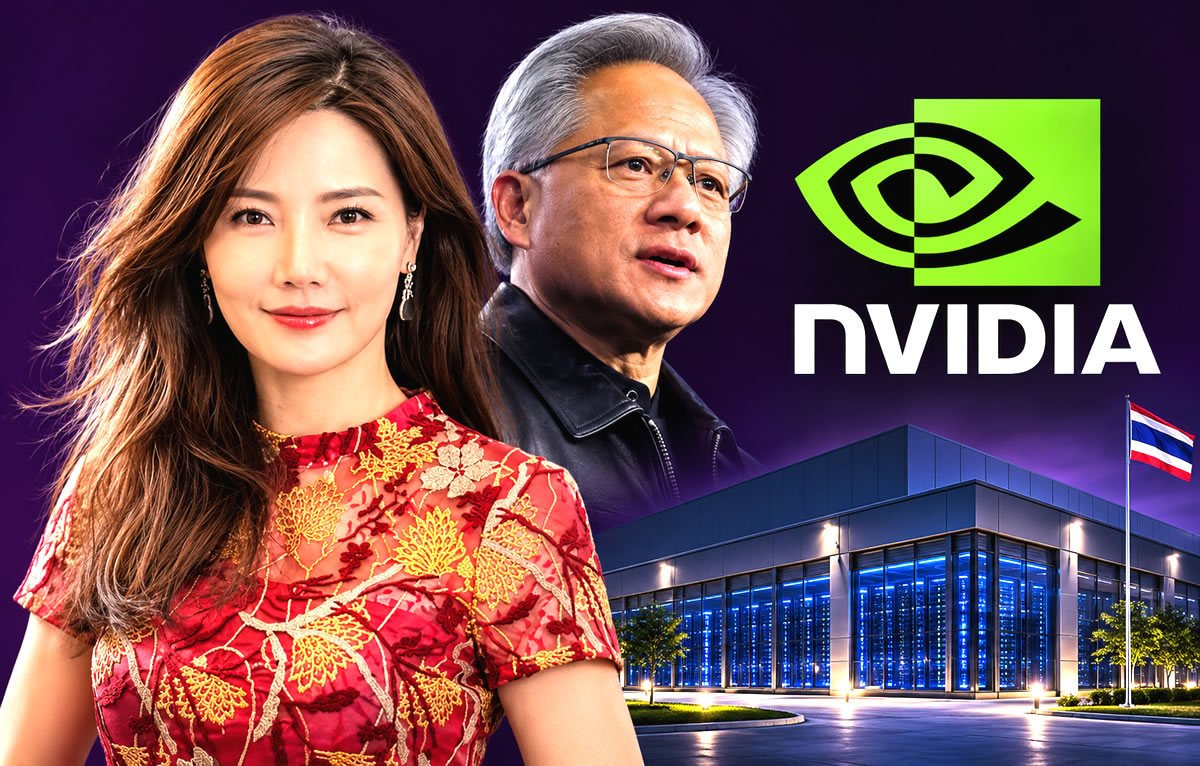
Thailand’s trillion-baht digital investment boom faces a major threat after American semiconductor giant Nvidia halted server shipments to Southeast Asia. On Thursday, November 26, international sources revealed that Nvidia had instructed manufacturing partners to suspend deliveries to four countries.
These include Thailand, Malaysia, Singapore and Indonesia. The decision follows sweeping export restrictions imposed by United States President Donald Trump’s administration. Crucially, Washington is targeting Chinese technology companies accessing advanced American artificial intelligence (AI) processors through overseas data centres.
American server manufacturers Dell and Supermicro have informed customers across the four countries that Nvidia will not authorise shipments. Both companies incorporate Nvidia’s advanced semiconductor technology into powerful computing servers.
Nvidia shipment suspension threatens Thailand’s ฿1.175 trillion digital investment pipeline and financing
As a result, orders placed by Southeast Asian customers cannot proceed. International sources cited three individuals familiar with the shipment suspension.
However, its duration remains undetermined as manufacturers address Washington’s new compliance requirements. Neither Nvidia, Dell nor Supermicro immediately responded to requests for comment outside regular business hours on Thursday.
The intervention threatens an industry driving unprecedented growth in Thailand’s foreign investment applications. During the first nine months of 2026, the country’s digital sector attracted proposed investments worth ฿1.175 trillion.
That represented 68.8% of all investment applications received by Thailand’s Board of Investment (BOI). Significantly, Washington’s restrictions raise the prospect of major developments being postponed, restructured or cancelled altogether. Projects already under construction could also encounter difficulties securing essential equipment and drawing down committed financing.
Fitch warns of slower Asian data centre investment as Chinese customer contracts come under pressure
On Thursday, international credit ratings agency Fitch Ratings issued a stark warning over the American restrictions. The agency expects data centre investment across the Asia-Pacific region to slow.
In particular, Fitch identified businesses dependent on Chinese customers and advanced American semiconductor technology as vulnerable. International lenders must examine whether existing commercial arrangements comply with Washington’s regulations.
Meanwhile, prospective investors face uncertainty over equipment deliveries, customer eligibility and the availability of financing.
Fitch expects investment decisions across the region to become increasingly selective. Projects with dependable semiconductor supplies and diversified international customers will be better positioned to attract capital.
By contrast, specialist computing providers serving Chinese technology companies face mounting financial pressure. These businesses purchase expensive artificial intelligence processors before renting computing capacity to technology developers.
Their operations depend heavily on maintaining high equipment utilisation rates. Consequently, losing major customers could undermine projected revenues and compromise their ability to repay substantial debts.
Banks halt $500 million in Malaysian project financing as ByteDance could abandon its computing deal
Already, international sources have identified a major computing development in neighbouring Malaysia where financing has been suspended. The project involves Singapore-based computing provider Aolani and Chinese technology giant ByteDance.
The latter owns the internationally popular social media platform TikTok. Banks have reportedly halted approximately $500 million in financing associated with the planned Malaysian operation.
More significantly, ByteDance could abandon the commercial arrangement entirely. The development provides a concrete example of the financial dangers confronting similar investments in Thailand.
Data centre developers require substantial capital before their facilities generate revenue. They must secure land, electricity supplies, cooling infrastructure, telecommunications connections and sophisticated computing equipment.
In addition, financing agreements frequently depend on long-term commitments from major technology corporations. Losing those commitments can undermine the financial foundations of entire developments. Under these circumstances, American restrictions could derail investments before developers receive their first shipment of advanced computing servers.
Washington targets five countries with new chip licensing rules covering exports and overseas transfers
The United States Department of Commerce announced its latest semiconductor restrictions on Monday, November 16. Three days later, on Thursday, November 19, the regulations took legal effect. The measures cover Thailand, Malaysia, Singapore, Indonesia and Brazil.
Washington identified these countries as jurisdictions presenting concerns over the unauthorised diversion of advanced computing technology. Under the new regulations, exporters face additional licensing requirements covering shipments of advanced semiconductor equipment.
Importantly, the measures extend beyond direct shipments from the United States. They also cover re-exports and certain transfers within the five designated countries. Purchasing American-designed processors through overseas manufacturers does not necessarily avoid Washington’s restrictions.
As part of this, the regulations address Chinese companies accessing advanced computing capacity through facilities operating outside China. American authorities are targeting both the movement of restricted equipment and access to its computing capabilities.
Previously, Chinese technology developers rented powerful computing infrastructure located in third countries. This allowed them to access advanced processors without physically importing restricted semiconductor equipment into China.
US targets Chinese computing arrangements and blacklists Bangkok-based Megaspeed in a separate move
Southeast Asia subsequently became an increasingly important destination for investment in artificial intelligence infrastructure. Chinese technology corporations represented a lucrative market for regional computing providers. Against this background, international investors committed substantial sums to developing facilities capable of meeting Chinese demand.
Washington’s latest intervention directly targets those commercial arrangements. Semiconductor supplies to overseas facilities serving Chinese customers can face additional restrictions.
Nevertheless, the regulations include conditional exemptions for qualifying American-owned companies. Equipment suppliers benefiting from these provisions must satisfy additional reporting obligations imposed by Washington. For other businesses, obtaining the necessary American export licences has become a critical commercial requirement.
On another front, American authorities have taken direct regulatory action against a Bangkok-based technology company. On Monday, November 23, the United States Department of Commerce added seven Southeast Asian businesses to its Entity List.
The decision was formally published in the United States Federal Register on Wednesday, November 25. Among the blacklisted businesses is Megaspeed (Thailand) Co., Ltd. The company has registered premises at Siam Piwat Tower on Rama I Road in central Bangkok.
Alibaba vows to challenge US blacklisting as $4.2 billion in overseas computing payments face scrutiny
American authorities cited concerns over the diversion of advanced computing equipment to unauthorised recipients. Alongside the Thai business, Washington blacklisted Megaspeed International Pte. Ltd. and Apex Enterprise Solutions (Singapore) Private Limited.
Swiftdata Pte. Ltd. was also targeted. The remaining businesses were MSFusion Sdn. Bhd., PT Megaspeed International and Speedmatrix Sdn Bhd. Notably, these companies face considerably tougher restrictions than businesses covered by the general licensing requirements imposed on Thailand.
Export licence applications involving the seven blacklisted companies will ordinarily face rejection. Beyond advanced artificial intelligence processors, the restrictions encompass goods and technology governed by American export regulations.
International sources identified Apex Enterprise Solutions as a Singapore-based subsidiary of Chinese technology giant Alibaba. In response, Alibaba denied that its subsidiary had diverted restricted semiconductor technology. The Chinese corporation intends to challenge Washington’s decision.
The commercial relationships under scrutiny involve enormous sums. International sources reported that Apex made advance payments worth approximately $4.2 billion for overseas computing services.
American and Singaporean investigators examine Megaspeed over suspected diversion of AI chips to China
These arrangements involved Megaspeed and other computing businesses. The payments demonstrate the scale of Chinese demand for advanced artificial intelligence infrastructure operating outside China.
Equally, they illustrate the substantial financial commitments underpinning relationships between Chinese technology corporations and Southeast Asian computing providers.
American investigators have been examining Megaspeed’s activities since 2024. Their investigations concern the suspected illegal diversion of advanced artificial intelligence processors to China. Megaspeed is an Nvidia partner that rents computing capacity at its data centres.
Investigators have also examined the company’s relationship with Nvidia’s international cloud computing network. In parallel, Singaporean authorities are conducting investigations into Megaspeed’s activities.
Megaspeed blacklist follows Scott Bessent criticism as Nvidia chief quits over reported personal affair
The decision to blacklist Megaspeed followed criticism from United States Treasury Secretary Scott Bessent. The senior American official had raised concerns over delays in taking regulatory action against the company.
At the corporate level, the controversy has reached the highest ranks of Nvidia’s leadership. On Thursday, November 12, Nvidia announced the departure of its co-founder and Chief Executive Officer Jensen Huang.
His resignation followed international reports concerning an affair with Chinese businesswoman Alice Huang. The woman, who is unrelated to Jensen Huang, previously worked at Megaspeed.
International sources reported suspicions concerning her possible involvement in Chinese intelligence operations. For its part, Beijing categorically rejects accusations that it conducted intelligence operations against Nvidia’s chief executive. The controversy brought Nvidia’s leadership and Southeast Asian commercial relationships under intense international scrutiny.
Jensen Huang returns as Nvidia chief while US export restrictions prompt Thai government economic review
On Monday, November 23, Nvidia’s board reinstated Jensen Huang following intervention by President Donald Trump. The decision followed intensive lobbying by prominent American technology executives.
Concerns had mounted over Nvidia’s corporate leadership and the wider financial consequences of Huang’s departure. Following his reinstatement, Nvidia’s share price recovered sharply. Washington’s regulatory action against Megaspeed took effect on the same day that Huang returned to office.
The restoration of Nvidia’s corporate leadership has not ended regulatory scrutiny of its Southeast Asian commercial relationships. Indeed, the United States Department of Commerce published its new export regulations following Huang’s resignation.
Thursday’s reports of suspended server shipments came just three days after his reinstatement. Despite the resolution of Nvidia’s leadership crisis, its manufacturing partners and international customers must comply with Washington’s tougher export regime.
Back in Bangkok, Thailand’s Ministry of Commerce had already begun examining Washington’s regulations before Thursday’s reported shipment suspension. Deputy Prime Minister and Minister of Commerce Suphajee Suthumpun instructed government agencies to assess the potential economic consequences.
Thai Commerce Ministry seeks US licensing details as overseas chip supplies face regulatory restrictions
On Thursday, November 19, Suphajee highlighted Thailand’s relatively limited direct semiconductor imports from the United States. These represented just 0.7% of the country’s total semiconductor imports.
That figure, however, does not capture Thailand’s full exposure to American semiconductor technology. Nvidia’s advanced processors reach international customers through extensive manufacturing and distribution networks.
American-designed processors are incorporated into computing equipment manufactured outside the United States. In practical terms, equipment arriving from Taiwan and other Asian economies can still fall within Washington’s export restrictions. The manufacturer’s geographical location does not necessarily exempt the finished product from American regulations.
Ministry of Commerce spokesperson Goranij Nonejuie identified several immediate concerns for Thailand. These include semiconductor availability, investment continuity and additional regulatory costs.
To address these issues, the ministry has been seeking details from American authorities concerning licensing requirements and available exemptions. Thursday’s reported suspension of server shipments has added urgency to those discussions. Thai businesses purchasing advanced computing equipment face uncertainty over delivery schedules and regulatory compliance.
Thailand approved ฿96.88 billion in new data centre projects after attracting ฿728 billion during 2025
For Prime Minister Anutin Charnvirakul’s government, the financial stakes are enormous. Thailand has spent several years establishing itself as a regional destination for cloud computing and digital infrastructure investment.
The country’s geographical location, industrial infrastructure and investment incentives have attracted major international technology corporations. Over that period, successive governments have promoted digital infrastructure as a new engine of economic growth. Official investment figures demonstrate the scale of the country’s commitments to the industry.
During 2025 alone, Thailand’s Board of Investment received applications for 36 data centre projects. Together, these represented proposed investments exceeding ฿728 billion.
At its first board meeting of 2026, the agency approved seven additional data centre and hosting projects. The combined investments were worth ฿96.88 billion. Several developments involve substantial commitments across Bangkok, Samut Prakan and Thailand’s eastern industrial provinces.
Among the largest was a ฿45.3 billion investment by True Internet Data Centre. Its developments are located in Chonburi and Samut Prakan. Separately, GSA Data Centre 05 secured approval for investments worth ฿37.2 billion.
Major data centre projects highlight Thailand’s growing reliance on AI as foreign investment jumps 62%
Its planned developments are located in Rayong and Samut Prakan. In Bangkok, Stellar DC secured approval for an ฿8.1 billion development. Freyr Technology (Thailand) received approval for ฿6.3 billion in investments across Rayong and Samut Prakan.
The True Internet Data Centre, GSA Data Centre 05 and Stellar DC developments represent 368 megawatts of planned computing capacity. None of these individual developments has been identified as affected by Nvidia’s shipment suspension.
Their investment values nevertheless demonstrate the enormous capital requirements associated with Thailand’s expanding data centre industry. Board of Investment Secretary-General Narit Therdsteerasukdi has identified digital infrastructure as essential to Thailand’s economic modernisation and technological competitiveness.
More recent investment figures reveal the country’s growing dependence on the international artificial intelligence industry. On October 26, the Board of Investment released investment application figures covering the first nine months of 2026. Total investment applications reached ฿1.707 trillion.
This represented a substantial 28% increase compared with the corresponding period in 2025. Over the same period, foreign direct investment applications surged by 62% to approximately ฿1.55 trillion.
AI supply chain dominates Thai investment as American technology giants could benefit from exemptions
Investment applications associated with the artificial intelligence supply chain exceeded $35.3 billion. These accounted for approximately 70% of all proposed investments during the nine-month period.
Outside data centres and cloud computing, these investments encompass semiconductor manufacturing, electronics and associated industrial activities. A significant slowdown could therefore have repercussions across several important sectors of Thailand’s economy. These include construction contracts, industrial estate development, electricity demand projections and anticipated government revenues.
The commercial consequences of Washington’s intervention will differ considerably between individual businesses. American technology corporations could benefit from conditional exemptions available to qualifying American-headquartered customers. Among the potential beneficiaries are Google, Amazon and Microsoft.
These provisions could provide the American corporations with a competitive advantage over other international computing providers. Even so, equipment suppliers serving eligible American companies must satisfy Washington’s reporting requirements.
Conversely, Thai, Chinese, Japanese and Singaporean operators face additional licensing obligations depending on their equipment and commercial arrangements.
US scrutiny of ultimate customers puts indebted AI computing operators with Chinese contracts at risk
American authorities consider corporate ownership, the ultimate recipient and the intended use of advanced processors. Accordingly, the nationality of a data centre’s registered owner does not automatically determine its eligibility for American technology. International suppliers must establish who will ultimately benefit from computing equipment installed at overseas facilities.
There is also an important distinction between conventional data centres and specialist artificial intelligence computing operations. Washington’s restrictions do not encompass every category of computing equipment.
Ordinary data storage and enterprise hosting operations are less directly exposed than facilities requiring advanced artificial intelligence processors.
American-backed developments serving domestic and diversified international customers may remain commercially viable. Independent operators dependent on major Chinese computing contracts face substantially greater difficulties.
International banks and equipment suppliers must examine relationships between Thai data centre developers and their ultimate customers. In this regard, companies operating through Singaporean holding structures could face closer scrutiny of their beneficial ownership.
Their commercial arrangements with overseas customers are also subject to examination. The greatest financial danger confronts highly indebted operators whose original investment plans depend on restricted Chinese customers.
Data centre developers face delays and possible cancellations as lenders review financing commitments
For developers approaching completion, the immediate threat is an interruption to equipment deliveries. Expensive buildings and associated infrastructure cannot generate their intended computing revenues without the necessary processors.
Without those deliveries, developers could face substantial commissioning delays and additional costs. Some may need to redesign their facilities or secure replacement customers. Others could face extensive restructuring of financing agreements negotiated before Washington introduced its latest regulations.
Fitch Ratings has warned that lenders could suspend financing while examining equipment availability and compliance with American regulations. For businesses unable to replace major computing contracts, outright cancellation could become commercially unavoidable.
As of Friday, November 27, no individual Thai data centre project cancellation had been confirmed. The Malaysian financing suspension nonetheless demonstrates that Washington’s intervention has already disrupted major commercial arrangements elsewhere in Southeast Asia.
Beyond the technology industry, the American restrictions highlight a growing challenge confronting Thailand’s economic relationships with China and the United States. Successive Thai governments have maintained close commercial relationships with both countries.
Thailand’s reliance on Chinese investment and American technology faces mounting national security risks
China represents a major source of industrial investment, machinery, technology and commercial demand. At the same time, the United States remains a vital export market and a dominant supplier of advanced computing technology. Thailand’s emergence as a regional artificial intelligence hub has depended on access to both economic powers.
Washington’s latest regulations extend American national security restrictions well beyond China’s geographical borders. Chinese businesses operating through Thai subsidiaries cannot automatically escape American semiconductor restrictions.
Likewise, Thai-owned computing facilities serving restricted Chinese customers can face American licensing requirements. The American government is targeting the ultimate recipients of sensitive technology rather than simply its physical destination. Commercial arrangements involving Chinese investment and American equipment consequently face a tougher regulatory environment.
Of particular concern is the timing of Washington’s intervention. Artificial intelligence and digital infrastructure dominate Thailand’s foreign investment applications. The country’s economic development plans increasingly depend on industries requiring access to advanced international technology.
Yet American national security regulations can directly affect the availability of essential computing equipment. Chinese commercial demand alone cannot guarantee the viability of projects dependent on restricted American processors.
Anutin government faces mounting economic pressure as US-China competition disrupts digital investment
With server shipments suspended, Thailand’s ambitions to become a regional artificial intelligence powerhouse face a substantial new obstacle. A Bangkok-based technology company is already subject to Washington’s trade blacklist.
A major computing development in neighbouring Malaysia has encountered a financing suspension. For affected Thai investors, securing American export licences and restoring equipment deliveries are immediate commercial priorities.
Pragmatic and progressive new regulations approved by Thai Cabinet for the data centre development boom
Bank of Thailand boss sees revised GDP data growth of up to 2.9% as Bangkok watches White House moves
Ultimately, Prime Minister Anutin Charnvirakul’s government faces a challenge extending far beyond the delivery of sophisticated computer servers. Intensifying competition between Washington and Beijing is directly affecting international investment financing, equipment supplies and commercial contracts.
Thailand has attracted unprecedented investment commitments by positioning itself between the world’s two largest economic powers. That position offers no automatic protection from American national security restrictions. The confrontation has reached the very industry driving Thailand’s extraordinary foreign investment boom.
Join the Thai News forum, follow Thai Examiner on Facebook here
Follow Thai Examiner on Google here
Receive all our stories as they come out on Telegram here
Follow Thai Examiner here
Further reading:
Drive against foreign owned property and business on Koh Samui and Koh Phangan now targets leases
International reservations system used by hotels targeted in latest Koh Phangan swoop by ministers
Anutin visits Koh Phangan as nominee crackdown shows 68% of firms with foreign ownership links
Blitzkrieg on foreign firms and enterprises on Koh Phangan continues with French owned resort busted