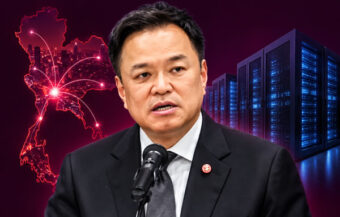
Dr. Cheng heads to Brussels to plug Thailand into Europe’s €95.5 billion innovation machine as Bangkok targets AI, advanced manufacturing and high-tech growth. Talks with EU Commissioner Ekaterina Zaharieva centred on research, OceanEye and future industries.
Deputy Prime Minister Yodchanan Wongsawat, or ‘Dr. Cheng’ has taken Thailand’s technology ambitions to Brussels, holding talks with European Commissioner Ekaterina Zaharieva on access to Horizon Europe, the EU’s €95.5 billion innovation programme. The mission focused on AI, advanced manufacturing, geospatial technology and the OceanEye project as Thailand seeks a place in the global race for future industries, research funding and technological leadership. It comes as Thailand scrambles to upgrade its economy through more advanced technologies.

Dr. Cheng or Deputy Prime Minister Yodchanan Wongsawat travelled to Brussels this week to strengthen Thailand’s links with Europe’s €95.5 billion Horizon Europe programme. During the visit, he met European Commissioner for Startups, Research and Innovation Ekaterina Zaharieva.
The talks focused on research cooperation, technology partnerships and future opportunities for Thai participation in major European projects.
The mission comes as Thailand seeks a bigger role in advanced industries. Policymakers increasingly view innovation as a critical source of future growth. As a result, greater attention is being directed towards artificial intelligence, geospatial technology, advanced manufacturing and scientific research. The Brussels visit reflected that strategy.
Thailand seeks a place in Europe’s vast innovation network as competition for future industries grows
A key focus of the discussions was the OceanEye project. The initiative combines marine monitoring, satellite technology and environmental observation systems. It aims to improve understanding of coastal and ocean environments through advanced scientific tools. In turn, the project offers opportunities for international collaboration in areas where Thailand already possesses recognised expertise.
“The OceanEye project aligns with Thailand’s strengths, particularly its expertise in space and geospatial technology, as well as its extensive experience in coastal management,” Prof. Dr. Yodchanan said.
The deputy prime minister’s comments highlighted sectors where Thailand already has established capabilities. Equally important, they underscored Bangkok’s intention to contribute expertise to international projects rather than simply receive assistance.
Geospatial technology, satellite applications and coastal management are becoming increasingly valuable as governments seek better environmental data and stronger resource management systems.
OceanEye project highlights Thailand’s strengths in geospatial systems and coastal expertise
The Brussels mission formed part of a wider effort to connect Thai universities, research centres and technology businesses with leading international institutions. At the same time, officials are seeking stronger links between scientific research and industrial development.
The objective is straightforward. Thailand wants more innovation, more technology transfer and more high-value economic activity.
That ambition sits behind growing interest in Horizon Europe. The programme operates between 2021 and 2027 and carries a budget of approximately €95.5 billion. Consequently, it ranks among the largest publicly funded research initiatives in the world. It also represents one of Europe’s most significant strategic investments in science and technology.
Horizon Europe succeeded Horizon 2020. However, it was designed with broader ambitions. The programme seeks to strengthen Europe’s scientific base, improve industrial competitiveness and support innovation across multiple sectors. Moreover, it aims to ensure Europe remains competitive in an increasingly technology-driven global economy.
Horizon Europe programme offers Thailand access to one of the world’s largest research funds
Funding supports projects across artificial intelligence, healthcare, biotechnology, climate science, energy systems and advanced manufacturing. In parallel, resources are directed towards transport technologies, quantum computing and space-related research. Digital innovation also remains a major priority.
Universities, research institutes, startups, businesses and public organisations compete for grants. Funding is awarded through competitive calls for proposals. Thereafter, independent experts assess submissions before final decisions are made. Competition remains intense because demand consistently exceeds available funding.
The programme operates through three principal pillars. Together, they form the foundation of Europe’s research strategy.
The first pillar focuses on scientific excellence. It supports frontier research through institutions such as the European Research Council. The goal is to strengthen Europe’s standing in fundamental science while supporting ambitious long-term projects. Notably, this pillar has become one of the continent’s most prestigious sources of research funding.
First pillar focuses on scientific excellence through frontier research and long-term funding
The second pillar focuses on global challenges and industrial competitiveness. It supports collaborative projects involving multiple countries and institutions. As part of this effort, funding is directed towards healthcare, climate change, energy security and advanced manufacturing. Digital technologies and transport systems also receive significant support.
The third pillar focuses on innovation and commercialisation. It operates through the European Innovation Council. Its purpose is to help startups and scale-up companies transform research into commercial products. In doing so, it addresses a challenge that has long concerned European policymakers.
Europe has earned a strong reputation for scientific excellence. Yet many analysts argue it has struggled to convert research into globally dominant companies. Therefore, Horizon Europe places growing emphasis on innovation, entrepreneurship and commercial outcomes.
Supporters regard the programme as one of Europe’s most successful research initiatives. Thousands of projects have already received support. Furthermore, it has strengthened cooperation between universities, research institutions and businesses across the continent.
Europe seeks stronger commercial returns from research through innovation and entrepreneurship
Researchers frequently praise its long-term funding model. Scientific projects often require years of development before producing practical results. Consequently, stable financing is viewed as essential. This is particularly true in fields such as climate science, advanced materials and quantum technologies.
Many projects supported under Horizon Europe involve long development horizons. Private investors often hesitate to fund such work because returns may take years to emerge. Accordingly, public funding plays a critical role in sustaining research that could eventually generate significant technological advances.
The programme’s collaborative structure is also widely praised. Research teams routinely combine expertise from different countries and disciplines. As a consequence, institutions gain access to wider knowledge networks and specialised capabilities. Smaller organisations benefit as well because they can participate alongside larger research centres.
Green technologies have become another major focus. Significant resources have been directed towards sustainability, climate research and energy transition projects. Meanwhile, governments and industries continue searching for technologies capable of improving efficiency and competitiveness.
Researchers praise scale and collaboration, but critics point to bureaucracy and complexity
Despite its scale, Horizon Europe has attracted criticism. Researchers frequently complain about bureaucracy and lengthy application procedures. Preparing proposals can require months of work. In addition, extensive documentation is often necessary before applications are submitted.
Competition remains fierce. Therefore, success rates can be relatively low. Critics argue that substantial resources are devoted to proposals that ultimately fail. Universities and research institutions often commit significant manpower to unsuccessful applications.
Another area of debate concerns funding distribution. Some observers argue that resources are spread too broadly across member states. As a consequence, critics contend that the strongest scientific proposals do not always receive maximum support. Supporters reject that assessment and argue that broad participation strengthens Europe’s wider research ecosystem.
The debate becomes particularly interesting when Horizon Europe is compared with the United States model. America relies heavily on agencies such as the National Science Foundation, the National Institutes of Health and the Defence Advanced Research Projects Agency, or DARPA.
Comparison with the United States highlights differing approaches to research and innovation
Many analysts regard the US system as exceptionally effective. Unlike Horizon Europe, it is generally more decentralised and mission-driven. Different agencies pursue specific objectives and often enjoy considerable flexibility. Consequently, they can move quickly in strategically important sectors.
DARPA is frequently cited as the best example. The agency became known for funding ambitious, high-risk projects. Over time, research linked to DARPA contributed to technologies underpinning the internet, GPS navigation and modern computing. For that reason, it is often viewed as a benchmark for innovation policy.
The United States is also widely regarded as more successful in commercialising research. American universities, investors and technology companies operate within a powerful innovation ecosystem. As a result, scientific discoveries can often move rapidly from laboratories into commercial markets.
Europe presents a different picture. European universities consistently produce world-class research.
Europe excels in science but faces challenges in creating globally dominant technology companies
Likewise, European laboratories maintain strong international reputations. However, critics argue that Europe still struggles to create globally dominant technology companies at the same pace as the United States.
That distinction sits at the centre of many discussions surrounding Horizon Europe. Supporters point to scientific excellence and multinational collaboration. Critics focus on commercial outcomes and business creation. Nevertheless, both sides agree that innovation will play an increasingly important role in future economic growth.
For Thailand, those issues are becoming more relevant. Policymakers have repeatedly identified innovation, advanced manufacturing and digital technology as national priorities. On another front, officials are seeking stronger research capabilities and deeper international partnerships. The Brussels mission reflected both objectives.
Thailand pursues research partnerships to strengthen innovation and support industrial upgrading
By engaging with Horizon Europe, Thailand gains access to research networks, scientific expertise and technology partnerships. At the same time, Thai institutions gain opportunities to collaborate with leading universities and innovation centres. Such cooperation could help strengthen domestic capabilities in strategic sectors.
The government’s ambitions extend beyond academic research. Instead, officials are pursuing outcomes that support industrial upgrading, technology development and long-term competitiveness.
Thailand may miss the AI boat over political brawls as a pioneering project becomes mired in controversy
Ireland and Thailand forge trade and personal bonds as St Patrick’s Day is widely celebrated in Bangkok
In response to intensifying global competition, countries are investing heavily in advanced technologies and innovation ecosystems.
Against that backdrop, Thailand’s engagement with Horizon Europe carries significance beyond science policy. It reflects a broader effort to secure a stronger position in industries expected to shape future economic growth. The Brussels mission therefore represented another step in Thailand’s push towards a more technology-driven economy and a larger role within the global innovation landscape.
Join the Thai News forum, follow Thai Examiner on Facebook here
Receive all our stories as they come out on Telegram here
Follow Thai Examiner here
Further reading:
Ministry fails to halt ฿25.4 billion payment order to Hong Kong based firm linked to 1990 contract
Microsoft accepts charges of corrupt payments in Thailand as it makes a deal with US investigators
Provincial agency boss arrested in Mukdahan after trying to extort ฿2 million from a businessman
Parliamentary vote on constitutional reform is questioned, court says referendum may be needed
Bangkok MP on Phuket mission to investigate controversial local condo project before the courts
Drinks giant Thai Beverage to resume expansion with Singapore IPO for Asean regional beer operation