Retired diplomat Rasmi Chalijanchai says Thailand has crossed a diplomatic line with China, warning Beijing’s growing influence threatens the kingdom’s independence and hoping it never becomes “a province of someone else.”
One of Thailand’s most senior former diplomats has issued a stark albeit humorous warning that the kingdom is drifting dangerously closer to Beijing after Prime Minister Anutin Charnvirakul’s landmark China visit. Retired ambassador Rasmi Chalijanchai argues an unprecedented statement on Taiwan, increasingly assertive interventions by the Chinese Embassy and Bangkok’s response mark a fundamental shift in relations. He warns Thailand has crossed diplomatic ground no previous government entered and says he hopes never to wake up and find the country has become “a province of someone else.”
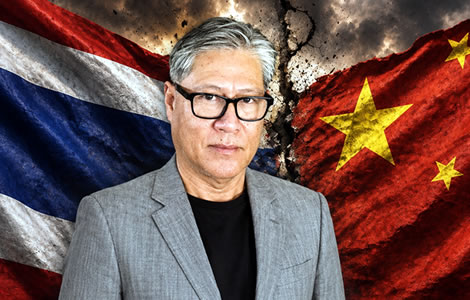
Former Thai diplomat Rasmi Chalijanchai has launched a sharp attack on Thailand’s increasingly close relationship with China. The retired ambassador questioned recent diplomatic decisions and warned about Beijing’s growing influence in the kingdom.
Writing on Facebook, the outspoken former diplomat, widely known as the “Maverick Ambassador,” revisited the controversy surrounding Prime Minister Anutin Charnvirakul’s performance of the Chinese classic Tian Mi Mi during his recent visit to Beijing.
However, Mr Rasmi insisted the song itself was never the real issue. Instead, he argued the joint statement issued after the visit revealed a much more significant shift in Thailand’s diplomatic position.
Accordingly, Mr Rasmi publicly apologised for criticising Mr Anutin’s musical diplomacy. He admitted he had failed to read the official statement carefully before commenting. He described that as his own mistake. Nevertheless, he argued the wording fundamentally changed his understanding of the visit.
Thailand’s Taiwan declaration marked the biggest diplomatic shift towards Beijing in decades
Specifically, he highlighted paragraph six of the joint declaration. That section recognised Taiwan as “an inseparable part of China.” According to Mr Rasmi, no previous Thai government had expressed the One China policy in such explicit language.
Moreover, he argued most countries recognising Beijing avoid making such direct declarations. He said the wording showed Thailand had made a full diplomatic choice. “It speaks for itself,” he wrote.
As a result, Mr Rasmi said he now understood why Chinese officials welcomed Mr Anutin’s performance so warmly. He recalled that the Chinese ambassador said the rendition of Tian Mi Mi had made Thai-Chinese relations even sweeter.
Mr Rasmi accepted that explanation. He then added, with evident sarcasm, that it would hardly matter whether Thai leaders sang one Taiwanese song or dozens more. The relationship, he suggested, would remain harmonious regardless.
Yet Mr Rasmi argued the more important developments were unfolding inside Thailand. He said recent events had raised uncomfortable questions about the balance of the bilateral relationship. He also suggested accepted diplomatic boundaries were beginning to blur.
Rasmi says Chinese Embassy crossed diplomatic norms over Taiwan film festival and security guard dispute
First, he referred to reports involving the long-running Taiwan Film Festival in Thailand. According to Mr Rasmi, a Chinese Embassy official telephoned the Thai private company organising the event. He described the call as threatening.
The festival, he noted, has been organised successfully for many years. If the embassy had concerns, they should have been raised through Thailand’s Ministry of Foreign Affairs. Instead, the organisers themselves received the approach. Mr Rasmi said that was not standard diplomatic practice.
Separately, he turned to another controversy involving a dispute between a Chinese national and a Thai security guard. The case drew national attention after the Chinese Embassy issued a public statement. Mr Rasmi said the decision surprised him.
Based on decades of diplomatic experience, he argued embassies rarely intervene publicly in incidents involving no deaths, serious injuries or substantial property damage.
Ordinarily, he said, such disputes are left to domestic legal systems. Likewise, he argued the Thai Embassy would almost certainly adopt the same approach in China. It would allow Chinese authorities to handle the matter without public interference. In response, Mr Rasmi questioned why the Chinese Embassy considered public intervention appropriate in Thailand.
Veteran envoy questions why Bangkok gave exceptional weight to a relatively minor embassy intervention
Notably, he also placed the incident in a broader context. He argued the harm suffered by Chinese nationals in isolated disputes was likely much smaller than the cumulative harm suffered by Thai citizens through crimes committed by some Chinese nationals operating in Thailand. He offered no figures. However, he said the comparison deserved careful consideration.
On another front, Mr Rasmi suggested the embassy’s statement had attracted close attention throughout Bangkok’s diplomatic community. According to him, other embassies were quietly watching developments. He indicated that many diplomats regarded the intervention as unusual because it departed from normal diplomatic practice.
He then questioned the Thai government’s response. In particular, he noted that Foreign Minister Sihasak Phuangketkaew personally addressed the issue through media interviews. Mr Rasmi argued that the level of involvement was striking.
Normally, he said, the ministry’s spokesperson could have handled the matter. Alternatively, the Director-General of the Department of Consular Affairs could have responded. Instead, the foreign minister intervened directly. To Mr Rasmi, that demonstrated the exceptional importance the government now attaches to relations with China.
Former ambassador warns today’s minor disputes could become far bigger tests for Thailand in future
In parallel, he argued the embassy’s statement inevitably placed pressure on Thai authorities. The underlying dispute was relatively minor, he wrote. He therefore questioned what might happen if a much larger incident arose.
Close relations, he argued, should rest on equality. They should also reflect mutual dignity and respect. Equally, they should avoid interference or exploitation.
Finally, Mr Rasmi returned to the controversy surrounding Tian Mi Mi. Again, he apologised to Prime Minister Anutin for his earlier criticism. He accepted that he had judged the performance before understanding the significance of the accompanying statement. Even so, he said he would still prefer Thai leaders to perform royal compositions by the late King Bhumibol Adulyadej during important overseas engagements.
His closing remark delivered the strongest warning. “I also hope that one day I won’t wake up and read a statement saying that Thailand is a province of someone else,” he wrote. Although delivered humorously, the comment reflected broader unease among many Thais over China’s expanding influence inside the country.
Diplomatic career gives added weight to Rasmi’s criticism of Thailand’s changing relationship with China
That concern extends well beyond ceremonial diplomacy. Chinese investment has expanded across multiple sectors of Thailand’s economy. At the same time, public attention has increasingly focused on grey business operations linked to Chinese nationals.
Questions have also been raised about nominee business structures. In addition, organised crime investigations have intensified scrutiny. Mr Rasmi did not refer to this. However, it comes amid wider public concern over Chinese capital, growing economic influence and Beijing’s increasingly visible role in issues arising within Thailand.
His intervention carries particular weight because of his diplomatic background. Born into a diplomatic family, Mr Rasmi spent decades serving in Thailand’s Ministry of Foreign Affairs. During that time, he held senior posts in Bangkok and overseas, including serving as ambassador to Mozambique and Kazakhstan.
He worked extensively on bilateral and multilateral diplomacy. He also contributed to foreign policy development. His responsibilities included ASEAN affairs, relations with major powers and regional security.
After retiring, Mr Rasmi became one of Thailand’s best-known foreign policy commentators. He founded the popular Facebook page Thut Nok Thaew, or The Unconventional Diplomat. Through that platform, he comments regularly on diplomacy, international affairs and domestic politics. His direct style earned him the nickname “The Maverick Ambassador.”
Former adviser remains an influential voice as Thailand’s strategic partnership with China deepens
Later, he returned to government service. In September 2023, he became adviser to the deputy foreign minister. He subsequently served as Assistant Minister attached to the Ministry of Foreign Affairs. During that period, he represented Thailand at several high-level international meetings.
Those included the Organisation for Security and Co-operation in Europe Ministerial Council and the Indian Ocean Conference. He also led Thai delegations promoting the country’s positions on regional security and international cooperation.
Argy bargy over Taiwanese film show highlights Chinese efforts to censor or control Thai media output
Chinese ambassador appeals to the Thai media not to offend genuine business investment from his country
Today, Mr Rasmi remains one of Thailand’s most influential diplomatic voices. His latest intervention comes as Bangkok and Beijing continue strengthening political, economic and strategic cooperation. Against that backdrop, domestic debate over China’s influence continues to grow. His remarks are therefore likely to intensify scrutiny of Thailand’s foreign policy and its increasingly close relationship with Beijing.
Join the Thai News forum, follow Thai Examiner on Facebook here
Receive all our stories as they come out on Telegram here
Follow Thai Examiner here
Further reading:
Officials zero in on ownership of expanding Chinese food delivery services operating in the kingdom
Huai Khwang raid shows nominee shareholdings being used by Chinese infiltrating the economy
Sweep of nominee firms and business networks on Koh Phangan. 22 arrested, 200 million in land seized
Anutin visits Koh Phangan as nominee crackdown shows 68% of firms with foreign ownership links
Blitzkrieg on foreign firms and enterprises on Koh Phangan continues with French owned resort busted
Russian-Chinese Koh Phangan alliance to sell drugs to foreigners. Accused entered Thailand illegally