London’s Tower Bridge becomes the backdrop for Thailand’s flagship overseas festival as more than 90,000 visitors are expected to celebrate Thai culture, while Britain’s Thai community emerges as one of the United Kingdom’s fastest-growing Southeast Asian diasporas.
More than 90,000 people are expected to attend Thailand’s biggest cultural celebration in Britain this weekend as London hosts one of the country’s flagship international festivals against the backdrop of a rapidly expanding UK Thai community. From Thai cuisine, Muay Thai and traditional arts to innovation, tourism and creative industries, Thai Festival: Thailand Showcase 2026 highlights a relationship that has deepened far beyond diplomacy, reflecting two decades of sustained migration, growing business links and a British Thai population that has more than doubled to become one of the United Kingdom’s most established Southeast Asian communities.
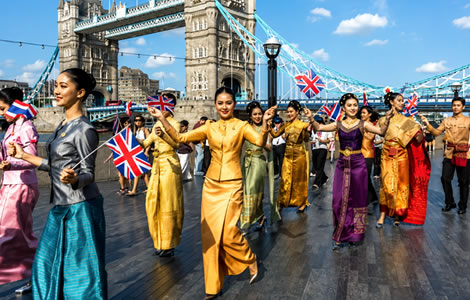
The Royal Thai Embassy in London has launched Thai Festival: Thailand Showcase 2026, transforming one of the British capital’s busiest public spaces into a celebration of Thai culture, cuisine and creativity.
The event also reflects the remarkable growth of Britain’s Thai community, which has expanded steadily over the past two decades. Once relatively small, it has become one of the United Kingdom’s most established Southeast Asian diasporas.
The three-day festival opened on 17 July at Potters Fields Park beside Tower Bridge. Thai Ambassador to the United Kingdom Nadhavathna Krishnamra led the opening ceremony. He was joined by Southwark Deputy Mayor Patrickson Obanya, members of Team Thailand in London, business representatives and the media.
London festival opens showcasing culture while celebrating Britain’s fast-growing Thai community
Notably, this is the first time the festival has been staged in the London Borough of Southwark. The location places Thailand’s flagship cultural event before one of Europe’s largest flows of residents and international visitors.
This year’s festival carries the theme “Creative Life and Creative Heartbeat”. Rather than focusing solely on tradition, organisers have broadened the programme considerably. Visitors can experience Thai food, arts, wellness, tourism, innovation and traditional craftsmanship in one venue. The showcase also presents Thailand’s expanding creative industries alongside its long-established cultural heritage.
The Royal Thai Embassy said London was selected as one of only 12 flagship cities from 43 Thai Festival locations worldwide this year. That status reflects the depth of Thailand’s relationship with the United Kingdom.
It also recognises the expansion of cooperation in trade, education, tourism and cultural exchange. As a result, the London festival has become one of Thailand’s highest-profile overseas public events.
Southwark hosts flagship Thai festival promoting creativity, tourism and stronger UK-Thailand ties
Throughout the weekend, visitors can watch traditional dance and music performances. They can also enjoy Muay Thai demonstrations and live cooking shows. Thai businesses are displaying products from across the country.
Family activities are taking place throughout the site. In parallel, tourism displays introduce visitors to destinations across Thailand while creative industry exhibitions highlight the country’s growing design and innovation sectors.
The festival runs from 17 to 19 July. According to the Royal Thai Embassy, more than 30,000 people attended the opening day. Attendance is expected to exceed 90,000 before the event closes. Those figures place the festival among the largest annual celebrations of Thai culture in Britain.
The turnout also reflects broader demographic changes. Britain’s Thai community has expanded consistently over the past 20 years. Although no single official population figure exists, every major dataset points to sustained long-term growth. Different organisations measure nationality, ethnicity and country of birth separately. Consequently, estimates vary depending on the methodology used.
Official figures chart two decades of sustained growth in Britain’s expanding Thailand-born resident population
The Office for National Statistics recorded just over 50,000 Thailand-born residents living in England and Wales in the 2021 Census. Additional Thai-born residents live in Scotland and Northern Ireland. Together, those figures place the official Thai-born population across the United Kingdom at between 50,000 and 60,000 people.
Separately, researchers and community organisations estimate the wider British Thai diaspora at between 70,000 and 100,000 people.
That estimate includes British-born children of Thai migrants and people of mixed Thai heritage. While widely accepted, it is not an official government statistic. Even so, it illustrates the community’s expanding footprint across the country.
The pace of growth has accelerated over two decades. Around 20,000 to 25,000 Thai-born residents lived in Britain in 2001. By 2011, that figure had climbed to between 40,000 and 45,000. A decade later, the 2021 Census recorded more than 50,000 Thailand-born residents in England and Wales alone. The overall UK total was slightly higher once Scotland and Northern Ireland were included.
Thai communities spread nationwide as migration patterns diversify and opportunities expand
Greater London remains the centre of Britain’s Thai population. However, sizeable communities have also developed in Birmingham, Greater Manchester, Leeds, Edinburgh and Glasgow.
Over time, these cities have built extensive networks of Thai-owned businesses and community organisations. Thai restaurants, supermarkets and Buddhist temples now form an established part of many local neighbourhoods.
Migration patterns have also changed. During the early 2000s, many Thai nationals settled through marriage or family reunification. Others entered hospitality, healthcare and small businesses. At the same time, increasing numbers arrived as university students. Many remained after completing their studies.
Today, the community is considerably more diverse. Thai professionals work across finance, education, healthcare and information technology. Entrepreneurs have established businesses in hospitality, food imports, wellness, beauty services and property. Those sectors have strengthened the community’s economic profile while broadening its professional reach.
Thai food, temples and traditions deepen Britain’s cultural links as second generation builds success
Thai cuisine has become one of the country’s strongest cultural exports. Restaurants serving regional Thai food now operate across Britain. Specialist supermarkets continue expanding to meet demand for authentic ingredients.
In addition, food festivals and cooking demonstrations have introduced wider British audiences to Thailand’s regional culinary traditions.
Community institutions have expanded alongside that commercial growth. Buddhist temples remain central gathering places for many families. Cultural organisations organise language classes, religious ceremonies and public celebrations throughout the year. Songkran and Loy Krathong festivals now attract thousands of participants in London, Birmingham and Manchester.
The second generation has also become increasingly visible. British-born Thais are entering careers across business, medicine, education and finance. Their growing professional presence reflects higher educational attainment and deeper long-term settlement. Meanwhile, many families continue maintaining strong cultural links with Thailand.
The relationship between both countries has strengthened beyond migration alone. Tourism continues generating substantial travel in both directions each year. Educational exchanges have expanded university partnerships.
Bilateral trade has also deepened commercial cooperation. Modern air travel and digital communication now allow families to maintain close relationships despite distance.
Festival reflects stronger UK-Thailand ties built through migration, business, tourism and culture
Against that backdrop, Thai Festival: Thailand Showcase 2026 serves several purposes. It celebrates Thai culture before a large international audience.
It also promotes tourism, creativity, innovation and Thai business. Equally, it provides Britain’s Thai community with a public platform to showcase its heritage and its growing contribution to British society.
Justice served up to evil rapist after horrific ordeal of a Thai woman who refused to obey UK criminals
Teenager appears before a London Magistrates court Saturday charged with 2024 murder of a Thai woman
Food remains one of the festival’s biggest attractions. Live cooking demonstrations showcase dishes from different regions of Thailand. Visitors can sample traditional recipes and modern interpretations alike. Elsewhere, Muay Thai demonstrations, handicraft exhibitions and cultural performances present a wider picture of the country’s identity.
By the festival’s conclusion, more than 90,000 visitors are expected to have attended. The opening day’s crowd of over 30,000 suggests that target is achievable. Ultimately, the event reflects more than cultural celebration.
It mirrors a relationship that has deepened steadily through migration, business, education, tourism and sustained people-to-people ties over the past two decades.
Join the Thai News forum, follow Thai Examiner on Facebook here
Receive all our stories as they come out on Telegram here
Follow Thai Examiner here
Further reading:
Health Minister Somsak launches regulatory blitz to outlaw non-medical cannabis use within 40 days
Outbound cannabis smuggling smashed by Chiang Mai police this week. Europe and London targeted