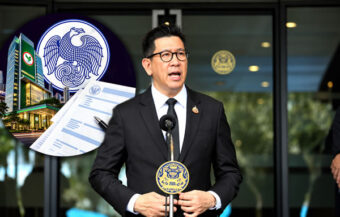
Crisis grips Thailand’s telecoms watchdog as Anutin moves to remove NBTC chairman Dr Saran. Three meetings have failed, 34 urgent matters remain stalled and commissioners face Section 157 risks after previous regulatory battles reached the courts.
Prime Minister Anutin Charnvirakul has moved to remove NBTC Chairman Dr Saran Boonbaichaiyapruk as Thailand’s powerful communications regulator faces mounting legal turmoil and paralysis. His intervention follows a unanimous finding that Dr Saran possessed a prohibited characteristic, while an attempted court challenge failed to stop the removal process. Three board meetings have since collapsed, leaving 34 urgent matters stalled. The crisis is further sharpened by Section 157 exposure for commissioners, including Professor Pirongrong Ramasoota, who remains on the board after receiving a two-year prison sentence.
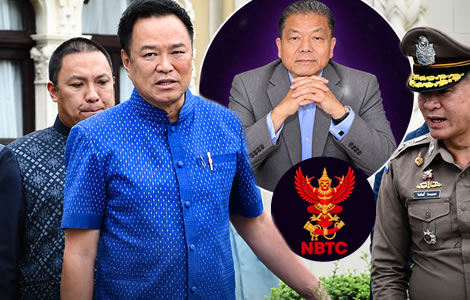
Prime Minister Anutin Charnvirakul has signed the formal submission seeking the removal of NBTC Chairman Dr Saran. The move pushes a deepening regulatory crisis into a decisive new stage. Mr Anutin confirmed the action at Government House at 12.45 pm on August 11. He said the document was being submitted to His Majesty the King.
The submission seeks Dr Saran’s removal as both chairman and member of the National Broadcasting and Telecommunications Commission (NBTC). Notably, Mr Anutin insisted every government action had followed the law. He said all required procedures had been observed. The government had also acted following advice from its legal team.
At the same time, Mr Anutin distanced his government from the turmoil engulfing the regulator. He stressed that the NBTC remained an independent organisation. Therefore, the government could not directly supervise its operations. It could only cooperate with the commission where required. He also pointed out that other NBTC commissioners remained in office.
Anutin’s move comes as three failed meetings leave dozens of urgent NBTC regulatory matters delayed
The Prime Minister said decisions concerning the regulator’s operations remained within the NBTC’s authority. Even so, his signature marks a critical development in the escalating stand-off. The seven-member commission has already suffered repeated disruption. Three board meetings collapsed within roughly two weeks.
Three commissioners reportedly refused to participate in meetings chaired by Dr Saran. As a result, dozens of regulatory matters were delayed. These included 34 matters described as urgent. The dispute has therefore moved beyond the future of one commissioner.
It is now obstructing the decision-making machinery of Thailand’s telecommunications and broadcasting regulator.
The confrontation stems from a dispute over Dr Saran’s original eligibility for the commission. He was selected as an NBTC commissioner in the consumer protection field in 2021. Subsequently, he was chosen to chair the independent regulator. He received royal appointment as NBTC chairman in April 2022.
However, questions later emerged concerning payments Dr Saran received for medical work. Those payments raised questions about his qualifications under legislation governing NBTC commissioners. Eventually, the issue returned to the original committee responsible for selecting commission members. In July 2026, that committee reached a unanimous decision.
Selection committee’s unanimous finding over Dr Saran’s eligibility completely undermined his position
The selection committee determined that Dr Saran possessed a prohibited characteristic affecting his eligibility. Specifically, the dispute concerned payments linked to medical work while he served at Ramathibodi Hospital. That unanimous finding immediately intensified the fight over his position. Dr Saran, however, rejected claims that the decision automatically ended his chairmanship.
Instead, Dr Saran maintained that he remained legally in office until the formal removal procedure was completed. The dispute centres partly on Section 15/1 of the Frequency Allocation Act. Those seeking his departure regard the selection committee’s determination as final under that provision. On that interpretation, the finding triggers the statutory process required for his removal.
In addition, the legislation provides for termination from the date when the disqualifying circumstance arose. Dr Saran disputed that interpretation. Consequently, he turned to the Central Administrative Court seeking to challenge the selection committee’s decision. That legal action produced another major development on August 8.
The Central Administrative Court declined to accept Dr Saran’s case. Importantly, the court did not determine whether he was legally qualified to remain an NBTC commissioner. Nor did it declare that his chairmanship had already ended. Instead, the ruling concerned whether his challenge could proceed at that stage.
Administrative Court blocks Dr Saran’s immediate challenge as uncertainty spreads inside the NBTC
The court found Dr Saran had not yet suffered the legally recognised injury required to bring his action. At that point, he had not formally been removed. Accordingly, the court struck the case from its docket. The decision therefore blocked an immediate route for challenging the selection committee’s finding.
Crucially, however, the ruling did not settle the underlying qualification dispute. That uncertainty quickly spread into the NBTC boardroom. Three commissioners reportedly refused to attend meetings whenever Dr Saran occupied the chair. Their concerns centred on the legality of decisions approved under his disputed chairmanship.
In particular, they feared those decisions could later face legal challenges or annulment. The commissioners nevertheless indicated that they remained prepared to work with other board members. Their objection concerned participation in meetings chaired by Dr Saran. The legal battle was therefore directly preventing the commission from completing its normal work.
Meanwhile, the boycott created another potential legal problem. NBTC commissioners exercise statutory powers and carry corresponding official responsibilities. Refusing to exercise those responsibilities can also generate legal complaints under particular circumstances. Central to those concerns is Section 157 of Thailand’s Criminal Code.
Section 157 raises the stakes for NBTC commissioners as regulatory decisions bring personal legal risks
Section 157 deals with misconduct by public officials while exercising, or refusing to exercise, their official duties. The provision applies when the required elements concerning wrongful conduct and corrupt or injurious intent are established. For NBTC commissioners, its significance is already clear. Previous regulatory battles have exposed individual commissioners to criminal complaints and prosecution.
The starkest example came in February 2025. NBTC commissioner Professor Pirongrong Ramasoota was convicted under Section 157. The Central Criminal Court for Corruption and Misconduct Cases sentenced her to two years in prison. Significantly, the sentence was imposed without suspension.
The prosecution followed a complaint by True Digital Group concerning regulatory action involving its TrueID platform. The court found Professor Pirongrong had improperly exercised her official duties. It also found that she acted with an intention to cause damage to the company. Afterwards, she was granted bail while challenging the judgment.
Professor Pirongrong remained an NBTC commissioner during that process. Nonetheless, the first-instance judgment demonstrated the personal legal exposure faced by individual regulators. An NBTC commissioner had been prosecuted and convicted over actions taken while exercising regulatory powers. She had also received an unsuspended prison sentence.
True-DTAC merger dispute showed commissioners can also face complaints over exercise of powers
On another front, the True-DTAC telecommunications merger generated separate Section 157 complaints. In October 2022, the NBTC voted to “acknowledge” the merger while imposing conditions. Consumer representatives subsequently challenged the approach taken by commissioners. They argued that members might have failed properly to exercise the regulator’s statutory powers.
Consequently, the dispute generated complaints and litigation. The Central Administrative Court eventually dismissed the consumer challenge in September 2025. Even so, the controversy demonstrated another potential route to legal action. Commissioners could face complaints over claims that they had failed to use their regulatory powers.
Separately, Section 157 concerns have surfaced during disputes within the NBTC itself. Commissioners have previously warned about failures to implement decisions already approved by the board. They warned that deliberate failures could potentially constitute intentional dereliction of official duty. Those disputes now provide important context for the present stand-off.
In practice, NBTC commissioners face legal scrutiny over both decisions and omissions. Decisions taken while exercising regulatory powers can generate criminal complaints. Conversely, claimed failures to perform statutory duties can produce another form of legal exposure. The Dr Saran dispute has brought those competing pressures into the same boardroom.
Commissioners face legal risks over disputed meetings as 34 urgent matters remain in the deadlock
Commissioners questioning Dr Saran’s position must decide whether to attend meetings under his chairmanship. Yet participation raises concerns about the validity of decisions subsequently approved. On the other hand, refusing to participate prevents the regulator from completing important statutory work. That has already happened repeatedly.
Three meetings have collapsed during the stand-off. Moreover, dozens of matters have been delayed. Among them are 34 matters classified as urgent. The consequences therefore extend well beyond an internal leadership dispute.
The NBTC exercises extensive statutory powers across Thailand’s communications industries. It regulates telecommunications networks and broadcasting operations. In parallel, it oversees spectrum allocation and satellite services. Major licensing decisions also fall within its responsibilities. Competition issues within regulated sectors form another significant part of its work.
Functioning board meetings are therefore required for important regulatory decisions. They can also affect major commercial matters across the communications industry. Yet repeated meeting failures have produced a growing backlog. The legal fight surrounding Dr Saran has consequently developed into a broader operational crisis.
Anutin says government followed the law but cannot directly supervise the independent NBTC regulator
The government was also pulled directly into the confrontation. Pressure had mounted on Mr Anutin to advance the formal process following the selection committee’s decision. Questions emerged about possible consequences if responsible officials failed to complete required statutory procedures. Once again, Section 157 entered discussions surrounding failures to perform official duties.
In response, Mr Anutin has now signed the submission advancing the removal process. He was emphatic about the legal basis for that decision. Everything had been undertaken according to the law and required procedures, he said. He also pointed to advice from the government’s legal team.
At Government House, however, Mr Anutin rejected suggestions that his government could settle the NBTC’s internal problems. The commission is an independent organisation. Accordingly, it does not operate under direct government supervision. The government can cooperate with it but cannot manage its regulatory affairs.
When questioned about a possible vacuum, Mr Anutin pointed to the presence of other commissioners. All actions within the commission remained matters for the NBTC, he said. His government had performed its legal role. Responsibility for running the regulator remained elsewhere.
Removal process advances after court ruling while the NBTC remains burdened by internal deadlock
As part of this, the Prime Minister has now advanced the formal process arising from the July determination. The original selection committee unanimously found that Dr Saran possessed a prohibited characteristic. Dr Saran continues to dispute the legal consequences of that decision. The Administrative Court has not ruled on the underlying merits of his qualifications.
Rather, its August 8 ruling concerned the legal timing of Dr Saran’s attempted challenge. He had not formally been removed when he approached the court. The court therefore found that the necessary legally recognised injury had not yet occurred. His challenge was consequently removed from the docket.
The government’s latest action changes that position significantly. Mr Anutin has now signed the submission seeking Dr Saran’s removal from both NBTC posts. The process follows the selection committee’s unanimous July determination. However, the formal procedure must still run its course.
Against this backdrop, the regulator remains burdened by weeks of deadlock. Its commissioners exercise powers affecting some of Thailand’s largest communications businesses. Yet their individual actions can become the subject of criminal complaints and litigation. Previous cases have shown that those risks can become personal.
Past Section 157 cases sharpen legal risks as the NBTC faces disputed leadership and stalled business
Most notably, Professor Pirongrong received a two-year unsuspended prison sentence at first instance. Her case arose from regulatory action involving TrueID. By contrast, the True-DTAC dispute generated claims that commissioners had failed to exercise their powers properly. Both disputes involved Section 157.
The current crisis combines those legal pressures with a disputed chairmanship. Three commissioners have refused to attend meetings chaired by Dr Saran. Their boycott has contributed to three failed meetings. Meanwhile, 34 urgent matters are among the business awaiting action.
Thailand’s media firmament faces a slow collapse as international digital services eat up market share
Watchdog body in crisis as public complaints mount over the service impacts of the True DTAC merger
For the NBTC, the immediate problem is therefore both legal and operational. Dr Saran’s status remains contested while the formal removal process advances. At the same time, the commission retains its statutory responsibilities across telecommunications and broadcasting. Those duties continue regardless of the leadership dispute.
For the government, Mr Anutin has drawn a firm boundary around its involvement. He says the required action has been taken according to law. The submission seeking Dr Saran’s removal has now been signed. Meanwhile, the independent NBTC remains responsible for keeping its regulatory machinery functioning.
Join the Thai News forum, follow Thai Examiner on Facebook here
Follow Thai Examiner on Google here
Receive all our stories as they come out on Telegram here
Follow Thai Examiner here
Further reading:
Unprotected sex stream on Facebook overnight stuns Thailand. Government orders robust police action
Tourist police track down Danish Romeo who went missing from his family and switched off Facebook
Body of crazed German man who refused to take his meds but instead smoked cannabis, found at home
Visa to be revoked as crazy pot smoking German is charged following Nakhon Ratchasima clinic terror
Loony pot-smoking German who terrorises dentist clinics on the run in Nakhon Ratchasima. Arrested
29-year-old Indian tourist jumped to his death in Bangkok’s Sukhumvit area. Cannabis found in room