Bangkok–Auckland flights are back from March 2027 as Anutin presses Thai Airways for an earlier take-off. Thailand and New Zealand launch a strategic partnership, target triple trade by 2045 and deepen security, tourism and investment links together.
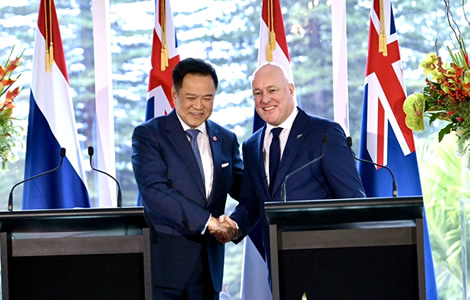
Thailand and New Zealand have launched a sweeping strategic partnership as Thai Airways International prepares to restore direct Bangkok–Auckland flights. Prime Ministers Anutin Charnvirakul and Christopher Luxon also pledged to triple trade by 2045 and strengthen security cooperation. The landmark agreement marks 70 years of diplomatic relations while expanding links across tourism, investment, education and technology amid growing Indo-Pacific tensions.
Thai Airways International will restore direct flights between Bangkok and Auckland as Thailand and New Zealand expand their bilateral relationship. The airline plans to resume services in March 2027. Prime Minister Anutin Charnvirakul wants the route restored earlier, if commercially possible.
Government spokeswoman Rachada Dhanadirek announced the plan on Friday after high-level talks in Auckland. She said direct flights would promote trade, tourism, investment and travel. Initially, Ms Rachada did not identify the airline. New Zealand Prime Minister Christopher Luxon later confirmed Thai Airways International’s involvement.
The carrier previously served Auckland for more than three decades. However, it suspended direct services after the COVID-19 pandemic stalled global aviation. Border controls and passenger restrictions crushed international travel. Consequently, the established air link between Thailand and New Zealand disappeared.
Thai Airways return restores direct passenger and freight links between Bangkok and Auckland next year
Mr Luxon welcomed the Thai flag carrier’s planned return. “Its return is great news for tourism and trade,” he said. The service would make travel easier and restore an important air-freight connection. Moreover, it would strengthen connections through Bangkok to wider Asia.
Bangkok also offers links to Europe and the Middle East through the Thai Airways International network. Therefore, the route will serve passengers travelling beyond Thailand and New Zealand. Auckland passengers will gain direct access to a major Asian aviation hub. Meanwhile, exporters will gain a fast freight channel between both markets.
The service will carry tourists, business executives, students and people visiting relatives. In addition, many passengers will avoid changing aircraft in another country. New Zealand travellers will gain direct access to Bangkok and Thailand’s wider tourism network. Thai passengers will receive easier access to Auckland and other New Zealand destinations.
Air freight will provide another significant commercial benefit. Notably, Mr Luxon highlighted the importance of restoring that lost connection. Direct cargo capacity can support products requiring rapid transportation. These include food products, specialised equipment and other time-sensitive goods.
Thailand and New Zealand launch strategic partnership after 70 years of close diplomatic relations
The aviation announcement formed part of a much wider package agreed during Friday’s talks. Most importantly, both leaders formally launched the Thailand–New Zealand Strategic Partnership. The agreement marked 70 years of diplomatic relations between the two countries. Thailand and New Zealand established formal diplomatic ties in 1956.
Today, Thailand maintains an embassy in Wellington, while New Zealand operates an embassy in Bangkok. Their relationship covers diplomacy, security, commerce, education, tourism and culture. Friday’s declaration elevated those established links to a strategic partnership. It also created a formal structure for substantially broader cooperation.
As part of this, Mr Anutin and Mr Luxon adopted a joint programme covering 2026 through 2030. The programme will direct officials implementing the partnership. Specifically, it contains four central areas of cooperation. These cover security, economic links, cultural relations and regional coordination.
The first pillar addresses political and security cooperation. It includes stronger action against transnational crime, online scams and human trafficking. Furthermore, both governments want closer information-sharing between their law-enforcement agencies. The Royal Thai Police and New Zealand Police will lead much of that work.
Leaders target threefold trade increase by 2045 as commercial partnership gathers fresh momentum
In parallel, the second pillar covers trade, investment, innovation and wider economic cooperation. Both prime ministers agreed to pursue a threefold increase in bilateral trade by 2045. Figures released after the talks carried different currency valuations. Even so, both governments described the objective as tripling two-way commerce.
Ms. Rachada placed the 2045 target at US$ 7.5 billion or approximately ฿246 billion. Mr. Luxon cited NZ$ 13.5 billion, equivalent to about US$8.06 billion. Both described the target as tripling bilateral trade by 2045.
Thailand already ranks consistently among New Zealand’s ten leading trading partners. Indeed, their commercial relationship has expanded substantially during the past two decades. The Thailand–New Zealand Closer Economic Partnership entered into force in 2005. Since then, two-way trade has tripled.
The agreement reduced barriers and provided clearer rules for exporters and investors. As a result, it became the main foundation for the present commercial relationship. Full implementation came in January 2025, almost 20 years after the agreement took effect. Both governments now want trade to triple again by 2045.
Thailand offers New Zealand companies a substantial domestic market and extensive manufacturing capacity. Equally important, it provides access to wider commercial networks across Southeast Asia. Mr Luxon highlighted both advantages during Friday’s discussions. He described Thailand as a gateway to more than 600 million Southeast Asian consumers.
Regional trade agreements deepen market access as both countries target several high-growth sectors
Thailand and New Zealand also have largely complementary export sectors. For example, New Zealand supplies dairy products, fruit, food ingredients, timber and specialised technology. Thailand exports vehicles, machinery, electrical equipment and processed food. Other Thai manufactured goods also enter the New Zealand market.
Beyond their bilateral agreement, both countries participate in wider regional trading frameworks. These include the Regional Comprehensive Economic Partnership. Separately, they belong to the ASEAN–Australia–New Zealand Free Trade Area. Those arrangements reduce tariffs and simplify procedures throughout participating economies.
The regional agreements also provide shared commercial rules for exporters and service companies. Accordingly, they support businesses operating across several markets. The strategic partnership will build upon those existing arrangements. At the same time, it will strengthen the direct economic relationship between Bangkok and Wellington.
Agricultural technology and food innovation will receive particular attention. On another front, both countries want closer cooperation involving clean energy and environmental conservation. Food security, energy security and supply-chain resilience also feature in the programme. Officials will promote stronger links between companies, agencies and educational institutions.
New Zealand backs Thailand’s OECD bid as four new agreements broaden strategic cooperation plans
Investment and technological development form another part of the economic plan. Against this backdrop, both countries will seek commercial projects alongside government agreements. Restored direct flights should support that effort. Faster passenger and freight services will reduce a substantial physical barrier between both markets.
New Zealand also reaffirmed support for Thailand’s bid to join the Organisation for Economic Co-operation and Development. Thailand has made membership an important economic policy objective. Crucially, New Zealand’s backing was formally recorded in the leaders’ joint statement. Mr Luxon also expressed full support during the discussions.
The two prime ministers witnessed four additional agreements during Friday’s programme. First, their governments concluded an agreement covering cultural cooperation. Another document involved Thailand’s Office of the Civil Service Commission and Education New Zealand. It addressed education and professional development for public-sector personnel.
In the security field, both national police organisations signed an information-sharing agreement. The arrangement will support joint action against criminal networks operating across borders. Online scams and human trafficking featured prominently during the security discussions. Other forms of transnational crime were also included.
Police and business agreements widen cooperation as education, tourism and cultural links strengthen
The police agreement gives both countries a direct channel for mutual information exchange. In practical terms, it places law-enforcement cooperation within the wider strategic partnership. Police coordination will operate alongside diplomatic, commercial and educational programmes. Security therefore becomes a distinct pillar of the relationship.
The fourth document linked companies from both countries. Chata Instruments Company Limited and Aeroqual Limited agreed to pursue technological and commercial cooperation. Thus, Friday’s package extended beyond relations between national governments. It also covered policing, education, culture and private enterprise.
Education and personal connections form the partnership’s third pillar. Under this programme, both governments want wider skills development, professional training and academic exchanges. They also plan closer cooperation involving innovation and institutional capacity. Cultural programmes will strengthen contact between citizens of both countries.
Tourism remains another established link. For that reason, the Bangkok–Auckland route became the meeting’s most immediate public announcement. Direct flights will make journeys faster and simpler. They will also support students, workers and business representatives travelling between both markets.
Restored Auckland route opens direct tourism links and wider international access through Bangkok
New Zealand visitors will gain direct access to Thailand’s tourism industry. Conversely, Thai travellers will receive a simpler route into Auckland. Families with connections in both countries will also benefit. Business travellers will regain a direct service linking two established commercial markets.
The restored route also carries wider network value. From Bangkok, passengers can continue towards other destinations throughout Asia. Likewise, Thai Airways International offers connections into Europe and the Middle East. Auckland will therefore regain access to the airline’s broader international network.
Regional affairs form the partnership’s fourth pillar. Within that framework, Thailand and New Zealand agreed to work through ASEAN-led mechanisms. They also plan coordination through Asia-Pacific Economic Cooperation and regional Mekong frameworks. Both governments reaffirmed support for multilateral institutions.
Thailand and New Zealand back wider regional cooperation amid growing United States-China rivalry
Their joint statement emphasised a rules-based international order. Additionally, it referred to regional peace, stability, resilience and sustainable development. The two prime ministers exchanged views on regional and international developments. Their public statements remained centred on practical cooperation.
The agreement comes amid strategic competition between the United States and China across the Indo-Pacific. New Zealand maintains close security relationships with the United States and Australia. Simultaneously, China remains New Zealand’s largest trading partner. Wellington therefore has substantial security and commercial interests across the region.
Thailand is a longstanding treaty ally of the United States. In contrast, Bangkok also maintains extensive trade, investment and defence links with China. Neither leader presented Friday’s partnership as a response to Washington–Beijing competition. Instead, both focused publicly on commerce, stability and established regional institutions.
Strategic partnership sets firm trade and aviation targets as officials begin four-year programme
The strategic partnership now provides a working structure across numerous sectors. Going forward, senior officials will monitor progress under the 2026–2030 programme. The countries’ foreign ministers will oversee implementation and maintain political momentum. Government ministries and related agencies will carry out the agreed measures.
Friday’s meeting produced defined targets, four supporting agreements and a detailed programme. Above all, the countries committed to tripling their trade by 2045. The strategic partnership also expanded cooperation covering security, education, technology and culture. Direct aviation provided the clearest immediate development.
Anutin jets off to Australia and New Zealand Monday in bid to boost partnership between the countries
24 year old New Zealand tourist arrested. Cocaine found inside his passport clearing Phuket Airport
Thai Airways International currently plans to return to Auckland in March 2027. Yet Mr Anutin wants the timetable accelerated. Any earlier resumption will depend upon the carrier’s operating arrangements. Once restored, the route will reconnect two markets separated since the pandemic.
For Thailand, the service will reinforce Bangkok’s role as an international transport centre. For New Zealand, it will restore direct passenger and freight access to Southeast Asia. Finally, the route will give the strategic partnership an immediate commercial link. It will reconnect both countries after a disruption lasting several years.
Join the Thai News forum, follow Thai Examiner on Facebook here
Receive all our stories as they come out on Telegram here
Follow Thai Examiner here
Further reading:
Bungling French drug dealer arrested at Phuket Airport after cocaine sachets found on concourse
Phuket Airport Immigration Chief rebuts UK tabloid coverage linked with the arrest of a UK tourist
24 year old New Zealand tourist arrested. Cocaine found inside his passport clearing Phuket Airport
;