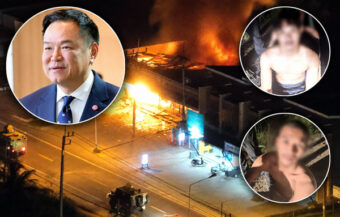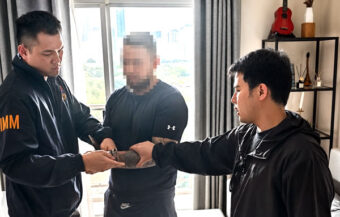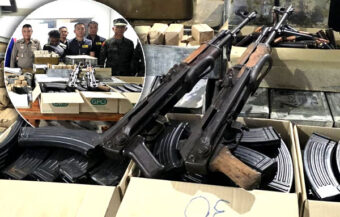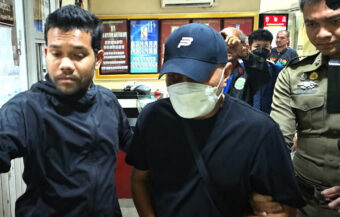
Fury grips Khao San Road as a drunk foreign tourist rips open a Krungsri ATM that swallowed his card. Police seize him within ten minutes while the spectacle exposes costly tourist reliance on Thailand’s shrinking network of 56,839 cash machines.
A drunk foreign tourist tore open a Krungsri ATM on Bangkok’s Khao San Road after it swallowed his bank card. Witnesses filmed the furious man ripping away its display and plunging inside the exposed machinery. Security guards held back, but the ATM’s automatic alarm brought police within 10 minutes. The viral rampage exposed a wider threat facing foreign visitors. Thailand’s 56,839 ATMs remain essential for tourists needing cash, despite fees reaching ฿350, rejected cards and overseas bank charges. Meanwhile, Thai machines have previously suffered multimillion-baht raids involving cutting tools, bombs, malware and data-stealing.
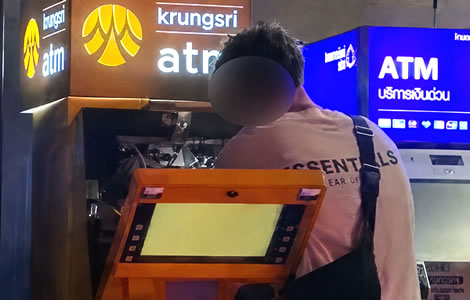
A drunk foreign tourist has been arrested on Bangkok’s Khao San Road after breaking open an ATM which swallowed his bank card. The incident occurred on Friday night. Enraged, he tore apart the machine’s display and plunged his hands into its exposed interior. Witnesses filmed him rummaging through the machinery as he hunted for the missing card.
Meanwhile, security guards watched the man attack the Krungsri Bank machine. They reportedly kept their distance because he was drunk and furious. Within minutes, the ATM’s automatic emergency system raised the alarm. Police reached the scene and arrested him less than 10 minutes later.
The disturbance unfolded amid the bars, hotels, restaurants and shops of Bangkok’s famous backpacker district. Yet the tourist appeared unconcerned by the gathering witnesses. Instead, he repeatedly reached behind the dislodged screen and searched through the upper compartment.
Tourist’s frantic ATM search spreads online as viewers question how easily he opened the display
At one point, the man removed what appeared to be a roll of receipt paper. However, he quickly threw it back inside and continued searching. His card remained missing as the machine’s display hung open above the keypad.
TikTok user @Хелен published the footage on August 28, 2026. The accompanying caption read: “ATM swallowed the card, huh? #KhaoSanRoad #Foreigner #pov.”
Notably, the video did not show how the tourist opened the display. It also ended before police arrived and arrested him. Even so, the footage captured the scale of the damage and his frantic search.
Soon afterwards, the spectacle spread across Thai social media. Many viewers questioned whether an ordinary person could open an ATM so easily. Others expressed surprise that the tourist apparently required no cutting equipment or specialist tools.
In contrast, the footage only showed the machine’s upper display section. It did not show the protected compartment containing the banknotes. ATM cash is normally stored inside a separate reinforced section deeper within the structure.
The distinction was significant. Opening the display did not necessarily provide access to the machine’s cash reserves. Indeed, the man appeared focused entirely on retrieving his retained card.
Automatic alarm brings police within minutes as guards keep well clear of the angry drunken tourist
Nonetheless, his actions left the screen hanging open and several internal components exposed. The visible damage fuelled questions about the security of ATMs positioned inside shops and tourist areas.
One Facebook user claimed the video demonstrated wider indifference towards ATM security. “This video shows that nobody cares about ATMs anymore; they’re so easy to rob!” the user wrote.
In response, the original poster rejected that interpretation. The poster said the machine contained an automatic emergency alert system connected to a rapid police response.
“Yes, there are ATMs throughout the store, but they have an automatic SOS system,” the reply said. “They were apprehended in less than 10 minutes. Don’t judge based solely on the video.”
Separately, the poster confirmed that store security guards monitored the disturbance. They reportedly avoided approaching the man because of his drunken and aggressive behaviour.
“The store’s security guards were also watching because he was drunk and angry,” the poster continued. “I’m leaving; it’s not worth getting punched, haha.”
Police subsequently reached the location and arrested the tourist. No details were supplied about his age or nationality. Likewise, the charges brought against him were not immediately disclosed.
Thailand retains Southeast Asia’s densest ATM network despite thousands of machines disappearing
Krungsri Bank also provided no public assessment of the damage. The cost of replacing the display, casing or internal equipment remained unknown. Nor was it confirmed whether technicians later recovered the retained card.
The Khao San Road incident was crude, impulsive and conducted before numerous witnesses. By comparison, previous Thai ATM raids involved planning, cutting equipment, bombs, weapons and malicious computer software.
Thailand had 56,839 ATMs nationwide in 2024, the latest complete annual figure available. That represented a marked decline from 65,148 machines in 2020. The total had already fallen to 59,589 during 2023.
Over the following year, another 2,750 machines disappeared from the national network. Mobile banking and electronic payments have driven the longer-term contraction. Despite that shift, Thailand still maintains one of Asia’s densest ATM networks.
In 2024, the country had approximately 93 machines for every 100,000 adults. Significantly, that was the highest ATM density recorded in Southeast Asia.
Foreign tourists depend on costly Thai ATMs as cash remains vital beyond major retail centres nationwide
For foreign tourists, those machines remain an important source of Thai currency. Most visitors cannot access local banking applications or Thailand’s domestic PromptPay network. As a result, they withdraw baht through Visa, Mastercard, UnionPay and other international card systems.
Cash also remains important across large parts of Thailand’s tourism industry. Street vendors, traditional markets, taxis and small restaurants frequently require banknotes. In addition, tourists often need cash on islands and throughout provincial districts.
Major hotels and retailers commonly accept international payment cards. Smaller businesses, though, can operate entirely in cash. That makes ATM access particularly important outside Bangkok and the largest tourism centres.
The cost of that access can be substantial. Thai ATM operators commonly charge between ฿220 and ฿250 for every international-card withdrawal. Some reported charges have reached between ฿300 and ฿350.
Kasikornbank’s published tariff listed a ฿220 charge for foreign Visa and Mastercard transactions. Beyond that, the traveller’s home bank may impose another overseas withdrawal fee. It may also apply a foreign-exchange margin when converting the transaction.
Foreign-card fees mount as ATM operators, home banks and currency conversion raise withdrawal costs
Consequently, one cash withdrawal can generate several separate charges. The Thai machine takes its fee before the customer’s bank applies its own costs.
Credit-card withdrawals can prove still more expensive. They may be treated as cash advances carrying an additional charge. Furthermore, interest may begin running from the transaction date.
On another front, Thai ATMs sometimes offer conversion into the cardholder’s home currency. This process is known as dynamic currency conversion. The machine displays its proposed exchange rate before completing the withdrawal.
Most Thai ATMs permit withdrawals of approximately ฿20,000 to ฿30,000 per transaction. The foreign issuing bank, however, may impose a lower daily limit. Card networks and account settings can also restrict the available amount.
Because the Thai charge applies to every withdrawal, many visitors remove larger sums less frequently. That reduces the number of flat ATM fees. At the same time, it leaves travellers carrying substantial amounts of cash.
One retained or blocked foreign bank card can immediately leave a tourist without access to cash
Dependence on one foreign card creates another problem. A retained, rejected or blocked card can immediately end access to money. The Khao San Road incident demonstrated that risk in unusually dramatic fashion.
In this case, the machine retained the tourist’s bank card. His drunken effort to retrieve it then caused extensive visible damage. Before he could leave, the ATM’s emergency system summoned police.
Card retention is only one possible interruption. A foreign bank may block a card after detecting an unusual transaction in Thailand. Alternatively, a damaged magnetic strip can prevent the machine from reading it.
Expired cards and exhausted daily limits produce the same outcome. Banks can also freeze accounts pending security or identity checks. Under those circumstances, a visitor may need to telephone the issuing bank.
In parallel, mobile telephones have become central to overseas banking security. Many banks require customers to approve withdrawals or account changes through an application. Losing the telephone can therefore prevent access to those controls.
Power cuts, empty machines and remote locations deepen cash problems as criminals target Thai ATMs
Power failures and communications outages can also disable ATMs across a particular area. During busy periods, heavily used machines may simply run out of banknotes. Weekends and public holidays can delay replenishment or access to staffed branches.
These difficulties can become more serious on islands and in remote provinces. Alternative ATMs may be located many kilometres away. Similarly, the nearest staffed bank branch may be closed or difficult to reach.
Some hotels and hospitals also request substantial deposits. Those amounts can exceed a visitor’s ATM or card limit. Meanwhile, smaller establishments may accept neither foreign cards nor electronic payments.
Thailand’s extensive network therefore handles large volumes of legitimate tourist withdrawals. At the same time, its machines have repeatedly attracted criminals seeking cash or customer information. Physical raids remain less common than card fraud and electronic theft.
Several successful attacks have nevertheless produced substantial losses. In June 2025, a robber cut open an ATM in Chanthaburi and escaped with ฿765,000. Police later arrested a 37-year-old suspect.
Police recover cash after Chanthaburi raid while organised gangs target machines across Thailand
As part of that operation, officers recovered more than ฿200,000. The raid involved equipment capable of penetrating the machine’s protected cash section.
Four years earlier, robbers targeted a Siam Commercial Bank ATM on the Chiang Mai–Hot road. They struck in February 2021 and escaped with more than ฿2 million. The machine stood outside a bank location in Chiang Mai province.
Despite the location, the thieves broke into the machine and fled before police arrived. The case demonstrated the speed required for a successful physical raid.
In September 2018, police arrested three Serbian nationals following another prepared operation. The group used a gas cutter against a Krungthai Bank ATM in Rayong. Approximately ฿100,000 was taken from the machine.
The suspects also tried cutting open a second Rayong ATM. That attempt failed to reach the stored cash. Moreover, investigators believed the group was preparing another raid in Surat Thani.
Police arrested the three before that suspected operation proceeded. Their case involved specialist equipment and more than one intended target.
Bombs, gas devices and cutting tools deliver major ATM hauls across Bangkok, Chon Buri and Rayong
Bangkok suffered a more destructive ATM attack during September 2017. A Polish man used an improvised gas device against a Bangkok Bank machine. The device tore open the ATM and released its cash.
The attacker escaped with approximately ฿300,000. At the time, metropolitan police described the method as unprecedented in Bangkok. Later that month, officers arrested the Polish suspect.
Following his arrest, police returned him to the scene for a reconstruction. His prepared attack differed sharply from the drunken Khao San Road rampage.
Another major raid struck Chon Buri during April 2014. Four men reportedly used cutting equipment to open the rear of an ATM. They escaped with approximately ฿2.9 million.
That operation produced one of the largest hauls among Thailand’s reported physical ATM raids. Once again, the thieves penetrated the protected cash section rather than the external display.
A far larger loss emerged through computer software in 2016. Criminals targeted Government Savings Bank machines without cutting through their steel compartments. Instead, malicious software forced the ATMs to release money.
Malware drains ฿12.29 million before armed Pattani raiders bomb an ATM and seize guards’ shotguns
Altogether, the malware compromised 21 machines and dispensed approximately ฿12.29 million. In reaction, the bank temporarily closed thousands of ATMs for security inspections.
The cyberattack showed how organised criminals could strike several machines through one coordinated operation. Physical raids continued, however, alongside malware and account-data theft.
In October 2025, armed men attacked an Islamic Bank ATM outside a university in Pattani. They seized two security guards and tied their hands. The attackers also stole the guards’ two shotguns.
Afterwards, the group used a bomb against the ATM while armed accomplices controlled the area. The blast failed to penetrate the machine’s cash compartment. The raiders escaped without the banknotes but retained the stolen weapons.
Security officials suspected an operation intended to finance an insurgent group. They also examined possible connections with another ATM attack in Pattani.
Elsewhere, criminal groups have targeted information entered by genuine ATM customers. In May 2025, police arrested a Bulgarian man after investigating 13 compromised machines. The ATMs were located across Bangkok and neighbouring Nonthaburi.
Electronic devices hidden inside 13 ATMs expose customer data as warnings focus on card-reader fraud
Investigators found electronic equipment concealed inside the machines. The devices reportedly used SIM-equipped connections and could intercept sensitive banking information. Thus, criminals could target accounts without stealing cash directly from an ATM.
Foreign travel guidance has also identified card and ATM fraud in Thailand. Canadian government advice specifically confirms that both forms of crime occur. It highlights unusual attachments placed on card readers as one possible warning sign.
Furious Dutchman rips ATM from its moorings after his ฿10 million investment with Thai wife fails
Young couple nabbed by police for using a home printer to counterfeit currency for ATM lodgments
Against that background, the Khao San Road case was remarkably unsophisticated. The tourist carried no bomb, cutting torch or malicious software. His apparent target was his own swallowed bank card.
Still, his drunken anger transformed a routine card-retention problem into a public rampage. The display was ripped open as witnesses watched and recorded him. Within 10 minutes, the machine’s automatic alert had brought police to the scene.
The tourist’s frantic search then ended in arrest. Behind him stood a damaged Krungsri ATM, an exposed display and the missing card which triggered the disturbance.
Join the Thai News forum, follow Thai Examiner on Facebook here
Receive all our stories as they come out on Telegram here
Follow Thai Examiner here
Further reading:
Furious Dutchman rips ATM from its moorings after his ฿10 million investment in with Thai wife fails
Body of crazed German man who refused to take his meds but instead smoked cannabis, found at home
Loony pot-smoking German who terrorises dentist clinics on the run in Nakhon Ratchasima. Arrested
29-year-old Indian tourist jumped to his death in Bangkok’s Sukhumvit area. Cannabis found in room