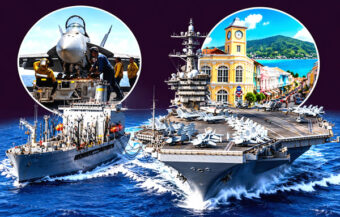
A ring of steel grips Phuket Deep Sea Port as USS George H.W. Bush arrives a day early with 5,109 US personnel. The 97,000-ton nuclear carrier anchors 3.3km offshore after six months at sea as 14 boats ferry sailors and Marines ashore under guard.
One of America’s largest warships arrived off Phuket a day early on Sunday, bringing more than 5,100 US military personnel to the island. The 97,000-ton nuclear-powered USS George H.W. Bush is anchored 3.3 kilometres offshore alongside guided-missile destroyer USS Delbert D. Black. Meanwhile, Phuket Deep Sea Port has become a ring of steel as 14 boats ferry sailors and Marines ashore. Police, soldiers, plainclothes officers, sniffer dogs and US security teams are guarding the gateway. The six-day visit marks the carrier group’s first port call since leaving America in March. It follows six months of deployment, including Middle East operations and service in the Arabian Sea. Now, thousands of crew are pouring into Phuket for long-awaited shore leave as the carrier moves into the US Seventh Fleet area.
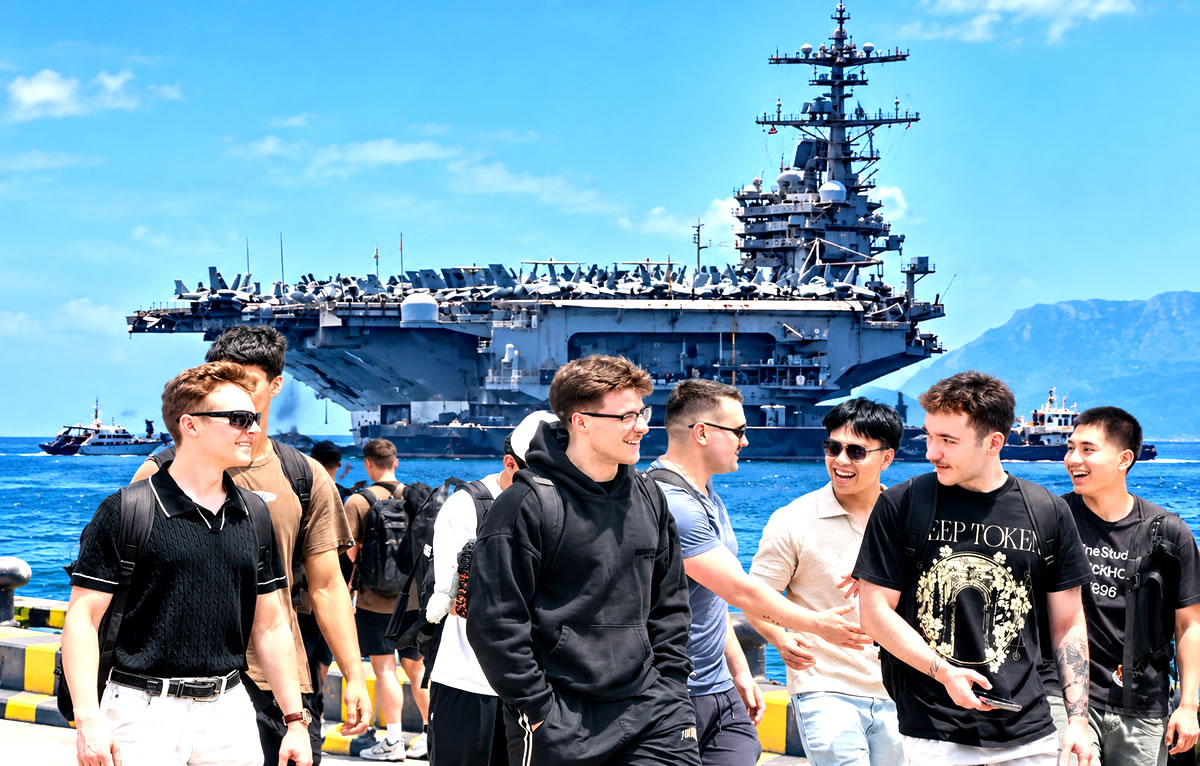
The USS George H.W. Bush arrived off Phuket early on Sunday, one day ahead of its announced schedule. The nuclear-powered aircraft carrier is anchored about 3.3 kilometres offshore, looming beyond Phuket Deep Sea Port.
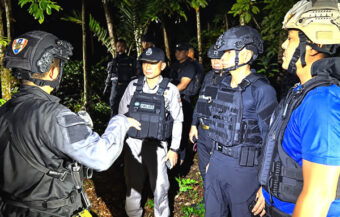
Onshore, the port has become a ring of steel for the six-day American naval visit. Police, military personnel and plainclothes officers have secured the facility. Sniffer dogs have swept sensitive areas, while US Navy security teams have established their own operational points.
More than 5,100 American military personnel arrived aboard the carrier and the accompanying USS Delbert D. Black. The giant carrier carries approximately 4,820 personnel. The guided-missile destroyer has another 289 aboard. Together, the vessels have brought 5,109 sailors and Marines to Phuket. They follow six months of deployment that included American operations in the Middle East.
First shore leave in six months begins as 5,109 US personnel arrive early off Phuket aboard two warships
Notably, Phuket is their first port visit since the carrier strike group left the United States in March. That makes the stop far more substantial than a routine replenishment call. Thousands of personnel are getting their first conventional overseas shore leave in approximately six months. They will remain in Phuket until Friday, October 9.
The arrival itself came sooner than expected. Initial arrangements called for the visit to begin on Monday, October 5. Instead, the two warships reached Phuket waters on Sunday morning. Earlier estimates also suggested approximately 5,120 personnel would arrive. The latest figure puts the combined complement at 5,109.
Because of its immense size, George H.W. Bush remains well outside Phuket Deep Sea Port. It is anchored approximately 1.78 nautical miles from the facility at Wichit. That places the 333-metre vessel roughly 3.3 kilometres offshore. Every sailor heading into Phuket must therefore first cross that stretch of water.
In response, a major ship-to-shore transport operation began shortly after the vessels arrived. Fourteen transport boats are ferrying American personnel between the warships and the port. Transfers started at about 8 am on Sunday. Buses, taxis and other vehicles were waiting as the first groups reached land.
Fourteen boats ferry US sailors ashore as Phuket manages heavy marine traffic and tight port security
In parallel, the Phuket Regional Marine Office is controlling the heavy small-vessel traffic around the anchorage. Police are managing the corresponding road movements around the port. Personnel are then being transported into Phuket’s principal tourism districts. Patong is expected to receive particularly large numbers.
Elsewhere, Kata, Karon and Phuket Old Town are also expected to attract visiting personnel. Thousands could move between Wichit and those tourism centres throughout the visit. The process must then operate in reverse as sailors return aboard. That creates a continuous maritime and road operation lasting most of the week.
Security preparations began before the American vessels appeared offshore. Thai officials had already met representatives of the US Embassy ahead of the visit. Those talks covered security, logistics, transport and the movement of thousands of military personnel. Direct communications were also established between Thai agencies and American representatives.
As part of this, visiting personnel were briefed about Thai law and expected standards of conduct. Uniformed police have since deployed around Phuket Deep Sea Port. Military personnel and plainclothes officers are also involved. Sniffer dogs have searched sensitive areas surrounding the facility.
US Navy sets up inside guarded Phuket port as carrier crew ends six months of operations in Middle East
Inside the port, US Navy personnel have established tents and operational points. These facilities are helping coordinate the movement of thousands of sailors and Marines. Thai marine officials are simultaneously controlling traffic on the water. The result is a tightly controlled gateway between two American warships and Phuket.
Pol Col Somsak Thongkliang, chief of Wichit Police Station, was among officials supervising Sunday’s arrangements. Phuket marine officials were also overseeing movements between the ships and shore. American representatives were present as the first personnel arrived. Security and transport operations will continue throughout the visit.
Beyond the security operation, the port call marks a major break in a long American deployment. Carrier Strike Group 10 departed from Norfolk, Virginia, and Mayport, Florida, in March. Since then, its personnel have spent approximately six months overseas. Much of that period involved operations within the US Central Command theatre.
During that deployment, the strike group supported Operation Epic Fury. It also supported American naval operations connected with the conflict involving Iran. George H.W. Bush operated in the Arabian Sea during that period. Phuket now provides the group’s first conventional port visit since leaving America.
Carrier commanders hail crew resilience as 97,000-ton nuclear-powered Bush anchors offshore from Phuket
Rear Admiral Todd F. Cimicata commands Carrier Strike Group 10. He described the performance and resilience of personnel during those six months as exceptional. He also said Phuket offered sailors and Marines an opportunity to experience Thai culture. Captain Justin T. Issler commands the carrier itself.
Issler described Phuket as a “well-earned opportunity” for his crew to rest. That break follows months of continuous deployment far from the United States. However, the vessel now sitting offshore remains a fully operational American aircraft carrier. Its scale dwarfs almost every other vessel around Phuket.
At approximately 333 metres, George H.W. Bush is longer than three football pitches placed end-to-end. Its flight deck reaches about 77 metres across at its widest point. At full load, the carrier displaces approximately 97,000 tons. Yet it can exceed 30 knots despite that enormous mass.
Two nuclear reactors provide the carrier’s power. Those reactors drive four propulsion shafts. Nuclear propulsion gives the vessel exceptional operational endurance. Aviation fuel, ammunition, food and other supplies still require replenishment.
George H.W. Bush is the tenth and final Nimitz-class aircraft carrier built for the US Navy. It entered service in 2009. The ship carries the name of George H.W. Bush, America’s 41st president. Bush served as a US Navy aviator during the Second World War.
George H.W. Bush carries nine aviation squadrons giving the giant carrier formidable air power at sea
He attended the carrier’s christening in 2006. Three years later, he also attended its commissioning. The vessel subsequently became one of America’s principal carrier platforms. Its central purpose is delivering naval air power from the sea.
Carrier Air Wing 7 is embarked aboard George H.W. Bush. The US Navy says the air wing comprises nine aviation squadrons. Thus, the vessel anchored outside Phuket effectively operates as a mobile military airbase. Its aircraft provide strike, surveillance, electronic warfare, command, helicopter and logistics capabilities.
When the strike group deployed in March, four strike-fighter squadrons formed its principal combat aviation component. They included the VFA-83 Rampagers and VFA-103 Jolly Rogers. VFA-105 Gunslingers and VFA-131 Wildcats were also deployed aboard the carrier. Several supporting aviation units accompanied them.
Separately, the VAQ-140 Patriots provide electronic warfare capabilities. The VAW-116 Sun Kings provide airborne command and control. Helicopter units include the HSC-5 Nightdippers and HSM-46 Grandmasters. The VRM-40 Mighty Bison logistics unit also supports the deployed aviation force.
Combined, those units give the carrier capabilities extending far beyond conventional surface warfare. Aircraft can operate hundreds of kilometres from the ship. Helicopters support maritime and other missions closer to the carrier. Other aircraft provide command, surveillance, electronic warfare and logistical support.
USS Delbert D. Black brings Aegis missile defence and multiple combat roles alongside the giant carrier
Alongside the carrier sits USS Delbert D. Black, hull number DDG-119. The ship has sometimes been loosely described as an accompanying battleship. It is not one. The US Navy no longer operates battleships.
Rather, Delbert D. Black is a Flight IIA Arleigh Burke-class guided-missile destroyer. It is approximately 155 metres long and displaces nearly 9,500 tons. Four gas turbines provide propulsion. The destroyer can exceed 30 knots.
At its core is the Aegis combat system. That system provides sophisticated detection, tracking and engagement capabilities against aircraft and missile threats. The destroyer can also perform several different combat missions. These include air defence, missile defence, anti-submarine warfare and surface warfare.
In addition, the ship can escort aircraft carriers or operate independently. Its Cooperative Engagement Capability links information gathered by ships and aircraft. This allows sensor information to contribute to a much broader operational picture. Such capabilities are central to modern carrier protection.
The destroyer carries the name of Delbert D. Black. Black was the first Master Chief Petty Officer of the US Navy. DDG-119 is the first American naval vessel named after him. Its presence in Phuket also highlights the flexible structure of American carrier operations.
US Navy confirms Delbert D. Black after escort confusion as Bush strike group moves into Seventh Fleet
Earlier reporting had created confusion over which destroyer would accompany Bush into Phuket. Initial local reports identified USS Mason. Subsequently, the US Navy confirmed that USS Delbert D. Black arrived with the carrier. That distinction matters because Delbert D. Black is not among Bush’s three originally listed destroyers.
Those vessels are USS Mason, USS Ross and USS Donald Cook. They were identified when George H.W. Bush left the United States on March 31. USS Mason also serves as the strike group’s air and missile defence commander. Accordingly, the entire carrier strike group has not assembled off Phuket.
Instead, its warships can operate separately across substantial distances while remaining part of the same formation. That structure allows the group to spread its surface combatants across a wide operational area. George H.W. Bush remains the centrepiece. However, accompanying destroyers can be reassigned according to operational requirements.
The Phuket visit also marks a geographical transition in the carrier’s deployment. Carrier Strike Group 10 has moved from the US Central Command theatre into the Seventh Fleet area. That operational region covers vast sections of the western Pacific and Indian Ocean. The Navy calls Seventh Fleet its largest forward-deployed numbered fleet.
Bush enters Seventh Fleet as senior US officers prepare Thai meetings and crews begin cultural activities
Against that backdrop, the Navy says George H.W. Bush is now conducting routine operations within Seventh Fleet. Phuket therefore provides a break between major stages of the deployment. The carrier arrived after months of Middle East operations. It will later return to operational duties.
On another front, the port call carries a substantial diplomatic and military programme. Senior Carrier Strike Group 10 officers are scheduled to meet Thai civilian and military officials. Washington has linked the visit with the longstanding US-Thai security relationship. The Navy describes Thailand as America’s oldest partner in Asia.
Thailand is also America’s only formal treaty ally in mainland Southeast Asia. Military cooperation includes the annual Cobra Gold exercise. The relationship therefore extends well beyond occasional ship visits. Still, the immediate focus in Phuket is the movement of thousands of American personnel ashore.
Organised cultural and sightseeing tours are planned. Community relations activities are also scheduled during the visit. A US-versus-Thailand football match has also been organised. The George H.W. Bush Morale, Recreation and Welfare Committee is involved in those activities.
More than 5,000 US personnel bring a potential tourism windfall to Phuket after Pattaya’s ฿100m boost
Commercially, the arrival puts thousands of comparatively well-paid American personnel into Phuket’s tourism economy for several days. Patong is expected to receive a large share. Kata, Karon and Phuket Old Town will also see visiting sailors. Hotels, restaurants, bars, taxis and tour operators are positioned to receive additional business.
A recent American carrier visit provides some indication of the possible scale. USS Abraham Lincoln visited Laem Chabang in September with approximately 5,000 sailors and Marines. The stop lasted five days. Its personnel largely travelled around Pattaya, Si Racha and surrounding districts.
Local officials estimated the Abraham Lincoln visit generated approximately ฿100 million for the surrounding economy. Earlier projections suggested visiting personnel could spend as much as ฿3,000 daily. Applied to 5,109 people, that would equal approximately ฿15.3 million each day.
That figure, however, is not an official forecast for Phuket. Not every crew member will necessarily go ashore daily. Individual spending will also vary widely. Even so, the scale of the visiting force makes the commercial impact potentially substantial.
The timing also comes shortly before Phuket’s main tourism high season. Businesses will have thousands of additional potential customers moving through the island. Transport operators will handle repeated journeys between Wichit and tourism centres. Restaurants and entertainment venues will receive sailors enjoying their first major shore break for months.
Two US carrier visits bring roughly 10,000 personnel to Thailand as Phuket manages offshore transfers
More broadly, Thailand has now received two enormous American carriers within little more than one month. USS Abraham Lincoln visited Laem Chabang from September 2 until September 6. George H.W. Bush has now followed at Phuket. The two visits brought roughly 10,000 American military personnel to Thailand within weeks.
There is, however, a major logistical difference between the visits. George H.W. Bush cannot simply discharge personnel directly onto the quay. Its offshore anchorage requires continuous boat transfers. Fourteen vessels must therefore maintain the connection between the carrier and Phuket.
Once personnel reach Wichit, the operation shifts immediately onto Phuket’s roads. Buses and taxis carry sailors and Marines towards the island’s tourism districts. Hours later, the same personnel must return through the port. They must then board transport boats for the journey back offshore.
Consequently, the operation involves three separate movements for every person taking shore leave. There is the journey from ship to port, the road movement across Phuket and the return. Marine officials must manage the first and last stages. Police and transport operators handle the movements on land.
At the same time, security personnel must control access to the port. Police, soldiers and plainclothes officers remain deployed around the facility. Sniffer dogs provide another security layer. US Navy personnel are operating their own coordination positions inside the perimeter.
Massive carrier and destroyer sit offshore as 14 boats feed thousands of US personnel through guarded port
The physical contrast is striking. Offshore sits a 97,000-ton nuclear-powered carrier measuring 333 metres from bow to stern. Nearby is a 9,500-ton guided-missile destroyer packed with sophisticated weapons and sensors. Between them and Phuket, 14 boats carry sailors and Marines towards land.
Onshore, the deep-sea port serves as the funnel for the entire operation. More than 5,100 American personnel are potentially moving through that gateway during the visit. Vehicles then disperse them across Phuket. The process continues until the ships prepare to leave.
For local agencies, that means several days of sustained maritime, road and security operations. For the carrier crew, it means their first port call since March. The contrast is considerable. Six months of overseas deployment have ended, temporarily, with shore leave on one of Thailand’s busiest tourism islands.
George H.W. Bush will remain anchored approximately 3.3 kilometres offshore until the scheduled departure. USS Delbert D. Black will remain in Phuket waters during the same period. Meanwhile, the 14-vessel shuttle will continue linking the American ships with the heavily secured port.
By Sunday afternoon, the scale of the visit was already clear. One of America’s largest warships was sitting just beyond Phuket’s coastline. A heavily armed destroyer accompanied it. Thousands of sailors and Marines were moving towards shore after months of deployment.
Early arrival puts Phuket port on alert as thousands of US sailors begin long-awaited shore leave
Crucially, the entire operation began one day earlier than initially expected. The ships appeared off Phuket on Sunday rather than Monday. Soon afterwards, the maritime shuttle began. Personnel then started moving through Phuket Deep Sea Port and onwards across the island.
For the remainder of the visit, that port will remain the operational centre ashore. Uniformed police, military personnel and plainclothes officers are guarding it. American security teams are also operating inside. Sniffer dogs have been deployed around key areas.
Just offshore, George H.W. Bush remains impossible to miss. The carrier stretches more than three football pitches from bow to stern. Its flight deck carries an entire naval aviation force. Nearly 4,820 personnel live and work aboard the vessel.
USS George HW Bush heading for Phuket for 6 days R&R. Docks October 5 with over five thousand sailors
US servicemen left behind a financial windfall in Pattaya but also a spirit of optimism and generosity
Close by, USS Delbert D. Black adds another 289 personnel. Its Aegis system and multiple warfare capabilities make it a formidable surface combatant. Together, the two vessels represent nearly 106,500 tons of American naval power in Phuket waters.
Yet the immediate operation is focused on shore leave rather than combat operations. Thousands of sailors and Marines are being ferried towards Phuket. Their carrier has just completed six months without a conventional overseas port visit. Their deployment included operations in the Arabian Sea and Middle East.
For Phuket, the figures remain stark. There are 5,109 American personnel aboard the two visiting warships. Fourteen transport vessels are moving them between sea and land. A 333-metre nuclear aircraft carrier sits 3.3 kilometres offshore.
And at the centre of the shore operation, Phuket Deep Sea Port remains under heavy security. It is the sole gateway between the American naval force offshore and the island beyond.
Join the Thai News forum, follow Thai Examiner on Facebook here
Follow Thai Examiner on Google here
Receive all our stories as they come out on Telegram here
Follow Thai Examiner here
Further reading:
Business lobby urges Anutin to improve climate for inward investment by axing old laws and red tape