Blue replaces orange for 5,281 Pattaya motorcycle taxi drivers, igniting a row over politics and road safety. Riders say tourists no longer recognise them, business is falling and they must pay ฿550 for new jackets. Some are still waiting for theirs.
A political controversy has engulfed Pattaya’s motorcycle taxi trade after officials ordered 5,281 riders to replace their familiar orange vests with blue uniforms, supposedly reflecting the seaside resort’s identity. However, drivers warn the darker jackets could cost lives on poorly lit roads. A leading road safety expert has backed their concerns, while Pheu Thai MP Adisorn Piengkes questions whether the decision was politically motivated. Orange is associated with the opposition People’s Party, while blue represents Prime Minister Anutin Charnvirakul’s Bhumjaithai Party. Meanwhile, veteran riders report confused tourists, falling earnings and compulsory ฿550 replacement costs. Some have paid but received nothing. Night-time observations have also exposed visibility concerns, while officials defend the scheme as a tourism and transport improvement. Despite mounting criticism, the controversial policy remains in force.
A political storm is gathering in Pattaya after officials ordered 5,281 motorcycle taxi drivers to abandon their traditional orange vests. The replacement blue uniforms are intended to promote the international resort’s seaside identity.
However, riders warn that the darker jackets are difficult to see at night, increasing the risk of accidents. A leading road safety expert has backed their concerns. Meanwhile, a Pheu Thai MP has questioned whether the change was intended to please political superiors.
Drivers also report confused tourists, falling passenger numbers and compulsory replacement costs of ฿550. Night-time observations have since shown the blue jackets blending into poorly illuminated roads.
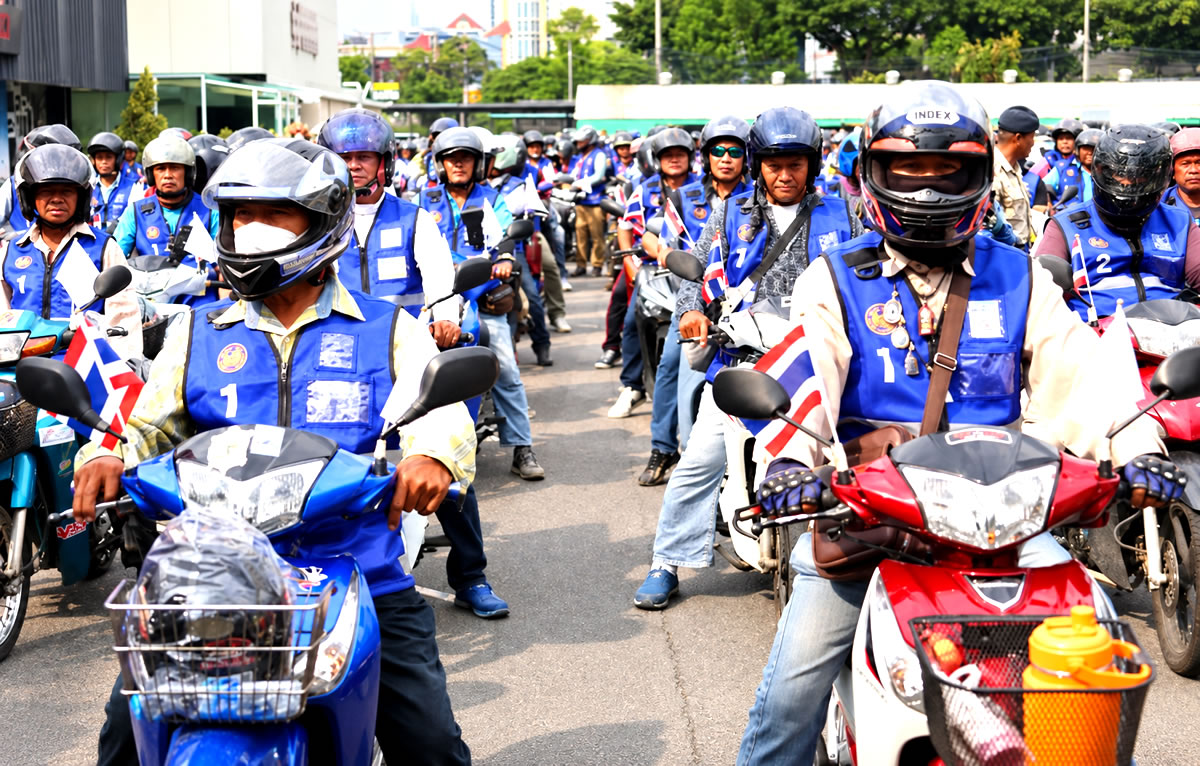
Pattaya launches blue motorcycle taxi uniforms for 5,281 riders across hundreds of registered stands
The dispute follows a major reorganisation of motorcycle taxi services across Pattaya and neighbouring Bang Lamung district in Chonburi province. Officials formally launched the programme on Friday, 16 October, at the Alcazar Theatre on Pattaya Second Road.
Deputy Chonburi Governor Pongsathit Pichanan presided over the ceremony. Alongside him were Bang Lamung District Chief Anusak Piriyamorn, police officers, provincial officials and approximately 500 motorcycle taxi operators. The event included a parade of riders displaying their new blue uniforms.
The programme covers 5,281 registered drivers operating from hundreds of designated taxi stands. Official accounts identify 564 approved stands, although another figure places the number at 554. Pattaya City Police Station supervises the largest group, with 4,558 riders operating from 478 stands.
Separately, Bang Lamung Police Station covers 525 drivers across 61 groups. Nongprue Police Station accounts for another 198 riders operating from 28 groups. The reorganisation therefore affects thousands of operators serving residents and foreign visitors throughout the resort.
Chonburi approved blue vests in 2025 as officials sought a new seaside identity and tighter taxi controls
The colour change was approved almost eleven months before the public launch. A Chonburi provincial subcommittee authorised replacing orange with blue on 20 November 2025.
Subsequently, officials incorporated the uniforms into a broader programme regulating motorcycle taxi operations. The measures include standardised registration, designated waiting areas and procedures for removing operators who breach regulations. However, the choice of blue has become the most contentious element of the entire scheme.
District Chief Anusak explained that blue was selected to reflect Pattaya’s identity as an international seaside resort. He described motorcycle taxi drivers as frontline tourism personnel who regularly encounter Thai and foreign visitors.
Consequently, their appearance, conduct and service standards contribute directly to the city’s international reputation. Officials also believe distinctive uniforms will improve passenger confidence and strengthen Pattaya’s tourism image. The scheme follows earlier complaints about disputes with passengers and inappropriate conduct by some operators.
The new jackets display information identifying each driver’s registered taxi stand. They also contain a slot for the operator’s identification card. As part of the programme, officials want passengers to distinguish registered drivers from unauthorised operators.
This is particularly important during festivals and major international events, when Pattaya attracts large crowds. Registered motorcycle taxis must also operate from approved locations and display the required identification.
Uniform suppliers face no monopoly as Pheu Thai MP questions the darker colour and its safety implications
Anusak insisted that drivers could purchase their uniforms from any supplier. There was no requirement to buy from a particular manufacturer. Nevertheless, the jackets must comply with the approved design and identification requirements.
Officials maintained that the changes would improve transport services without imposing unnecessary restrictions on drivers. The launch parade was intended to introduce the new uniforms to residents and tourists. Within days, the colour decision had become the focus of growing public criticism.
Pheu Thai Party list MP Adisorn Piengkes entered the controversy on Monday, 19 October. In a video posted on X, Adisorn questioned why officials had abandoned the familiar bright orange jackets.
He suggested that the decision might have been intended to please political superiors. Notably, he challenged the Interior Ministry’s involvement and criticised the practical consequences of selecting a darker colour. His intervention brought national political attention to the provincial decision.
Adisorn argued that orange jackets were clearly visible from a distance. By contrast, he said the new blue uniforms appeared almost black. He warned that reduced visibility could endanger motorcycle taxi drivers, particularly after dark. The criticism introduced a political dimension to what officials had presented as a tourism branding initiative. It also coincided with growing complaints from riders about the safety of the replacement jackets.
Political colour suspicions grow as road safety expert warns dark blue jackets reduce rider visibility
Orange is closely associated with the opposition People’s Party and its predecessor, Move Forward. Blue, in turn, is associated with the governing Bhumjaithai Party, led by Prime Minister Anutin Charnvirakul. The contrasting political colours have attracted attention to the decision by Chonburi officials.
However, no evidence has emerged establishing that Bhumjaithai ordered the change for political reasons. The documented decision originated with a provincial subcommittee in November 2025. Adisorn’s criticism nevertheless placed the uniform policy under political scrutiny.
On another front, a leading road safety specialist has raised concerns about the darker uniforms. Dr Thanapong Jinwong, manager of Thailand’s Road Safety Academic Centre, warned that blue jackets could reduce riders’ visibility.
He explained that clothing colour affects how quickly motorists recognise motorcycles and other road hazards. In particular, he identified fluorescent yellow-green and bright orange as colours associated with better visibility. Darker clothing can reduce the distance at which motorists identify riders.
Night-time collision fears grow as expert explains lost reaction time at speeds of 80 kilometres per hour
The danger becomes more serious at night, when drivers have less time to recognise hazards and react. Furthermore, motorcycles are smaller than cars and can be harder to distinguish in poor lighting. Dr Thanapong warned that reduced visibility could increase the danger of rear-end collisions.
His assessment focused on the practical consequences of replacing a conspicuous colour with a darker alternative. The warning came as riders were already complaining about the appearance of their new uniforms.
Dr Thanapong illustrated the problem by comparing recognition distances of 30 metres and 20 metres. At 80 kilometres per hour, a vehicle travels approximately 22 metres every second. Consequently, identifying a rider only 20 metres ahead leaves less than one second before reaching that position.
The figures illustrated the potential danger rather than results from a controlled test of Pattaya’s uniforms. Even so, the comparison highlighted the importance of visibility for motorcyclists travelling after dark.
Reflective strips proposed as night-time checks find orange motorcycle taxi vests easier to see than blue
The specialist recommended reflective strips on the front and back of the blue jackets. In addition, he suggested reflective materials on motorcycles and riders’ helmets. Such measures would improve recognition in poor lighting, particularly on roads without adequate street illumination.
Importantly, he explained that national transport regulations did not necessarily require every motorcycle taxi driver to wear orange. The dispute therefore concerns the safety of the replacement colour rather than an established regulatory breach.
Fresh observations emerged on Wednesday, 21 October, following night-time checks by local journalists. Reporters examined motorcycle taxi operations in Pattaya, comparing riders wearing orange jackets with those using the new blue uniforms.
The comparison took place in poorly illuminated conditions. The orange jackets appeared considerably more noticeable, while the dark blue material blended into the surroundings. However, the observations were informal rather than a controlled engineering assessment.
Veteran Pattaya rider challenges seaside colour rationale as delayed jackets and safety complaints mount
The checks also revealed that some riders continued wearing orange because replacement jackets had not arrived. Among those interviewed was Rat, a 65-year-old veteran motorcycle taxi driver.
He questioned the official explanation that blue reflected Pattaya’s seaside identity. Rat pointed out that motorcycle taxis operated on roads rather than at sea. Instead, he suggested brighter colours, including yellow or green, together with reflective strips. His objections centred on whether motorists could recognise riders clearly at night.
Rat rejected suggestions that his criticism was politically motivated. He maintained that visibility mattered more than whether the uniforms were orange, red or blue. Moreover, he warned that poor recognition could endanger riders and their passengers.
He urged officials to reconsider the colour decision following the safety complaints. The veteran operator also criticised the speed of the transition, saying suppliers were struggling to complete orders.
The controversy has extended beyond road safety to the commercial impact on motorcycle taxi drivers. Operators say the unfamiliar uniforms have confused passengers and damaged an already struggling trade.
Passengers struggle to identify blue-vested motorcycle taxis as Pattaya drivers report lost custom
For decades, orange jackets have identified motorcycle taxi services throughout Thailand. This recognition is particularly important in Pattaya, where many customers are foreign visitors unfamiliar with local transport arrangements. Drivers depend heavily on being recognised immediately by people seeking short journeys.
On Tuesday, 20 October, local journalists visited motorcycle taxi stands near shopping centres in North Pattaya. They interviewed operators wearing both the new blue jackets and the traditional orange uniforms.
Bannasit, 53, and Manas, 50, reported confusion among passengers. Previously, customers immediately recognised orange jackets and approached drivers seeking transport. Since the change, the pair claimed some passengers had become reluctant to use their services.
Both drivers complained that the blue jackets were too dark and difficult to distinguish at night. Equally concerning, they said the replacement colour lacked the visibility of the traditional uniforms.
They wanted the jackets returned to orange or replaced with another brighter colour. Their complaints reflected broader concerns among operators whose earnings depend on attracting passing customers. The uncertainty was especially apparent among foreign visitors unfamiliar with the new identification system.
Another rider, Sakchai, 40, reported similar problems after more than 20 years in the profession. He regarded orange as an established symbol recognised by Thai residents and international tourists.
However, he said the blue jackets were almost invisible in poor lighting. Sakchai also complained that foreign visitors appeared uncertain about approaching riders wearing blue. He believed the replacement uniforms resembled clothing worn by government personnel. That resemblance, he argued, made motorcycle taxi operators less immediately recognisable.
The reported commercial impact was particularly troubling for drivers already facing weak passenger demand. Yon, 59, said he previously carried six or seven passengers daily while wearing orange.
Since changing to blue, his daily passenger numbers had fallen to three or four. He attributed part of the decline to customers failing to recognise the new uniforms. Nevertheless, Yon acknowledged that residents and tourists would need time to become familiar with the change.
Riders seek consistent uniform rules as tourist confusion, weak demand and app competition hit earnings
Yon also called for clearer rules governing the transition from orange to blue. He believed consistent uniforms would eventually help passengers recognise the new appearance. However, the continued presence of riders wearing both colours had added to the confusion.
Some operators were still waiting for jackets they had already ordered and paid for. Others had received their uniforms but complained that customers no longer recognised them.
Another driver, Somnuek, 50, reported that his daily journeys sometimes fell from five or six to three. He acknowledged that passenger demand fluctuated and that Pattaya’s low tourist season affected business.
Separately, other operators identified competition from app-based transport services, including Bolt and Grab, as another problem. The available evidence does not establish how much of the decline results directly from the uniforms. Nonetheless, several riders believe the colour change has added to their commercial difficulties.
Passenger questions new colour as drivers face ฿550 replacement costs amid declining daily trade
A regular passenger, Somron Ruraks, 50, also reported confusion over the new uniforms. He said riders wearing blue were difficult to recognise from a distance. Previously, orange jackets made motorcycle taxi operators immediately identifiable.
He questioned the decision to abandon a colour already associated with the service. His account supported complaints that passengers were struggling to identify drivers following the change.
The financial cost of the replacement uniforms has become another source of dissatisfaction. Drivers said the new jackets cost approximately ฿550 each. Pong, a 67-year-old motorcycle taxi driver on Central Pattaya Road, complained about the additional expense. He recalled receiving free uniforms under previous governments. Specifically, he mentioned the Thaksin Shinawatra government and the military-led National Council for Peace and Order.
This time, drivers must purchase their replacement jackets themselves. Pong said the change had coincided with falling income and growing competition from app-based transport operators.
Although he supported efforts to improve regulation, he questioned the choice of such a dark colour. He also warned that reduced visibility could create dangers for drivers. The compulsory expense was particularly unwelcome among operators reporting fewer daily passengers.
Veteran riders pay for blue jackets still undelivered as suppliers struggle and safety objections continue
Two other veteran riders, Non, 75, and Rat, 76, raised similar complaints. Both had worked as motorcycle taxi drivers in Pattaya for more than 30 years. They had registered and paid ฿550 for replacement jackets.
However, neither had received the new uniform. Consequently, both continued operating in orange while waiting for their orders. They also expressed concern about colleagues unable to afford replacement jackets.
The two veteran operators questioned whether the colour change had any political significance. Both preferred a brighter colour or a return to orange. Nevertheless, they had already complied with the payment requirement despite their objections.
Their experience highlighted delays in supplying the new jackets as the scheme took effect. In the meantime, drivers wearing both colours continued serving passengers throughout the resort.
Separately, the 65-year-old Rat interviewed during the night-time observations proposed free initial replacement jackets. Drivers could then purchase additional uniforms themselves. He also complained that suppliers were struggling to meet demand.
The cost was particularly significant for operators reporting exceptionally low daily passenger numbers. Rat said he sometimes carried only two passengers during a working day lasting from 10 am until approximately 8 pm.
Replacement vests cost ฿2.9 million at retail prices as officials defend tighter taxi regulation
At ฿550 each, supplying one jacket to all 5,281 registered drivers would cost approximately ฿2.9 million. That figure is calculated from the reported retail price, not an announced government procurement budget.
For individual drivers, however, the expense comes directly from earnings already affected by weak demand. Some have paid for jackets they have yet to receive. Others are questioning why previous government assistance has not been repeated.
Bang Lamung officials continue to defend the wider reorganisation of motorcycle taxi services. District Chief Anusak said the programme followed complaints involving disputes with passengers and inappropriate conduct by some drivers.
The new arrangements include registration requirements, designated waiting areas and procedures for removing operators who breach regulations. As part of this, officials want to prevent unauthorised drivers from operating at registered taxi stands.
The identification details on the jackets are intended to improve accountability and passenger confidence. Anusak also stressed that the programme was designed to improve service standards rather than obstruct drivers’ livelihoods.
However, the available reporting does not establish whether officials conducted a formal night-time visibility assessment before selecting blue. Nor has a completed independent safety assessment of the replacement jackets been identified.
No confirmed accident or policy reversal as Pattaya riders continue to challenge blue uniforms at night
There is also no verified evidence that the colour change has already caused a road accident. Even so, the warnings from Dr Thanapong concern the potential danger of reduced visibility. The night-time observations have added to those concerns, although they were not a scientific test.
Riders have also identified difficulties attracting passengers and meeting replacement costs. The objections therefore extend across road safety, business conditions and political questions.
As of Wednesday, 21 October, officials had not announced a confirmed reversal or formal review of the colour requirement. The new uniforms remain part of the reorganisation affecting 5,281 registered drivers across Pattaya and Bang Lamung.
Off duty policeman kills a mototaxi rider and wounds two others in an early hours Bangkok roadside shooting
Pattaya Mototaxi sought after early morning assault on a drunk Indian tourist after indiscreet touching
In parallel, the political controversy continues following Adisorn’s intervention and the public objections from veteran riders. The programme has also attracted criticism from passengers struggling to recognise motorcycle taxi operators.
The complaints come as drivers face competition from ride-hailing applications and weak passenger demand. Additionally, some have yet to receive jackets they have already purchased. Others report fewer customers because tourists no longer recognise their uniforms. The safety concerns remain unresolved, while officials continue promoting the new colour as part of Pattaya’s tourism identity.
For now, orange and blue jackets remain visible at motorcycle taxi stands across the resort. The programme launched on 16 October was intended to create a distinctive image for Pattaya’s motorcycle taxis. Five days later, it faces political criticism, complaints of falling earnings and warnings about night-time visibility. The provincial decision remains in force, with thousands of riders required to adopt the new blue uniforms.
Join the Thai News forum, follow Thai Examiner on Facebook here
Follow Thai Examiner on Google here
Receive all our stories as they come out on Telegram here
Follow Thai Examiner here
Further reading:
Murder suspected by police in Pakkred, Nonthaburi. Wealthy barber charged with premeditated killing