Thailand is joining a global tax transparency network that will allow Revenue officials to scrutinise multinational profits worldwide from 2027. Backed by a new 15% OECD minimum tax, the crackdown targets offshore tax havens and could raise ฿10 billion a year.
Thailand is moving to a new era of corporate taxation after joining an OECD-led information-sharing network that will give authorities greater access to multinational tax data and help enforce a 15% global minimum tax. The changes, backed by a domestic top-up tax and due to take effect from 2027, are expected to curb profit shifting, tighten scrutiny of offshore structures and generate about ฿10 billion in additional annual revenue.
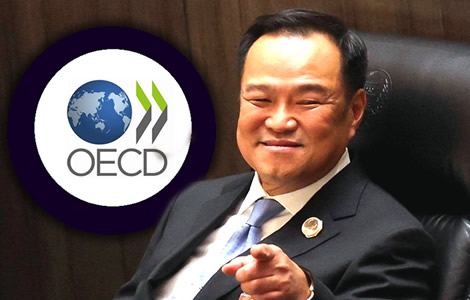
Thailand has moved closer to implementing the OECD-backed Global Minimum Tax after the cabinet approved participation in an international tax information-sharing framework.
The decision will allow the Revenue Department to exchange tax data on large multinational corporations with overseas authorities. Information exchanges are scheduled to begin in June 2027. As part of this, tax officials expect greater visibility over corporate structures, overseas profits and cross-border transactions.
Finance Minister Ekniti Nitithanprapas said the framework will strengthen Thailand’s ability to collect taxes from multinational companies operating across multiple jurisdictions. He said it will also help curb cross-border tax avoidance.
Thailand joins global tax transparency framework as OECD rules reshape multinational tax enforcement
The move places Thailand within a growing network of countries adopting common standards for corporate taxation. In turn, authorities expect stronger enforcement and improved compliance among large multinational groups.
Thailand is among the countries that have adopted the Global Minimum Tax rules developed by the Organisation for Economic Co-operation and Development. Under the framework, large multinational corporations must pay a minimum effective corporate tax rate of 15%.
The initiative was designed to address profit shifting and the use of low-tax jurisdictions. For years, multinational groups have used offshore entities to reduce tax liabilities. As a result, governments often struggled to tax profits generated within their own economies.
Meanwhile, Thailand has already completed a key legal step. The government enacted an executive decree introducing a domestic “top-up tax”. The measure allows authorities to collect additional tax from companies paying less than the OECD minimum rate.
Thailand’s top-up tax framework targets offshore profit shifting and low-tax corporate structures
Any shortfall can be recovered through the top-up mechanism. Consequently, multinational groups benefiting from very low effective tax rates may face additional tax assessments.
According to the Ministry of Finance, the combination of the top-up tax and international information-sharing will reduce opportunities for profit shifting. Previously, tax authorities often had limited access to information held overseas.
That restriction complicated efforts to examine multinational tax arrangements. However, the new framework is designed to provide a clearer picture of where profits are generated and where taxes are paid.
Mr Ekniti said multinational companies have traditionally used entities in tax havens to lower their tax obligations. International information-sharing, he said, will make such practices more difficult. Notably, participating tax authorities will gain access to a wider pool of corporate tax information. That access is expected to improve the ability to identify discrepancies between reported profits and actual business activity.
The financial stakes are significant. The Revenue Department estimates the Global Minimum Tax could generate around ฿10 billion in additional annual revenue. That figure reflects taxes collected from multinational corporations whose effective tax rates fall below 15%.
Revenue Department forecasts ฿10 billion yearly gain from OECD minimum corporate tax regime
Moreover, officials believe enhanced transparency will strengthen tax compliance across large corporate groups operating internationally.
The reform also marks a significant change in global investment policy. For decades, countries relied heavily on tax exemptions to attract foreign investment. Those incentives became a central tool in competition for multinational projects.
However, the Global Minimum Tax reduces the value of such arrangements. A company receiving tax exemptions in one jurisdiction may still face additional taxation elsewhere.
In response, governments are increasingly examining alternative forms of investment support. OECD rules allow countries to maintain competitiveness through tax credits and direct subsidies. These measures can support investment while remaining consistent with the global minimum tax framework. Therefore, the focus is shifting from broad tax holidays towards more targeted forms of assistance.
Tax credits and direct subsidies emerge as alternatives to traditional tax exemption incentives
Thailand faces limitations in that area. Mr Ekniti noted that the current Revenue Code does not yet support broader tax-credit programmes. Legislative amendments would be required before such measures could be expanded significantly.
Even so, other support mechanisms already exist. Financial assistance can be provided through the Board of Investment’s Competitiveness Enhancement Fund.
Separately, officials see the fund as an important tool during the transition. It allows targeted support for investment projects without relying solely on tax exemptions. That flexibility may become increasingly important as more countries implement the OECD framework. In effect, governments are being encouraged to compete through incentives other than low tax rates.
On another front, the cabinet decision aligns Thailand more closely with a rapidly expanding international tax system. The OECD initiative seeks to create greater consistency in the taxation of multinational corporations. It also aims to reduce gaps between national tax regimes. As more countries join the framework, opportunities for aggressive tax planning are expected to narrow.
Thailand prepares for global tax data sharing as OECD compliance rules take effect in 2027
For multinational companies, the direction of travel is becoming clearer. International tax authorities are sharing more information and coordinating more closely. Cross-border structures are facing greater scrutiny. Likewise, tax arrangements that once relied on limited transparency are becoming easier to detect.
For Thailand, the next milestone arrives in June 2027. That is when information-sharing with foreign tax authorities is scheduled to begin. By then, the top-up tax framework will already be in force.
OECD membership now at the heart of Thailand’s new plan to progress economically with higher standards
New tax era in Thailand begins as Revenue now shares data with 138 countries within the OECD
Together, the measures are expected to strengthen enforcement, improve compliance and increase tax collection from some of the world’s largest corporate groups.
Ultimately, the government’s objective is straightforward. It wants greater visibility over multinational profits, stronger compliance and higher tax revenues. With the legal framework largely in place, attention is now turning to implementation. The cabinet’s decision signals that Thailand intends to participate fully in one of the most significant changes to international corporate taxation in decades.
Join the Thai News forum, follow Thai Examiner on Facebook here
Receive all our stories as they come out on Telegram here
Follow Thai Examiner here
Further reading:
Interim government outlines economic policy. Focus on the baht and finances with 1.4% to 1.8% growth
Dark days ahead for the economy despite a 1.8% GDP gain with ominous warning signs on employment
Concern for US tariff deal as new Thai government shows enthusiasm for stronger links with Beijing
Thailand’s once mighty tourism industry is failing but now faces further damage from overvalued baht