Generations of family enterprise go up in flames as Bangkok’s Khlong Thom Centre and 300 stalls are destroyed. Traders face multimillion-baht losses with weak cover and barely ฿20,000 in relief. Chadchart says the complex cannot be saved. Gone for good.
Decades of hard work building family businesses went up in flames when Friday night’s inferno destroyed Bangkok’s Khlong Thom Centre. Around 300 stalls were lost as fire tore through the four-rai electrical and automotive hub, leaving traders without shops, stock or capital. Many face multimillion-baht losses without adequate insurance, while expected government relief averages barely ฿20,000. Now, elderly operators and their families must consider starting again as unstable wreckage, hazardous pollution and an unknown cause compound the disaster.
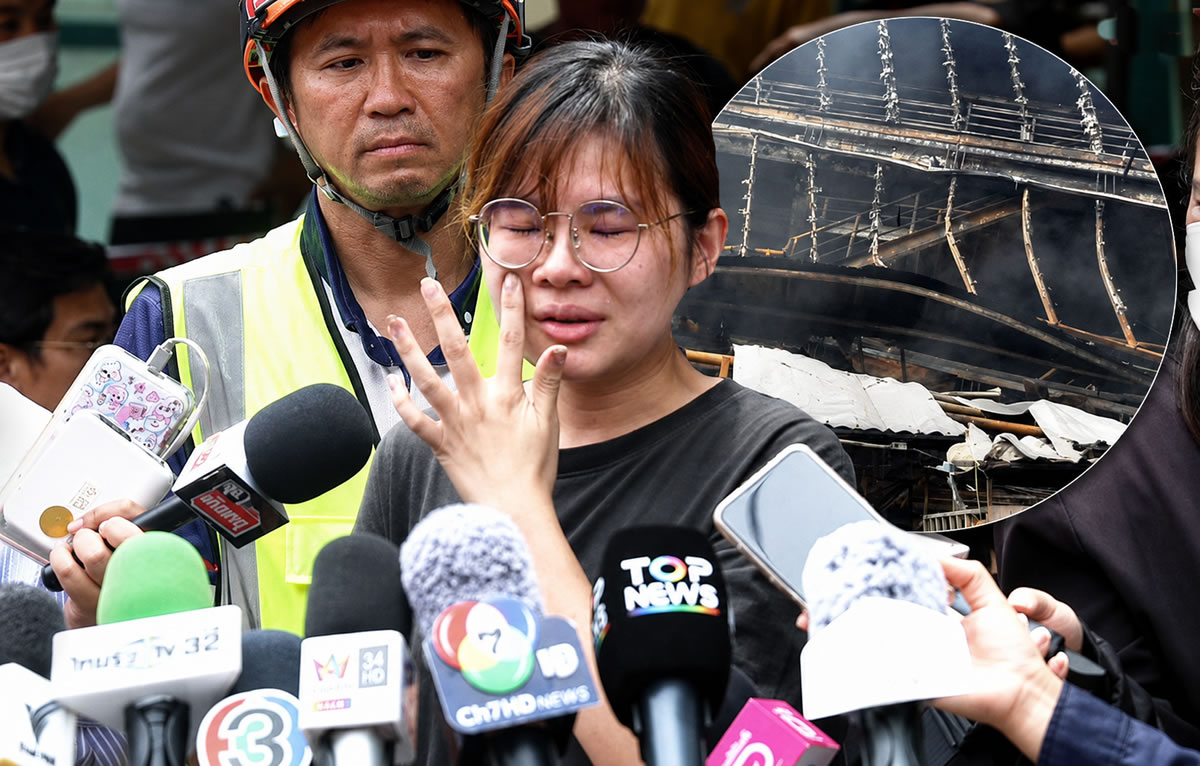
The Bangkok Metropolitan Administration is managing the wreckage left by Friday night’s Khlong Thom Centre fire. The blaze destroyed a major electrical and automotive trading hub in central Bangkok. Hundreds of stalls, storage areas and small businesses were burned out. Meanwhile, traders face multimillion-baht losses, weak insurance coverage and limited government relief.
The fire started on August 28 inside the centre in Pom Prap Sattru Phai district. It spread through shops packed with electrical goods, rubber products and automotive accessories. Furthermore, many businesses stored additional merchandise on mezzanine floors. Solar panels, lighting systems, inverters and electrical components filled other units.
The blaze burned through the night and devastated the four-rai commercial site. Floors collapsed, steel supports warped and internal sections became inaccessible. Later, fresh flames appeared after firefighters had largely contained the main fire. Consequently, crews continued working around hotspots and unstable wreckage.
Bangkok governor says the ruined Khlong Thom Centre cannot be saved as engineers assess full damage
Bangkok Governor Chadchart Sittipunt said damage covered the entire site. More than 80% of the building’s structure was affected. Crucially, he said the centre could not be saved. The complex has therefore closed indefinitely while structural assessments continue.
No formal condemnation or demolition order has yet completed the legal process. Even so, traders cannot enter the building or recover any surviving property. Engineers fear weakened sections could collapse without warning. In practical terms, the old Khlong Thom Centre is finished.
Excavators were brought in to clear routes through the debris. However, operators moved carefully because damaged floors and supports remained unstable. At the same time, firefighters struggled to reach smouldering sections deep inside the complex. Those conditions also delayed forensic examinations.
In response, Bangkok deployed drones carrying infrared cameras above the wreckage. They located hotspots and mapped sections posing risks to ground crews. Additionally, the drones tracked wind direction and smoke movement. That information helped teams plan safer access through the ruined centre.
Investigators have not established the official cause of the fire. First, they must safely reach the suspected starting area. One trader placed the origin six to eight units from her first-floor shop. Nonetheless, that account does not replace the pending forensic findings.
Up to 300 Khlong Thom traders face uncertain relief after emergency disaster assistance declaration
The centre contained approximately 300 stalls. Reports suggest those stalls were controlled by about 100 principal tenants. Separately, other estimates place the number of affected traders between 200 and 300. Several operators may have controlled multiple shops, warehouses or storage units.
Officials are checking identities, leases and evidence of losses. As part of this, they must distinguish principal tenants from employees and subtenants. The process will determine eligibility for government assistance. It will also establish the centre’s full commercial losses.
The Disaster Prevention and Mitigation Department declared an emergency disaster-assistance area on Saturday, August 29. This released government support under existing disaster-relief rules. Importantly, the declaration was not a condemnation or demolition order. Nor did it guarantee compensation matching each trader’s losses.
Early reports pointed to a possible payment of about ฿86,000. Yet that figure confused business relief with assistance for damaged permanent homes. Housing regulations allow up to ฿88,600 for repairs to a permanent residence. Since Khlong Thom Centre was commercial property, its traders do not qualify.
Instead, each eligible operator may receive slightly more than ฿20,000 on average. The package could include up to ฿13,500 for occupational equipment. In addition, ฿3,900 may cover subsistence where premises were completely destroyed. Other limited payments could come from Bangkok and the Interior Ministry.
Traders face strict claims checks as limited relief and uncertain insurance deepen devastating losses
All claims require registration, supporting documents and official verification. Accordingly, traders must prove their identities, leases and declared damage. Payments may differ according to each verified case. Nor is immediate payment assured for every applicant.
The proposed relief falls far below the reported commercial damage. Individual businesses estimate losses ranging from more than ฿1 million to ฿4 million. Notably, several traders lost their entire inventories and working capital. They also lost the premises needed to resume sales.
The centre’s building carried property-risk insurance with Dhipaya Insurance. The Office of Insurance Commission confirmed the policy after the fire. On another front, Dhipaya assessors were instructed to inspect the structural damage. The building’s insured owner may then pursue compensation under that contract.
However, the property policy does not automatically protect each tenant’s merchandise. Coverage depends upon the insured assets and precise contract terms. By contrast, traders normally require separate cover for their stock and equipment. Lost income may require additional business insurance.
The Office of Insurance Commission is checking policies held by individual traders. It is also examining cover for vehicles damaged inside or near the centre. So far, officials have not confirmed comprehensive coverage among the businesses. Several traders have already disclosed that they had no separate fire insurance.
Uninsured trader loses millions after fire destroys her family shop months into a new four-year lease
Without individual cover, tenants cannot rely upon the building owner’s insurance payment. Thus, they may depend on limited relief, savings or other available capital. For some, decades of accumulated stock disappeared within hours. Their regular commercial expenses also continue despite the centre’s closure.
Wiyaporn, 32, operated an automotive accessories and car-parts shop near the front. Her store carried rubber goods, electrical components and other highly flammable products. Above the shop, a mezzanine floor held additional stock. The fire destroyed everything in both sections.
Nothing remained from the retail space or its storage area. As a result, Wiyaporn lost her merchandise, equipment and operating capital. She initially placed the damage in the millions of baht. The destruction left her with virtually no funds.
Her family previously controlled two shop spaces inside the centre. Because rents increased, her parents decided that arrangement was unsustainable. They merged both operations into one commercial unit. Then, in January, the family signed a new four-year lease.
Only eight months later, the shop and its contents were destroyed. The family had occupied the trading area since Wiyaporn was a child. She is now 32. Over that period, she witnessed three separate fires around Khlong Thom.
Earlier fires caused limited damage but Friday night’s blaze exposed missing safety systems at centre
“Looking back from childhood to the present, my family has made a living in this area since I was in 4th grade, and now I’m 32 years old. We’ve experienced three fires in this area, the most recent of which occurred in 2017 and was caused by an electrical short circuit in an electrical supply shop.”
Previous fires generally happened during the day. Typically, firefighters contained them within two or three blocks. Nearby traders sometimes suffered minor water damage during suppression work. None caused Friday night’s widespread destruction or structural collapse.
This fire struck after normal trading ended. Moreover, large volumes of merchandise remained inside locked units. Physical shops increasingly served as warehouses for online businesses. Therefore, the losses extended beyond goods displayed for walk-in customers.
Wiyaporn said the premises lacked basic fire-safety equipment. She had never seen sprinklers installed throughout the centre. Likewise, she had not noticed permanent extinguishers in common areas. Any extinguishers may have belonged to individual shops selling such equipment.
Many established business owners were elderly. Some parents still working there were nearly 70. Simultaneously, their children and grandchildren had shifted towards online sales. The old storefronts then became storage, packing and distribution centres.
Online and shop traders lose all stock as uninsured Wiyaporn faces millions of baht in fire damage
Traders used those premises to prepare orders for customers outside Bangkok. Hence, destroyed inventory included goods awaiting provincial delivery. The blaze damaged conventional shops and online operations at once. It also removed their established fulfilment base.
Wiyaporn confirmed that her business had no fire insurance. She had also heard reports of possible ฿20,000 government payments. Against that, her estimated loss reached several million baht. The proposed relief would replace only a small fraction of her stock.
She said government agencies should consider the scale of the verified losses. Still, no increased payment has been announced. Existing calculations remain tied to established relief rules. The final amount will depend upon official assessment and documentation.
The shop itself represented decades of work by Wiyaporn’s father. He personally designed its layout and constructed its steel cabinets. He also installed the internal systems. Recently, however, he became ill.
“Importantly, this shop was the result of my father’s hard work, who recently fell ill. He personally designed the layout, built the steel cabinets, and installed all the internal systems. Today, everything has been lost in the fire and the building’s structure has collapsed.”
Ailing father cannot rebuild family shop as decades of hard work and treasured memories disappear
His health now prevents him from rebuilding the operation himself. Beyond the stock, the fire destroyed fixtures created through his labour. “It’s impossible for my ailing father to get up and start over, to rebuild everything,” Wiyaporn said. The loss left the family without its longstanding commercial base.
“Everyone might say that possessions or money that were burned can be replaced, but some memories, once lost, can never be recovered.”
Wiyaporn grew up around Khlong Thom Centre. Her parents used the business to support her education through graduation. Elsewhere inside the centre, other families followed similar paths. Children played, studied and read around nearby convenience stores and restaurants.
Kanjana, 38, operated a large electrical supply shop inside the complex. Wasana, 45, ran a car-wash and automotive-parts business. Both had traded at Khlong Thom Centre for more than ten years. Each reported being left without stock or working capital.
They started there before the trading area had a roof, air conditioning or fans. During that period, merchants worked through Bangkok’s heat in basic stalls. Gradually, the site developed into a recognised specialist trading centre. It became the women’s principal source of income.
Electrical and automotive traders lose stock and capital after building livelihoods for over a decade
Kanjana stocked solar panels, spotlights and light-emitting diode signs. Her shop also carried power inverters and other electrical equipment. Depending on the product, prices ranged from hundreds to tens of thousands of baht. The shop held large quantities across several product categories.
Preliminary estimates placed Kanjana’s loss between ฿3 million and ฿4 million. In comparison, Wasana and neighbouring traders also reported multimillion-baht losses. Their goods were destroyed throughout the affected units. The businesses retained no stock for immediate resale.
On Friday, Kanjana and Wasana left at around 5 pm. The complex was beginning to close for the evening. Their shops were normally among the final businesses to shut. Afterwards, they learned that fire was spreading through the centre.
They did not attempt to re-enter the burning building. Firefighters were already facing intense heat, thick smoke and collapsing sections. The following day, smoke and ash still covered the site. The women then saw that their shops had been destroyed.
“I can only say that I have nothing left. My life is ruined. The economy was already bad, and then this happened. I really can’t accept it,” Kanjana said.
Kanjana and Wasana lose goods worth millions after fire consumes their long-established trading shops
Both women had previously endured floods, earthquakes and the COVID-19 crisis. In each case, they eventually resumed business. This time, however, the premises and merchandise disappeared together. They described the fire as the worst loss they had experienced.
Trading conditions were already weak before the blaze. On some days, sales failed to cover operating expenses. Occasionally, the shops recorded no sales. Consequently, neither operator had spare capital for a full restart.
Kanjana said she understood the risks surrounding electrical systems. For that reason, her shop had a circuit breaker. She switched it off before leaving each evening. She also checked that no transformers or plugs remained connected.
Those measures could not stop flames spreading from elsewhere. At present, investigators have made no official finding about the cause. Forensic officers still require safe access to the suspected origin. Responsibility therefore remains undetermined.
Finding replacement premises would create another major expense. Khlong Thom attracted a steady flow of Thai and foreign customers. Over time, traders built commercial relationships around that location. The centre also became closely associated with specialist electrical and automotive products.
Veteran traders face another costly restart after fire destroys shops despite electrical safeguards
A move would require new rent, fittings, equipment and merchandise. More significantly, traders would need to rebuild customer traffic elsewhere. Kanjana and Wasana said they lacked the necessary capital. They also viewed an unfamiliar location as commercially dangerous.
The losses reach beyond physical retail sales. In parallel, many units supplied orders to customers throughout Thailand. The centre provided storage, packing and dispatch facilities for those operations. Its closure has halted that distribution work.
Air pollution created a separate emergency around the site. Smoke, dust and ash remained after the principal fire was controlled. On Saturday, Mr Chadchart visited the area and inspected the continuing operation. Bangkok teams also began measuring airborne contaminants.
Initial tests found no gases or toxic substances at immediately worrying concentrations. Volatile organic compounds measured approximately 0.4 parts per million. By comparison, particulate pollution reached extremely high levels. PM2.5 measured about 630 micrograms per cubic metre at the site.
Relocation threatens customer base as toxic smoke and extreme PM2.5 create another Bangkok emergency
In light of this, residents were advised to avoid the affected area. Anyone exposed to smoke was told to wear an N95 mask. Vulnerable groups were urged to take additional precautions. These included children, elderly residents and people with existing medical conditions.
The wind was moving towards the northeast. In turn, Bangkok expanded monitoring along the smoke’s projected route. Teams continued checking particulate concentrations despite the initial gas readings. Burned electrical and automotive merchandise remained inside the wreckage.
From an operational standpoint, crews stayed around the centre to control hotspots. They also protected neighbouring buildings from renewed flames. A complete structural inspection still requires safer access. The same restriction applies to forensic officers examining the cause.
Engineers must determine which remains require controlled removal. Only then can demolition planning proceed through the formal process. Until that work finishes, the area remains sealed. Traders cannot enter to search for goods, documents or equipment.
Financial assessments will also take time. Officials must verify hundreds of leases, business claims and inventory losses. Likewise, insurers must identify valid policies and covered property. Vehicle owners must establish whether their motor insurance includes the damage.
N95 warning issued as smoke drifts northeast while crews confront hotspots and unstable centre wreckage
The divide between insured and uninsured traders is now decisive. Those holding valid commercial policies may recover part of their stock losses. Conversely, those without protection face the full financial cost. Government relief will not match inventories valued in the millions.
The building owner can pursue the confirmed Dhipaya Insurance claim. Individual tenants cannot assume that payment will flow through to them. Unless their goods were specifically covered, their losses remain separate. No blanket insurance payment for all traders has been announced.
The centre’s destruction also removed a recognised commercial address. This matters because customers knew where to find specialist traders. It supported retail sales, storage and national distribution from one location. Recreating that structure elsewhere would require substantial funding and time.
For now, approximately 300 stalls remain destroyed or inaccessible. Hundreds of traders, workers and relatives have lost their workplace. On top of that, many operators have lost every item available for sale. Their cash flow stopped when the centre burned.
Insurance divide leaves traders exposed while claims, demolition and full structural checks continue
Expected relief averages slightly more than ฿20,000 per eligible trader. Some shop losses exceed that amount by more than 100 times. Kanjana’s preliminary estimate reached ฿3 million to ฿4 million. Wiyaporn also reported damage running into millions.
In the immediate term, Bangkok must control hotspots, pollution and structural risks. Insurance assessors must then document the building and covered assets. Government officers must process relief applications. Traders, however, remain without their premises and stock throughout that process.
Huge fire in central Bangkok at a major electronics retail centre. Governor Chadchart was on the scene
Huge fire in Bangkok brought under control. Garage owner claims a cigarette butt from a hotel caused it
Ultimately, the engineering assessment has not completed the formal condemnation procedure. Mr Chadchart’s operational conclusion was already clear. The building cannot be saved. The old Khlong Thom Centre will not return to its previous form.
For its traders, the numbers are stark. Multimillion-baht businesses vanished, while expected relief remains slightly above ฿20,000. Many lacked separate fire insurance. They now need fresh premises, replacement stock and new capital before trading can resume. Friday night saw the dreams of many small business owners, backed by decades of hard work, go up in flames. They must now try to dig deep and see if there is a way back. However, recreating another electrical and automotive centre will be hard.
Join the Thai News forum, follow Thai Examiner on Facebook here
Receive all our stories as they come out on Telegram here
Follow Thai Examiner here
Further reading:
Chiang Mai family home gutted by fire. Occupants escaped after woman of the house spotted smoke
Khon Kaen Police probing a pre dawn blaze caused by a charging EV that burned down a family home
Government sends strong warning to EV industry after a dramatic surge in consumer complaints
Thaksin wants higher excise duties on EV cars that are simply assembled in Thailand by Chinese firms
EV sector crisis as Chinese firms are trapped between lack of demand and government tax penalties
Thailand changes tack as EV revolution turns into a damp squib with warehouses full of unsold cars
Top Thai insurer says no more new policies for EV cars. Later, it emphasised renewals case by case