Thailand’s EV industry faces mounting scrutiny after two fires in three days destroyed a family home in Khon Kaen and a Volvo SUV in Bangkok. As police investigate, BYD denies fault and fresh safety concerns emerge at a pivotal moment for the booming sector.
Thailand’s electric-vehicle industry is facing a fresh test after two vehicle fires within three days destroyed a family home in Khon Kaen and consumed a luxury Volvo SUV in Bangkok, prompting separate investigations and renewed scrutiny of safety standards in one of the country’s fastest-growing industries. The incidents come as market leader BYD rejects suggestions its Dolphin EV caused the Khon Kaen blaze and as manufacturers, regulators and consumers confront broader questions over customer complaints, future investment and the sector’s direction ahead of the expiry of key government incentives in 2027.
Thailand’s electric vehicle industry is facing renewed scrutiny after two serious vehicle fires within three days, including a blaze that destroyed a family home in Khon Kaen and another that consumed a luxury Volvo SUV in Bangkok.
The incidents have triggered separate investigations and intensified attention on EV safety at a critical stage in the market’s development.
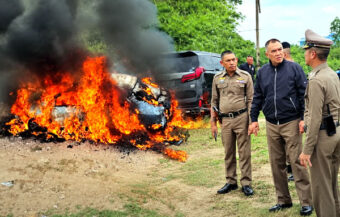
The latest fire erupted before dawn on Tuesday, June 16, at a residential property in Mueang district, Khon Kaen. A BYD Dolphin electric vehicle was charging when flames broke out and rapidly spread through the home. Five residents escaped the property as the blaze intensified. Although there were no fatalities, the vehicle was destroyed and the house suffered extensive damage.
Khon Kaen police and forensic teams examine burned BYD Dolphin as investigators probe cause
At approximately 5am, Pol Lt Wachara Ngamcheua, deputy investigator at Mueang Khon Kaen Police Station, received an emergency report from the Khon Kaen radio centre. He immediately alerted senior officers before travelling to the scene.
Shortly afterwards, Pol Col Yosawat Kaewsubthanyanit, superintendent of Mueang Khon Kaen Police Station, arrived to oversee the initial response. Police were later joined by forensic specialists examining the cause of the blaze.
Photographs from the property showed severe damage. The BYD Dolphin was reduced to a charred wreck. Meanwhile, large sections of the house were blackened by smoke and fire. Household possessions were destroyed and parts of the structure suffered extensive heat damage. As part of the investigation, officers are examining both the vehicle and the property’s electrical systems.
On Wednesday, Rever Automotive, BYD’s distributor in Thailand, issued a public response. The company rejected suggestions that a defect in the vehicle caused the fire. Instead, it said preliminary findings pointed towards external factors.
BYD distributor points to charging equipment and external electrical systems in preliminary findings
According to the company, technical specialists were dispatched immediately after the incident. Their initial assessment found no evidence linking the fire to the vehicle’s internal systems. Rather, Rever Automotive said the blaze originated from an external electrical circuit and charging equipment that was incompatible with the vehicle’s charging system.
In a statement released through Facebook, the company said investigators found that the fire was not caused by the vehicle or its built-in electrical components. However, Rever Automotive stressed that its investigation remains ongoing. Further findings will be released following additional technical analysis.
Notably, the company’s response carries particular significance within the industry. BYD remains Thailand’s dominant EV manufacturer. The Chinese brand controls close to 40% of the country’s electric vehicle market and approximately 14% of the overall automotive sector. Consequently, any incident involving one of its vehicles attracts substantial public attention.
Bangkok Volvo SUV blaze follows closely behind Khon Kaen fire as investigations continue
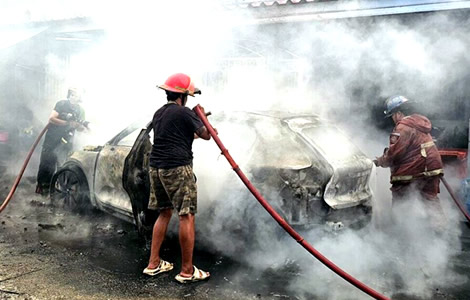
The Khon Kaen blaze occurred only two days after another high-profile vehicle fire in Bangkok. On Sunday, June 14, the 199 emergency hotline received reports of a vehicle engulfed in flames in Thawi Watthana district. The call came at 6.23pm from Soi Borommaratchachonnani 121 on Borommaratchachonnani Road in Sala Thammasop subdistrict.
Firefighters from the Thawi Watthana Fire and Rescue Station responded with a water truck and arrived to find the vehicle fully ablaze outside a two-storey townhouse. Nearby residents had already attempted to control the fire using chemical extinguishers. Nevertheless, firefighters were required to bring the situation under control.
The operation lasted approximately 10 minutes. Eventually, crews extinguished the blaze. The vehicle, however, was completely destroyed. Fortunately, there were no reports of injuries or deaths. Authorities are continuing to investigate the cause.
The vehicle involved is understood to have been a Volvo EX40 luxury electric SUV. That detail has drawn additional attention because of previous fire-related concerns involving Volvo models.
Volvo faces renewed scrutiny as earlier EV fires add context to the latest Bangkok incident
Earlier, Volvo discontinued its EX30 electric vehicle model following fires linked to the vehicle. Separately, a Volvo XC60 plug-in hybrid recently caught fire on a busy motorway. During that incident, a family evacuated the vehicle before the fire intensified. In light of those events, the latest Bangkok fire has attracted close attention from both consumers and industry observers.
The two incidents have emerged during a period of significant growth for Thailand’s EV sector. Chinese manufacturers have rapidly expanded their presence across the market. BYD has become the dominant player, supported by aggressive expansion and strong sales growth.
At the same time, consumer concerns have continued to build. Sales improved during the second half of 2025 and have remained comparatively strong throughout 2026. Even so, customer service complaints have become increasingly common. Warranty disputes have also generated criticism among vehicle owners. Now, recent fires have introduced a further area of concern.
Industry sources identify three issues confronting the sector. First, customer support standards have struggled to keep pace with rapid growth. Second, warranty and repair complaints remain widespread. Third, safety concerns have gained greater prominence following the recent fires in Khon Kaen and Bangkok.
Industry weighs safety concerns and customer complaints as the EV market continues expanding
Separately, manufacturers face growing uncertainty over future market conditions. Government subsidies and import duty reductions that helped drive EV adoption are due to expire in 2027. As that deadline approaches, questions are emerging about the long-term viability of domestic EV production.
Industry groups fear cheaper imported vehicles could undermine local manufacturing once current incentives end. Some executives believe manufacturers may increasingly rely on imports rather than locally assembled vehicles.
On another front, concerns are growing that investment in Thailand’s EV production base could weaken if market conditions change sharply after 2027.
In response, automotive industry representatives are discussing potential measures with government officials. Among the proposals under consideration are higher import tariffs and stricter local content requirements. Supporters argue such measures could encourage manufacturers to maintain production operations within Thailand.
Investigations may shape confidence as Thailand prepares for a post-subsidy EV market transition
For now, investigators remain focused on the two fires. In Khon Kaen, police, forensic experts and company specialists continue examining evidence from the destroyed property. In parallel, authorities in Bangkok are working to establish how the Volvo EX40 caught fire outside the townhouse.
The findings are expected to be closely watched across the automotive sector. Thailand has invested heavily in establishing itself as a regional EV production hub.
Khon Kaen Police probing a pre dawn blaze caused by a charging EV that burned down a family home
Government sends strong warning to EV industry after a dramatic surge in consumer complaints
Against that backdrop, the outcome of both investigations may influence perceptions of a market that has become one of the country’s most important industrial growth sectors.
Until definitive conclusions emerge, officials will continue examining the evidence from both scenes. Meanwhile, manufacturers, distributors and consumers await answers about two fires that have abruptly placed EV safety under a spotlight.
Join the Thai News forum, follow Thai Examiner on Facebook here
Receive all our stories as they come out on Telegram here
Follow Thai Examiner here
Further reading:
Khon Kaen Police probing a pre dawn blaze caused by a charging EV that burned down a family home
Government sends strong warning to EV industry after a dramatic surge in consumer complaints
Thaksin wants higher excise duties on EV cars that are simply assembled in Thailand by Chinese firms
EV sector crisis as Chinese firms are trapped between lack of demand and government tax penalties
Thailand changes tack as EV revolution turns into a damp squib with warehouses full of unsold cars
Top Thai insurer says no more new policies for EV cars. Later, it emphasised renewals case by case