Thailand’s 1-trillion-baht EU export trade faces its toughest compliance test yet as Brussels demands proof products are free from forced labour before sweeping new rules take effect December 2027.
Thai exporters face a dramatic shake-up as the government warned that sweeping new European Union forced labour rules could shut products out of one of Thailand’s biggest export markets unless companies can prove every stage of their supply chains is free from forced labour. With the regulations taking full effect on December 14, 2027, businesses are being urged to rapidly strengthen traceability systems, tighten due diligence and prepare for far tougher scrutiny from European buyers, particularly in the vital electronics sector, as Brussels rolls out one of its toughest-ever trade enforcement regimes while Thailand moves to protect more than 1 trillion baht in annual exports to the EU.
Thai exporters have been told to prepare for sweeping European Union labour rules that will tighten access to one of Thailand’s most valuable export markets.
The Department of International Trade warned businesses to strengthen supply chain oversight before the regulations take full effect on December 14, 2027. Exporters were also urged to build traceability systems capable of proving their products are free from forced labour.
The warning follows the European Commission’s publication of compliance guidance for the EU Forced Labour Regulation (FLR) in June 2026.
The document is designed to help governments, businesses and other stakeholders prepare for enforcement. As a result, companies now have a clearer roadmap for meeting the regulation’s requirements before the deadline arrives.
EU forced labour rules will ban non-compliant goods while imposing strict new supply chain standards
Once fully implemented, the regulation will prohibit the sale, import and export of goods connected to forced labour. The ban covers products linked to forced labour at any production stage.
According to the International Labour Organisation, this includes extraction, harvesting, manufacturing and every process within the supply chain. Even partial use of forced labour will place products within the regulation’s scope.
Notably, the Department of International Trade said the framework is intended to eliminate forced labour from global supply chains. It is also designed to improve transparency across international commerce. In addition, the regulation supports the United Nations Sustainable Development Goal 8.7, which targets the long-term elimination of forced labour, child labour and human trafficking.
Before issuing the guidance, the European Commission conducted extensive public consultations. Government agencies, labour organisations, non-governmental organisations and other stakeholders participated in the process.
Consequently, the final document is intended to be comprehensive, practical and capable of consistent enforcement across all European Union member states.
Guidance sets legal duties for governments, businesses and civil society under EU labour regulation
The guidance also establishes detailed responsibilities for every major participant in the trading system. Government agencies must develop inspection procedures and enforcement mechanisms for the new regulation.
Customs authorities will oversee imports and exports entering the European market. They will also investigate suspected violations and pursue legal action where required. Penalties, meanwhile, should be proportionate to the seriousness of each offence.
Businesses face equally demanding obligations under the framework. Companies must carry out due diligence throughout their supply chains before products reach European customers. They must also demonstrate that goods are free from forced labour.
That responsibility extends beyond direct suppliers and may require verification across multiple production stages. As part of this, exporters may need far more detailed records covering sourcing, production and processing.
Separately, civil society organisations receive a formal role under the regulation. They will be able to submit information concerning suspected forced labour to the relevant authorities. Victims will also be entitled to file complaints directly with government agencies in European Union member states.
Brussels to review enforcement while Thailand highlights the EU’s importance as a key export market
The Department of International Trade said these measures are intended to strengthen enforcement while improving transparency throughout international supply chains.
In parallel, the European Commission will continue monitoring implementation before the regulation becomes fully operational. Officials will review the guidance on an ongoing basis.
They will also seek further feedback from governments, businesses and supply chain participants. Any revisions will reflect changing economic conditions, social developments and practical enforcement experience before December 2027.
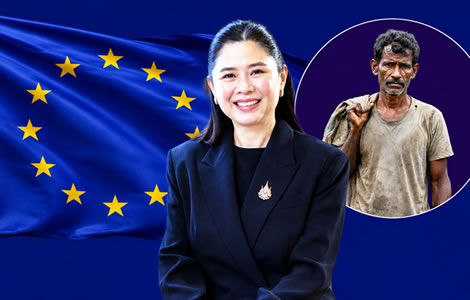
Ms Arada Fuengthong, Director-General of the Department of International Trade, said the European Union remains one of Thailand’s most important trading partners. She revealed that total bilateral trade reached approximately 1.7 trillion baht in 2025.
Thai exports accounted for roughly 1 trillion baht of that total. Imports from the European Union reached about 700 billion baht. Thailand therefore recorded a trade surplus of approximately 300 billion baht.
Electronics exporters face toughest compliance burden as European buyers demand far greater proof
Those figures, she said, underline the importance of preserving uninterrupted access to the European market. However, she warned the Forced Labour Regulation could significantly affect Thailand’s export sector.
The electrical and electronics industry is expected to face the greatest exposure because it represents Thailand’s largest export category to the European Union.
In response, Thai exporters may need to provide substantially more information to European importers. They could be required to show where products originate and how they are manufactured. Buyers may also request evidence covering every stage of production.
Documentation alone may no longer satisfy compliance requirements. Instead, businesses may need traceability systems capable of verifying the entire supply chain.
Department urges rapid traceability upgrades before tougher EU rules reshape Thai exporters’ access
On another front, the Department of International Trade urged exporters to upgrade supply chain standards before enforcement begins.
Businesses were also encouraged to accelerate investment in traceability technology and compliance systems. Early preparation, officials said, will help companies respond more effectively when European customers request supporting evidence.
Commerce Minister Suphajee visits Brussels to push a badly needed Thai European Union trade pact
Commerce Minister to travel stateside in a make or break mission on the long awaited US Thai trade deal
Looking ahead, the department advised exporters to use the remaining preparation period to review sourcing practices, strengthen due diligence procedures and improve supply chain documentation.
Companies supplying the European Union will face greater scrutiny once the regulation takes effect. By December 14, 2027, exporters will need stronger oversight, greater transparency and verifiable evidence throughout their production networks to maintain access to one of Thailand’s most significant overseas markets.
Join the Thai News forum, follow Thai Examiner on Facebook here
Receive all our stories as they come out on Telegram here
Follow Thai Examiner here
Further reading:
Commerce Minister Suphajee visits Brussels to push a badly needed Thai European Union trade pact
US Ambassador Seán O’ Neill briefed Prime Minister Anutin Charnvirakul at Government House on War
Visa waivers, discounted hotel stays and 2,000 baht a person per day for stranded tourists announced
Liquidity crisis or shortage of cash on the ground is shrinking Thailand’s economic growth prospects
Thai Minsters engage with US trade chief Jamieson Greer in Paris at global OECD ministerial meeting