Thailand has sent Deputy Prime Minister Suphajee Suthumpun to Brussels in a high-stakes bid to seal a landmark EU free trade pact after 13 years of talks, as Vietnam and Singapore widen their export advantage and only a handful of contentious chapters remain.
Thailand has stepped up its drive to secure one of the biggest trade deals in its modern history, sending Deputy Prime Minister and Commerce Minister Suphajee Suthumpun to Brussels to break key deadlocks after more than 13 years of negotiations. The push comes as Thai exporters lose ground to regional rivals Vietnam and Singapore, which already enjoy preferential access to the European Union’s vast consumer market. With more than US$45 billion in annual trade at stake, only a handful of politically sensitive chapters on agriculture, food safety and market access now stand between Thailand and a landmark free trade agreement.
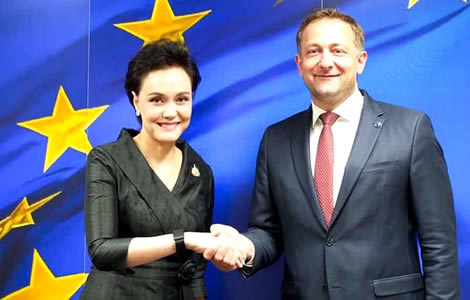
Thailand has stepped up its campaign to secure a landmark free trade agreement with the European Union, sending Deputy Prime Minister and Commerce Minister Suphajee Suthumpun to Brussels for high-level talks aimed at breaking remaining deadlocks.
The government wants to conclude negotiations in 2026 as global trade becomes increasingly uncertain and regional competitors widen their advantage in Europe’s lucrative market.
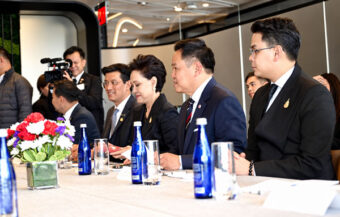
Ms Suphajee arrived in Brussels on June 24 with a senior Thai delegation. Joining her were Thai Trade Representative Veerapong Prapha, Commerce Ministry Permanent Secretary Wutikrai Leewiraphan and Department of International Trade Negotiations Director-General Chotima Iamsawadikul. Together, they held talks with the European Union’s two most senior officials overseeing trade and agriculture.
Thailand sends delegation to Brussels seeking to seal a landmark European Union trade agreement in 2026
The delegation met European Commissioner for Trade and Economic Security, Interinstitutional Relations and Transparency Maroš Šefčovič. Separately, it held discussions with European Commissioner for Agriculture and Food Christophe Hansen. Both meetings centred on accelerating negotiations and building what both sides described as a long-term economic partnership.
The Brussels mission reflects growing urgency inside Bangkok. Thailand regards the agreement as one of its most important economic priorities. Moreover, ministers see the deal as essential to expanding exports, attracting investment and strengthening competitiveness during a period of volatile global trade.
Ms Suphajee said the Thailand-EU Free Trade Agreement remains a central government policy. She said both sides recognised the importance of closer economic cooperation. That cooperation, she added, would strengthen supply chains, diversify trade risks and support shared economic stability.
Those objectives have taken more than a decade to pursue. Thailand and the European Union first launched negotiations for a comprehensive agreement in March 2013. However, the process stalled only a year later after Thailand’s military coup.
Nine-year suspension delayed talks before Thailand and the European Union revived talks in March 2023
The European Union suspended negotiations in May 2014 under its policy towards the military government. As a result, talks remained frozen for almost nine years. During that period, several neighbouring economies continued expanding their own trade relationships with Europe.
Relations gradually improved after Thailand returned to elected government. Consequently, the European Union began normalising relations in 2019. Both sides eventually agreed to restart negotiations formally in March 2023.
The renewed process began with the first negotiating round in Brussels during September 2023. Since then, officials have alternated meetings between Europe and Thailand. By the middle of 2025, six formal negotiating rounds had already been completed.
Negotiators also made steady technical progress. By early 2026, 11 of the agreement’s 24 negotiating chapters had reportedly been completed. Several additional chapters had also been agreed in principle.
Against that backdrop, the latest Brussels meetings carried added importance. Both sides are now attempting to resolve the most difficult chapters before entering the final phase of negotiations. Officials hope the ninth negotiating round will deliver substantial additional progress.
Thailand and European Union target remaining commercial chapters before a decisive phase begins
During discussions with Commissioner Šefčovič, negotiators reviewed the agreement’s principal commercial chapters. These included market access for goods, services, investment and government procurement. In addition, they examined sanitary and phytosanitary measures, known as SPS, together with intellectual property protection.
Both parties also reviewed the remaining obstacles. Notably, officials acknowledged that several chapters involve politically sensitive issues. Those areas require careful consideration before any final agreement can be reached.
Even so, negotiators agreed to accelerate work where consensus already exists. Outstanding technical issues will continue through direct discussions between negotiating teams. Both sides also agreed to maintain close contact before the next formal negotiating round.
The talks with Commissioner Hansen focused heavily on agriculture. That sector remains one of the agreement’s most complex components. Food safety rules and SPS standards also remain central to the negotiations.
The European Union stressed the importance of agricultural and livestock products. It also highlighted the significance of SPS measures governing food imports. For its part, Thailand emphasised that agriculture remains a sensitive domestic sector requiring balanced treatment.
Agriculture and food safety emerge as pivotal issues requiring careful balance before wider market opening
Thai negotiators argued that future commitments must protect domestic agricultural interests while expanding commercial opportunities. In response, European officials expressed interest in wider access for European agricultural and food exports into Thailand. Both sides agreed that further consultation will be essential before those markets can be fully opened.
Agricultural trade nevertheless remains an important strength for Thailand. The country exports substantial volumes of food and processed agricultural products to Europe. Accordingly, negotiators underlined Thailand’s strong export potential throughout the discussions.
Ms Suphajee reaffirmed Thailand’s commitment to concluding negotiations as quickly as possible. She said Bangkok would continue advancing chapters already ready for agreement. At the same time, negotiators would continue constructive discussions on unresolved issues.
She also said future commitments must reflect domestic readiness. Farmers, entrepreneurs and small and medium-sized enterprises would remain important considerations. Thailand, she added, wants every sector to benefit from the agreement.
The minister expressed confidence that the ninth negotiating round could produce further results. More importantly, she said negotiators should narrow differences on the remaining chapters. That would preserve momentum towards the final stage of negotiations.
Thailand continues pressing sensitive trade chapters while seeking to preserve forward momentum
Thailand nevertheless repeated concerns over several high-standard provisions. Officials said those issues require careful assessment before commitments can be made. Domestic impacts remain under close examination.
Commissioner Hansen responded by reaffirming the European Union’s willingness to work closely with Thailand. He expressed support for maintaining rapid progress in negotiations. Both sides agreed that regular engagement will remain essential as talks continue.
Before the Brussels meetings, negotiators had already made progress across several technical chapters. Nevertheless, significant work remains before the agreement can be finalised. Agriculture, intellectual property and market access continue to rank among the most demanding areas.
Current agricultural negotiations cover seven principal chapters. These include trade in goods, rules of origin, SPS measures, technical barriers to trade, intellectual property, sustainable trade and development, and sustainable food systems. Together, they form one of the agreement’s most commercially important sections.
Negotiators have already concluded four of those chapters. They cover specific provisions on trade in goods, technical barriers to trade, sustainable trade and development, and sustainable food systems. However, rules of origin, SPS measures, intellectual property and market access remain under active negotiation.
Remaining chapters on market access and SPS measures hold the key to completing the trade pact
Those remaining chapters are commercially significant. Rules of origin determine whether products qualify for preferential tariff treatment. Likewise, SPS provisions establish food safety and animal and plant health standards governing international trade. Both areas directly affect exporters seeking easier access to European markets.
The agreement also carries considerable economic weight for Thailand. The European Union ranks as Thailand’s fourth-largest trading partner. Consequently, Bangkok views the negotiations as central to its long-term export strategy.
Total trade between Thailand and the European Union is projected to exceed US$45.03 billion during 2025. That represents 6.58% of Thailand’s total international trade. Thailand is expected to export goods worth US$26.45 billion while importing products valued at US$18.58 billion.
Those figures leave Thailand with a substantial trade surplus. They also demonstrate the scale of commercial ties already linking both economies. Officials believe an FTA could expand those flows significantly by reducing trade barriers and encouraging new investment.
Agricultural trade provides another strong example. Total trade in agricultural and processed agricultural products stands at approximately US$2.01 billion. Thailand exports around US$1.47 billion to the European Union while importing roughly US$540 million.
Thailand’s growing trade surplus with Europe strengthens the case for concluding the delayed deal
As a result, Thailand records an agricultural trade surplus approaching US$940 million. Officials say those figures illustrate the sector’s export strength. They also reinforce the importance of securing broader market access under the proposed agreement.
Beyond trade figures, competitive pressures are also shaping Bangkok’s negotiating strategy. Thailand is no longer competing only with developed economies. Instead, it increasingly faces direct competition from neighbouring ASEAN exporters already benefiting from preferential access to Europe.
Currently, only Singapore and Vietnam have fully implemented bilateral free trade agreements with the European Union. Singapore’s agreement entered into force in 2019. Vietnam’s followed in 2020 after several years of negotiations.
Those agreements have strengthened both countries’ competitive positions. Exporters there enjoy tariff preferences unavailable to Thai manufacturers. The benefits extend across electronics, machinery, textiles, footwear and agricultural products.
Indonesia has also moved ahead. It has concluded negotiations on its own agreement with the European Union, although implementation has yet to follow. Meanwhile, Malaysia and the Philippines continue negotiating separate agreements with Brussels.
Vietnam has expanded its trade advantages beyond Europe. Following Brexit, Hanoi quickly secured the UK-Vietnam Free Trade Agreement. That accord entered into force on January 1, 2021.
Vietnam’s trade advantages increase pressure on Thailand to secure comparable agreements
The agreement largely preserved the preferential access Vietnam previously enjoyed under its European Union trade deal. Consequently, Vietnamese exporters retained favourable access to one of Europe’s largest consumer markets despite Britain’s departure from the bloc.
Thailand has yet to secure a comparable agreement with the United Kingdom. Even so, Bangkok and London have steadily strengthened their economic relationship. Both governments launched a Strategic Partnership in 2024 and agreed to pursue a future bilateral free trade agreement.
They also established an Enhanced Trade Partnership to prepare the ground for formal negotiations. However, those discussions have not yet produced a completed agreement. Thai exporters, therefore, continue facing higher tariff barriers than many Vietnamese competitors in Britain.
That competitive gap has added urgency to Thailand’s wider trade agenda. Securing agreements with both the European Union and the United Kingdom has become increasingly important. Together, those markets represent two of the world’s wealthiest consumer economies.
Without equivalent agreements, Thai exporters continue competing at a tariff disadvantage in several important sectors. That affects manufacturers as well as agricultural producers. It also influences long-term investment decisions by multinational companies choosing regional production bases.
Brussels negotiations help to strengthen Thailand’s long-term competitiveness and attract investment
The government believes comprehensive trade agreements would strengthen Thailand’s attractiveness as a manufacturing and logistics hub. Ministers also expect expanded export opportunities and stronger foreign investment if negotiations conclude successfully.
For that reason, the Brussels meetings marked more than another routine negotiating round. They represented an attempt to accelerate talks after more than 13 years of intermittent negotiations. They also reflected a shared commitment to maintaining momentum before the next phase begins.
Fears rising exports are also delivering even bigger trade deficits as Thailand becomes a transit hub
Dr. Cheng goes to Brussels to get Thailand’s access to Horizon Europe, an advanced technology programme
The process has already survived years of political interruption. It has also weathered changing governments, shifting global supply chains and growing competition across Southeast Asia. Yet both Thailand and the European Union are now working towards the same objective.
If negotiations remain on schedule, officials hope to conclude one of Thailand’s most significant trade agreements during 2026. Such an agreement would end a negotiating process first launched in 2013, suspended after the 2014 military coup and revived only three years ago. The Brussels talks were designed to move that objective significantly closer.
Join the Thai News forum, follow Thai Examiner on Facebook here
Receive all our stories as they come out on Telegram here
Follow Thai Examiner here
Further reading:
US Ambassador Seán O’ Neill briefed Prime Minister Anutin Charnvirakul at Government House on War
Visa waivers, discounted hotel stays and 2,000 baht a person per day for stranded tourists announced
Liquidity crisis or shortage of cash on the ground is shrinking Thailand’s economic growth prospects
Thai Minsters engage with US trade chief Jamieson Greer in Paris at global OECD ministerial meeting