Pheu Thai closes ranks behind Anutin as Julapun rejects rumours of a Kla Tham alliance to install Yotsanan. Yet Cholnan joins an opposition crisis forum while 38% expect the government to collapse under corruption scandals and political pressure.
Pheu Thai leader Julapun Amornvivat declared Prime Minister Anutin Charnvirakul’s coalition “very strong” on Friday, rejecting reports of an emerging Pheu Thai–Kla Tham power play to install Deputy Prime Minister Yotsanan Wongsawat. However, former Pheu Thai leader Cholnan Srikaew is preparing to address an opposition forum on Thailand’s crisis of confidence. Meanwhile, nearly 38% of respondents in a national poll expect the government to fall. Recruitment corruption claims, Senate election collusion and the Khao Kradong land dispute lead the threats closing in.
Pheu Thai Party leader Julapun Amornvivat moved on Friday to reject reports of turmoil inside Thailand’s coalition government. He insisted his party remained firmly behind Prime Minister Anutin Charnvirakul. Notably, he described the government’s position as “very strong”. His declaration followed reports of a possible political realignment involving Pheu Thai and the Kla Tham Party.
Those reports pointed to a plan to elevate Deputy Prime Minister Yotsanan Wongsawat to the premiership. In response, Mr Julapun offered no support for the claims during his Government House interview. He instead presented Pheu Thai as a disciplined coalition partner standing firmly behind Mr Anutin. He also rejected suggestions that senior party figures were moving towards the opposition.
The denial came amid mounting public concern over the government’s political and economic problems. Last Sunday, a national opinion poll delivered a harsh assessment of its prospects. Nearly 38% believed the Anutin government would not survive its growing challenges. Separately, almost one-third believed it could handle none of the problems listed by researchers.
Julapun backs Anutin as Cholnan prepares to address an opposition seminar on Thailand’s political crisis
Mr Julapun spoke to reporters at 9.50 am on Friday, August 28. He serves as both Minister of Labour and Pheu Thai Party leader. Accordingly, his remarks represented the party leadership’s formal position. Much of the questioning centred on former Pheu Thai leader Cholnan Srikaew.
Dr Cholnan is preparing to speak at an opposition seminar on Saturday, August 29. The event carries the title “Thai Politics in a Crisis of Confidence”. Inevitably, his planned appearance raised questions about Pheu Thai’s commitment to the government. Dr Cholnan previously served as Pheu Thai leader, opposition leader and Minister of Public Health.
Mr Julapun confirmed that he had already spoken with Dr Cholnan about the invitation. Even so, he planned another discussion before Saturday’s event. Pheu Thai remained open to members participating in public and political activities, he said. Furthermore, the party did not prohibit members from meeting citizens or attending seminars.
According to Mr Julapun, the Office of the Opposition Leader invited Dr Cholnan because of his former parliamentary position. Thus, the invitation did not stem solely from his standing within Pheu Thai. Dr Cholnan would participate in only one section of the wider discussion. In parallel, several other former opposition leaders were expected to take part.
Abhisit and former opposition leaders join Cholnan for a debate on public confidence in Thai politics
Democrat Party leader Abhisit Vejjajiva was among those scheduled to participate. The programme also included several other former opposition leaders. Against that background, Mr Julapun placed Dr Cholnan’s involvement within a broader gathering of former parliamentary figures. He said the relevant discussion would not directly focus on the government.
Instead, the session would examine public confidence in Thailand’s political system. On that basis, Mr Julapun saw no immediate cause for concern. He also expressed confidence in Dr Cholnan’s political judgment and experience. Additionally, he described the former party leader as a respected senior figure.
Mr Julapun believed Dr Cholnan could speak within an appropriate framework. Nonetheless, he wanted another conversation before the event. That discussion would examine Dr Cholnan’s views about participating. It would also cover the seminar’s purpose, political content and use of public money.
Public seminars could produce worthwhile results when organised with genuine intentions, Mr Julapun said. For instance, they could bring political figures into direct contact with citizens. They could also allow participants to exchange ideas about public affairs. Beyond that, those ideas could spread more widely throughout society.
Julapun warns that state-funded seminars must inform the public rather than serve partisan interests
Mr Julapun drew a clear distinction between public discussion and political campaigning financed by the state. Specifically, he warned against using government money for partisan purposes. Excessive political content could turn the event into a misuse of public funds, he said. As a result, he wanted to examine the matter more closely with Dr Cholnan.
At that stage, Mr Julapun had not seen the seminar’s complete agenda. Consequently, he could not assess every scheduled session. Reporters asked whether opposition speakers would use the gathering to attack the government. He replied that each session carried its own separate subject.
Still, the Pheu Thai leader set a clear standard for every publicly financed political event. Government expenditure must remain transparent and follow its approved purpose. Equally, public money should support communication with citizens. It should not finance political advantage for any party.
Reporters then raised the opposition’s previous use of seminars to criticise governments. They also questioned whether Dr Cholnan’s appearance could create friction among coalition partners. In reply, Mr Julapun dismissed the prospect of an internal rupture. He said the appearance would not damage government stability.
Pheu Thai dismisses coalition friction as Julapun insists Cholnan’s opposition appearance poses no threat
Previously, Mr Julapun had told Mr Anutin that the partnership exceeded a conventional political coalition. Rather, he described it as a government working for the people. “We work together without division and have always collaborated well on all matters,” he said. From his perspective, nothing surrounding the seminar could shake the coalition.
Pheu Thai remained ready to work under the Prime Minister’s direction, Mr Julapun said. Likewise, the party would follow the coalition government’s agreed course. Its immediate task remained advancing public-sector work. Hence, he saw no foundation for discord over Saturday’s opposition event.
Mr Julapun also rejected any direct connection between Dr Cholnan’s appearance and a future no-confidence debate. At the same time, he acknowledged parliament’s responsibility to consider evidence presented during such proceedings. He described scrutiny as a normal mechanism within a majority-rule democracy. Every parliamentarian must listen to the arguments before reaching a decision.
Members must judge whether the opposition has produced new information, he said. They must also examine its relevance and credibility. Crucially, the same test applies regardless of which party presents the material. Coalition members, however, remain responsible for maintaining government business.
Julapun says coalition parties must weigh new evidence while keeping the government’s programme moving
Mr Julapun compared their task to steering the ship of state towards an agreed destination. That objective involved improving public welfare and quality of life. Under those circumstances, he expected the governing parties to continue working together. Only drastically new or damaging information could change that position, he said.
“As for being a coalition government, we are working together to steer the ship of state toward the goal of improving the well-being and quality of life of the people, which is a general principle. Therefore, unless there is something drastically new or detrimental, I believe we must ultimately move forward to advance the government for the benefit of the people.”
Reporters next asked whether senior Pheu Thai figures could strengthen the opposition by joining its events. Once again, Mr Julapun rejected that suggestion. “No, not at all. I’m not sure how others view this process, but it’s normal in parliamentary debates to have differing opinions on the same issue, even within the same party.”
Internal differences ended once the party adopted a formal resolution, he said. Thereafter, every member was expected to proceed together. Personal opinions did not automatically amount to rebellion against the coalition. Instead, formal party decisions determined Pheu Thai’s parliamentary votes.
Pheu Thai closes ranks behind party resolutions as Julapun rejects any boost for the opposition camp
Mr Julapun cited Pheu Thai’s support for the government’s emergency borrowing decree. The party backed the measure with its full parliamentary strength. In his account, Pheu Thai considered the project beneficial. It therefore supported the decree as a committed government partner.
“But ultimately, everyone adheres to the party’s framework. When the party’s resolution is made, everyone must be ready to move forward together.”
Mr Julapun then expanded on Pheu Thai’s support for the borrowing measure. “For example, regarding the vote on the emergency decree for borrowing, the Pheu Thai Party voted wholeheartedly because we saw it as a beneficial project.”
He said the party remained ready to advance mechanisms intended to help citizens. “As a coalition government party, we are ready to push forward the mechanisms for helping the people, and we just move forward, that’s all.”
Reporters then asked directly whether the government remained stable. Mr Julapun answered that it was “very strong”. Earlier that morning, he had met Prime Minister Anutin at Government House. Yet they had not discussed coalition instability or political realignment.
Their conversation focused solely on labour matters. In other words, Mr Julapun gave no indication that emergency coalition negotiations were underway. Nor did he refer to any plan involving Mr Yotsanan. His stated position remained that Pheu Thai fully supported the existing government.
Pheu Thai cites its borrowing decree vote as proof of firm support for Anutin and the coalition government
On another front, reporters asked about a planned dinner involving the governing parties. Mr Julapun said the Prime Minister had not formally informed him about the arrangements. Nevertheless, he had heard that preparations were underway. The proposed gathering still lacked a confirmed time and location.
Mr Julapun understood that the meetings could be divided into two groups. First, Mr Anutin would meet ministers from the governing parties. Afterwards, a second gathering would include all coalition members of parliament. No completed programme had been announced.
The possible meetings come during an intense test of public confidence. The latest National Institute of Development Administration poll detailed the scale of concern. Released on Sunday, it carried the blunt title “So Many Problems, Will It Survive?” Researchers questioned 1,310 people aged 18 and over across Thailand.
The survey was conducted between August 18 and August 20. It examined political, economic and security problems affecting the Anutin government. Overall, nearly 38% believed the government would not survive those challenges. The finding contrasted sharply with Mr Julapun’s declaration of firm coalition stability.
The largest concern involved claims of corruption in local government civil service recruitment examinations. Some 62.75% identified that issue as a threat to government stability. Put differently, almost two-thirds selected the recruitment controversy. No other listed problem attracted a higher response.
Anutin plans coalition gatherings as a national poll exposes deep public doubts over government survival
Claims of collusion in the Senate election ranked second. Some 55.88% identified the case as a threat to the government. Meanwhile, 42.29% cited parliamentary scrutiny of the Khao Kradong land dispute. Together, those issues dominated the poll’s political findings.
Energy price volatility came next, attracting 37.33% of responses. In addition, 33.36% selected the Thailand-Cambodia conflict. The government’s spending plans under a ฿400 billion borrowing decree concerned 28.78%. Agricultural commodity price movements followed closely on 28.17%.
Proposed restrictions on gun ownership were cited by 25.27%. Elsewhere, 24.27% pointed to stricter eligibility rules for the 2026 state welfare card programme. Illegal activities involving foreigners in Thailand concerned 22.98%. Scrutiny of the TH-AI Passport project attracted 18.17%.
The TH-AI Passport project falls under the Ministry of Digital Economy and Society. Yet it ranked below every other specified issue in the survey. Only 5.34% dismissed all the listed problems as insufficient to threaten government stability. In effect, more than nine in ten identified at least one serious danger.
The poll then examined confidence in the government’s ability to respond. Here again, the findings showed widespread doubt. The largest group, 39.69%, believed the government could handle only some challenges. They therefore expected several problems to remain unresolved.
Senate claims and the Khao Kradong dispute deepen concern as economic and security pressures also mount
Another 31.99% believed the government could handle none of the listed issues. Combined, those two groups represented 71.68% of respondents. By comparison, only 16.26% believed the government could manage every challenge. A further 11.68% thought it could resolve most of them.
Finally, 0.38% did not know or declined to answer. The figures placed Mr Julapun’s statement of unity against a severe public assessment. However, the survey measured public expectations, not the government’s parliamentary numbers. It did not calculate the coalition’s exact voting strength.
Mr Julapun maintained that Pheu Thai remained fully behind Prime Minister Anutin. He also rejected suggestions that Dr Cholnan’s seminar appearance changed the party’s position. Even so, the two men will speak again before Saturday’s event. Their discussion will cover its purpose, content and use of government money.
As pressure mounts Prime Minister Anutin says he’ll fight Senate election collusion allegations in court
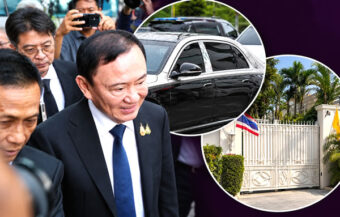
Thaksin back at centre of politics as Pheu Thai power play with the Kla Tham Party is speculated upon
For now, Pheu Thai’s formal position remains unchanged. The party supports Mr Anutin, backs the coalition and rejects reports of an approaching realignment. Meanwhile, the government faces recruitment corruption claims, the Senate case and the Khao Kradong dispute. Economic, welfare, security and border pressures add to that burden.
Against this difficult backdrop, Mr Julapun’s message was direct. Pheu Thai remains inside the government and will follow its formal resolutions. Above all, he insisted the coalition remained solidly behind Mr Anutin. Dr Cholnan’s opposition appearance, he said, would not change that position.
Join the Thai News forum, follow Thai Examiner on Facebook here
Receive all our stories as they come out on Telegram here
Follow Thai Examiner here
Further reading:
Ex PM and Democrat Party leader urges politicians implicated in Senate Collusion files to come clean
Opposition and People’s Party leader attacks ‘blue regime’ on the 12th anniversary of the 2014 coup
Thammasat University legal scholar and 1992 protest leader warns another coup cannot be ruled out