Thailand braces for a defining Senate ruling as Abhisit warns of injustice and opposition leaders demand 229 cases reach the Supreme Court. The Election Commission has decided unanimously but will keep its verdict secret until September 14 this year.
Former Prime Minister Abhisit Vejjajiva has warned that Thailand risks entering a period of injustice as opposition heavyweights unite over the unresolved 2024 Senate election. At an emergency forum moved from a Bangkok hotel to Parliament, the former premier joined opposition leader Nattapong Ruangpanyawut, Cholnan Srikaew and Chaitawat Tulathon in challenging a political order they fear is concentrating power through the Senate and independent agencies. The Election Commission has already reached a unanimous position on 229 cases involving 138 senators and 91 political figures. Yet it will reveal nothing until September 14. With one investigative panel recommending proceedings and another clearing those accused, the decision on a Supreme Court referral could become a defining political moment for public acceptance of Thailand’s emerging political system.
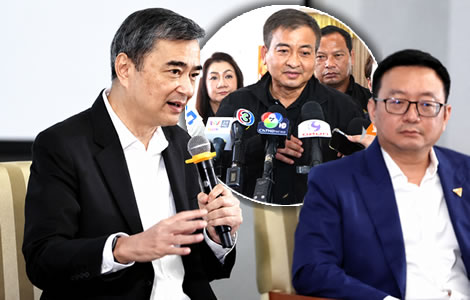
Former Prime Minister Abhisit Vejjajiva warned Saturday that Thailand risked entering a period of injustice. His intervention came during a gathering of senior opposition figures at Parliament. At issue was the Election Commission’s handling of the disputed 2024 Senate election. More than two years after the poll, the commission has announced no outcome.
Mr Abhisit was the most senior political figure on the stage. The former prime minister now serves as a list Member of Parliament. He has also returned as leader of the Democrat Party. His presence placed the Senate dispute within a wider argument about Thailand’s political order.
Alongside him was People’s Party leader Nattapong Ruangpanyawut. Mr Nattapong attended as Leader of the Opposition in the House of Representatives. Former opposition leaders Cholnan Srikaew and Chaitawat Tulathon also participated. Their appearance brought together senior politicians from several competing traditions.
Opposition leaders warn Senate ruling may confirm a new order of controlled politics in Thailand
Notably, each speaker focused on constitutional power, independent agencies and the Senate. They treated the pending decision as a seminal point in Thai politics. Its acceptance could gradually confirm a new order of controlled politics. Under that structure, political influence would operate through institutions created to provide checks and balances.
At the centre lies an investigation involving 229 people. They include 138 serving senators and 91 political figures or executives. Senior government and Bhumjaithai Party figures also appear within the inquiry. Their legal positions remain unresolved.
Initially, one investigative committee recommended proceedings against all 229 people. Its members included Election Commission and Department of Special Investigation officers. In contrast, a later Election Commission committee recommended clearing those accused. That body was identified as the 36th committee.
The seven election commissioners must now reconcile those sharply different recommendations. Election Commissioner Narong Rakroi confirmed they reached a unanimous position Friday. They reviewed the disputed Senate cases on August 28. Yet their formal announcement will not come until September 14.
Accordingly, the public still does not know how many cases may reach court. The commission could refer all 229 people to the Supreme Court. It could instead select a smaller group. It could also decline to refer anyone.
Senate inquiry tests confidence in independent agencies as cancelled seminar moves to Parliament
Against this background, the ruling will extend beyond individual suspects. It will test confidence in the Senate and independent constitutional organisations. Opposition figures claim the 2017 Constitution enabled a select network to consolidate influence. The Senate’s role in institutional appointments stands at the centre of those claims.
The Senate helps select members of powerful independent agencies. Decisions by those bodies are also difficult to challenge through ordinary legal channels. Meanwhile, the Senate’s own selection process remains under investigation. Many serving senators are among those facing possible proceedings.
The seminar itself began with an abrupt venue change. Organisers had booked the Pullman Hotel Bangkok for Saturday morning. At the last moment, the hotel cancelled the event. Parliament then became the replacement venue.
At about 9.20 am, Mr Nattapong opened the gathering. It formed part of his programme to meet members of the public. The forum carried the title “Thai Politics in a Crisis of Confidence: The Truth Society Demands Answers To.” He described the transfer to Parliament as a slight emergency.
Mr Abhisit first addressed the cancellation with sarcasm. He had accepted an invitation delivered through the Chief Opposition Whip. In part, he expected to test the Prime Minister’s reported praise for the hotel’s food. The transfer prevented that examination.
Abhisit says a strong opposition is essential as parliamentary power becomes dangerously concentrated
In response, Dr Cholnan suggested ordering food from the Pullman Hotel. Mr Abhisit declined. He said he had already given his word to attend. He then shifted directly to the opposition’s constitutional function.
Mr Abhisit offered encouragement to every opposition Member of Parliament. He said an effective opposition remained essential to democracy. Without one, political authority would become concentrated. Thai society, he added, did not always understand that function.
He then repeated a phrase he often used. “Whether a country is a democracy or not has nothing to do with the government.” Instead, he said it depended upon whether an opposition party existed. Without an opposition, he warned, power would become concentrated.
Even so, opposition parties were frequently accused of objecting to everything. Mr Abhisit said their parliamentary records showed a different picture. Opposition members regularly voted for government legislation. Those votes rarely received significant coverage.
By comparison, disagreement attracted attention because it exposed political differences. Mr Abhisit described that scrutiny as the opposition’s central value. Most public questions had more than one side. Differing positions therefore required examination inside Parliament.
Turning to the wider system, Mr Abhisit said he was extremely concerned. His concern covered both Thailand’s condition and its institutional arrangements. Previously, political fears centred on governments controlling large parliamentary majorities. Such dominance could reduce Parliament to a voting instrument.
Abhisit contrasts rigid Thai party control with freer parliaments as Senate networks now gain power
Under those conditions, government members simply followed party instructions. Parliamentary checks consequently lost much of their force. Mr Abhisit compared that practice with systems used elsewhere. Other parliamentary governments generally reserved strict discipline for essential votes.
For example, those votes included budgets and no-confidence motions. They also covered questions deciding whether a government survived. On other matters, lawmakers often exercised more freedom. They could support opposition measures or reject government proposals.
Thailand operated differently, Mr Abhisit said. Political parties imposed binding instructions during almost every parliamentary vote. As a result, Parliament’s internal checking mechanisms became weaker. Important oversight powers then moved towards independent organisations.
Those organisations were created because political scrutiny was considered inadequate. They were expected to remain neutral. Some accountability to the public was also required. For that purpose, the Senate received a role in selecting their members.
In practice, Mr Abhisit said the arrangement produced problems during every political era. The Senate was not always neutral. Alternatively, it might begin neutrally before changing over time. Its members could form networks and accumulate power.
Abhisit warns justice system is difficult to scrutinise before answering Bhumjaithai Party criticism
At that point, the former prime minister described current developments as frightening. He pointed particularly towards events within the justice system. Effective scrutiny of those developments had become extremely difficult. Political expression could itself draw a severe institutional response.
“We hoped that independent organisations would be neutral by having some form of accountability to the people, and that’s why we used the Senate,” Mr Abhisit said. “But we’ve faced problems in every era because, in reality, the Senate isn’t always neutral.”
He then described how political neutrality could weaken gradually. “Or, it might start out neutral, but over time it becomes less so and begins building power networks.” His next warning focused directly on the justice system.
“What’s frightening today is that it has gone so far that we see many phenomena appearing in the justice system,” he said. “Scrutiny is extremely difficult. It’s like using freedom of speech to conspire to overthrow the government.”
Separately, Mr Abhisit answered comments from Supachai Jaisamut. Mr Supachai is a Bhumjaithai Party list Member of Parliament. Mr Abhisit questioned why he considered a response necessary. He then delivered a pointed personal remark.
“I don’t understand why Mr. Supachai Jaisamut, a party-list MP from the Bhumjaithai Party, has to respond to me,” he said. “I don’t know what he ate, but he should calm down a bit.”
Abhisit vows Democrats will use every lawful tool as he now warns Thailand risks enduring injustice
Despite his concerns, Mr Abhisit separated the national situation from the opposition’s performance. He recalled major past battles against the Pheu Thai Party. Those disputes occurred inside Parliament and elsewhere. He declined to reopen their details.
Instead, he said the Democrat Party had always emphasised duty. Opposition parties must use every tool supplied by law. They must also exercise their constitutional rights. Nobody should doubt their willingness to act.
“I’m concerned about the state of the country, but I, as the opposition, am not worried about performing my duties,” he said. “In the past, when I fought against the Pheu Thai Party, there were many situations that were very significant.”
Mr Abhisit then closed that passage by returning to the immediate constitutional dispute. “However, what we at the Democrat Party always say is that we must do our duty.” He said opposition parties must use their lawful rights.
“Therefore, I don’t want anyone to worry about performing our duties,” Mr Abhisit said. “Ultimately, I believe that no one will allow the country to remain in a state of injustice.”
Nattapong says Senate appointment system places independent organisations under intense scrutiny
Earlier, Mr Nattapong had opened the forum by identifying a national confidence crisis. Specifically, he cited checks surrounding the Senate selection process. He said those checks were essential to democratic politics. The unresolved Election Commission case therefore dominated his address.
By coincidence, the seminar fell on a political anniversary. Saturday marked exactly 100 days since Mr Nattapong first warned about the “blue regime.” He defined that expression in direct terms. He called it “an authoritarian regime that lacks democracy.”
In his account, democracy required checks and balances. Institutions must also remain accountable to the electorate. They could not operate completely outside public control. Thailand’s current arrangements, he said, pointed in the opposite direction.
For instance, independent organisations were appointed through members of the current Senate. The Senate’s own selection process now faced manipulation and fraud claims. Several senators also faced possible proceedings. Those circumstances placed the appointment system under direct scrutiny.
Nattapong links Senate case to nationwide political control amid direct conflict of interest claims
Beyond that, Mr Nattapong linked the Senate with the party leading the government. He said the connection showed the “blue regime” monopolising power nationwide. Senate collusion, in his assessment, marked the beginning of broader political control. The dispute therefore extended beyond individual candidates.
As supporting evidence, he cited an earlier appearance by Police Colonel Tawee Sodsong. Police Colonel Tawee spoke during another opposition leader’s forum. He held up a book while discussing the Senate case. Mr Nattapong said the presentation illustrated the wider corruption issue.
From Mr Nattapong’s perspective, Saturday’s shared platform represented an important milestone. Several former opposition leaders appeared together despite their different political histories. Each had carried responsibility for scrutinising governments. Their presence moved the discussion beyond one party.
On another front, Mr Nattapong addressed the likelihood of court proceedings. He acknowledged that many analysts expected little from the Election Commission. Four of its seven commissioners were selected through the current Senate. Numerous senators also faced possible indictment.
That overlap created claims of a direct conflict of interest. Some observers considered a meaningful prosecution almost impossible. Mr Nattapong accepted that the argument carried weight. He nevertheless rejected surrender to those circumstances.
Opposition demands Supreme Court referral as Election Commission faces two contradictory findings
Politicians entered public life to make impossible outcomes possible, he said. Politics otherwise could not move society forward. Simply accepting existing institutional limits would produce no change. Repeated public forums could make rejection increasingly difficult.
As part of this effort, the opposition would keep placing information before the public. The Election Commission would eventually need to explain its evidence. It would also need to address its committees’ opposing findings. The September 14 delay allowed further scrutiny.
Crucially, Mr Nattapong distinguished the commission’s function from the Supreme Court’s role. The commission did not need to determine final guilt. It only needed sufficient grounds to suspect Senate election fraud. The court would then assess responsibility.
For that reason, he urged commissioners to send the full file to the Supreme Court. He said the law made that duty clear. A referral would allow judicial examination of the evidence. Refusal would leave the commission to explain its own reasoning.
Before Saturday, reports suggested commissioners would decide the matter Friday. Those accounts followed information from an Election Commission briefing. Officials later insisted the reports were false. The denial created fresh uncertainty around the timetable.
Narong confirms unanimous Senate case decision as Chaitawat challenges public trust in commission
Nonetheless, Mr Narong confirmed that commissioners had reviewed the files Friday. He said all seven reached a unanimous decision. He also said the matter had been resolved during that meeting. His statement confirmed the substance of the earlier timetable.
Over the previous three months, commissioners had worked continuously on the investigation. Some weekly meetings were missed because of other commitments. Additional information might still be required. Even so, Mr Narong confirmed September 14 as the formal decision date.
When asked about opposition and civil-society activity, Mr Narong dismissed any effect on the commission. “Oh, no. It’s something that can be done. We will proceed according to our procedures,” he said. He also stressed compliance with laws and regulations.
Regarding pressure, Mr Narong said he had experienced none during the three-month review. He then asked the public to trust the entire commission. “Rest assured, have confidence in all seven of us, the Election Commission. Thank you,” he said.
For his part, Mr Chaitawat questioned whether that confidence remained intact. He first challenged the Senate’s historical and constitutional position. Under a new constitution, supporters must explain why the chamber should survive. Without a clear answer, he said, it should disappear.
Chaitawat traces Senate to 1947 coup and demands all 229 cases go before Thailand’s Supreme Court
Historically, Mr Chaitawat traced the present Senate to the 1947 coup. That coup abrogated the existing constitution. An appointed upper chamber was then created. Its purpose, he said, was controlling the elected House of Representatives.
Over time, Thais were taught that a Senate was essential to parliamentary government. Mr Chaitawat rejected that assumption. He said a new constitution required a fresh justification. Otherwise, the chamber had no reason to remain.
More immediately, he challenged the Election Commission’s action against people who disclosed investigation documents. He asked how prosecuting them could restore confidence. In his view, those disclosures showed confidence had already collapsed. The people involved could no longer tolerate the inquiry’s handling.
Rather than pursuing the sources, Mr Chaitawat urged commissioners to refer all 229 cases. Further inquiries could then identify additional facts and connections. Material still remained with the Department of Special Investigation. Some of it never entered the commission’s examination.
Likewise, Mr Abhisit had referred to further evidence held by the department. The commission had refused to include some material. Alternatively, the department had rejected proposals concerning its use. Mr Chaitawat demanded another review before September 14.
Chaitawat flags financial links and selective charges as prosecutors reject a narrow eight-person case
Of particular concern were additional connections involving financial assistance. Mr Chaitawat wanted those links examined. He also demanded a clear explanation of the final reasoning. Any selective referral would require detailed justification.
Some observers feared commissioners would pursue only minor participants. Mr Chaitawat said they might instead prosecute nobody. Another possibility involved referring about 30 people. Depending on the files, those selected might reach prison more quickly.
To illustrate the scale problem, Mr Chaitawat cited a document dated January 16, 2026. Special Cases Division 1 prepared it for the Department of Special Investigation. The department had sent prosecutors a file naming eight people. They included two senators and six claimed accomplices.
Prosecutors returned that file to the department. They considered eight suspects insufficient for such a large operation. That response now bears directly on the wider case. The Election Commission’s inquiry covers 229 people across politics and the Senate.
Taken together, the files leave the commissioners facing several unresolved questions. They must explain how they assessed evidence against all 229 people. They must also reconcile the contrary committee recommendations. Finally, they must identify who will enter the Supreme Court process.
September 14 Senate ruling will shape confidence in Thailand’s independent constitutional system
Any exclusion of high-profile figures would draw an immediate opposition response. It would also intensify claims about the Senate’s institutional influence. The 2017 Constitution gave independent organisations extensive legal authority. The Senate, meanwhile, secured influence over their appointments.
Compounding the issue, those organisations issue decisions that are difficult to challenge. Their neutrality therefore remains central to the constitutional structure. The Senate involved in selecting them, now faces its own unresolved election case. Many serving members appear among those under investigation.
Police launch investigation into leaked DSI files thought to be linked to opposition Senate revelations
Political pressure building up in advance of expected August 31st decision on the controversial Senate collusion case
Ultimately, the September 14 announcement will reach far beyond individual prosecutions. It will shape political acceptance of the institutional system now operating in Thailand. Whatever the outcome, the Election Commission faces a defining ruling. The Senate case has already become a seminal point in Thai politics.
Join the Thai News forum, follow Thai Examiner on Facebook here
Receive all our stories as they come out on Telegram here
Follow Thai Examiner here
Further reading:
Ex PM and Democrat Party leader urges politicians implicated in Senate Collusion files to come clean
Opposition and People’s Party leader attacks ‘blue regime’ on the 12th anniversary of the 2014 coup
Thammasat University legal scholar and 1992 protest leader warns another coup cannot be ruled out