Thailand’s neon sex trade hides a deepening HIV danger as online prostitution bypasses regular health checks. Nearly 60,000 infections may be undiagnosed, while 620,000 people carry the virus and more than 10,000 Thais still die annually in Thailand.
Behind the neon signs of Thailand’s vast nightlife industry, HIV remains a deadly and deeply entrenched threat. Prostitutes and customers increasingly arrange paid sex through websites, applications and private messages. They then meet inside hotels, rented rooms or homes, bypassing medical checks once imposed through established sex venues. UNAIDS estimates that 620,000 people nationwide now carry HIV, while almost 60,000 may remain undiagnosed. Thailand’s infection rate is twice the American level and four times that across the European Union. Meanwhile, 10,217 AIDS-related deaths were projected for 2025, alongside 8,862 new infections. Bangkok carries the largest burden, while sex workers, transgender women and men who have sex with men face elevated risks. Thailand now remains almost nine times above its target of fewer than 1,000 annual infections by 2030.
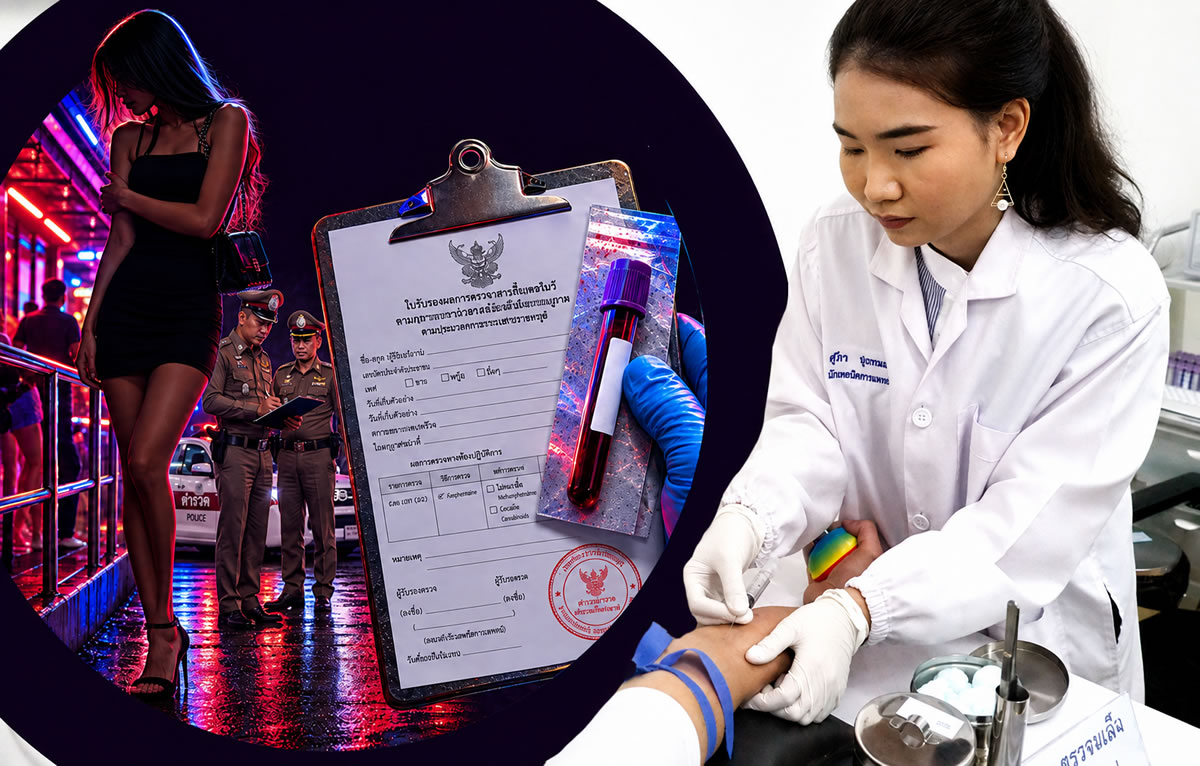
Thailand’s HIV epidemic now centres on three hard figures. More than 500,000 people live with the virus nationwide. Almost 60,000 may not know they are infected. Meanwhile, AIDS-related illnesses still kill over 10,000 Thais annually.
The sex industry presents another major pressure point. Its migration online and onto the streets has weakened long-established screening arrangements. Previously, many workers underwent regular examinations inside recognised venues. Today, private digital transactions can bypass that entire structure.
Thailand’s Department of Disease Control estimates that 565,600 people currently live with HIV. About 495,800 receive antiretroviral treatment. By contrast, almost 60,000 may remain unaware of their status. That hidden population cannot begin treatment or achieve confirmed viral suppression.
UNAIDS estimates 620,000 HIV cases as infections stall and Thailand falls far behind its 2030 target
Separately, UNAIDS estimates that 620,000 people live with HIV in Thailand. Its modelling range extends from 560,000 to 690,000. Different methods, definitions and reporting periods explain much of the variation. Even so, every dataset identifies a substantial and persistent epidemic.
These figures do not represent half a million recent infections. Rather, they count people living through an epidemic spanning more than 40 years. Modern medicine allows treated patients to survive much longer. As a result, the accumulated caseload remains high despite earlier declines in transmission.
At the same time, new infections have stopped falling quickly enough. Thailand continues recording an estimated 8,000 to 9,000 infections annually. The Department of Disease Control estimated 8,862 infections during 2025. Against this backdrop, Thailand’s 2030 target remains below 1,000 annual infections.
The present rate is therefore eight or nine times that target. Progress has remained largely stalled for five or six years. More significantly, the department projected 10,217 AIDS-related deaths during 2025. The projected death toll exceeded the estimated number of new infections.
Effective treatment is already available across Thailand. Yet thousands still die from illnesses linked to advanced HIV. Some patients enter treatment after extensive immune-system damage. Others remain undiagnosed and receive no medicine at all.
Almost 60,000 HIV cases remain undiagnosed as late treatment leaves patients and partners exposed
In practical terms, the estimated 60,000 undiagnosed cases form a major breach. These patients cannot suppress a virus they do not know they carry. Consequently, their health can deteriorate before treatment begins. Their sexual partners may also remain unaware of possible exposure.
Successful antiretroviral treatment can reduce HIV to undetectable levels. At that stage, the patient cannot transmit the virus through sex. This principle is called “undetectable equals untransmittable,” or U=U. Crucially, it requires testing, diagnosis, medication and continuing viral suppression.
Without diagnosis, none of those steps can begin. Late detection also gives HIV more time to damage the immune system. Accordingly, some infections are discovered only after serious illness develops. Treatment can manage HIV but cannot always reverse earlier physical damage.
Thailand’s former sex-industry health system drove infections down through screening and condoms
Thailand’s commercial sex industry has long occupied a central place in this history. Decades ago, the government introduced strict screening and prevention measures. Prostitution remained illegal under Thai law. Nonetheless, state agencies worked directly with businesses operating across the industry.
Thailand’s HIV epidemic is concentrated heavily among men who have sex with men, including homosexual and bisexual men. Transgender women also face disproportionately high infection rates. However, the supplied figures do not establish that these groups account for most people currently living with HIV.
Geographically, Bangkok records Thailand’s largest estimated number of new infections. The capital combines a large population with extensive nightlife and commercial sex markets. Consequently, people living in Bangkok and those with multiple sexual partners face elevated exposure.
Sex workers and their customers also remain disproportionately affected. Meanwhile, online and street-based sex can bypass the regular screening once conducted through established venues. Infections can then spread to customers and their other partners without detection.
Thailand’s former sex-industry health system drove infections down through screening and condoms
Officials worked with bars, clubs, massage premises and sex-for-sale establishments. Workers underwent regular health examinations. In addition, many required medical certification before working inside recognised venues. This arrangement placed much of the visible trade within a recurring screening system.
Health teams knew where workers could be reached. They could return to the same establishments and conduct further examinations. As part of this, condoms and sexual-health information could be distributed through venue networks. Managers also knew workers were expected to hold medical certification.
The programme never covered every sex worker. Nor did it make prostitution legal. Still, it created a practical disease-control structure across much of the visible industry. Regular contact linked many workers with healthcare services.
That programme contributed to Thailand’s sharp reduction in HIV transmission. During the 1990s, annual infections reportedly approached 170,000 at their peak. Subsequently, the figure fell below 10,000. Condom promotion and direct engagement with sex venues formed key parts of that response.
The structure of commercial sex has since changed markedly. Websites, mobile applications and social media now connect workers directly with customers. Private messages can arrange meetings without any established venue. In turn, the transaction may escape every former workplace health check.
Online and street-based sex bypasses the health checks once built around Thailand’s established venues
Online meetings can occur inside hotels, rented rooms or private homes. No bar, club or massage premises need be involved. Likewise, no venue manager may request health certification. The earlier screening structure therefore has no automatic point of contact.
On another front, parts of the industry have moved directly onto Thailand’s streets. Workers may change locations and operate without links to recognised businesses. Under those conditions, recurring health checks become harder to maintain. Contact with specialist services may also become irregular.
The former system depended on concentration. Health teams could visit known venues containing identifiable groups of workers. Conversely, the current market is dispersed across digital accounts and temporary locations. Thousands of private arrangements can remain largely invisible.
That transformation has weakened a system built for another commercial model. Fixed premises once provided entry points for screening and prevention. Now, smartphones can remove both workers and customers from those networks. The industry has expanded beyond many of its former health controls.
Notably, this change has coincided with stalled reductions in annual HIV transmission. Thailand remains near 9,000 estimated infections each year. Its 2030 target requires a fall below 1,000. The remaining gap is wide and the deadline is approaching.
Private online sex market leaves infections hidden as Bangkok and 15 provinces carry the heaviest burden
The online market also cuts across traditional categories. Female, male and transgender workers can all advertise privately. Similarly, customers can arrange encounters without entering an entertainment venue. No formal business relationship may ever exist.
An undiagnosed worker may therefore meet multiple customers before learning of an infection. Those customers may later expose other sexual partners. In parallel, none may view themselves as connected to a recognised higher-risk group. Testing can then be delayed across several linked relationships.
The available statistics do not identify every occupation among the undiagnosed population. They cannot show how many sell or purchase sexual services. Nonetheless, almost 60,000 infections remain outside confirmed diagnosis. The fragmented sex market creates further opportunities for infections to stay hidden.
Thailand’s epidemic remains concentrated among particular populations. Men who have sex with men are disproportionately affected. Transgender women, sex workers and people who inject drugs also face higher infection rates. Their sexual partners may face greater exposure as well.
Geographically, Bangkok records the country’s largest estimated number of new infections. Half of all estimated new infections occur across only 15 provinces. Thus, the epidemic is not evenly distributed across Thailand. The heaviest burden falls on particular locations and populations.
Bangkok’s changing sex trade tests prevention services as infections rise sharply among younger Thais
Bangkok also contains a large and varied commercial sex market. Established venues continue operating alongside online and street-based activity. Unlike fixed businesses, informal operators may have no continuing relationship with health services. This makes consistent screening more difficult.
Associate Professor Opas Putcharoen works at the Thai Red Cross AIDS and Infectious Diseases Research Centre. He says Thailand does not lack preventive tools. Instead, services fail to reach enough people who need them. Testing, condoms and preventive medicines are already available.
Pre-exposure prophylaxis can prevent infection before contact with HIV. Post-exposure treatment is available following possible contact. Despite this, uptake remains inadequate. Pre-exposure prophylaxis remains concentrated among people already connected to specialist services.
Elsewhere, many people underestimate their personal exposure. Shame and fear of disclosure also discourage testing. For that reason, some infections remain undiscovered until symptoms appear. The delay increases the possibility of advanced disease.
Younger people represent another prominent concern. Reports suggest that about one-third of recent recorded infections involve those aged 15 to 24. However, annual estimates vary between reports. One economic and social assessment cited approximately 13,000 cases.
Disease data reveals unsafe sex among young Thais as 60,000 HIV infections remain outside treatment
The Department of Disease Control’s model produced a figure closer to 9,000. This discrepancy may reflect differences between diagnosis and infection dates. For example, somebody diagnosed during 2025 may have contracted HIV years earlier. Newly diagnosed cases therefore cannot automatically represent recent transmission.
Other sexually transmitted infections provide a clearer measure of unsafe sexual contact. Over five years, recorded syphilis cases among young people rose sharply. The number climbed from 4,326 to 11,813. In comparison, recorded gonorrhoea cases increased from 3,912 to 9,897.
Both totals more than doubled during the period. Syphilis cases came close to tripling. Taken together, the figures confirm continuing unprotected sexual activity among young people. They also strengthen concerns about further HIV transmission.
HIV is no longer widely perceived as immediately fatal. Advances in treatment have changed that perception. On the other hand, condom use has weakened among some younger people. Many also underestimate the likelihood of personal exposure.
Sexual health education remains inconsistent. Additionally, youth-friendly clinics do not reach everybody requiring their services. Fear of disclosure can further delay testing. These gaps allow infections to remain unknown and untreated.
The 60,000 undiagnosed cases sit at the centre of this problem. Each represents a person outside confirmed treatment and viral suppression. Some may have carried HIV for years. During that period, serious illness and further transmission remain possible.
Thailand treats almost 496,000 HIV patients but late diagnosis still drives more than 10,000 deaths
Of Thailand’s estimated 565,600 infected people, about 495,800 receive antiretroviral medicine. That leaves a substantial gap between infection and treatment. In effect, effective drugs coexist with tens of thousands of hidden cases. The projected annual death toll shows the consequences of delayed or absent care.
Treatment generally continues throughout the patient’s life. Regular medicine suppresses the virus and protects the immune system. Furthermore, patients require viral-load monitoring and reliable healthcare access. Each new infection therefore creates another long-term treatment requirement.
Longer survival partly explains why the national caseload remains above 500,000. Patients receiving successful treatment can live for decades. Simultaneously, another 8,000 to 9,000 infections enter the total each year. The combination prevents a decisive fall in overall prevalence.
The projected 10,217 AIDS-related deaths provide a separate measure. HIV medicine is effective, yet fatal outcomes continue at substantial levels. In many cases, late diagnosis leaves less time for treatment. Advanced infection can already have caused severe immune damage.
Thailand’s HIV prevalence exceeds Asian, American and European rates despite Africa lifting world average
Measured internationally, Thailand’s burden remains high. Adult prevalence stands at approximately 0.8% among those aged 15 to 49. The corresponding global rate is near 0.7%. At first glance, the difference appears limited.
That global benchmark requires qualification. Eastern and southern Africa lift the worldwide average substantially. Across Africa, adult prevalence is approximately 2.9%. In several southern African countries, it exceeds 10% or even 20%.
Thailand remains far below those levels. Outside Africa, though, a prevalence rate near 1% is unusually high. The kingdom exceeds the Western Pacific regional average. It also stands above most neighbouring Asian countries.
The comparison with America is more direct. Around 1.2 million people live with HIV in the United States. America therefore has about twice Thailand’s infected population. Yet its overall population is nearly five times larger.
The American caseload represents approximately 0.36% of the total population. Thailand’s corresponding figure is close to 0.8%. Hence, Thailand’s rate is roughly twice the American level. National risk still varies sharply between communities in both countries.
Europe presents an even wider difference. Adult prevalence across the European Union and European Economic Area has historically stood near 0.2%. Thailand’s rate is about four times higher. This comparison excludes Russia and higher-prevalence Eastern European countries.
Thailand carries an outsized global HIV burden as online sex weakens its former screening safeguards
The broader World Health Organisation European Region includes Russia, Ukraine and parts of Central Asia. Those countries carry heavier HIV burdens than Western Europe. As such, their inclusion raises the regional average. Thailand still remains far above the European Union level.
Thailand contains approximately 0.9% of the world’s population. Nevertheless, it accounts for an estimated 1.4% to 1.5% of people living with HIV. Its share of the global caseload therefore exceeds its population share. The difference amounts to roughly 50% to 70%.
The national epidemic now combines an old caseload with continuing new transmission. Treatment keeps hundreds of thousands alive. At the same time, almost 9,000 estimated infections are added annually. More than 10,000 AIDS-related deaths are still projected each year.
Within this picture, the changing sex industry carries particular significance. Thailand’s earlier strategy relied heavily on recognised venues and recurring medical checks. Online and street-based work can bypass both. The former system now reaches less of the commercial market.
Previously, regular screening created repeated contact between workers and health services. Certification also placed responsibility inside established premises. Today, independent workers can operate without either arrangement. Customers may never know whether any recent health examination occurred.
Hidden HIV cases, weaker sex-industry checks and 10,217 annual deaths define Thailand’s continuing crisis
This fragmented market exists alongside almost 60,000 undiagnosed infections. It also operates while annual transmission remains far above Thailand’s target. Moreover, rising sexually transmitted infections reveal continuing unprotected sex among younger people. These pressures now overlap within the same national epidemic.
Thailand has the medicines needed to control HIV after diagnosis. It also has testing, condoms and preventive treatments. What the figures show is a substantial coverage gap. Nearly 60,000 infected people remain beyond confirmed diagnosis.
The death toll supplies the hardest measure. The Department of Disease Control projected 10,217 AIDS-related deaths during 2025. That figure stands despite decades of prevention programmes and modern treatment. It also exceeds the department’s estimate of 8,862 new infections.
Procedural move in parliament may well stall the Sex Workers Act making prostitution in Thailand legal
AIDS/HIV temple at the centre of massive fraud and embezzlement as top monk disrobes and confesses
Thailand is not facing 500,000 recent infections. It is supporting more than half a million people accumulated across four decades. Even then, the present figures remain severe. Transmission has stalled, hidden infections remain widespread and deaths exceed 10,000 annually.
Three linked facts now define the position. The sex industry has moved beyond many former screening controls. Almost 60,000 people may carry HIV without knowing it. Finally, AIDS-related illnesses continue killing over 10,000 Thais every year.
Join the Thai News forum, follow Thai Examiner on Facebook here
Receive all our stories as they come out on Telegram here
Follow Thai Examiner here
Further reading:
Sex tourism from the United Kingdom to Thailand spotlighted in BBC documentary series just aired
Pattaya punters preyed upon by transgender sex workers in a rash of hotel robberies while showering
Australian wheelchair user cheated by Thai woman he met on Pattaya’s beachfront on Thursday morning
Death sentences for the gruesome Pattaya murder of German property mogul Mr Ralter Mack in July 2023