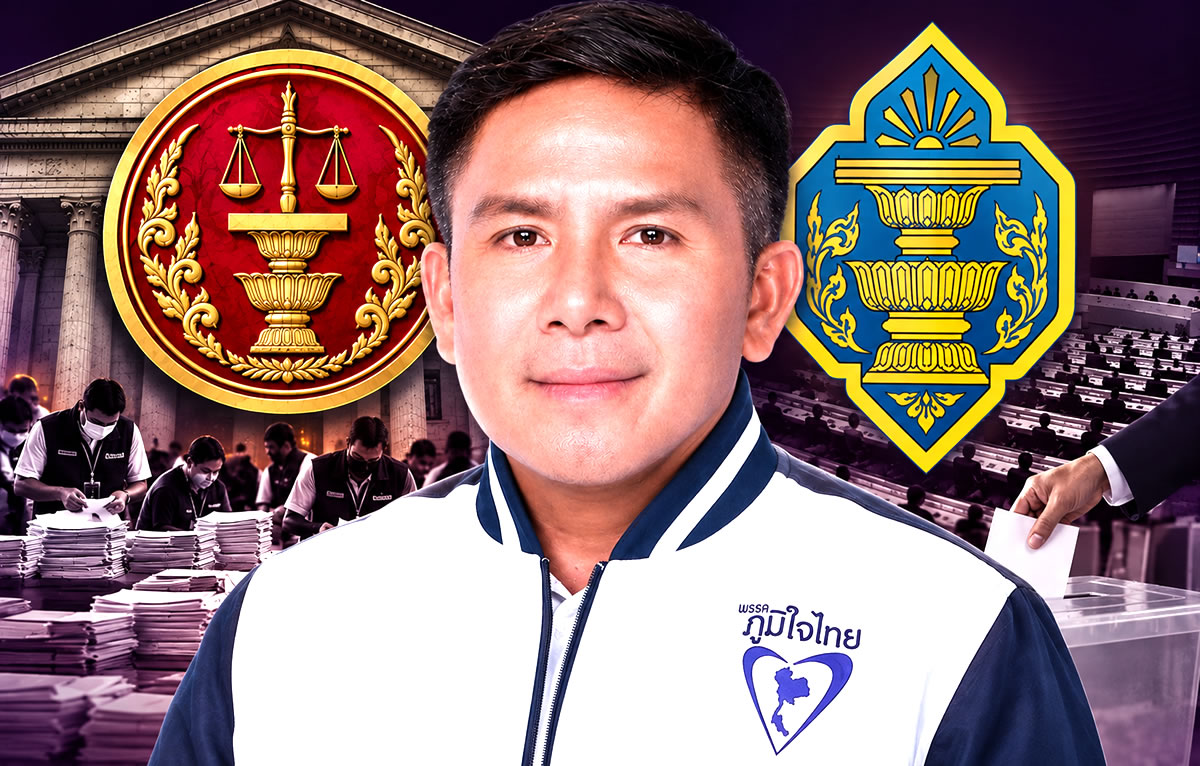
Supreme Court exposes corrupt conduct in the 2024 Senate selection and bans Bhumjaithai-linked Satchapong for 10 years. It came after PM Anutin escaped referral in an EC 5–2 decision openly challenged by two dissenting commissioners over EC evidence.
A bombshell Supreme Court ruling has exposed corrupt conduct inside Thailand’s disputed 2024 Senate selection. Judges banned Bhumjaithai-linked political figure Satchapong Phumiphak for ten years after finding he recruited selectors, promised benefits and distributed a voting list. One named candidate became a senator. The judgment came days after the Election Commission cleared Prime Minister Anutin Charnvirakul, Newin Chidchob and 19 other political figures in the wider 427-person probe. Crucially, that decision was openly challenged by dissenting Election Commissioner Sittichote Intharawiset, who pointed to voting lists, meetings, telephone evidence and political connections. The court found no wrongdoing by Bhumjaithai or its leaders. However, it has now established corrupt conduct inside the same Senate contest at the centre of those claims.
Thailand’s Supreme Court has barred a significant Bhumjaithai-linked political figure from standing for election for ten years. The ruling followed findings of corrupt conduct during the disputed 2024 Senate selection. Crucially, judges accepted evidence of organised recruitment, promised benefits and directed voting. They also accepted a prepared voting list distributed through Line. One candidate identified on that list subsequently became a senator.
At the centre is Satchapong Phumiphak, former mayor of Non Sa-at Subdistrict Municipality in Udon Thani. He is the father of sitting Bhumjaithai MP Suphiraphat Phumiphak. Mr Suphiraphat represents Udon Thani constituency 8 for the ruling party. Notably, Satchapong had also presented himself publicly as a prospective Bhumjaithai parliamentary candidate.
The judgment therefore directly concerns a political figure with established Bhumjaithai connections. However, judges did not find Bhumjaithai itself responsible for his conduct. Neither did they implicate Prime Minister Anutin Charnvirakul or other party leaders in Satchapong’s operation. Instead, the court examined his own actions immediately before the decisive national Senate selection.
Court finds Satchapong recruited selectors and promised benefits before the decisive national Senate vote
The court found Satchapong recruited national-level selectors to support specified candidates. Moreover, benefits were promised in connection with those votes. Judges ruled that this amounted to corrupt conduct. Consequently, his actions prevented the Senate selection from being conducted honestly or fairly.
The Supreme Court’s Election Cases Division delivered its judgment on September 21. The ruling was published on September 23 and reported more widely on Thursday. The proceedings were black case Lor Tor Sor Wor 3/2569 and red case 72/2569.
Significantly, the judgment comes amid a far larger investigation into the same 2024 Senate selection. That inquiry covered 427 respondents and eventually produced a 75,722-page case file. Investigators examined voting patterns, meetings, telephone records, financial information and suspected voting lists. They also investigated politicians and people connected with political parties.
Yet the Supreme Court has received only part of that wider case. The Election Commission decides which qualifying cases are placed before judges. That role has become increasingly important as separate strands of the Senate investigation follow different legal routes.
Hotel and restaurant meetings reveal efforts to build a 40-50 strong voting bloc before Senate selection
The Satchapong case began with complaints about the national Senate selection on June 26, 2024. One Senate selector reported irregularities, including large numbers of duplicate votes. Investigators then traced events immediately preceding the national vote.
Before election day, an unidentified caller invited the complainant to Pathum Thani Place Hotel. Four other Senate selectors also attended discussions there. Subsequently, participants were invited to Nittaya Kai Yang restaurant in Muang Thong Thani.
That restaurant meeting took place on June 24, two days before the national selection. Those present included Somkiatnaiwikun Tae-thitipong, Direk Pornsima, Phumiphat Lekdeepisut and Ratchanee Butrat. Satchapong was also there. Importantly, three witnesses sat opposite him and could clearly hear the discussions.
The Supreme Court later considered their testimony credible and carried weight. According to the evidence, Satchapong wanted national-level selectors recruited to support specified people. He also discussed assembling a substantial voting bloc. In return, benefits would be provided to participants.
Direk received a particularly specific proposal. Satchapong told him that gathering enough selectors could improve his prospects of becoming a senator. The proposed bloc would contain between 40 and 50 national-level voters. If Direk assembled them, Satchapong would negotiate with the group.
Selectors promised expenses and cash as court hears evidence of offers reaching as high as ฿10 million
The selectors would then be encouraged to support Direk and Somkiat. Meanwhile, Satchapong said participants would be “taken care of”. Direk understood that expression to cover travel expenses and additional cash.
The EC petition went considerably further on the financial evidence. It said Satchapong offered ฿200,000 to people involved. Furthermore, Somkiat was offered as much as ฿10 million, according to the petition. That proposal related to claims he could control around 80 national-level selectors.
However, the Supreme Court did not need to establish that every proposed payment was delivered. Rather, judges accepted evidence that promised benefits accompanied attempts to influence voting. That finding became central to the sanction imposed on Satchapong.
Ratchanee supplied another important strand of corroboration. Unlike several others involved, she was not herself a national-level Senate selector. Accordingly, the court examined whether she possessed an electoral interest in implicating Satchapong.
Judges found no convincing reason for her to falsely accuse him. Ratchanee testified that Satchapong offered money or property during the discussions. Although she could not remember the precise amount, the court considered her account credible.
Line voting list before national selection named specified candidates, including one future senator
Activity continued on June 25, immediately before the national selection. Satchapong invited members of the group to Pathum Thani Place Hotel. Somkiat and Ratchanee went there. Meanwhile, another meeting produced some of the strongest documentary evidence in the case.
National-level selector Thanin Chantharobol participated in occupational group 12. At about 10 am, he met Satchapong at the Grand Ratchaphruek Hotel in Nonthaburi. The meeting took place in room 302.
According to Thanin, Satchapong instructed him to find national-level selectors by 3 pm. A voting list could then be prepared for the following day. Moreover, digital evidence established a direct connection between the two men. Satchapong and Thanin acknowledged being Line contacts and possessed each other’s telephone numbers.
Most importantly, Satchapong subsequently sent Thanin a national Senate voting list through Line. The document became a central part of the evidence accepted by judges. It went beyond a general discussion about possible candidates. Instead, it identified people to receive support during the national selection.
One person on that list was identified as occupational group 12, candidate number 22. That candidate subsequently became a senator. Thanin himself failed to secure a Senate seat.
Court rejects jurisdiction challenge and rules non-candidates can face sanctions for corrupt Senate acts
Against that background, judges considered the list alongside testimony and communications. The court accepted that Satchapong sought voters for specified people. Likewise, it accepted that benefits had been promised as part of the operation.
The EC’s original petition placed those activities within several provisions of the Senate selection law. It cited Section 77(1) concerning property or other benefits offered to influence voting. In addition, the petition referred to Sections 11 and 33 of the Organic Act. It also invoked Section 107 of the Constitution governing the Senate selection system.
For the eventual sanction, however, Sections 226 and 62 became decisive. The court found corrupt conduct had prevented the selection from being honest or fair. Satchapong nevertheless raised a fundamental jurisdictional challenge because he had never been a Senate candidate.
He argued that the EC could not seek revocation of his electoral rights under Section 62. The Supreme Court rejected that interpretation. Importantly, judges ruled that Section 62 was not confined to Senate candidates. Its wording also covers “any person” involved in corrupt conduct affecting a selection.
Thus, an organiser or intermediary does not have to contest a Senate position. Outsiders can also face Supreme Court electoral proceedings. Consequently, the court revoked Satchapong’s candidacy rights for ten years.
Supreme Court dismisses Thanawut case after EC fails to authenticate potentially damaging Line account
The second respondent, Thanawut Saengarun, received a dramatically different outcome. The EC had also sought sanctions against him. However, the Supreme Court dismissed that part of the petition after identifying serious gaps in the evidence.
Thanawut was eligible to participate in the Senate selection process in Maha Sarakham. During proceedings, evidence showed he had been persuaded to recruit national-level selectors for a Pathum Thani Place Hotel meeting. Furthermore, the case material said he intended to receive a share of money from selectors attending the planning meeting. After the case reached court, Thanawut did not file an objection.
Investigators also possessed potentially damaging material involving a LINE account bearing Thanawut’s full name. Messages associated with the account referred to substantial benefits for successful senators. One discussion concerned a claimed ฿1.5 million payment at an initial stage.
Another message referred to a van provided for five years, valued at over ฿3 million. Additionally, the material mentioned two bodyguards or assistants for each senator. Yet investigators faced a basic evidentiary problem. The EC had not established that the Line account actually belonged to Thanawut.
No witness or documentary evidence sufficiently authenticated the account. More strikingly, Thanawut had appeared before the EC investigation committee on October 4, 2024. Investigators nevertheless failed to establish whether the disputed account was his.
Evidence gaps clear Thanawut as wider EC investigation examines payments, voting lists and political links
As a result, the Supreme Court refused to rely on the damaging Line conversations. The material appeared in pages 178 to 183 of an EC exhibit. Judges also identified inconsistencies across three rounds of testimony.
Another weakness concerned a claimed ฿100,000 cash payment. A witness declined to identify whoever supposedly handed over the money. Ultimately, the court found the evidence against Thanawut insufficient and dismissed the petition.
The two respondents therefore produced sharply different outcomes inside one judgment. Against Satchapong, corroborating witnesses supported communications, promised benefits and a voting list. Against Thanawut, potentially damaging digital material lacked authentication.
That contrast now sits beside the far larger Senate investigation completed by the EC this month. On September 14, commissioners finished considering a case involving 427 respondents. Its files eventually reached 75,722 pages.
Earlier, Central Investigation and Inquiry Committee 26 recommended proceedings against 229 people. They comprised 138 senators and 91 political or other figures. The committee examined recruitment, payments, voting lists, meetings and political connections.
As part of that inquiry, investigators recorded claims about payments at different stages. District-level recruits could receive between ฿10,000 and ฿50,000, according to the evidence. Provincial-level participants could receive ฿50,000. At national level, the recorded figure rose to ฿200,000.
EC panels split sharply before commissioners refer 77 people but clear political-assistance allegations
Another account described an alleged quota system. Organisers reportedly sought about 20 candidates to secure one Senate position. Separately, evidence suggested a network sought between 110 and 120 seats. Those remain investigative claims rather than Supreme Court findings.
However, the ฿200,000 national-level figure also appears independently in the Satchapong petition. That numerical parallel does not establish a single centrally controlled operation. It nevertheless appears in two separate bodies of evidence concerning the same Senate selection.
After Committee 26 completed its work, the case passed through another EC panel. Committee 36 reached a sharply different conclusion. Its majority voted 5–2 to clear respondents under major parts of the investigation.
The seven election commissioners then considered the case themselves. Ultimately, they approved Supreme Court petitions and criminal proceedings against 77 people. That group comprises 26 serving senators and 36 other eligible Senate selectors. A further 15 respondents fall into other categories.
However, nobody was referred under the first allegation covering political assistance. That charge concerned Section 76, paragraph one, of the Organic Act. The provision covers political figures assisting Senate candidates.
EC clears 21 political figures as dissenters point to voting lists, meetings and telephone evidence
The EC considered 21 political figures under that allegation. Most were Bhumjaithai leaders, executives or MPs. Yet commissioners decided not to refer any of them.
Twelve respondents were cleared by 5–2 votes. Another two were cleared 6–1, while seven received unanimous decisions. Prime Minister and Bhumjaithai leader Anutin Charnvirakul was among the 5–2 decisions. Influential Bhumjaithai figure Newin Chidchob received the same split.
Other respondents included Bhumjaithai secretary-general Chaichanok Chidchob and deputy leader Paradorn Prissananantakul. Party executives, MPs and other office-holders also appeared on the EC voting table.
Under allegation two, commissioners considered candidates accused of consenting to political assistance. That group contained 140 respondents. They comprised 137 serving senators, one reserve-list member and two other eligible selectors. By a 5–2 majority, the EC declined proceedings against all 140 under that allegation.
Two commissioners dissented on significant parts of the political case. They were Sittichote Intharawiset and Chai Nakhonchai. Sittichote later explained that the minority considered evidence collectively rather than treating incidents separately.
He pointed to activity across Nakhon Si Thammarat, Phuket and Nong Bua Lamphu. Uthai Thani, Nakhon Sawan and Sukhothai also featured. In parallel, investigators obtained 12 suspected Senate voting lists.
Dissenters cite voting patterns and meetings while EC majority questions witnesses and telephone evidence
Sittichote highlighted patterns appearing on those documents. He said candidates in positions one through seven corresponded with subsequent finishing positions. The minority also considered telephone information, witnesses and political connections.
Further evidence concerned provincial meetings before the national selection. Another strand involved a later gathering at Bangkok’s Pullman hotel. Location information linked at least 40 senators to that meeting.
Evidence also indicated that mobile phones were collected during the gathering. Moreover, a significant political figure was reportedly seen leaving the venue. Those points formed part of the minority commissioners’ assessment, rather than Supreme Court findings.
EC Chairman Narong Klanwarin defended the majority’s approach after the September decision. He cited weaknesses involving witnesses and evidence. One issue concerned witness Ekkarat Changlao, who withdrew parts of earlier testimony involving 16 of 26 matters.
Mr Narong also questioned whether telephone-location information alone established wrongdoing. In addition, he cited an absence of abnormal financial evidence supporting some claims. The majority therefore declined to refer the political-assistance allegations.
The September decision left those allegations outside the Supreme Court. That outcome is distinct from a judicial ruling clearing the respondents. Meanwhile, the 77 other respondents face a different legal process following the EC referrals.
People’s Party challenges seven commissioners as Satchapong ruling establishes separate corrupt conduct
The commission’s decision has also produced a separate challenge. The People’s Party moved against all seven election commissioners before the National Anti-Corruption Commission. Opposition leader Nattapong Ruangpanyawut challenged the handling of the evidence.
People’s Party MP Parit Wacharasindhu also questioned the investigation and Committee 36. Those complaints remain unresolved. No finding of wrongdoing has been made against the election commissioners.
Against this wider backdrop, the Satchapong judgment provides a completed judicial finding from the same Senate selection. There is also another politically sensitive element involving Direk, whose evidence against Satchapong was considered credible.
Separately, Direk later gave a public account of the recruitment discussions. He said Satchapong told him he had been assigned by “the party” to gather candidates. According to Direk, the target was people who survived the provincial stage. Direk understood “the party” to mean Bhumjaithai.
That statement remains Direk’s account rather than a Supreme Court finding against Bhumjaithai. Judges did not find that the party instructed Satchapong. Nor did they establish that its leadership controlled his activities.
Still, the court independently established Satchapong’s own role. It accepted evidence of recruitment, promised benefits and directed voting. Furthermore, it accepted the Line voting list connecting those activities with specified Senate candidates.
Satchapong judgment follows wider EC decision but makes no finding against Bhumjaithai leaders or party
Timing has added another dimension. The judgment came one week after the EC’s September 14 decision in the wider investigation. The two proceedings therefore produced markedly different legal outcomes from the same disputed Senate selection.
In Satchapong’s case, the EC placed evidence before the Supreme Court. Judges tested it and imposed a ten-year candidacy ban. By contrast, political-assistance allegations involving 21 figures stopped at the EC.
The distinction runs both ways. The Supreme Court has not cleared Mr Anutin, Mr Newin or the other political respondents. Equally, it has not found them responsible. Those allegations simply did not proceed to judicial determination.
Satchapong’s case reached a different endpoint. He denied arranging payments or promising benefits to influence selectors. He also denied that the meetings formed part of a Senate voting plan.
Supreme Court rejects Satchapong’s defence and imposes ten-year ban after finding corrupt Senate conduct
The Supreme Court rejected that defence. Judges accepted evidence from witnesses, communications and the national voting list. They found Satchapong acted as an intermediary recruiting selectors for specified candidates in exchange for promised benefits.
Furthermore, his status as a non-candidate provided no protection under Section 62. The court ruled that the provision expressly reaches “any person”.
Satchapong therefore became subject to the electoral sanction available under the law. His right to stand for election is revoked for ten years.
Legal heavyweights plan seminar to review Election Commission’s move to let top politicians off the hook
Election Commission member derails PM Anutin Charnvirakul’s efforts to put senate scandal in the past
Meanwhile, proceedings involving the 77 respondents referred by the EC remain on a separate legal track. The political-assistance allegations involving 21 political figures ended at the commission’s September 14 vote.
Satchapong’s case did not. His evidence reached the Supreme Court and was tested by judges. The court then found that corrupt conduct had made the Senate selection neither honest nor fair.
Join the Thai News forum, follow Thai Examiner on Facebook here
Follow Thai Examiner on Google here
Receive all our stories as they come out on Telegram here
Follow Thai Examiner here
Further reading:
Election Commission exposed based on Monday’s sweeping decisions and judgments warns opposition
Election Commission creates more questions than answers as it refers 77 people to the Supreme Court
Ex Pheu Thai minister warns Commission members that soon they could be judged as crunch vote looms
Opposition and People’s Party leader attacks ‘blue regime’ on the 12th anniversary of the 2014 coup