
Anutin’s government escapes a nationwide election rerun as the Constitutional Court upholds the February 8 poll. Judges clear QR codes 9-0 and barcodes 8-1, but warn the Election Commission to tighten safeguards and rethink future ballot designs now.
Prime Minister Anutin Charnvirakul won major political relief on Monday as Thailand’s Constitutional Court upheld the February 8 election, killing off the threat of a nationwide rerun. The House and his coalition survive intact after judges cleared QR codes 9-0 and party-list barcodes 8-1. However, the Election Commission escaped with a warning. The Court acknowledged concerns that ballot information could potentially identify voters when combined with other records. It told the EC to tighten safeguards and avoid future ballot markings capable of linking voters with their choices. The ruling ends a dangerous legal challenge for Mr Anutin as his poll support slides and separate political pressures mount.
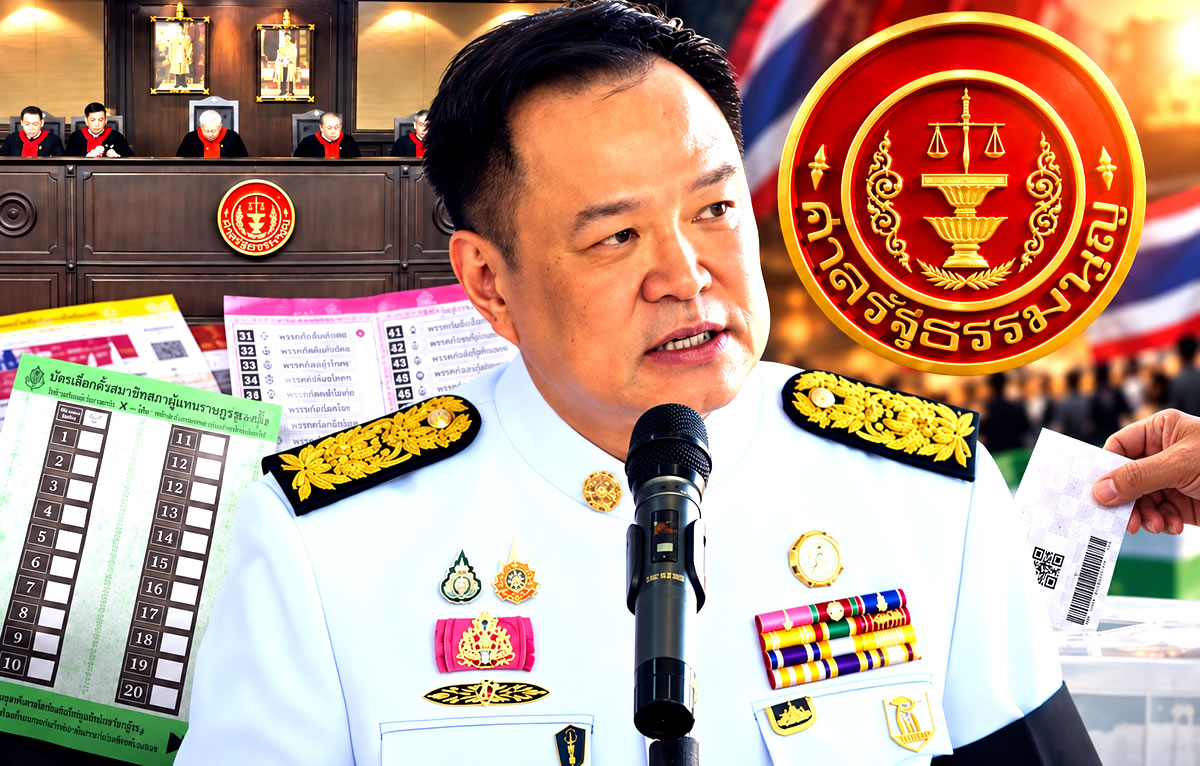
Thailand’s Constitutional Court on Monday upheld the February 8 general election, removing the threat of a nationwide election rerun. The decision leaves the election result and House of Representatives intact. It also removes a major legal threat facing Prime Minister Anutin Charnvirakul’s coalition government.
Crucially, though, the Election Commission did not receive an unrestricted endorsement. The Court told it to rethink future ballot designs and tighten safeguards around sensitive election records.
The ruling followed a challenge involving barcodes and QR codes printed on ballot papers. Twenty-two complaints questioned whether those codes could identify individual voters. Such identification could breach the constitutional requirement for secret voting. Instead, the Court found safeguards surrounding the February election sufficient. The nationwide poll consequently remains valid.
Court splits 8-1 on party-list barcodes after unanimously clearing QR codes used in February election
The nine judges were unanimous on QR codes. They ruled 9-0 that their use presented no constitutional problem. By contrast, the Court divided 8-1 over barcodes printed on party-list ballots. Eight judges found they did not violate constitutional rights or freedoms. Judge Noppadol Thepphitak dissented. He raised concerns that barcode information could potentially be traced to individual voters.
Notably, the Court did not find that tracing information was technologically impossible. Evidence showed that ordinary smartphones could scan both QR codes and barcodes. Yet scanning produced numerical information rather than a voter’s identity. Identifying somebody required access to additional election records. That distinction became central to the majority ruling.
Three separate records would have to be connected. They were the used ballot, its original stub and the relevant voter registration list. Importantly, election procedures required those records to be stored separately. Possession of a used ballot and its barcode was therefore insufficient. Anyone seeking a voter’s identity would need all three records.
As part of its examination, the Court traced those documents through the entire election process. Judges considered distribution, voting, counting, transfers and storage. They also heard senior Election Commission officials. In parallel, executives from companies printing the ballots gave evidence. The Court then examined how each coding system operated.
Judges find QR codes cannot identify individual voters while party-list barcodes require three records
For constituency ballots, QR codes could identify groups containing 20 ballot papers. The code could not establish which individual voter cast a particular ballot. Accordingly, judges concluded that QR codes could not reveal each voter’s choice. That finding produced the unanimous 9-0 ruling.
Party-list barcodes posed a more complicated problem. A barcode could provide a unique ballot book number. Nevertheless, that number did not independently reveal the voter. The original ballot stub and voter registration list were also required. Only by combining all three could somebody potentially identify an individual voter.
Against that background, the Court examined whether anybody could realistically obtain the necessary records. Its judgment followed their movement through polling stations, district offices and provincial election offices. At each stage, judges considered access and physical security. They also examined whether officials or outsiders could secretly combine the information.
At polling stations, personnel first checked voters against registration records. Officials verified voter information before providing ballot papers. Voters then entered private areas and marked their choices. Afterwards, they folded their ballots and placed them inside ballot boxes. At that point, matching individual ballots with corresponding stubs was effectively impossible, according to the Court.
Separately, polling stations involved several groups rather than one controlling official. They included election personnel, security officers, voters and political party representatives. That mixture created another obstacle to secretly assembling and scanning the required documents. In addition, records had to be transferred promptly after voting. The opportunity to match all three sets of information was consequently limited.
District and provincial storage safeguards make tracing individual voters increasingly difficult
Once voting ended, election materials moved to district offices. Ballots and associated records from numerous polling stations were then brought together. As a result, the volume of documents increased sharply. That created another practical obstacle to identifying individual voters.
At district level, the material was placed inside outer bags protected by plastic sealing. Documents also had to move onward within specified periods. Meanwhile, records from different polling stations continued arriving. Finding and matching one voter’s documents therefore became increasingly difficult. The Court found these district-level arrangements sufficiently secure.
The documents subsequently entered the provincial election system. Again, the volume of material increased. Storage bags were secured with cable ties and signed by election officials. Ballot papers were also stored separately from other relevant records. Taken together, the Court found these measures provided sufficient protection.
At that stage, provincial officials could not simply access all three records and identify voters. The documents would ultimately remain stored for two years. Afterwards, they would be destroyed under the relevant procedures. These arrangements created additional barriers against unauthorised tracing.
Court finds outsiders need illegal help to link ballot barcodes with individual voter identities
On another front, judges examined whether outsiders could scan barcodes during vote counting. Technically, such scanning was possible. A scanned number, however, did not identify the voter. An outsider still needed the ballot stub and voter registration records.
More significantly, obtaining those documents would require cooperation from election officials. Such cooperation would itself be illegal. Existing procedures also required separate and confidential storage. The Court therefore found individual identification extremely difficult. No evidence showed anyone had successfully combined the three records during the February election.
That evidential gap became important. The petitioners questioned whether the system created a possibility of tracing votes. The Court instead examined whether that possibility actually defeated constitutional ballot secrecy. By an 8-1 majority on barcodes, judges found it did not.
The Court then turned to the Election Commission’s reasons for introducing ballot codes. The EC identified several security and management purposes. First, the codes helped prevent counterfeit ballots entering the voting system. They also prevented ballots allocated elsewhere from being improperly used across constituencies.
Beyond that, the system helped control ballot quantities and printing. Millions of papers had to be produced within a limited period. Codes also allowed officials to identify ballot sets allocated to particular polling stations. The EC maintained that these functions strengthened election management.
Judges accept ballot codes as legitimate safeguards against counterfeiting and cross-district use
The Court accepted those purposes as legitimate. Even so, judges still had to balance election security against ballot secrecy. The Constitution requires voting to be direct and secret. Voters must therefore make their political choices without those decisions being exposed.
At its core, secret voting protects citizens from intimidation and improper influence. The state must prevent individual choices being connected with identifiable voters. If that connection becomes possible in practice, secret voting is compromised. The Court therefore scrutinised both technical capability and practical safeguards.
In this context, the judges considered different approaches to ballot security. Under absolute secrecy, ballot papers would contain no identifying codes. Identical ballots, however, could increase the risk of counterfeit papers or other fraud.
Alternatively, limited coding can support management, verification and anti-forgery controls. Such systems must still prevent outsiders or officials from discovering individual choices. The majority found the February system remained within that constitutional boundary.
On the QR code issue, individual voters could not be traced. With barcodes, more specific information was available. Even then, two additional protected records were needed. Officials could not easily access all three. Outsiders faced even greater barriers.
Court balances ballot secrecy against anti-fraud controls and finds February system constitutional
At the same time, the Court examined whether other security measures could perform similar functions. Watermarks and QR codes were among the alternatives considered. The judges nevertheless found barcodes effective for controlling ballot papers. They assisted printing, distribution and anti-counterfeiting measures.
On balance, the majority did not consider their use excessive. The decisive question was whether those benefits destroyed ballot secrecy. Eight judges concluded they did not. Identifying one voter required obtaining and matching three protected records. No evidence established that this had happened.
The constitutional challenge therefore failed. Yet the Court’s decision did not end with validation of the February election. Instead, judges addressed weaknesses exposed by the dispute. They noted the case had affected public confidence in election management.
In response, the Court advised the Election Commission to change its approach before future polls. Future ballots should avoid marks or symbols capable of connecting voters with their choices. Anti-forgery safeguards should instead operate without creating that potential link.
Likewise, the Court called for strict security surrounding stored ballots and related records. Such measures should prevent illegal access to information capable of identifying voters. The EC therefore won the immediate constitutional case but received clear instructions for future elections.
Election Commission wins constitutional case but is told to change ballot safeguards for future polls
The distinction carries considerable practical importance. The Court found the February system constitutional because several protected records were required for identification. At the same time, it advised the EC to avoid creating that possibility again. The February election survived, but the controversial ballot feature now faces change.
Politically, the immediate effect is substantial. Nearly 38 million people voted nationwide on February 8. Bhumjaithai emerged as the largest party. Mr Anutin subsequently formed a coalition controlling more than 290 seats in the 500-member House.
Monday’s ruling removes a serious legal threat hanging over the political structure produced by that election. A successful challenge could have raised fundamental questions over the nationwide poll. Instead, the result remains intact. The House continues and Mr Anutin’s coalition remains in government.
For the Prime Minister, the timing is also significant. He is facing pressure on several unrelated fronts. A recent NIDA survey placed his support as preferred prime minister at 13.76%. The election judgment now removes one source of uncertainty.
Elsewhere, controversy continues over the Election Commission’s handling of the 2024 Senate selection investigation. Earlier this month, the EC majority did not refer Mr Anutin for Supreme Court proceedings. Mr Anutin has denied wrongdoing in that affair.
Ruling removes major threat to Anutin coalition as separate Senate selection controversy continues
Those matters remain separate from Monday’s Constitutional Court case. The judges considered coded ballots and constitutional protections surrounding secret voting. Their ruling does not determine the other disputes. It does, however, settle this challenge to the February general election.
Procedurally, the Court also resolved objections against two judges before considering the main dispute. Mr Polkan Setthabundee challenged Sarawut Songsivilai and Police Lieutenant General Chakrapong Wiwatvanich. The Court found no legal grounds for either objection. Both were consequently dismissed.
The full bench then considered the QR code question. All nine judges upheld their use. They included Udom Sithvisawadtham, Wirul Sangthian, Jiraniti Hawanont and Banjongsak Wongprach. Udom Rattanamrit, Sumet Roykulcharoen and Sarawut Songsivilai also joined the unanimous ruling. Police Lieutenant General Chakrapong Wiwatvanich and Noppadol Thepphitak completed the bench.
When the Court moved to barcodes, the division appeared. Eight judges upheld their constitutionality. Judge Noppadol alone dissented. His concern focused on the possibility that barcode information could ultimately identify individual voters. The majority, however, found existing security barriers sufficient.
Full bench rejects objections to two judges before dividing 8-1 over the party-list ballot barcode issue
The case followed months of proceedings over an election held only seven months ago. The Ombudsman brought the matter after receiving 22 complaints. Those petitions sought constitutional examination of the EC’s conduct during the February 8 election.
Earlier on Monday, the judges began oral proceedings, deliberations and voting. Election Commission Chairman Narong Klanwarin attended for the ruling. The Court then delivered its decision later that day.
Significantly, its examination went far beyond whether smartphones could scan ballot codes. Judges instead asked whether scanned information could realistically identify individual voters. That required detailed scrutiny of the entire election document chain.
For QR codes, the answer was particularly clear. A constituency code related to a book containing 20 ballots. It could therefore narrow information to a group. It could not identify which voter had marked a specific paper.
For barcodes, scanning produced more precise ballot information. Yet an individual voter still could not be identified from that information alone. The original ballot stub and voter list remained essential. Without those records, the barcode could not reveal a person’s vote.
During storage, those three records did not remain together. Different procedures governed their handling and movement. Moreover, document volumes increased sharply as materials passed through district and provincial offices. Matching one ballot to one voter therefore became progressively harder.
Court traces ballot records through election system and finds individual voter identification difficult
Physical safeguards strengthened those barriers. At provincial level, bags were secured with cable ties and signed. Ballots were stored separately from associated documentation. The Court found these procedures sufficiently robust for the constitutional question before it.
For an outsider, the hurdles were higher still. The person would require illegal assistance from election personnel. They would then need access to every relevant record. Even with a scanned ballot number, the remaining documents would still have to be located and matched.
Ultimately, no evidence showed such a process occurred. The Court therefore found the claim insufficient to establish a constitutional violation. That conclusion kept the February 8 election intact.
The stakes extended far beyond ballot printing. The disputed system had operated nationwide. This was not a challenge involving one constituency or several disputed papers. It concerned procedures used across the election producing the present House and government.
Thailand also has precedents for national elections being invalidated following constitutional challenges. The April 2006 general election was annulled. Issues in that case included polling arrangements affecting voting secrecy.
Physical safeguards and lack of evidence leave nationwide challenge unable to overturn February poll
Later, the February 2014 election was invalidated on separate constitutional grounds. Voting could not be completed nationwide on the same day. Against that history, Monday’s challenge carried potentially wide consequences.
This time, the Court upheld the poll. The February 8 result remains intact. The House remains in place. Mr Anutin’s coalition also continues in government. Most immediately, the threat of a nationwide rerun from this case has disappeared.
The Election Commission, meanwhile, leaves the case with specific work ahead. Its anti-fraud systems must continue protecting ballot integrity. Future ballot designs, though, should avoid symbols capable of connecting voter identities with electoral choices.
Alongside that requirement, the Court wants strict protection for stored election documents. Ballots, stubs and voter lists must remain protected from illegal access. That instruction directly addresses the vulnerability examined throughout the proceedings.
Past election annulments frame ruling as Court keeps February result and Anutin coalition intact
In practical terms, the majority’s reasoning rested on several findings. QR codes did not identify individual voters. Barcodes required three separate sets of information. Those records were stored separately and protected by election procedures.
Additionally, security increased as records moved from polling stations into district and provincial storage. Outsiders could not obtain the necessary information without illegal assistance. Above all, no evidence showed the three records were combined to identify individual voters.
Crucial ballot decision of Constitutional Court on Monday could upend government and Thai politics
Court throws out one bar code case but more serious challenges to the February 8th poll remain in play
The constitutional challenge therefore failed and the February 8 general election stands. For Mr Anutin, one immediate legal threat to his government has been removed. For the Election Commission, the result is more qualified.
Its February ballot system survived constitutional scrutiny. Its next ballot system must take account of the Court’s warning.
Join the Thai News forum, follow Thai Examiner on Facebook here
Follow Thai Examiner on Google here
Receive all our stories as they come out on Telegram here
Follow Thai Examiner here
Further reading:
Crucial ballot decision of Constitutional Court on Monday could upend government and Thai politics
Rising chance Feb 8th General Election will be voided as Ombudsman writes to the Election Commission
People’s Party and Pheu Thai Party call for Election Commission to back up Sunday’s election outcome
Outcry as anomalies and errors detected in Sunday’s General Election. Spontaneous protests break out
Trade expert warns the government on barter deals with China being pursued by the Commerce Ministry