A farmer digging a ditch in Kamphaeng Phet uncovered a human skeleton believed to be 500 years old alongside ancient coins and metal artefacts. Police, forensic experts and archaeologists are now racing to solve one of Thailand’s most baffling burial mysteries.
A farmer digging a ditch in a Kamphaeng Phet rice field has uncovered a centuries-old mystery after unearthing a human skeleton buried more than a metre underground alongside ancient metal artefacts believed to be around 500 years old. The discovery has opened up an intensive police and forensic investigation as specialists examine the remains, possible jewellery and coins. With no missing persons records, no known historical murders and few clues, investigators are deciphering one of the province’s most baffling discoveries in decades.
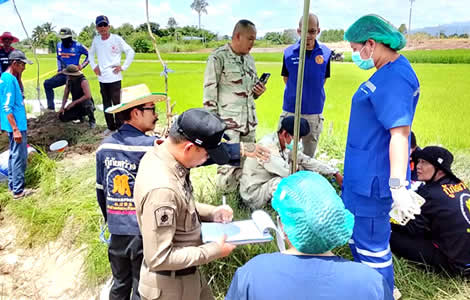
A mysterious human skeleton buried beneath a Kamphaeng Phet rice field has triggered an intensive police investigation after officials estimated the remains had lain underground for at least 500 years.
The discovery was made in Moo 1, Hin Dat Subdistrict, Pang Silathong District. Investigators are now attempting to identify the deceased. At the same time, specialists are examining several ancient artefacts recovered from the burial site.
The case surfaced after villagers reported the discovery on the evening of Saturday, June 20. In response, Pol. Col. Somnuk Nuankham, Superintendent of Pang Silathong Police Station, was briefed by the investigating officer, Pol. Lt. Col. Atsanai Phabjanda.
Police secure rice field site after villagers report skeletal remains buried deep underground
He then travelled to the location with rescue personnel from the Sawang Kamphaeng Phet Rescue Foundation’s Pang Silathong branch. Officers found the remains inside a rice field owned by Mr. Tan Sibprasert, 52.
The skeleton was buried deep within a field embankment. Investigators estimated the burial depth exceeded 1.20 metres. Because darkness had already fallen, the area was immediately secured with ropes. As a precaution, officers delayed a full excavation until daylight. Police said evidence recovery would have been difficult during the night.
The following morning, officers returned with a forensic doctor from Pang Silathong Hospital. As part of the examination, investigators carefully exposed the burial site and inspected the remains.
They found a skeleton in an advanced state of decomposition. Notably, many of the bones had hardened after decades underground. The condition of the remains prevented an immediate identification of gender. Even so, officials estimated the burial had occurred at least 500 years ago.
Forensic inspection finds hardened bones as officials estimate the burial dates back five centuries
Investigators also uncovered several objects mixed among the bones. Among the discoveries were iron fragments resembling an ancient shovel or axe.
Separately, officers recovered circular metal objects resembling jewellery, earrings or ancient silver coins. Several pieces were clustered among the skeletal remains. As a result, investigators are examining whether the items were buried with the deceased.
Despite extensive deterioration, police said the remains were unmistakably human. Visible fragments included part of a skull, a molar tooth, a patella and a long tibia bone. No clothing was found. Likewise, investigators recovered no personal possessions capable of identifying the deceased. Consequently, the skeleton’s identity remains unknown.
Rescue workers and local residents then expanded the excavation area. Their aim was to recover every available fragment before the remains were removed. Throughout the operation, workers carefully sifted through the soil surrounding the burial. In parallel, officers documented the location of bones and artefacts for further analysis.
Ancient coins and metal fragments emerge as workers recover bones from the burial site
Local customs were also observed during the recovery effort. Incense was burned at the scene. In addition, coins were tossed during a traditional ritual. Participants said the practice was intended to determine whether all bones had been recovered.
On another front, it was also used to seek guidance on the deceased’s gender. Those taking part said the result indicated the remains belonged to a male.
Once the excavation concluded, rescue workers gathered the recovered bones and transferred them to Pang Silathong Police Station. From there, the remains were prepared for examination at the Police Hospital. There, forensic specialists will conduct a detailed analysis. Authorities hope the examination may reveal clues about the deceased’s identity. They are also seeking evidence regarding the circumstances of the burial.
So far, investigators have uncovered few leads. According to police and local officials, there are no known missing persons reports linked to the area. Similarly, community leaders have identified no historical cases that match the discovery. The lack of records has added another layer of mystery to the investigation.
Police hospital examination may provide clues, as local records yield no matching cases
Attention has also focused on the artefacts recovered from the site. Preliminary information from police and local leaders suggests the objects may also be around 500 years old. However, investigators have not established any connection between the artefacts and the skeleton. Further examination will be required before any conclusions can be reached.
Mr. Tan said he discovered the remains while carrying out routine work in his rice field. At about 6pm on Saturday, he was digging a ditch to pump water into the area. Initially, he uncovered a metal object resembling an axe. Shortly afterwards, he found fragments of a human skull. Faced with the unusual discovery, he continued digging.
The deeper excavation revealed additional bones. It also exposed several metal objects resembling earrings. Realising the significance of the find, Mr. Tan contacted village officials. Soon afterwards, the site was inspected and authorities were notified.
Rice farmer’s ditch digging uncovers skull fragments, bones and possible ancient jewellery
Mr. Thaworn Sompong, 59, village headman of Ban Hin Dat, said villagers alerted him on Saturday evening. Following the report, he contacted police and local authorities. Officers then moved to secure the area and begin an investigation.
Mr. Thaworn said he had lived in the village since about 1974. During that time, he had never encountered a missing persons case connected to the location.
Police in Bangkok’s Lat Krabang work to identify remains found with a United Nations driver’s licence
Skeletal remains of a Canadian tourist who arrived on July 6th found on a vacant Pattaya brush site in the city
Nor could he recall a murder investigation involving a body buried in the area. For that reason, the discovery surprised both local residents and community leaders.
For now, the identity of the deceased remains a mystery. Meanwhile, forensic examinations are continuing. Investigators are also attempting to determine whether the ancient artefacts and the skeleton are connected. Until those questions are answered, one of Pang Silathong’s most unusual discoveries remains buried in uncertainty beneath a quiet Kamphaeng Phet rice field.
Join the Thai News forum, follow Thai Examiner on Facebook here
Receive all our stories as they come out on Telegram here
Follow Thai Examiner here
Further reading:
Prolific Nigerian romance scammer boss arrested by the CSD police twice in just over two years
Campaign begins to fight cybercrime in Thailand with 800 criminal cases being reported per day
Online skimming scam impacting thousands of Thai bank account holders shut down by officials
Online scammers are an organised crime group in Thailand working with international hackers
Thai man’s ฿10 million credit card fraud ended Monday with his arrest by CSD police in Bangkok