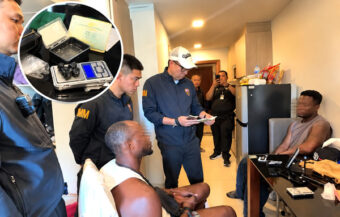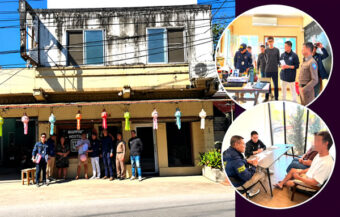
Thai police have exposed how transnational scam gangs recruit cash-strapped Thais, launder millions through local bank accounts and shift operations into Laos as a sweeping crackdown tightens across Southeast Asia, pushed by US law enforcement.
Thai police have uncovered fresh evidence that Southeast Asia’s vast scam industry is rapidly reinventing itself, exposing how criminal syndicates are shifting operations into Laos, recruiting struggling Thais through fake job offers, moving personnel across international borders and laundering millions of baht through ordinary bank accounts. A major police operation in Samut Prakan, together with a local media investigation, reveals a sophisticated cross-border criminal network that continues expanding despite relentless regional crackdowns, prompting an increasingly aggressive response from Thai investigators determined to dismantle both the syndicates and the financial machinery keeping them alive.
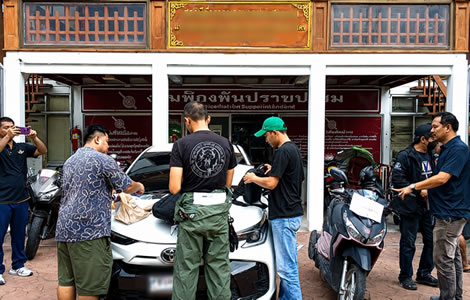
The Royal Thai Police are intensifying their offensive against transnational scam syndicates as criminal organisations continue reshaping operations across mainland Southeast Asia.
Officers are disrupting the movement of suspected scam workers, dismantling money laundering networks and tracing financial pipelines supporting international cybercrime. Meanwhile, fresh evidence suggests the industry is adapting once again, with Laos emerging as a significant new operational base following sustained crackdowns in Myanmar and Cambodia.
This week, police intercepted another group believed to be linked to scam operations while travelling from Thailand’s Cambodian border towards the frontier with Myanmar. The movement reflected the increasingly mobile nature of organised scam networks. Rather than remaining in fixed locations, syndicates are shifting personnel between established compounds as enforcement pressure intensifies.
At the same time, investigators are pursuing the financial structures allowing these criminal organisations to survive despite repeated regional crackdowns.
Thai police intensify regional crackdown as scam syndicates shift workers, money and border operations
Police believe many of the laundering networks operating inside Thailand receive support from Chinese criminal organisations. However, investigators say the money itself frequently passes through ordinary Thai bank accounts.
Those accounts are often controlled by financially vulnerable people recruited through deceptive online advertisements. Instead, syndicates divide responsibilities among numerous couriers, account holders and recruiters. The structure reduces exposure for senior organisers while keeping money moving quickly through the banking system.
Recruitment methods remain remarkably consistent. Advertisements promise driver, office or administrative positions with attractive salaries. Applicants are assured the work is legitimate and requires little experience.
However, many later discover they have been recruited to withdraw fraud proceeds, transport cash or provide bank accounts for criminal transactions. According to investigators, these apparently routine jobs now form an essential component of the international scam economy.
Separately, a major investigation published this week by Thai Rath suggested the regional scam industry is entering another period of expansion. The newspaper concluded that criminal groups are reorganising rather than disappearing.
Scam gangs regroup in Laos as major Thai Rath investigation reveals expanding crime network
Following enforcement operations in Myanmar and Cambodia, many operators appear to be relocating into Laos while establishing new commercial infrastructure. Sources interviewed during the investigation described continuing construction projects, expanding Chinese investment and facilities capable of supporting large-scale cybercrime.
Scam compounds remain active throughout Myanmar, Cambodia and Laos. Others are still under development. Intelligence cited during the investigation described communications centres, reinforced security systems and even detention facilities inside some compounds. Consequently, investigators believe organised cybercrime continues investing heavily despite mounting regional enforcement.
Against that backdrop, Samut Prakan police dismantled another money laundering operation linked to a call centre gang. Three suspects were arrested, and assets worth almost 20 million baht were seized. Investigators said the operation exposed how financially distressed Thais continue being recruited into international scam networks through apparently legitimate employment offers.
Senior officers announced the arrests during a press conference at Phra Pradaeng Police Station on July 17. Samut Prakan Provincial Police Commander Pol Maj Gen Phumin Singhasut led the briefing.
He was joined by Deputy Commander Pol Col Praphas Mangkang, Investigation Division Superintendent Pol Col Sorayuth Jirophas and Deputy Superintendent Pol Lt Col Phonpracha Thammachotiwong. Together, they outlined an investigation that gradually uncovered a laundering operation moving fraud proceeds through Thai bank accounts.
Samut Prakan police uncover laundering network recruiting struggling Thais into scam operations
Police identified the suspects as Supharit, known as Art, aged 28, Wacharun, known as Keng, aged 32, and Chinese national Hai Zhu, aged 47.
Officers informed all three of the charges following their arrests. Investigators accused them of participating in the procurement, advertising or dissemination of information facilitating the purchase, sale, rental or lending of electronic deposit accounts intended for cybercrime. They also face allegations of jointly participating in an organised criminal gang operating through concealed methods.
The evidence recovered reflected the scale of the operation. Officers seized six mobile telephones, a rented Bangkok-registered sedan and a motorcycle carrying Chiang Mai registration plates.
Police also recovered 1.06 million baht in cash together with six bank passbooks. Deposit slips worth 400,000 baht were confiscated alongside a banknote counting machine. Investigators also seized a notebook computer and three land title deeds valued at approximately 12 million baht. Overall, the assets recovered were estimated at almost 20 million baht.
The investigation centred on a 46-year-old woman identified only as Ms A, who lives in Phra Pradaeng district. Investigators discovered that fraud victims repeatedly transferred money into her account.
Afterwards, another individual contacted her and instructed her to withdraw the funds from automated teller machines. According to police, Ms A received 3,000 baht every time she completed a withdrawal. As a result, investigators decided to monitor the account rather than intervene immediately.
Undercover surveillance targets bank withdrawal to identify organisers behind money laundering
The opportunity arrived on Thursday, July 16. At approximately 1.10pm, officers detected another transfer involving exactly 100,000 baht. Instead of freezing the account, investigators launched a controlled surveillance operation. Every movement connected with the transaction was monitored. Police hoped the withdrawal would expose those directing the money laundering network rather than simply recovering the cash.
Ms A received instructions to withdraw the money from the Government Savings Bank’s Tha Nam Phra Pradaeng branch on Sri Khueankhan Road. In response, surveillance teams deployed around the bank and nearby access routes.
Other officers positioned themselves near a parking area beside Wat Klang on Nakhon Khueankhan Road. Investigators believed it would become the collection point after the withdrawal.
Shortly afterwards, Ms A arrived at the designated location. A white sedan entered the parking area moments later. Police identified Supharit as the driver and Wacharun as the passenger. The pair collected Ms A before driving directly to the bank. Investigators maintained uninterrupted surveillance throughout the journey. Once the withdrawal had been completed, officers immediately moved in and arrested both men.
Arrests outside bank expose Chinese suspect and financial network behind call centre laundering
Police recovered the entire 100,000 baht withdrawn from the account. During questioning, investigators quickly identified another suspect.
According to police, the two men admitted the cash was intended for delivery to Hai Zhu, a Chinese national living in Bangkok’s Lat Krabang district. Without delay, officers expanded the investigation. Teams travelled to the address identified during questioning, arrested Hai Zhu and seized additional evidence from the residence before transferring all three suspects for legal proceedings.
Supharit and Wacharun admitted their involvement during questioning. By contrast, Hai Zhu denied the allegations and exercised his right to remain silent. Investigators have continued examining seized bank records, electronic devices and financial documents.
Officers are attempting to determine whether the operation formed part of a substantially larger laundering network supporting international call centre fraud.
Police also released details from interviews conducted with the two Thai suspects. Supharit told investigators he had previously worked as a farmer on family land in Chiang Rai province. His income, however, had become insufficient.
Consequently, he searched online for supplementary work and eventually found an advertisement seeking executive drivers. He first communicated through online messages before speaking by telephone with a Thai intermediary.
Online driver job lured Chiang Rai farmer south before training for scam cash withdrawal work duties
The intermediary instructed him to travel south. Supharit flew to Nonthaburi the previous weekend and checked into a hotel. Later, he attended a meeting at a coffee shop where another individual explained the work.
Training began immediately afterwards. According to his statement, the assignment involved accompanying another person to withdraw money from bank accounts before delivering the cash elsewhere.
He told investigators the transaction ending with his arrest was his first assignment. He had not yet received any payment. Supharit also said he had already exhausted 10,000 baht of emergency savings while paying for accommodation. After his arrest, he expressed regret about becoming involved.
“I had just started training. My first withdrawal was 100,000 baht, but I haven’t received my pay yet because I was arrested by the police.”
“After being arrested, I regretted doing it, but I had to because I had already used up all my emergency funds.”
Wacharun gave investigators a similar account. He said he had previously worked as a motorcycle taxi rider in Pathum Thani. His earnings, however, no longer covered his daily expenses. Consequently, he also searched online for supplementary employment.
He found an advertisement seeking executive drivers with monthly salaries ranging from 10,000 to 30,000 baht. The offer appeared genuine, and he accepted the position.
He told investigators he worked for approximately one to two weeks before his arrest. His duties centred on withdrawing cash from automated teller machines before transporting it to roadside collection points in Lat Krabang.
Another individual then collected the money. According to investigators, he received between 1,000 and 4,000 baht for each withdrawal. Individual transactions ranged from 100,000 to 400,000 baht. He estimated completing seven or eight assignments before police intercepted the operation.
Recruits describe online job offers that led struggling workers into laundering cash for scam syndicates
“I previously worked as a motorcycle taxi driver in Pathum Thani, but due to insufficient funds to cover my daily expenses, I sought supplemental income online.”
“I found an advertisement for a driver position for executives, with a starting monthly salary of 10,000-30,000 baht.”
Investigators believe both men occupied relatively low positions within a much larger criminal structure. Nevertheless, police say their evidence points further up the chain. Officers are now examining seized telephones, financial records and electronic devices for links to recruiters, account suppliers and organisers operating elsewhere. Bank records are also being analysed to identify additional accounts used to receive transfers from scam victims.
On another front, investigators continue tracking the recruitment methods used by international scam syndicates. Police say online advertisements remain the preferred tool for attracting financially vulnerable applicants.
Promises of regular salaries and straightforward work continue drawing job seekers into criminal operations. Many recruits only discover the true nature of the work after travelling to meet organisers or beginning training.
Police target recruiters, financial coordinators and account holders behind sophisticated networks
The Samut Prakan investigation mirrors patterns repeatedly identified in recent police operations. Recruits are assigned narrowly defined tasks rather than broad responsibilities. One person provides an account. Another withdraws cash.
A different courier transports the money. Someone else collects it. As part of this structure, organisers remain insulated from direct contact with both victims and stolen funds.
Investigators believe this compartmentalised system complicates enforcement. Even so, police say every arrest provides valuable financial evidence. Telephone records, banking transactions and digital communications frequently identify additional participants. For that reason, investigators increasingly focus on dismantling the entire support network rather than recovering individual transfers.
In parallel, attention has shifted towards developments beyond Thailand’s borders. A major investigation by Thai Rath’s SEE TRUE programme suggests organised scam operations are undergoing another strategic relocation. The mafia gangs are responding to intense US law enforcement pressure in Cambodia, Thailand and Myanmar.
Rather than concentrating activity in long-established compounds, criminal groups appear to be expanding into new areas of Laos following sustained crackdowns elsewhere.
Thai Rath investigation traces organised scam operations shifting south into strategic locations across Laos
The investigation followed an earlier exposé examining the King’s Roman empire in the Golden Triangle Special Economic Zone. This time, reporters traced movements much further south. Their findings indicate scam-linked operations have expanded into Tha Khaek, the capital of Khammouane province. The city lies directly opposite Thailand’s Nakhon Phanom province along the Mekong River.
According to the investigation, recruitment methods remain largely unchanged despite the geographical shift. Victims continue receiving online offers for positions managing stock account systems or performing computer-related work.
Advertisements promise salaries between 20,000 and 30,000 baht. Applicants are told computer skills are required. Ultimately, many discover they have been recruited into scam operations based across neighbouring countries.
Professor Songrit Phonngern, an expert on Mekong River Basin countries, described the movement as part of a broader regional adjustment. He said the criminal network remains extensive despite recent enforcement campaigns. Earlier violence had already occurred in Khammouane province. Meanwhile, sustained operations against established scam centres have forced organised groups to seek alternative locations.
Expert says pressure on KK Park and Shwe Kokko pushed scam operators towards Mekong locations
Professor Songrit pointed specifically to enforcement in Burma’s KK Park and Shwe Kokko. Both areas have been subject to intensive pressure from authorities in recent months. Accordingly, criminal organisations have searched for replacement operating bases capable of supporting large-scale cybercrime. In his assessment, Tha Khaek has become one of those strategic locations.
Thai Rath reporters also documented extensive construction visible from the Thai side of the Mekong River. One building rises approximately ten storeys and remains covered with green protective netting.
Local sources said the development stands close to Lao government buildings and several Chinese-owned restaurants. The location, they said, forms part of a concession linked to the Zhao Wei group.
According to the investigation, the concession is intended to accommodate a comprehensive entertainment complex. Plans reportedly include entertainment venues, a shopping centre and a casino designed primarily for Chinese visitors. At the same time, an old prison is being demolished to accelerate construction. The wider development also includes industrial investment and potash mining projects.
Chinese-backed investment spreads into Ban Dong Tai as mining concessions transform border region
Reporters travelled deeper into Ban Dong Tai, another area undergoing rapid transformation. Chinese investors have received concessions there for potash mining. There, journalists observed widespread physical changes.
Roads displayed numerous Chinese-language signs. KTV entertainment venues lined several streets. Factory compounds appeared highly organised, with worker accommodation built alongside industrial facilities.
Security arrangements also attracted attention. According to the investigation, almost all security personnel appeared to be Chinese nationals. Most employees inside the compounds also appeared to be Chinese. Only a relatively small number of Laotian workers were observed. In addition, reporters noted extensive infrastructure supporting the industrial developments.
Local taxi drivers also described dramatic changes within the surrounding economy. Some claimed Chinese nationals were establishing businesses across the province. Others alleged involvement in money laundering activities. Several also claimed Chinese men married local women who later acted as nominees for property and business assets. Those accounts formed part of the newspaper’s investigation and reflected information gathered from local residents.
Chinese investment reshapes Lao border region as industrial projects and commercial influence expand
Notably, the investigation described a changing cultural landscape alongside the commercial expansion. Industrial investment continues growing. Construction activity remains extensive. Chinese-language businesses have become increasingly visible. Infrastructure projects continue advancing. Together, the developments suggest rapid economic change within parts of central Laos bordering Thailand.
For Thai investigators, those developments carry immediate significance. Scam compounds no longer operate only in traditional locations. Instead, organised groups appear willing to relocate whenever enforcement threatens established operations. Personnel, communications and financial systems can all be transferred to new locations while recruitment continues uninterrupted through online platforms.
The continued movement of workers between Cambodia, Myanmar and Laos reflects that flexibility. Police believe criminal organisations increasingly treat national borders as logistical corridors rather than fixed operating areas.
Consequently, enforcement efforts have also become more regional, combining intelligence gathering with financial investigations and cross-border cooperation.
Within Thailand, investigators are responding by attacking the networks supporting the scam industry rather than concentrating solely on the compounds themselves. Recruitment agents, account holders, cash couriers and financial coordinators have become primary targets. Equally important, investigators are tracing assets, analysing communications and following money trails to identify organisers operating behind layers of intermediaries.
Police widen probe from scam compounds to financial networks, recruiters and money laundering chains
The Samut Prakan operation illustrates that approach. Officers did not simply recover stolen funds. They monitored financial movements, identified couriers, followed the cash and expanded the investigation until another suspect was arrested.
Seized telephones, bank records and digital evidence are now expected to support further inquiries. Looking ahead, investigators continue examining whether additional participants remain active elsewhere in the network.
Police intercept call centre gang on the move from the Cambodian border to Thailand’s border with Burma
Bank of Thailand cracking down on grey capital. New five million baht limit on funds without source details
Taken together, the Samut Prakan arrests and the Thai Rath investigation reveal the continuing evolution of organised scam networks across Southeast Asia.
Police operations are disrupting money laundering cells inside Thailand while enforcement pressures criminal organisations beyond the country’s borders. Even so, the scam industry continues adapting through relocation, recruitment and investment in new infrastructure. Thai investigators are therefore pursuing both the international networks and the domestic financial systems that enable them to continue operating.
Join the Thai News forum, follow Thai Examiner on Facebook here
Receive all our stories as they come out on Telegram here
Follow Thai Examiner here
Further reading:
Party leader makes explosive claims linking Hun Sen to Cambodian slave camp run as a scamming centre
Police top brass push back on claims by Cambodia’s Hun Sen that scammers enter through Thailand
Money Laundering Office seizes assets with money trail linked to South African financier Ben Smith
Kla Tham MP dismisses unproven scam centre claims about Deputy Prime Minister Thamanat Prompow
People’s Party warns Anutin of a No Confidence move over cabinet links to Cambodian scam networks
United States, South Korea and United Kingdom act against Cambodian scam industry with Thai tie-ins