Chinese intelligence and the reported confession of scam kingpin Chen Zhi link Hun Sen to one of Southeast Asia’s biggest scam compounds, a senior Thai politician claims, saying Hill 350 was fought over for far more than disputed territory.
A senior Thai politician has made explosive claims linking Cambodia’s Senate President and de facto leader Hun Sen to one of the largest scam compounds on the Thai-Cambodian border. He said the allegations are based on newly obtained Chinese intelligence and reported confessions made by alleged scam kingpin Chen Zhi after his arrest in Cambodia earlier this year and subsequent deportation to China.
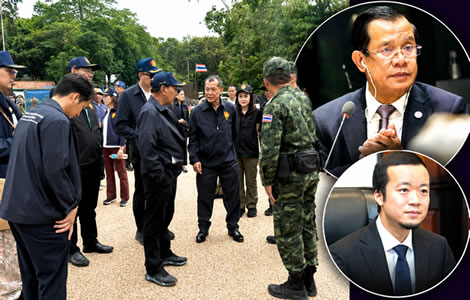
A senior Thai politician has claimed newly obtained Chinese intelligence links Cambodia’s de facto leader and Senate President Hun Sen to one of the largest scam compounds uncovered along the Thai-Cambodian border.
He made the remarks on Sunday during a visit to Hill 350, the strategic position captured by Thai forces during last year’s border conflict.
General Rangsi Kitiyanasop, leader of the Economic Party and adviser to the Parliamentary Committee on Military and Security Affairs, led a delegation to the hill overlooking the disputed frontier in Surin province.
He was accompanied by Mr Peerapol Kanokwalai, secretary-general of the Economic Party and spokesman for the parliamentary security committee, together with Ms Angsana Niamvanichkul, deputy secretary-general of the party and spokeswoman for the Parliamentary Anti-Money Laundering Committee.
Thai delegation visits Hill 350 as soldiers honoured and scam compound discoveries are outlined
The delegation first inspected the security situation before climbing Hill 350. Afterwards, members laid white roses at the memorial honouring Sergeant Major Samroeng Klangprakhon, known as Sergeant Roeng, and Lieutenant Phanupat Sausasa. Both soldiers were killed on December 16, 2025, while defending the position. Their memorial bears the inscription: “I will plant the national flag there. If I can’t, then they’ll cover me with the national flag.”
Following the ceremony, General Rangsi outlined what he said Thai forces discovered after securing the surrounding area during last year’s fighting. He said nobody fully understood the purpose of the nearby buildings before the military operation.
However, he said detailed inspections later revealed a sophisticated transnational scam complex operating on an industrial scale. According to General Rangsi, the compound functioned as a complete criminal ecosystem rather than a simple call centre.
He said investigators found an integrated financial system operating like a commercial bank. In addition, the site contained security checkpoints, personnel performing policing functions, detention facilities and an underground prison. Police also recovered scripts allegedly used to deceive victims around the world. Furthermore, investigators found documents resembling slave contracts, which General Rangsi said forced workers to participate in organised fraud.
General outlines alleged punishment system before making claims attributed to Chinese sources
According to General Rangsi, each worker was assigned financial targets. Failure to reach those targets resulted in punishment. Likewise, attempting to escape or revealing operational secrets allegedly triggered penalties imposed by those controlling the compound. He said the operation involved Chinese, Vietnamese, Americans, Nepalese, Indians and several other nationalities. Some participants, he said, joined voluntarily. Others were allegedly deceived or forced into the operation.
General Rangsi then turned to what he described as intelligence received from Chinese sources following the reported confession of businessman Chen Zhi after his arrest in China. Chen Zhi was previously regarded as one of Cambodia’s most successful businessmen before becoming the focus of international investigations. General Rangsi claimed the reported confession indicated Hun Sen held a 90% interest in the scam operation previously associated with Chen Zhi.
Those claims have not been independently verified.
Nevertheless, General Rangsi argued the alleged ownership explained Cambodia’s continued determination to recover Hill 350 and neighbouring territory. He said control of the area affected significant financial interests. Consequently, he claimed Cambodia wished to regain the position before future negotiations under the Joint Boundary Commission.
General says Cambodia seeks strategic hill before future border negotiations to boost its frontier position
“This isn’t just a border issue; there’s a large scammer base behind it with vested interests,” General Rangsi said.
“When Thailand took control of the area, it directly impacted Cambodia’s interests. Therefore, Cambodia wants to reclaim the territory, both to protect its interests and to gain an advantage before entering into JBC negotiations.”
Separately, General Rangsi said agencies operating along the frontier had strengthened preparations in case tensions escalated. Personnel had already been deployed to sensitive locations. Field doctors and medical supplies were also in place.
Moreover, officials were preparing for the possibility of significant casualties should fighting resume. He added that any renewed confrontation could spread beyond existing flashpoints. Therefore, Thailand should remain fully prepared to defend its territory and sovereignty while preventing new facts from being created before future negotiations.
Hill 350 became a decisive battlefield overlooking disputed temples and strategic border approaches
Hill 350 became one of the decisive objectives during the renewed Thai-Cambodian conflict in late 2025. The elevated position overlooks the Ta Kwai, or Ta Krabey, Temple area within the Dângrêk mountain range. Its commanding height provides observation across extensive sections of the disputed frontier.
Consequently, military observers could direct artillery over much of the surrounding battlefield. For that reason, the hill became one of the campaign’s most fiercely contested objectives. After several days of intense fighting in December 2025, Thai forces captured the position, shifting military momentum in Thailand’s favour.
The hill lies opposite Cambodia’s Oddar Meanchey Province and is adjacent to Thailand’s Surin Province near Kap Choeng district and the Chong Chom border crossing.
Although Thailand administers territory on its side of the frontier, overlapping sovereignty claims have existed for decades. The wider disputed area also includes the Ta Kwai and Ta Muen temple complexes together with several elevated military positions stretching along the Dângrêk Mountains.
However, military importance represented only part of Hill 350’s significance. The surrounding Cambodian border region had also developed into one of Southeast Asia’s largest centres for industrial-scale online fraud. Around nearby O’Smach, casino developments and hotel complexes gradually evolved into heavily fortified scam compounds. Investigations later described these facilities as functioning like self-contained cities.
Scam compounds evolved into fortified cities driving global fraud through trafficked workers and crime
The compounds reportedly contained apartment blocks housing thousands of workers. They also included office floors packed with computer terminals, television-style studios used for video fraud, call centres, training facilities, restaurants, dormitories, medical clinics and extensive security infrastructure.
According to investigators, victims from dozens of countries were trafficked into the compounds and forced to conduct investment fraud, romance scams and cryptocurrency fraud targeting people around the world.
Investigators estimated the compounds generated billions of dollars annually through organised cybercrime. Many reportedly operated continuously throughout the day and night.
Former workers described tightly controlled shifts, constant surveillance and physical punishment for failing to meet financial targets. International organisations have identified Cambodia as one of the world’s largest concentrations of organised online scam compounds, many clustered around casino developments close to international borders.
Thai military said scam compounds also served military roles during last year’s border conflict
During last year’s conflict, Thai military planners argued several casino and scam compounds also served military purposes. According to Thai assessments, some sites accommodated troops, supported drone operations and provided logistical facilities.
As a result, Thai operations targeted not only conventional military positions but also infrastructure linked to the scam industry. Cambodia disputed those military assessments. Even so, the fighting highlighted the unusual overlap between a long-running territorial dispute and one of the world’s largest transnational cybercrime networks.
Police top brass push back on claims by Cambodia’s Hun Sen that scammers enter through Thailand
Secrets of a sprawling international scam empire revealed on Thai Cambodian border in Surin province
Following the ceasefire, foreign journalists visiting the frontier were shown casino buildings and scam compounds opposite Thailand’s Chong Chom crossing. Thai officials presented the sites as evidence of the extensive criminal infrastructure that had developed immediately across the disputed frontier. Against that backdrop, General Rangsi’s latest allegations have once again drawn attention to Hill 350, although his claims remain unverified.
Join the Thai News forum, follow Thai Examiner on Facebook here
Receive all our stories as they come out on Telegram here
Follow Thai Examiner here
Further reading:
Police top brass push back on claims by Cambodia’s Hun Sen that scammers enter through Thailand
Money Laundering Office seizes assets with money trail linked to South African financier Ben Smith
Kla Tham MP dismisses unproven scam centre claims about Deputy Prime Minister Thamanat Prompow
People’s Party warns Anutin of a No Confidence move over cabinet links to Cambodian scam networks
United States, South Korea and United Kingdom act against Cambodian scam industry with Thai tie-ins