Thaksin Shinawatra blasts soaring domestic airfares after his secretary finds Chiang Mai return tickets nearing ฿30,000. Cheaper to fly to Hong Kong. Ministers scramble as overseas booking platforms expose glaring loopholes in Thailand’s fare controls.
Former Prime Minister Thaksin Shinawatra blasted Thailand’s budget airline industry on Friday, November 27, over staggering domestic airfares. His secretary encountered return fares approaching ฿30,000 between Bangkok and Chiang Mai, more expensive than flying to Hong Kong. Thaksin recalled introducing budget airlines two decades ago, when promotional return tickets cost just ฿999. Deputy Prime Minister and Minister of Transport Phiphat Ratchakitprakarn defended existing regulations but admitted paying ฿10,000 for one-way domestic flights. Meanwhile, Deputy Minister of Transport Siripong Angkasakulkiat sought Thaksin’s booking details as officials scheduled emergency talks. Crucially, overseas ticket resellers can escape Thailand’s regulatory controls despite a basic ฿10,000 return fare ceiling. The controversy followed Chiang Mai airport’s busiest day in history, exposing serious gaps in consumer protection.
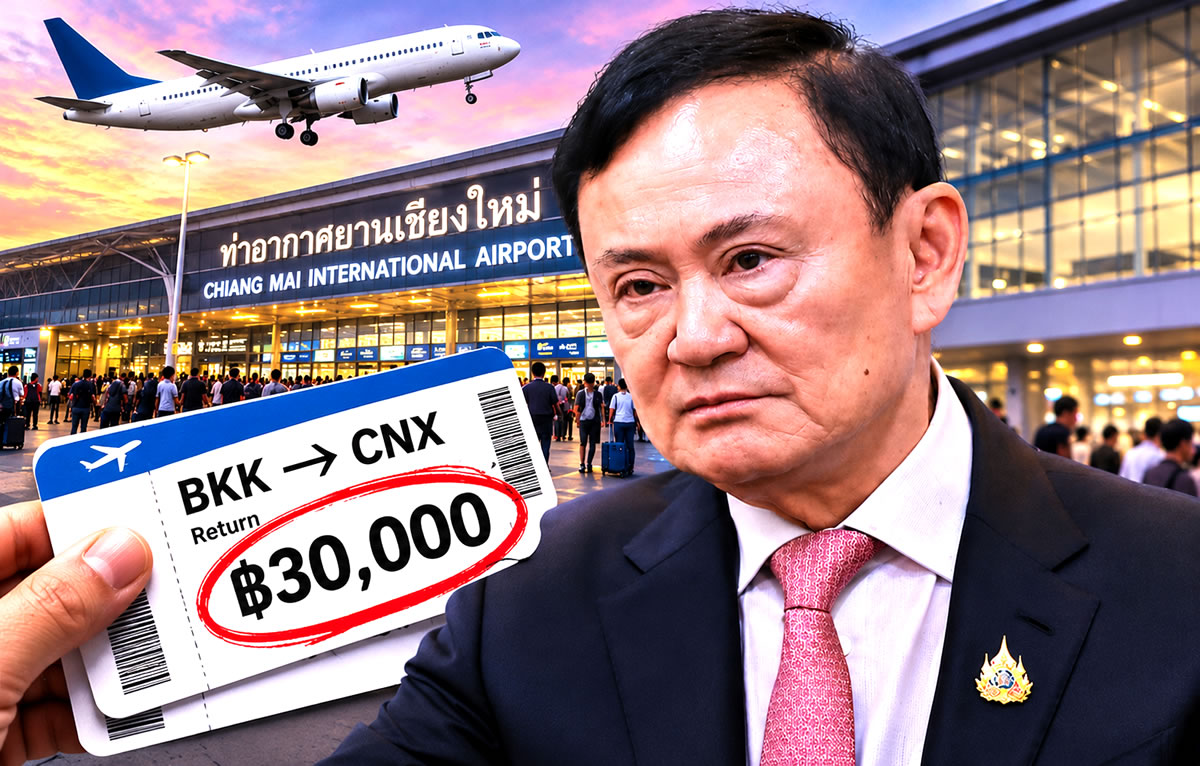
Former Prime Minister Thaksin Shinawatra hit out on Friday, November 27, over the staggering cost of Thailand’s domestic airfares. His secretary encountered return ticket prices approaching ฿30,000 while attempting to book budget flights between Bangkok and Chiang Mai.
Thaksin pointed out that passengers could fly to Hong Kong and back for less. Furthermore, he questioned how airlines charging such prices could continue describing themselves as low-cost carriers. The former premier demanded effective government controls on maximum ticket prices.
His intervention drew a swift response from Deputy Prime Minister and Minister of Transport Phiphat Ratchakitprakarn. Meanwhile, officials scheduled emergency talks involving aviation regulators, consumer protection authorities and domestic airlines.
Thaksin slams premium prices for economy travel after secretary finds Chiang Mai fares nearing ฿30,000
Thaksin published his complaint on his personal Facebook page and X account early on Friday morning. He explained that he had travelled to Chiang Mai for the annual Loy Krathong celebrations.
However, his secretary encountered considerable difficulty securing seats with a budget airline. Initially, available return tickets cost more than ฿13,000. The price subsequently increased to ฿23,000 when a booking change was involved.
Eventually, a booking website quoted a return fare approaching ฿30,000. The former prime minister appealed directly to government officials responsible for regulating Thailand’s domestic aviation industry.
“This is not what you call a low-cost airline,” Thaksin declared. He also attacked the disparity between the prices demanded and the standard of service provided. Passengers were paying premium prices without receiving premium services.
Former premier recalls ฿999 return flights as he demands price controls on Thailand’s budget airlines
Indeed, Thaksin suggested that Thailand’s budget carriers were competing as “high-cost airlines”. He rejected describing them as luxury operators because passengers were still travelling in economy class. Instead, the former premier demanded that the Ministry of Transport exercise its regulatory powers over maximum ticket prices.
Thaksin recalled introducing low-cost airlines to Thailand during his Thai Rak Thai administration approximately two decades ago. His government’s objective was to make domestic air transportation accessible to ordinary Thai citizens.
Previously, flying between Bangkok and provincial cities was beyond the financial means of many households. The introduction of budget airlines brought fierce competition between operators and substantially cheaper tickets. Thaksin recalled carriers aggressively cutting fares to attract passengers.
At one point, promotional return tickets between Chiang Mai and Bangkok cost just ฿999. By comparison, the highest price encountered by his secretary was approximately 30 times that historical promotional fare.
Thaksin renews complaint after slow response under Paetongtarn as Phiphat defends existing fare rules
Notably, Thaksin revealed that Friday’s intervention followed an earlier complaint concerning expensive domestic air travel. He previously raised the matter during the administration of his daughter, former Prime Minister Paetongtarn Shinawatra.
Nevertheless, the former premier said cooperation from the responsible government agencies had been extremely slow. He renewed his appeal on Friday, specifically requesting action from the Ministry of Transport. Thaksin stressed that he was pursuing the matter on behalf of ordinary citizens.
“I am filing this complaint on behalf of ordinary citizens,” the former prime minister declared.
In response, Deputy Prime Minister Phiphat Ratchakitprakarn defended Thailand’s existing aviation regulations on Friday. The transport minister insisted that authorities had not established that domestic airlines were breaching legally prescribed fare ceilings.
He stressed that Thailand’s aviation industry operates within a liberalised commercial environment. Consequently, the government faces limitations on its ability to dictate commercial ticket prices. Phiphat also defended airlines facing substantially different operating conditions from those prevailing during Thaksin’s administration.
Phiphat cites changing operating costs and recalls paying up to ฿10,000 for one-way flights in Thailand
In particular, the deputy prime minister highlighted volatility in international energy markets and its impact on aviation fuel costs. Airlines must contend with changing operating expenses when determining commercial ticket prices.
Phiphat pointed out that the economic circumstances facing domestic carriers had changed considerably over two decades. The transport minister rejected a straightforward comparison between current ticket prices and those available during the Thai Rak Thai administration.
Interestingly, Phiphat acknowledged experiencing exceptionally expensive domestic airfares himself. He recalled paying between ฿7,000 and ฿10,000 for one-way flights to destinations in southern Thailand.
These included Phuket and Hat Yai. The deputy prime minister attributed those prices to reservations made shortly before departure. Accordingly, he urged passengers to secure domestic airline tickets well in advance. He also advised travellers to avoid independent booking agents imposing additional charges on airline tickets.
Chiang Mai return fare ceiling of ฿10,000 exposes regulatory gaps involving overseas ticket resellers
Crucially, Thailand already has regulations governing maximum domestic airfares. The Civil Aviation Authority of Thailand (CAAT) imposes specific fare ceilings on domestic airline operators.
For budget flights between Bangkok and Chiang Mai, the maximum fare is approximately ฿5,000 each way. That puts the regulated basic return fare at approximately ฿10,000. Certain taxes, supplementary charges and additional services are excluded from the ceiling. Even so, the highest price quoted to Thaksin’s secretary approached three times the regulated basic return fare.
A major regulatory difficulty concerns tickets advertised through independent online booking platforms. Overseas travel agencies can operate outside the direct jurisdiction of Thailand’s aviation regulator.
As a result, passengers can encounter prices substantially exceeding the maximum fares imposed on domestic carriers. The existing regulations distinguish between charges imposed by airlines and those demanded by independent ticket resellers.
Government officials acknowledged significant deficiencies in their ability to regulate overseas intermediaries. Friday’s exchanges brought those deficiencies into sharp focus.
Deputy transport minister seeks Thaksin’s booking details as gaps in consumer protection come to light
Separately, Deputy Minister of Transport Siripong Angkasakulkiat thanked Thaksin for bringing the matter to public attention. He acknowledged that ticket resale becomes particularly problematic during periods of exceptionally heavy passenger demand.
The problem intensifies when available airline seats become scarce. Siripong requested specific details concerning the former prime minister’s attempts to secure tickets for his Chiang Mai trip. The deputy minister wanted to identify the booking website and establish which airline was involved.
As part of this, officials wanted to determine whether Thaksin’s secretary had attempted to purchase tickets directly from domestic carriers. The former prime minister had not publicly identified the airline or independent booking platform concerned.
Neither had he disclosed whether the highest-priced tickets were ultimately purchased. Siripong indicated that identifying the businesses involved would assist officials in examining the transaction. The deputy minister acknowledged that the complaint had exposed potential shortcomings in existing consumer protection arrangements.
More specifically, Siripong acknowledged that current legislation did not adequately address certain pricing practices employed by online travel agencies. Thailand’s aviation authorities can regulate domestic airlines but face restrictions when dealing with overseas ticket resellers.
Transport officials schedule Friday talks with airlines and regulators to tackle ticket resale problems
Additional regulatory controls would therefore have to be examined. The deputy minister revealed that discussions involving several government agencies had already been scheduled for Friday afternoon.
The Ministry of Transport was to meet representatives of the Office of the Consumer Protection Board (OCPB). In addition, officials from the Department of Internal Trade were expected to participate.
The discussions were also to involve the Civil Aviation Authority of Thailand and representatives of domestic airlines. The meeting brought together agencies responsible for aviation regulations, commercial pricing and consumer protection. Officials were examining the problem of expensive domestic tickets and the regulatory difficulties associated with independent booking platforms.
In parallel, Siripong highlighted government efforts to increase domestic flight capacity during periods of exceptionally heavy passenger demand. Increasing the number of available seats is among the measures being pursued by transport authorities.
Nonetheless, the deputy minister acknowledged that additional flights alone would not resolve the problems associated with independent ticket resale. The outcome of Friday afternoon’s interagency discussions had yet to be confirmed.
Chiang Mai airport breaks passenger record as festival demand coincides with restrictions on flights
On another front, passenger figures released on Friday revealed unprecedented demand for flights serving Chiang Mai. On Thursday, November 26, Chiang Mai International Airport handled 41,136 passengers travelling aboard 279 flights.
It was the busiest day in the airport’s history. The record followed the annual Yi Peng celebrations, which attracted substantial numbers of domestic and international visitors. Airport authorities anticipated continued congestion throughout the weekend.
Domestic passengers were advised to arrive two hours before departure. International travellers were advised to allow three hours before their scheduled flights.
In fact, Thailand’s aviation regulator had identified potential difficulties more than two weeks before Thaksin’s public intervention. On November 12, CAAT warned that exceptional festival demand coincided with restrictions on aircraft operations.
The restrictions were associated with traditional sky lantern releases during Chiang Mai’s annual celebrations. Available flight capacity was consequently reduced during a period of exceptionally strong passenger demand. Aviation officials had also warned passengers about unusually expensive tickets advertised through third-party booking platforms.
Dynamic pricing hits last-minute passengers as Thaksin demands fair fare ceilings linked to fuel costs
Against this backdrop, dynamic pricing arrangements placed further pressure on the cost of remaining airline seats. Domestic carriers offer tickets through different fare categories. As passengers purchase available seats, the cheaper ticket categories become exhausted.
Thereafter, travellers face progressively higher prices for the remaining seats. Advance reservations allow passengers to access cheaper fares before those categories sell out. Last-minute passengers have considerably fewer options when flights are approaching capacity.
Domestic air travel, however, is not exclusively a recreational purchase. Passengers frequently require urgent transportation for medical treatment, family emergencies and essential business commitments.
New taxes simply for going in and out of Thailand in addition to higher airport tax already implemented
Thai Airports to become far more expensive after government jacks up service charge by 50% from June
Such travellers cannot always secure reservations several weeks before departure. Thailand’s statutory fare ceilings provide regulatory protection against excessive charges imposed by domestic airlines.
The outstanding difficulty concerns the application of effective price controls when passengers purchase tickets through independent overseas intermediaries.
For his part, Thaksin did not demand an unconditional return to the exceptionally cheap promotional fares of his administration. The former prime minister specifically called on the Ministry of Transport to “cap max”, meaning control maximum ticket prices. He accepted that regulated fares could fluctuate in accordance with aviation fuel costs. Nevertheless, he insisted that such adjustments must be fair to ordinary passengers.
Join the Thai News forum, follow Thai Examiner on Facebook here
Follow Thai Examiner on Google here
Receive all our stories as they come out on Telegram here
Follow Thai Examiner here
Further reading:
60-day visa regime to be ended confirms Minister responding to rising industry security concerns
Tourism boss warns Thailand it is facing a Chinese blacklist if another security controversy erupts