Nine workers injured as a huge blast tears through Bangchak’s Bangkok refinery. Three are critically hurt. Cancer-causing benzene is detected in nearby communities. Suchart orders round-the-clock pollution checks as investigators hunt for its cause.
A massive explosion ripped through Bangchak’s Bangkok oil refinery on Thursday, November 26, injuring nine workers, three critically. The blast shook buildings and forced emergency evacuations across Phra Khanong. Crucially, the refinery had recently restarted following maintenance. Prime Minister Anutin Charnvirakul ordered emergency environmental inspections after the disaster. Officials detected carcinogenic benzene in three residential communities. Subsequently, Minister of Natural Resources and Environment Suchart Chomklin ordered round-the-clock pollution monitoring within five kilometres. Meanwhile, Energy Minister Akanat Promphan demanded safety clearance before operations resume. Investigators are hunting for the cause of the explosion at the refinery in the capital, which suffered a similar disaster in 2012.
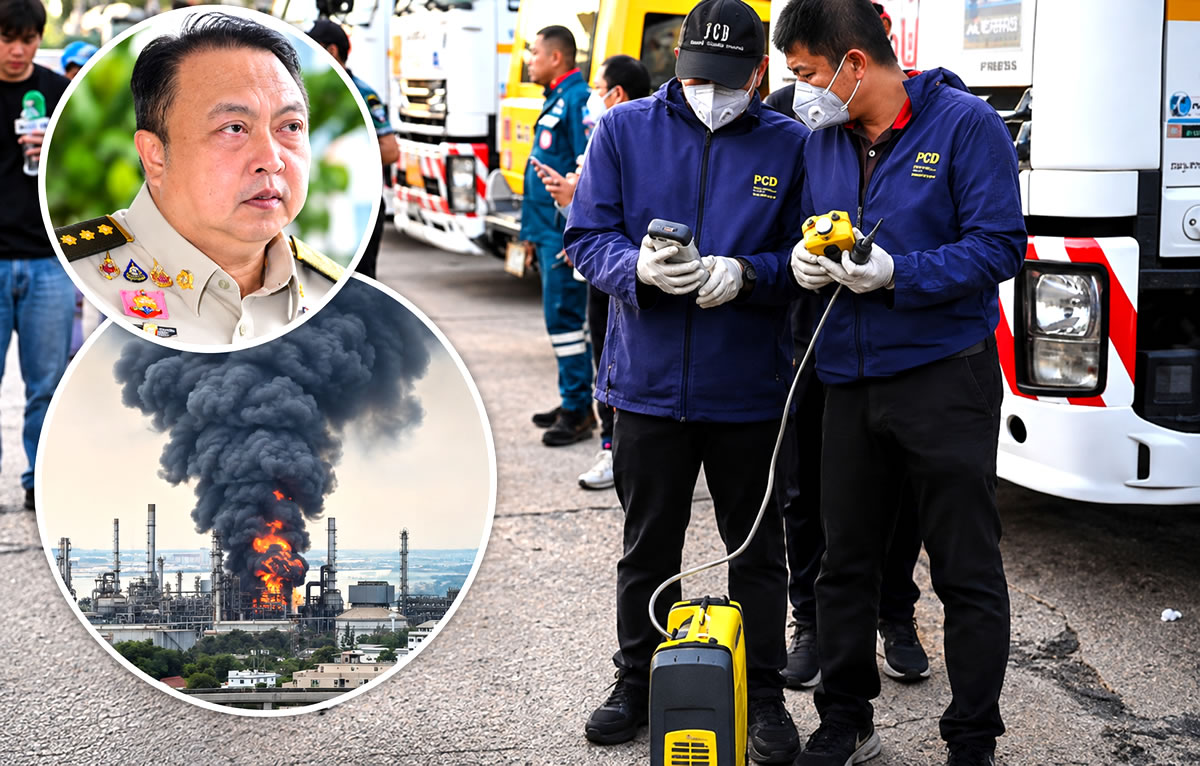
A massive explosion ripped through Bangchak’s oil refinery in Bangkok’s Phra Khanong district on Thursday afternoon, November 26. Nine workers were injured, three critically, as a towering column of black smoke swept across eastern Bangkok.
The blast struck at 2.45 pm inside the sprawling industrial complex on Sukhumvit Soi 62. Emergency authorities ordered immediate evacuations as flames engulfed processing equipment. Nearby schools hurriedly evacuated students, while office workers reported buildings shaking from the force of the explosion.
Crucially, Bangchak later said the refinery had resumed operations after maintenance. Investigators traced the fire to auxiliary equipment attached to a hydrocracking processing tower.
Anutin orders emergency pollution inspections as Bangkok residents and schoolchildren flee refinery fire
However, the precise equipment failure responsible for the explosion remained undetermined. Prime Minister Anutin Charnvirakul ordered emergency environmental inspections amid fears of toxic chemical contamination. Industrial regulators later invoked statutory powers to suspend operations at the damaged facility.
Within three minutes of the explosion, the Bang Na district office issued an urgent public warning. Officials confirmed an explosion at the Bangchak facility and instructed surrounding communities to evacuate immediately.
Thick black smoke billowed high above the industrial complex. Furthermore, intermittent bursts of flames were visible from considerable distances across the capital.
Footage circulating on social media showed students being hurriedly evacuated from nearby schools. Workers in a neighbouring office building reported feeling the structure shake as the initial blast struck.
The emergency unfolded in a densely populated area of eastern Bangkok. Residential communities, schools and commercial buildings surround the major petroleum processing facility.
Firefighters extinguish refinery blaze within 30 minutes as Bangchak shuts down all production units
At the same time, emergency crews battled to contain the blaze within the refinery grounds. Firefighters successfully extinguished the fire at 3.15 pm, just 30 minutes after the initial explosion.
Nevertheless, authorities remained concerned about emergency access to the industrial complex. The surrounding road network became the subject of a citywide emergency warning.
At 3.30 pm, a cell broadcast alert reached mobile phones across Bangkok. Authorities instructed motorists to avoid roads surrounding the refinery. In particular, officials demanded that motorists stay away from the road alongside the old railway line. Emergency vehicles and fire engines required unobstructed access to the affected facility.
By 3.45 pm, Bangchak Corporation declared the situation fully under control. The company confirmed that every production unit at its Phra Khanong refinery had been shut down. An investigation into the circumstances surrounding the explosion was already underway.
Meanwhile, medical personnel were treating workers injured during the industrial accident. The Erawan Emergency Medical Centre initially reported seven injured people, including four in critical condition.
Later reports placed the casualty toll at nine injured workers, three critically injured. Bangchak subsequently confirmed that two injured personnel had been discharged from medical care.
Investigators identify hydrocracking equipment as source of fire after refinery restart after maintenance
Energy Minister Akanat Promphan travelled to the refinery to oversee the government’s response. Preliminary findings identified the hydrocracking unit as the source of Thursday’s industrial emergency.
More specifically, Secretary to the Energy Minister Thitipat Chotedechachainan identified auxiliary equipment attached to a processing tower. The ministry had yet to establish which individual component failed or what triggered the ignition.
Hydrocracking is a complex industrial process involving hydrogen, extremely high pressure and elevated temperatures. It converts heavier petroleum fractions into commercially valuable products, including diesel and aviation fuel.
Additionally, the operation involves highly flammable hydrocarbons and specialised industrial machinery. The equipment must withstand considerable temperatures and pressures throughout the petroleum processing operation.
Significantly, Bangchak Group Chief Executive Officer and President Chaiwat Kovavisarach disclosed that the refinery had recently completed maintenance. The facility had returned to production before Thursday’s disaster. That disclosure placed the maintenance shutdown and subsequent restart among the circumstances requiring examination.
Bangchak chief cuts short European trip as government orders urgent checks for air and water pollution
Chaiwat was in Frankfurt, Germany, when news of the explosion reached him. He had been scheduled to continue his European trip with a visit to London. Instead, the Bangchak chief executive cancelled that engagement and arranged his return to Thailand. No evidence had established that defective maintenance or human error caused the explosion.
Separately, Energy Minister Akanat Promphan revealed the proximity of the damaged processing infrastructure to the refinery’s petroleum storage facilities. The affected equipment stood approximately 100 metres from the storage area.
Firefighters contained the blaze before it reached the main oil and gas storage tanks. Prime Minister Anutin Charnvirakul also indicated that the fire had not struck the refinery’s main production area.
The Prime Minister expressed particular concern about the potential consequences for residents surrounding the industrial complex. He assigned Minister of Natural Resources and Environment Suchart Chomklin to oversee the emergency environmental response.
In response, Suchart ordered the Pollution Control Department (PCD) to dispatch personnel immediately. Their instructions covered atmospheric pollution, hazardous chemical compounds and potential contamination of surrounding water sources.
Pollution Control Department chief warns invisible toxic chemicals may prevent residents returning home
Under the minister’s orders, environmental inspections covered areas ranging from 100 metres to five kilometres from the refinery. Officials were instructed to establish whether airborne chemicals presented an immediate threat to surrounding communities.
The government’s intervention extended beyond measuring visible smoke, soot and dust. Specialised monitoring equipment was required to detect potentially dangerous substances released during the fire.
At 5 pm, Pollution Control Department Director-General Surin Worakitthamrong arrived at the Bangchak refinery. He warned that hazardous chemicals could remain in the atmosphere despite the disappearance of visible smoke.
Notably, some pollutants released during petroleum combustion cannot be detected by the naked eye. Environmental officials therefore required detailed measurements before issuing definitive safety instructions.
At that stage, Surin could not confirm whether evacuated residents could safely return to their homes. Neither could he establish whether surrounding communities had been exposed to harmful concentrations of chemicals.
Consequently, the director-general urged residents to await the results of official environmental measurements. The disappearance of smoke alone was insufficient to establish atmospheric safety.
Environmental teams hunt for hazardous airborne chemicals as initial readings remain within normal limits
Surin explained that pollutants released during the fire would initially travel in the direction of the prevailing wind. Preliminary assessments placed the potential impact within approximately one kilometre of the refinery.
Further measurements were required to establish the actual extent of atmospheric contamination. To that end, Surin dispatched two additional inspection teams into surrounding villages and residential communities.
Their equipment could detect carbon monoxide and potentially hazardous organic compounds associated with petroleum combustion. Among the substances targeted were benzene, toluene and xylene.
These chemicals formed part of the department’s emergency assessment of atmospheric conditions. Officials were examining concentrations at different distances from the industrial complex.
By 5.30 pm, Pollution Control Department officials had conducted air quality tests three to four kilometres from the refinery. The department reported that readings remained within normal limits.
Attention then turned to measurements obtained from residential communities considerably closer to the industrial complex. At 5.45 pm, Surin released detailed findings from the emergency environmental operation.
Benzene detected in three residential communities with highest concentration one kilometre from refinery
Officials had examined three residential locations at different distances from the site of the explosion. The first covered a community situated within 100 metres of the refinery.
Another inspection targeted the Wat Boonrod community, approximately 500 metres away. Finally, environmental teams examined atmospheric conditions at Laddao Village, approximately one kilometre from the industrial complex.
Importantly, officials detected neither carbon monoxide nor sulphur dioxide at any of the three residential locations. Monitoring equipment did, however, register measurable concentrations of benzene at every location examined. Within 100 metres of the refinery, officials recorded a concentration of 0.09 parts per million.
Further away, the concentration reached 0.18 parts per million in the Wat Boonrod community. The highest of the three measurements came from Laddao Village. There, approximately one kilometre from the refinery, benzene concentrations reached 0.32 parts per million.
All three readings remained below the 52 parts per million threshold cited by officials during Thursday’s emergency assessment. That threshold should not be confused with a standard governing prolonged residential exposure.
Suchart orders round-the-clock pollution monitoring and quick public alerts despite low benzene readings
Benzene is a recognised carcinogen. Surin attributed the relatively low ground-level concentrations to favourable atmospheric conditions and the rapid suppression of the fire.
Despite those initial findings, Suchart ordered continuous environmental surveillance throughout the affected area. The Pollution Control Department arranged the deployment of mobile air quality monitoring units around the refinery.
These units will maintain surveillance 24 hours a day. Officials must issue immediate public warnings whenever readings indicate potentially dangerous concentrations of pollutants.
As part of this operation, environmental teams must coordinate with relevant government agencies whenever atmospheric conditions deteriorate. Suchart’s instructions also covered abnormal readings indicating a developing threat to surrounding communities. The monitoring programme will allow authorities to track changes in pollution concentrations following the industrial fire.
In parallel, Bangchak Corporation conducted its own atmospheric monitoring operation. The company operates automatic ambient air quality monitoring stations covering Phra Khanong, Bang Na and Bang Nam Phueng.
In a statement issued on Thursday evening, Bangchak reported that readings remained within normal levels. Government officials continued extending their independent inspections across the surrounding districts.
Pollution surveillance extends five kilometres across Bangkok with environmental reports every 30 minutes
The wider environmental surveillance programme covered three zones extending five kilometres from the refinery. Immediate attention focused on residential communities within one kilometre of the industrial complex.
The second zone extended between one and three kilometres, covering schools and communities potentially exposed to downwind pollution. Beyond that, the outer surveillance area extended to five kilometres.
Phra Khanong and Bang Na received priority attention during Thursday’s emergency environmental response. The surveillance programme also covered Khlong Toei, Yan Nawa, Rat Burana, Suan Luang and Vadhana.
Of particular concern was the possible westward movement of airborne pollutants overnight. Environmental officials were instructed to monitor atmospheric conditions throughout the designated districts.
The surveillance programme included hydrogen sulphide, nitrogen dioxide and hazardous particulate matter. In addition to continuous monitoring, environmental teams were instructed to submit reports every 30 minutes.
Any development presenting an immediate threat to public health required urgent notification. The operation was scheduled to continue throughout Thursday night.
Officials target possible wastewater contamination as industrial regulators invoke powers under Factory Act
On another front, Suchart ordered an investigation targeting potentially contaminated wastewater generated during the emergency. The investigation covers water used during firefighting operations and wastewater arising from activities inside the refinery.
Pollution Control Department officials were instructed to coordinate their inspections with other government agencies. Their task is to establish whether contaminants entered surrounding waterways or threatened other water sources.
As of Thursday night, no confirmed wastewater laboratory findings were available. The Ministry of Natural Resources and Environment maintained that environmental inspections must address both atmospheric and water contamination. Officials were instructed to continue assessing potential environmental consequences following the suppression of the blaze.
Alongside the environmental response, industrial regulators moved to impose formal restrictions on operations at the damaged refinery. The Department of Industrial Works invoked Section 39 of the 1992 Factory Act.
The statutory order suspended the affected processing operation pending comprehensive industrial safety inspections. The Department of Energy Business received separate instructions to examine the refinery’s petroleum storage infrastructure.
Akanat demands safety assurances before refinery can reopen as previous major explosion in 2012 recalled
By 8 pm, details of Energy Minister Akanat Promphan’s shutdown and safety inspection orders had emerged. The minister insisted that operations could not resume without satisfactory assurances regarding the facility’s safety.
He also demanded a comprehensive investigation establishing the precise cause of the explosion. Investigators must identify measures required to prevent another industrial accident at the facility.
Thursday’s explosion was not the first major industrial emergency at Bangchak’s Phra Khanong refinery. In July 2012, another explosion triggered a massive fire inside the same complex. Neighbouring residential properties sustained damage, although no injuries were reported. Repairs following that incident took approximately two weeks.
At the time, the explosion prompted questions about the refinery’s location within Bangkok’s increasingly developed residential environment.
The Phra Khanong facility remains a substantial component of Thailand’s petroleum processing infrastructure. Bangchak describes the facility as a modern complex refinery. Its maximum processing capacity stands at 120,000 barrels daily.
Thailand’s petroleum supplies remain secure as investigators hunt for cause of devastating refinery blast
From a national energy perspective, Bangchak’s two oil refineries have a combined processing capacity of approximately 300,000 barrels daily.
Despite Thursday’s production shutdown at Phra Khanong, Energy Minister Akanat Promphan indicated that Thailand’s national petroleum supplies should remain secure.
Business tenants of Bangkok’s Khlong Thom Centre wiped out after decades of hard work went up in flames
Huge fire in central Bangkok at a major electronics retail centre. Governor Chadchart was on the scene
By late Thursday night, industrial regulators and environmental authorities were pursuing separate investigations into the disaster. The precise cause of the explosion remained officially undetermined.
Government inspectors must establish what failed inside the hydrocracking processing infrastructure before authorising its return to service. Environmental teams, meanwhile, maintained their overnight surveillance across surrounding Bangkok districts.
Join the Thai News forum, follow Thai Examiner on Facebook here
Receive all our stories as they come out on Telegram here
Follow Thai Examiner here
Further reading:
Chiang Mai family home gutted by fire. Occupants escaped after woman of the house spotted smoke
Khon Kaen Police probing a pre dawn blaze caused by a charging EV that burned down a family home
Government sends strong warning to EV industry after a dramatic surge in consumer complaints
Thaksin wants higher excise duties on EV cars that are simply assembled in Thailand by Chinese firms