Thailand’s 30-day visa-free rule splits tourism chiefs. Sisadiwat Cheewaratanaporn says genuine tourists need far less time, while William Heinecke warns the move threatens lucrative medical and wellness tourism where visitors often book extended stays.
Thailand’s new 30-day visa-exemption rule is opening a sharp fault line across its tourism industry before the crucial fourth-quarter peak. The Association of Thai Travel Agents says most genuine tourists need only seven to 10 days. It also wants tougher action against foreigners abusing tourist status. However, Minor International founder William E. Heinecke warns the September 30 change could hurt medical and wellness tourism. Treatment and recovery can require longer stays. Northern operators also fear disruption to established long-stay markets in Chiang Mai and Pai. Meanwhile, the Association of Thai Travel Agents is pressing Prime Minister Anutin Charnvirakul to tackle illegal foreign business activity, improve Thailand’s safety image and counter growing competition from Vietnam and Malaysia, both of which are winning market share.
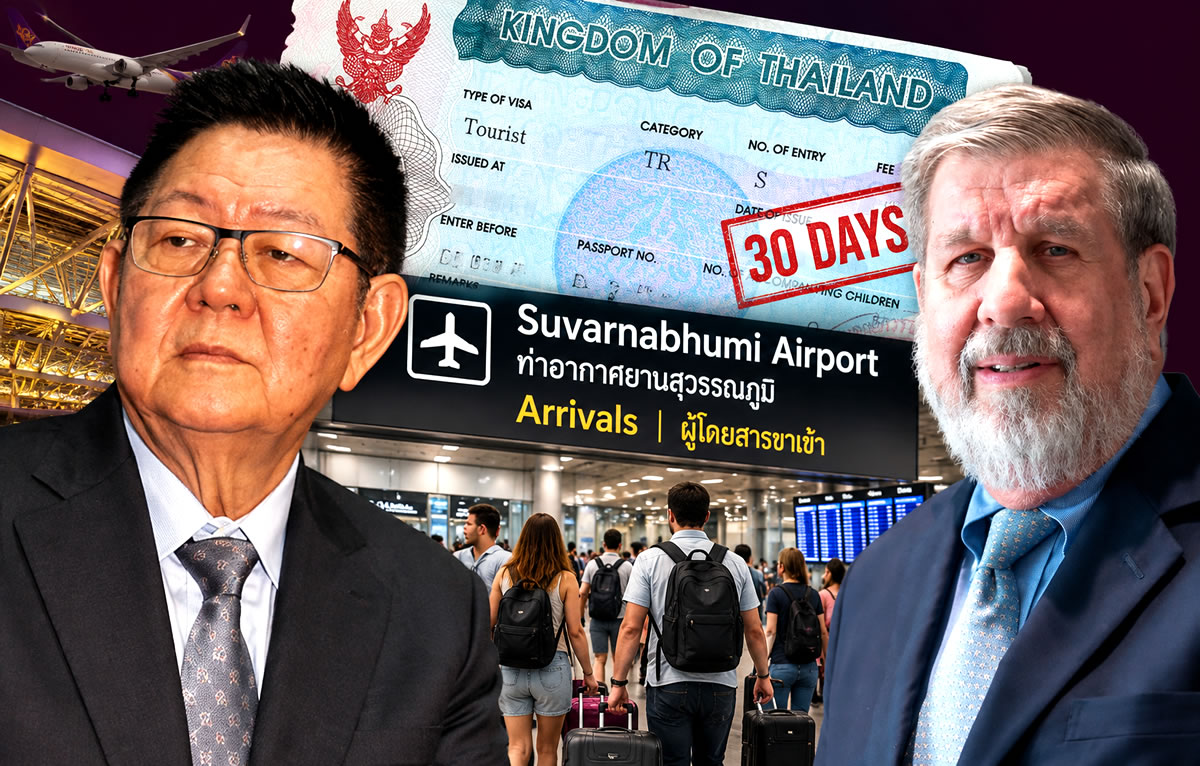
Thailand’s tourism industry is divided over the government’s decision to cut visa-exempt stays from 60 days to 30 days. The new limit takes effect on September 15. Mainstream travel organisations broadly support the change. However, significant voices in hospitality warn that it could damage valuable long-stay tourism.
The dispute has produced two sharply different assessments of what Thailand needs from foreign visitors. The Association of Thai Travel Agents (ATTA) says 30 days is ample for genuine tourists. In contrast, Minor International founder and chairman William E. Heinecke warns of consequences for medical and wellness tourism.
Mr Heinecke is one of Thailand’s most prominent business leaders and hospitality entrepreneurs. His intervention therefore gives the opposition significant weight. He argues that medical visitors cannot always fit treatment and recovery into a conventional holiday timetable. Accordingly, a 30-day restriction can become an obstacle for precisely those customers.
ATTA backs 30-day stays as Sisadiwat says most genuine tourists need far less time in Thailand now
Sisadiwat Cheewaratanaporn takes the opposite position. He chairs ATTA’s advisory board and is the association’s honorary president. Mr Sisadiwat says the reduction is appropriate and sufficient for tourism. Moreover, he sees little justification for giving conventional holidaymakers 60 days.
According to Mr Sisadiwat, most tourists spend only seven to 10 days travelling in Thailand. Even longer conventional holidays generally last between 15 and 20 days. On those figures, a 30-day permission provides ample time for the overwhelming majority of visitors. ATTA therefore expects little disruption to normal tourism.
Mr Sisadiwat also rejects concerns about a negative psychological impact from the shorter period. Instead, he identifies the previous lengthy stay as a potential enforcement problem. Foreigners permitted to remain for two or three months have greater opportunities to pursue activities unrelated to tourism.
In particular, Mr Sisadiwat points to foreigners entering as tourists before working or operating businesses. Some exploit immigration loopholes to make a living inside Thailand, he says. Consequently, they can become direct competitors to Thai entrepreneurs and workers. Their activity then moves well beyond the purpose of tourist entry.
Local communities are already familiar with the problem, according to the ATTA veteran. Yet he says it has not been adequately resolved. For that reason, he wants faster government action against foreign investment groups operating outside Thai law. He also wants businesses exploiting legal loopholes targeted.
ATTA links longer tourist stays to illegal work, business activity and direct competition with Thais
ATTA’s support for 30 days consequently forms part of a wider economic argument. The organisation does not simply believe tourists require less time. Mr Sisadiwat also connects lengthy tourist permissions with illegal work and unlawful commercial activity. In response, he wants the government to tighten both immigration and enforcement.
Mr Heinecke approaches the issue from another end of Thailand’s tourism market. He warns that legitimate high-value visitors can require much longer periods. Medical tourism provides the clearest example. Treatment, rehabilitation and recovery can extend beyond one month.
Rather than using permitted stay length as the principal control, Mr Heinecke favours stronger screening. He has also called for improved immigration procedures and airport controls. In his assessment, those measures can distinguish genuine visitors from people abusing tourist entry. Meanwhile, legitimate medical customers could retain greater flexibility.
His argument is particularly significant because Thailand is seeking higher-value tourism. Medical and wellness visitors form an important part of that market. They can also behave very differently from ordinary holidaymakers. As a result, the dispute reaches beyond the simple question of whether 30 days is enough.
Heinecke warns 30-day limit could obstruct medical tourism as Thailand targets higher-value visitors
Mr Heinecke has additionally pointed towards growing competition from Malaysia. The neighbouring country is competing directly for medical and wellness customers. Thus, Thailand’s immigration arrangements become part of a wider regional contest for valuable visitors.
The competing positions expose a clear fault line within the industry. ATTA assesses the policy through conventional inbound tourism. Mr Heinecke focuses on specialised visitors who may require extended stays. Both are therefore examining different sections of Thailand’s foreign visitor market.
For ATTA, the calculation remains straightforward. A tourist staying seven days does not require a 60-day exemption. Neither does someone taking a two-week holiday. Even a 20-day visitor remains comfortably inside the new 30-day period.
Medical tourism operates differently. A patient may arrive for treatment lasting several weeks. Afterwards, rehabilitation or recovery may be required. Medical schedules can also extend beyond the original timetable. Consequently, the visitor’s immigration needs may bear little resemblance to those of an ordinary tourist.
Long-stay tourism in northern Thailand creates another pressure point. Chiang Mai has developed a market involving remote workers, digital nomads and other extended-stay foreigners. These visitors also fall outside ATTA’s seven-to-10-day model.
Malaysia rivalry sharpens visa dispute as medical tourists and northern long-stay markets face pressure
La-iad Bungsrithong, adviser to the Thai Hotels Association Northern Region, previously raised concerns about this market. She estimated long-stay visitors at around 5-8% of foreign arrivals across Chiang Mai and northern Thailand. While relatively small, the segment has become established within the regional tourism economy.
Importantly, Ms La-iad did not simply demand that the 60-day exemption remain unchanged. Instead, she called for alternative arrangements for genuine long-stay visitors. She also noted that competing destinations were simplifying their requirements. Accordingly, her concern centred on preserving legitimate extended stays rather than defending unrestricted tourist entry.
Pai has even greater exposure to the issue. Panudej Chaiyasakul, president of the Mae Hong Son Tourism Business Association, has addressed the impact there. Conventional tourists would be largely unaffected, he said. However, long-stay visitors represent approximately 15% of Pai’s market.
Some of those visitors remain for 30 or 60 days. Others stay considerably longer. Under the revised system, many will therefore need different immigration arrangements. Separately, Mr Panudej has called for government marketing measures to offset any resulting impact.
Chiang Mai and Pai operators warn shorter stays could disrupt established long-stay visitor markets
The dispute consequently runs through several different layers of Thailand’s tourism economy. It is not simply an argument between Thai businesses and foreign visitors. Instead, different Thai tourism sectors have different commercial exposures to longer stays.
The national leadership of the Thai Hotels Association broadly supports the shorter period. ATTA has taken an equally firm position. Both see 30 days as sufficient for conventional tourists. Their arguments also reflect how accommodation spending changes as stays become longer.
Long-stay foreigners frequently use condominiums, apartments and villas instead of conventional hotels. Therefore, extended visa exemptions do not necessarily deliver equivalent gains to the formal hotel industry. That helps explain why mainstream hotel interests have broadly supported the reduction.
By comparison, Chiang Mai and Pai depend more heavily on specific long-stay markets. Medical and wellness businesses face another set of circumstances. Their customers may deliberately remain longer because their treatment or lifestyle requires it. Consequently, the commercial effect of 30 days varies substantially between destinations and sectors.
Mr Heinecke’s intervention adds considerable force to that side of the debate. Minor International has extensive interests across hotels, restaurants and hospitality. He is therefore speaking from inside a major Thai tourism business. More importantly, his concern relates directly to the higher-value visitors Thailand has sought to attract.
Hotel groups back 30 days while long-stay, medical and wellness sectors face a different calculation
ATTA, meanwhile, remains focused on foreigners using tourist status for economic purposes. Mr Sisadiwat says some arrive ostensibly for holidays before earning money or establishing businesses. Once that happens, he argues, they can compete directly against Thai operators.
The problem becomes particularly serious when foreign investment structures also breach Thai requirements. Mr Sisadiwat therefore wants the government to accelerate legal action against such groups. As part of this, he wants business arrangements exploiting Thai people or circumventing restrictions tackled directly.
Yet immigration abuse is only one of ATTA’s concerns before the high season. Mr Sisadiwat has issued an equally strong warning about Thailand’s international safety image. He says safety remains the number one consideration for foreign tourists.
According to Mr Sisadiwat, Thailand’s image has not improved sufficiently. Frequent reports involving road accidents, fires and criminal incidents continue to reach foreign audiences. Notably, he highlighted the case involving two Russian siblings, which generated international headlines.
The effect of such reports has intensified as information travels faster. Foreign media and tourists can access negative stories almost immediately. Sometimes, Mr Sisadiwat said, information spreads abroad faster than awareness develops inside Thailand. That creates particular difficulties in major markets such as China.
ATTA turns focus to illegal foreign business and Thailand’s worsening international safety image
Negative reports can then influence destination choices. Mr Sisadiwat says some tourists are already avoiding Thailand and choosing Vietnam. He says the competing destination is perceived as safer and more affordable. Hence, Vietnam has become a growing concern for Thailand’s mainstream tourism industry.
Regional competition is therefore hitting Thailand from different directions. Vietnam challenges its conventional holiday market on safety and price. On another front, Malaysia is competing for medical and wellness visitors. The visa debate sits directly between those two competitive pressures.
Mr Sisadiwat wants Prime Minister Anutin Charnvirakul to take charge of the response. He sees the Prime Minister as having sufficient authority to coordinate all relevant agencies. Specifically, he wants Mr Anutin to examine the negative international perceptions surrounding Thailand.
The government should then order corrective measures across the relevant organisations, Mr Sisadiwat said. Security agencies should urgently address concerns affecting tourist confidence. At the same time, enforcement agencies should target foreigners exploiting Thailand’s immigration and business rules.
“The Prime Minister must build confidence to attract tourism and investment in a straightforward manner, protect the rights of Thai people, and ensure economic stability. He must not allow foreigners to invest in a way that exploits Thais. There must be clear policies and plans to counter those with malicious intentions, focusing on safeguarding Thai territory and the rights of Thai citizens. This is because we still hope that the tourism sector will perform better, especially in the short term, particularly in the fourth quarter of 2026, which is the peak tourist season,” Mr Sisadiwat said.
Vietnam and Malaysia raise regional pressure as Sisadiwat urges Anutin to restore tourist confidence
His demands place the 30-day rule inside a much broader tourism challenge. ATTA wants genuine visitors reassured about safety. Simultaneously, it wants foreigners abusing tourist permissions confronted more aggressively. The organisation sees both issues as urgent before the fourth-quarter peak.
The timing adds pressure. Thailand is entering the final quarter of 2026 and its most important foreign tourism period. ATTA hopes the sector will perform more strongly during the high season. However, regional competitors are fighting for many of the same visitors.
For mainstream tourism, ATTA sees no reason for the visa change to hurt that recovery. Its position rests heavily on actual visitor behaviour. Most tourists stay seven to 10 days, while longer holidays generally remain below 20 days. Accordingly, 30 days still provides a substantial buffer.
The association sees the other 30 days differently. Mr Sisadiwat argues that lengthy permissions create opportunities for foreigners with purposes unrelated to tourism. Those people can work, operate businesses or compete with Thai entrepreneurs. For ATTA, reducing the period therefore carries limited tourism cost while narrowing that opportunity.
Mr Heinecke’s warning challenges that calculation at the high-value end of the market. A medical visitor cannot always compress treatment into 30 days. Nor can every rehabilitation or recovery period be fixed around immigration rules. Thus, he sees the restriction as capable of creating difficulties for legitimate customers.
ATTA wants stronger safety and enforcement drive as Thailand heads into crucial fourth-quarter peak
Wellness tourism produces a related issue. This market is built partly around visitors prepared to spend more on specialised services. Some also remain longer than conventional holidaymakers. Consequently, Mr Heinecke sees flexibility as important when Thailand competes with Malaysia.
Northern operators face the same policy from yet another direction. Chiang Mai has an established remote-worker and digital-nomad market. Pai has a substantial long-stay segment representing about 15% of its visitors. Neither market closely resembles conventional package tourism.
Taken together, three broad industry positions have emerged. ATTA and mainstream hotel interests support the 30-day period. Mr Heinecke warns about its effect on medical and wellness tourism. Northern operators want workable alternatives for legitimate long-stay foreigners.
The differences become clearer when individual visitors are considered. Someone taking a 10-day holiday sees almost no practical change. A 20-day visitor also remains comfortably within the new period. By contrast, someone requiring six weeks faces an entirely different immigration calculation.
That distinction is central to the argument. ATTA wants the visa exemption designed around the behaviour of ordinary tourists. Longer-term visitors can use immigration arrangements intended for their circumstances. Mr Heinecke’s concern is that this creates extra barriers for valuable customers.
Wellness, Chiang Mai and Pai markets expose three-way industry split over Thailand’s 30-day rule
Meanwhile, Mr Sisadiwat wants no delay in dealing with people who exploit tourist status. He says some foreigners are already using lengthy stays to make money inside Thailand. Others become direct competitors to local businesses. He therefore wants enforcement intensified alongside the new visa regime.
At the same time, safety remains a separate threat to the approaching high season. Road accidents, fires and crime continue generating damaging international reports. The Russian siblings case demonstrated how rapidly one incident can reach foreign audiences, according to Mr Sisadiwat.
China is particularly important because negative information can spread quickly among prospective travellers. Vietnam then offers an immediate alternative. Mr Sisadiwat says its perceived safety and lower prices are already drawing some visitors away from Thailand.
Thailand consequently approaches the fourth quarter under pressure on several fronts. It must defend conventional tourism against Vietnam. Its medical and wellness sector faces competition from Malaysia. Meanwhile, northern destinations must manage tighter conditions for long-stay visitors.
The government also faces demands for stronger enforcement against foreigners using tourist status for illegal economic activity. In parallel, ATTA wants a coordinated campaign to restore confidence in tourist safety. Mr Sisadiwat has placed responsibility for both issues directly with the Prime Minister.
Sisadiwat presses for tougher enforcement as safety fears and regional rivals weigh on high season
Against that backdrop, the 30-day change has exposed a genuine division within Thailand’s tourism industry. ATTA sees the shorter stay as practical and sufficient. It also sees extended permissions as creating opportunities for abuse.
Mr Heinecke sees a different commercial risk. Legitimate medical and wellness visitors sometimes require substantially longer stays. Consequently, he argues that better screening and immigration controls offer another way to tackle abuse.
Chiang Mai and Pai add a third dimension. Their tourism economies contain established long-stay markets that cannot be measured against a typical 10-day holiday. Those operators therefore want alternatives that preserve legitimate extended visits.
The government’s new limit takes effect on September 30. From that point, the argument moves from policy into practical operation. Conventional tour operators, medical businesses and northern destinations will experience the same rule in markedly different ways.
Thirty-day rule exposes industry fault line as operators prepare for sharply different market impacts
For ATTA, however, the immediate priorities are clear before the high season. Mr Sisadiwat wants safety confidence restored and illegal foreign businesses targeted. He also wants Prime Minister Anutin to coordinate the response personally.
Mr Heinecke has meanwhile placed one of Thailand’s biggest business names firmly on the other side of the visa argument. His warning centres on high-value visitors whose legitimate requirements can exceed one month.
Blunder over Indian visa policy saw Thailand lose tourists in August. Quick volte face to a 30 day visa
New visa regime hits Western visitors and expats in Thailand hard with shorter stays and long haul trips
Thailand therefore enters its peak tourism period with an important industry fault line exposed. One side says 30 days is ample for genuine tourism and reduces opportunities for abuse. The other warns that some of Thailand’s most valuable legitimate visitors simply need longer.
Join the Thai News forum, follow Thai Examiner on Facebook here
Follow Thai Examiner on Google here
Receive all our stories as they come out on Telegram here
Follow Thai Examiner here
Further reading:
60-day visa regime to be ended confirms Minister responding to rising industry security concerns
Tourism boss warns Thailand it is facing a Chinese blacklist if another security controversy erupts
Visa waiver scheme questioned with another China Crisis for foreign tourism driven by security fears
Tourism cryptocurrency sandbox payment plan is bound to face stiff opposition from the central bank