Thailand ranks third for digital nomads and fourth for retirees, yet its welcome is getting tougher. Visa rules are tightening, property ownership structures face scrutiny, while a new deportation regime broadens the basis for removal. Still, Bangkok urges wealthy foreigners to come, stay and spend.
Thailand is selling itself as a global haven for digital nomads and retirees, but the welcome now comes with sharper conditions. As Bangkok celebrates a top-four global ranking, foreign property structures face sweeping scrutiny, DTV rules are tightening, visa-free stays are being cut, deportation powers are expanding and anti-Israel street protests are adding to unease. The result is a striking policy collision: Thailand wants wealthy foreigners to stay longer and spend more, while simultaneously making long-term residency, property control and immigration status more closely regulated than before.
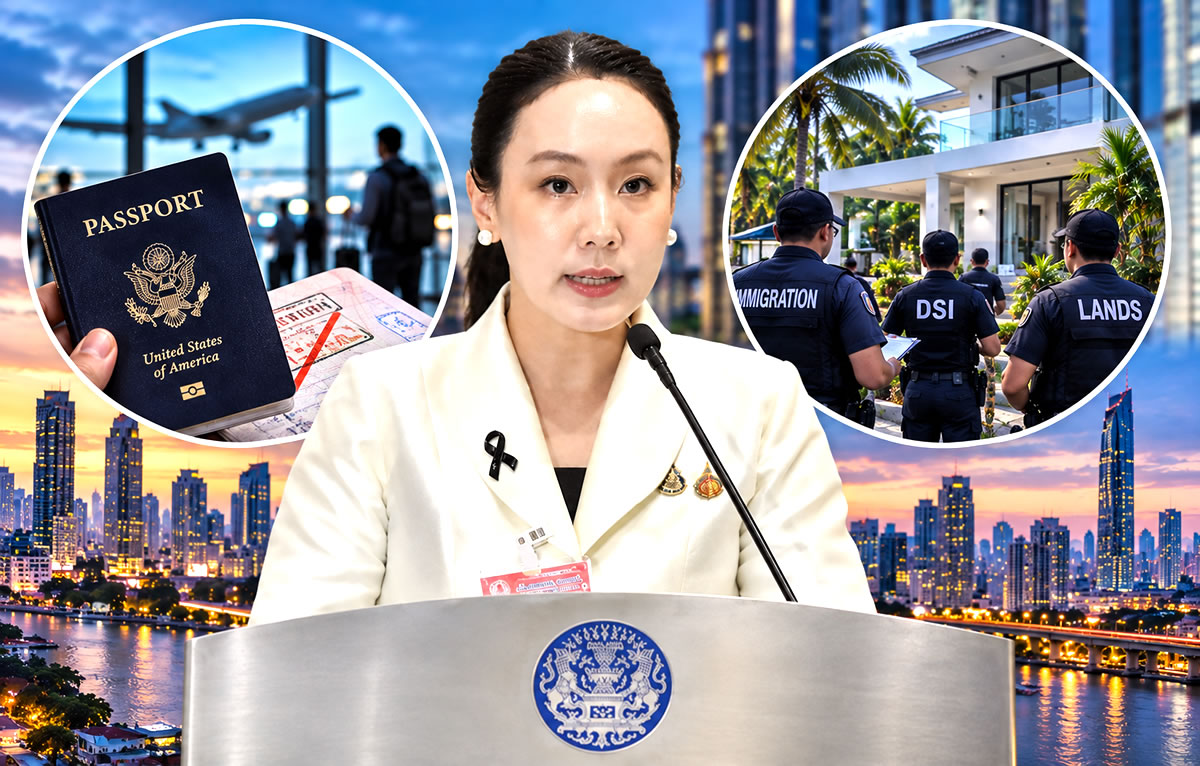
Thailand has emerged as a leading global destination for digital nomads and foreign retirees, the Prime Minister’s Office declared Saturday. Deputy government spokeswoman Lalida Persvivatana highlighted Thailand’s strong showing in the Rumavi Global Relocation Index 2026. Thailand ranked third worldwide for digital nomads. Meanwhile, it took fourth place globally for retirees.
The index covered 192 countries and territories. Thailand scored 75.4 for digital nomads and 74.3 for retirees. For the government, the figures support an increasingly important economic strategy. Thailand wants more than millions of short-stay tourists. Instead, it wants wealthier foreigners living here and spending throughout the year.
Lalida highlighted accommodation, food, transport, healthcare and other services as major beneficiaries. “The goal is not simply to make people around the world want to visit Thailand,” Lalida said. The government instead wants foreigners with sufficient means to remain longer. As a result, officials hope longer stays will generate substantially greater economic value.
Thailand’s affordability and infrastructure drive its rise as a global haven for long-stay foreigners
Thailand ranked behind Malaysia and Portugal for digital nomads. Separately, Malaysia, Panama and Portugal took the top three retirement positions. Nevertheless, Thailand performed exceptionally strongly on affordability, scoring 96.9. Currency and banking received 91.8, while digital infrastructure scored 89.4. Healthcare quality and affordability each scored 78.
Those figures underline the government’s economic pitch. Digital nomads rent condominiums, buy food and use local services. Likewise, retirees require homes, private healthcare, transport and financial services. Their spending can also continue outside traditional tourism peaks. Accordingly, Thailand wants long-stay foreigners contributing throughout the year.
Prime Minister Anutin Charnvirakul has already stressed the wider ambition. Thailand wants international talent, longer-stay visitors and financially secure foreigners. In parallel, the government wants higher expenditure from each visitor. It also wants longer stays rather than concentrating entirely on arrival numbers.
Yet Saturday’s upbeat message comes during a much tougher period for foreigners establishing long-term roots. Notably, the same relocation assessment identified the rule of law among Thailand’s weaker areas. English-language accessibility and business opportunities were also identified for improvement.
Rule-of-law concerns collide with Thailand’s intensifying crackdown on foreign property ownership
The rule-of-law issue carries particular weight for long-term residents. A tourist taking a fortnight’s holiday carries relatively little financial exposure. By contrast, a retiree buying a home can commit millions of baht. Equally, digital workers can relocate savings, families and business arrangements to Thailand.
At the same time, Thailand is conducting a far-reaching crackdown on foreign-linked companies and property ownership. The campaign covers nominee shareholders, landholding companies and financial structures used by foreigners. It also reaches Thailand’s biggest foreign property markets.
Foreigners generally cannot own Thai land directly. Furthermore, Thai citizens cannot legally act as nominees concealing foreign ownership. Those restrictions are longstanding. However, enforcement has intensified dramatically during 2026.
Prime Minister Anutin ordered tougher scrutiny of nominee landholding nationwide earlier this year. Subsequently, the Interior Ministry issued an urgent circular on August 25. Provincial governors and land officials were instructed to investigate suspected nominee arrangements more closely.
Crucially, investigators are looking beyond names appearing on company documents. They can examine tax records, funding sources and financial transactions. In addition, they can investigate the economic position of Thai shareholders. Officials can therefore establish whether those shareholders genuinely invested their own money.
Investigators look behind company paperwork as foreign property structures face tougher scrutiny
As part of this, investigators can establish who actually controls a company. A structure appearing compliant on paper can therefore face extensive examination. Where illegal foreign landholding is established, officials can order disposal of the land. Criminal proceedings can follow.
The implications are substantial for Thailand’s foreign-facing property industry. For decades, foreigners have acquired villas and houses through Thai companies. Lawyers, developers and property agents routinely assisted buyers with such structures. Some companies represent genuine businesses with genuine Thai investment.
Others, however, primarily gave foreigners effective control over houses standing on Thai land. Such nominee arrangements were not made legal by becoming commonplace. Even so, their widespread use created a substantial property market around them. Thousands of foreigners bought homes believing those arrangements offered dependable long-term control.
Now, those structures face much harder examination. The numbers are huge. Commerce Ministry figures identified 36,277 foreign-invested companies holding 305,838 land plots. Together, the properties cover approximately 1.064 million rai.
On another front, 7,082 foreign-linked companies hold 76,840 condominium units. Those units cover more than 4.1 million square metres. Importantly, officials have not accused all these companies of wrongdoing. Many are legitimate businesses or genuine Thai-foreign joint ventures.
Foreign-linked companies and hundreds of thousands of properties fall under expanding national scrutiny
Still, the government is cross-checking shareholders, directors, capital, land records and company histories. Investigators are also following money trails. Consequently, corporate, personal, financial and property databases are increasingly being linked.
Koh Samui has become one major focus. Officials there reviewed 12,906 companies, including 8,254 with foreign shareholders. Of those, 875 were flagged for closer examination. The investigations covered 60 cases and 37 land plots worth approximately ฿1.2 billion.
Phuket has also faced sustained enforcement. More than 100 companies were examined during one major operation in August. Those businesses generated revenue exceeding ฿5 billion. Following those checks, 16 faced prosecution.
Pattaya has become another key target. On August 21, investigators raided three locations during a suspected Israeli-linked nominee investigation. The operation covered a law office, condominium company and hotel business.
The Department of Special Investigation has since pursued a wider inquiry. Investigators are tracing hotels, condominiums, companies and funding arrangements. Therefore, the property crackdown is no longer confined to isolated resort cases.
Nationally, around 14,000 foreign-linked companies have faced scrutiny alongside approximately 5,800 land plots. The properties involved have been valued at around ฿60 billion. Separately, officials have targeted about 1,500 companies suspected of illegal landholding arrangements.
Property enforcement widens as buyers face deeper checks and long lease structures come under pressure
The enforcement machinery is also widening. Commerce and Interior officials can examine corporate and land records. Meanwhile, police, the DSI and Anti-Money Laundering Office can become involved. Investigators can then follow capital, shareholders and financial flows.
For foreign property buyers, the environment has consequently changed substantially. Formal registration does not necessarily end official scrutiny. Investigators can examine how a structure was created, funded and controlled.
That affects existing owners and prospective buyers differently. Existing owners can face questions over arrangements created years earlier. New buyers, however, must assess structures against a much tougher enforcement environment.
The financial exposure can be considerable. A tourist can simply choose another destination. Conversely, a retiree with ฿10 million invested in property cannot move the asset. The exposure grows further with ฿20 million or more tied to a villa.
Another established property mechanism has also suffered a major legal setback. Long leases were frequently promoted to foreigners unable to own land. In particular, developers sometimes offered arrangements described as 30+30+30-year leases.
Under those structures, buyers received an initial 30-year lease with promises covering another 60 years. For years, such arrangements were marketed as providing something approaching permanent control. However, Supreme Court Decision 4655/2566 severely weakened that proposition.
Supreme Court lease ruling adds uncertainty as Thailand simultaneously courts long-stay foreign residents
The case involved a registered 30-year lease and contractual promises covering another 60 years. Moreover, rent for the additional periods had been paid in advance. The Supreme Court upheld the initial 30-year lease. It rejected the arrangement intended to guarantee the remaining 60 years.
The court found the additional arrangement attempted to circumvent Thailand’s statutory 30-year lease limit. Consequently, one long-used route marketed to foreign buyers carries substantially less protection than many purchasers expected.
The legal position itself requires an important distinction. Thailand has not suddenly prohibited foreign ownership of land that was previously unrestricted. Foreign land ownership restrictions have existed for decades. Likewise, widespread use never made unlawful nominee arrangements lawful.
What has changed is enforcement. Structures marketed, processed and routinely used for years now face intensive investigation. Simultaneously, the government is asking financially secure foreigners to establish longer-term lives in Thailand.
The same contradiction is appearing in immigration policy. Thailand introduced the Destination Thailand Visa as a flagship route for remote workers. The DTV quickly became particularly popular among Western digital nomads.
Its five-year validity was a major attraction. Additionally, the visa offered multiple entries and lengthy stays. Applicants generally needed to demonstrate at least ฿500,000 in financial resources. They also required evidence of remote employment, freelance work or another qualifying activity.
New DTV rules demand permanent residence and criminal checks from mobile digital nomad applicants
From August 31, however, Thailand significantly tightened the application process. Applicants must now prove permanent residence where their applications are lodged. Previously, they generally needed evidence establishing their current location.
For digital nomads, that distinction is substantial. Many remote workers are mobile by definition. Some spend months moving between Asian countries without establishing permanent residence there.
Previously, that mobility could still allow a Thai DTV application while travelling. Under the revised requirements, permanent residence must be demonstrated in the application jurisdiction. Moreover, applicants must provide a criminal-record clearance certificate.
Thai diplomatic missions across several countries have confirmed the changes. For British and Irish applicants, the Thai Embassy in London issued specific requirements. Applicants must prove permanent residence in Britain, Ireland or a British Overseas Territory. Police certificates must generally have been issued within six months.
The changes do not abolish the DTV. Nor do they remove its five-year validity. However, they eliminate part of the flexibility that originally made it attractive.
For highly mobile Western workers, that change is particularly significant. The affected group includes precisely the digital nomads highlighted by Saturday’s government announcement.
Digital nomads face closer checks as Thailand cuts visa-free stays from 60 days back to just 30 days
Concerns have consequently surfaced within digital-nomad communities. The permanent-residence requirement has attracted particular attention. Separately, reports have appeared of closer checks on whether DTV holders undertake their declared activities.
One Muay Thai operator reported receiving an Immigration call concerning a DTV holder. The officer was checking whether the visa holder attended the declared activity. That report does not establish a nationwide procedure. Nevertheless, it reflects a harder enforcement climate.
The wider visa regime is tightening as well. From September 15, Thailand will end the 60-day visa-exemption arrangement introduced in 2024. Most qualifying travellers will instead receive 30 days.
The revised scheme covers 60 countries and territories. Officials cite national security, economic interests, reciprocity and abuse of immigration privileges. In response, the government points travellers seeking longer stays towards Thailand’s electronic visa system.
Visitors entering before September 15 retain the permission already stamped into their passports. Yet the broader policy direction has clearly changed. Thailand dramatically liberalised entry during 2024. Two years later, one of those flagship concessions is being rolled back.
For retirees, the immediate visa picture is less dramatic. Thailand has not imposed a comparable wholesale rewrite of standard retirement-extension financial requirements. Applicants aged 50 and above generally continue using familiar thresholds.
Retirement rules stay broadly intact as anti-Israel street campaigns add to the pressure on foreigners
Those requirements include ฿800,000 in qualifying funds or ฿65,000 monthly income. Different retirement visa categories carry separate conditions. Non-Immigrant O-A applicants also face health insurance requirements.
Even so, retirement decisions extend beyond an annual immigration stamp. Property arrangements matter heavily. Banking, healthcare and taxation also affect long-term residents. Future immigration requirements remain another consideration.
Meanwhile, another foreigner-related issue has become highly visible. A growing street campaign has targeted Israeli visitors, Israeli-linked businesses and perceived foreign influence. Veteran protest leader Sondhi Limthongkul has placed those issues at the centre of his latest campaign.
On Thursday, hundreds of protesters gathered outside the Israeli Embassy in Bangkok. Demonstrators demanded tougher enforcement of Thai laws. They also raised foreign business activity, nominee ownership and landholding.
A day later, the campaign moved south. More than 500 protesters marched through Patong in Phuket towards Chabad House. Marchers carried anti-Israel signs and chanted “Free Palestine”.
Police deployed officers and controlled traffic around the demonstration. Subsequently, a major Rosh Hashanah gathering at Chabad House was cancelled amid security concerns.
The distinction between street pressure and government policy remains clear. The Thai government has not announced a campaign against Israeli tourists based on nationality. Its official enforcement drive targets illegal businesses, nominee structures and foreigners breaking Thai law.
Israeli-linked businesses face scrutiny as deportation proceedings put foreign residents under spotlight
Yet Israeli-linked business networks have received intense scrutiny. The DSI is investigating suspected Israeli nominee structures in Pattaya and Chon Buri. Investigators are examining hotels, condominiums and company funding.
Beyond Pattaya, Israeli-linked assets worth tens of billions of baht are under review nationwide. Areas receiving attention include Bangkok, Phuket, Pai, Koh Samui and Koh Pha Ngan.
Enforcement against individual foreigners has also become more visible. New deportation procedures took effect on August 28. The rules established procedures for deportation orders and appeals.
Soon afterwards, French businessman Kevin Dimino faced deportation proceedings on Koh Samui. Dimino is a co-owner of Samui Exotic Park in Mae Nam. Police summoned him on September 8 and informed him of the deportation action.
He was then held at Koh Samui Police Station. Officials cited complaints involving violence, knife threats, tourist confrontations, online posts and public nuisance. They also referred to a flight incident.
Israeli national Yaacov “Jacob” Ohayon separately faced deportation proceedings. He was held at Bo Phut Police Station. Earlier, he was convicted over threats, fined ฿5,000 and given a suspended 15-day sentence.
Elsewhere in the Gulf of Thailand, enforcement has reached foreign workers. Six foreign diving instructors were arrested on Koh Tao on August 20. Officials also examined 110 business entities during that operation.
Thailand courts wealthy foreigners while property probes, visa tightening and deportations gather pace
Taken together, the developments have changed the operating environment for foreigners. Property companies face investigation. Nominee shareholders face deeper financial checks. Visa privileges are tightening, while deportation powers are being used more visibly.
Yet Thailand is not closing its doors. Saturday’s Prime Minister’s Office announcement says precisely the opposite. The government actively wants financially secure foreigners.
It wants their spending flowing into Thai businesses. It also wants their skills, investment and year-round economic contribution. Retirees and digital workers fit directly into that model.
At the same time, the government is sending another clear message. Foreign residents face closer scrutiny. Company structures will be examined, while questionable property arrangements face investigation.
Visa privileges can also change quickly. Likewise, foreigners breaking Thai law face tougher enforcement. Thailand is therefore pursuing two major policy objectives at once.
It wants more high-value long-term foreign residents. At the same time, it is dismantling questionable arrangements used by some foreigners.
The property crackdown is particularly significant. Government agencies are examining tens of thousands of companies and hundreds of thousands of land plots. They are also looking behind corporate paperwork to establish who actually supplied the money.
Beneficial ownership checks deepen as tighter DTV rules collide with Thailand’s global relocation pitch
In many cases, the key issue is beneficial control. Thai shareholders appearing on company records may now have to explain their investment. Investigators can then compare those explanations with financial and tax records.
Long-established nominee structures are therefore directly in the government’s sights. Separately, another once-popular property mechanism has already suffered a significant Supreme Court setback.
For digital nomads, the picture is similarly mixed. Thailand ranks third globally and promotes that position heavily. Yet its flagship DTV has just become harder to obtain for mobile applicants.
At the same time, visa-free stays are being cut from 60 days to 30. The timing makes Saturday’s announcement particularly striking.
The Prime Minister’s Office is selling affordability, banking, digital infrastructure and healthcare. Those remain formidable Thai advantages. Still, Thailand is competing directly against other countries for the same foreigners.
Malaysia and Portugal already rank ahead of Thailand for digital nomads. Malaysia, Panama and Portugal also outrank Thailand for retirees. Consequently, the competition now extends well beyond tourism arrivals.
Thailand’s low costs and strong healthcare compete with tougher rules facing foreigners putting down roots
A digital nomad can choose Kuala Lumpur instead of Bangkok. Similarly, a retiree can examine Portugal, Malaysia or Panama before moving substantial savings overseas.
Thailand remains cheaper than many competitors. Its private healthcare sector remains another major attraction. Digital connectivity is strong, while the country has an established international community.
Those advantages help explain Saturday’s ranking. Yet attracting someone for three weeks differs fundamentally from securing a long-term resident.
Long-term residents need to understand their immigration requirements. Property buyers need to know exactly what they control. Investors need to know whether corporate structures can withstand official scrutiny.
Drive against foreign owned property and business on Koh Samui and Koh Phangan now targets leases
Massive Russian nominee property empire smashed by police in Chonburi. 775 homes worth 5 billion baht
Retirees need to understand how their homes can legally be held. Digital nomads need to know where they can apply. Above all, long-term residents must deal with whatever regulatory requirements are currently enforced.
That makes one weakness in the relocation assessment particularly significant. The index itself identifies the rule of law as an area where Thailand needs improvement.
The Prime Minister’s Office wants Thailand to become somewhere foreigners do not simply visit. It wants them to live, work, retire and spend here.
Yet the success of that strategy may ultimately depend on more than affordability, healthcare and fast internet. It will depend on whether the foreigners Thailand wants to attract believe they can safely put down roots.
Join the Thai News forum, follow Thai Examiner on Facebook here
Follow Thai Examiner on Google here
Receive all our stories as they come out on Telegram here
Follow Thai Examiner here
Further reading:
Drive against foreign owned property and business on Koh Samui and Koh Phangan now targets leases
International reservations system used by hotels targeted in latest Koh Phangan swoop by ministers
Anutin visits Koh Phangan as nominee crackdown shows 68% of firms with foreign ownership links
Blitzkrieg on foreign firms and enterprises on Koh Phangan continues with French owned resort busted
Russian-Chinese Koh Phangan alliance to sell drugs to foreigners. Accused entered Thailand illegally
Crackdown aimed at upending foreign business trade moves from Koh Phangan to Phuket. Four arrested
Crackdown to wipe out foreign business abuses and ownership on Koh Phangan & Koh Samui intensifies