Bangkok battles severe flooding after almost 300mm of rain as all 50 districts become disaster areas. PM Anutin takes command from London while the crisis revives scrutiny of Thailand’s unfinished ฿350 billion flood defence programme.
Prime Minister Anutin Charnvirakul directed emergency flood operations from London on Saturday as nearly 300mm of rain hammered Bangkok, forcing all 50 districts into disaster status. With canals full and pumping stations at maximum capacity, business leaders warned the flooding could hit Thailand’s fragile GDP recovery. Yet the crisis carries a far bigger sting. After the devastating 2011 floods caused ฿1.43 trillion in losses, Thailand launched a ฿350 billion programme to prevent another economic catastrophe. It stalled, was overtaken by the 2014 coup and later reworked. Fifteen years later, torrential rain, upstream water and overwhelmed drainage are again threatening the economic heart of the country.

Prime Minister Anutin Charnvirakul directed emergency flood operations from London on Saturday as severe flooding spread across Bangkok and surrounding provinces. Almost 300mm of rain had fallen on the capital since Thursday afternoon. Bangkok subsequently declared all 50 districts disaster areas as canals filled and major roads went underwater. At the same time, business leaders warned that the disruption could slow Thailand’s fragile economic recovery.
The crisis has also reopened an expensive chapter in Thailand’s recent economic history. Fifteen years ago, catastrophic floods inflicted approximately ฿1.43 trillion in damage and losses nationwide. In response, Thailand planned a ฿350 billion engineering programme to strengthen flood defences and water management. However, legal challenges, environmental requirements, consultation disputes and political turmoil stalled the original programme.
Then came the May 2014 military coup. The incoming military government reviewed the programme and later abandoned or redesigned important elements. Separately, other projects were incorporated into subsequent water-management programmes. As a result, the original integrated ฿350 billion programme never proceeded as initially conceived.
Anutin directs Bangkok flood response from London as ministers and agencies join emergency operation
Now, Bangkok is again battling extensive flooding while businesses assess disruption to transport, supplies and operations. Mr Anutin chaired an urgent teleconference from London on Saturday, September 26. He had arrived in Britain following official engagements in Japan and the United States. Yet the rapidly developing flood situation dominated Saturday’s government response.
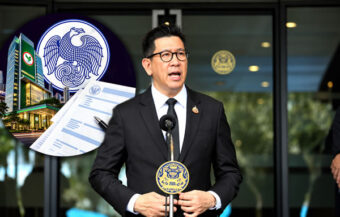
The Prime Minister ordered ministries, Bangkok officials and neighbouring provinces to operate under one coordinated response. Notably, he rejected suggestions that responsibility rested solely with Bangkok Governor Chadchart Sittipunt. “There should be no ‘this is a matter for the Governor of Bangkok’,” Mr Anutin told officials. Instead, he ordered government agencies to work together and provide immediate assistance.
Mr Anutin is scheduled to return from London at 8 am on Sunday. In parallel, senior ministers joined Saturday’s emergency meeting from different locations. Deputy Prime Minister and Foreign Minister Sihasak Phuangketkaew attended. Deputy Prime Minister and Finance Minister Ekniti Nitithanprapas also participated as commander of the situation.
Digital Economy and Society Minister Chaiyanok Chidchob joined the conference. Deputy Interior Minister Jetset Thaiseth was also involved. Furthermore, the Meteorological Department and National Water Resources Office participated. Officials from the Department of Disaster Prevention and Mitigation and Royal Irrigation Department also joined.
Bangkok flood operation widens as 300mm rainfall fills canals and pushes pumps to maximum capacity
The operation extended well beyond Bangkok. Governors from Pathum Thani, Samut Sakhon, Samut Prakan, Nakhon Pathom and Nonthaburi participated. Those provinces form part of the wider metropolitan water system. Accordingly, rainfall and water movements across provincial boundaries became central to Saturday’s discussions.
The meeting followed almost 48 hours of intense rainfall across the capital. Initially, Bangkok designated Nong Chok, Suan Luang and Khan Na Yao as flood disaster areas. Conditions then worsened, forcing officials to expand the declaration across all 50 districts. Governor Chadchart said almost 300mm of rain had fallen since Thursday afternoon.
Consequently, major canals filled while parts of Bangkok’s drainage network came under intense pressure. Homes, shops and roads were flooded across affected areas. Elsewhere, widespread waterlogging disrupted traffic across the capital. Bangkok’s pumping stations were operating at their combined maximum capacity of about 1,200 cubic metres per second.
Rainfall, though, was only one part of the developing water problem. Mr Anutin said several factors were affecting conditions simultaneously. These included accumulated rainfall, upstream water and drainage capacity within individual areas. For that reason, he ordered officials to treat the water network as one interconnected system.
Agencies were specifically warned against managing individual components in isolation. Rather, departments must use the same information when making operational decisions. As part of this, the Prime Minister ordered closer coordination between weather, water-management and disaster agencies. Transport, security and public assistance bodies were also brought into the operation.
Anutin orders advance preparations, clear public warnings and a coordinated government flood response
Particular attention was ordered for high-risk locations and vulnerable groups. Moreover, Mr Anutin demanded preparations before conditions deteriorated. He rejected responses that began only after flooding occurred. The Prime Minister said people required accurate information, timely warnings, clear routes and accessible assistance.
Government agencies were therefore instructed to provide factual information in simple language. Mr Anutin also demanded a clear operational plan identifying areas requiring monitoring. Officials must know who controls individual operations and where equipment is positioned. Likewise, personnel must be deployed before changing conditions create further problems.
A dedicated flood press centre will begin operating on Sunday. Meanwhile, contingency arrangements must remain ready if rainfall or water conditions deteriorate. Mr Anutin ordered agencies to work as one team and coordinate rapidly. Public safety and assistance were placed at the centre of the immediate response.
Mr Ekniti reinforced those instructions during the meeting. He said agencies must closely monitor rainfall, accumulated water, weather conditions and drainage capacity. “This is a government matter,” Mr Ekniti said. “All agencies must work together to resolve the problem and minimise the impact on the public as much as possible.”
Thai Chamber warns businesses of prolonged disruption to transport, supplies and employee movements
Beyond the emergency response, the flooding is already producing economic concern. Thailand’s leading business organisations are warning about disruption and recovery. Thai Chamber of Commerce President Poj Aramwattananon issued a statement on Saturday as flooding spread across several regions.
Flooding and waterlogging have affected Bangkok and surrounding provinces. In addition, eastern Thailand and several other provinces have suffered disruption. Travel, transportation and businesses have been affected in some areas. The Chamber warned that normal economic activity could take time to recover.
Against that backdrop, businesses were urged to prepare contingency plans immediately. Companies should inspect premises, machinery and electrical systems. They were also advised to examine goods, raw materials and transport routes. On another front, businesses were told to review logistics arrangements before further disruption developed.
Employee movements represent another concern. Workers may struggle to reach workplaces while roads remain flooded or heavily congested. Hence, businesses may need to alter working schedules or operating patterns. Companies were also urged to assist employees directly affected by flooding.
Crucially, the Chamber’s warning extends beyond the period when floodwater remains visible. Disruption could continue after conditions improve. Transportation and goods movements may require additional time to recover. Similarly, raw-material supplies could remain interrupted while logistics networks return to normal.
Flooding threatens Thailand’s fragile recovery as growth slows and business supply chains face disruption
Provincial chambers and trade associations are gathering information from affected businesses. In turn, those findings will be coordinated with government agencies. The objective is to restore normal business operations as quickly as possible. Even so, the flooding arrives at a sensitive point for Thailand’s economy.
The country is trying to strengthen growth after another relatively weak performance. Thailand’s economy expanded by an average 2.4% during the first half of 2026. Growth, however, slowed significantly between the first and second quarters. GDP expanded 2.8% during the first quarter before falling to 1.9% in the second.
Earlier this month, the Joint Standing Committee on Commerce, Industry and Banking raised its 2026 GDP forecast. It projected growth of 2.1% to 2.5%, supported by exports and investment. Nevertheless, major transport and business disruption now presents another threat to that recovery.
The exposure stretches beyond flooded shops, houses and vehicles. Bangkok sits at the centre of Thailand’s financial, commercial and transport systems. Surrounding provinces also contain major industrial, warehousing and logistics operations. Factories and distribution networks depend heavily on functioning roads and reliable transport.
Prolonged flooding can therefore spread quickly through business supply chains. Thailand has experienced that process before. Indeed, the current flooding revives the enormous economic shock suffered during 2011. That disaster became one of Thailand’s most expensive natural catastrophes.
Thailand’s 2011 floods inflicted ฿1.43 trillion losses and triggered a ฿350 billion water programme
Floodwater spread across large parts of central Thailand during that crisis. Eventually, major industrial estates were inundated. Factories supplying international automotive and electronics companies stopped production. Subsequently, supply chains were disrupted inside Thailand and overseas.
The total economic damage and losses reached approximately ฿1.43 trillion. That was equivalent to roughly 12.6% to 13% of GDP. Manufacturing suffered the overwhelming share of the damage. The sector accounted for approximately 70% of total damage and losses.
Around 90% of the economic burden ultimately fell on the private sector. The World Bank also calculated a substantial impact on national growth. Thailand’s 2011 GDP growth was cut by about 1.1 percentage points against the pre-flood projection. The disaster consequently triggered demands for a fundamentally different water-management system.
The government of Prime Minister Yingluck Shinawatra responded with an ambitious national programme. Cabinet adopted a master plan covering water resources and flood management. It then approved emergency borrowing of ฿350 billion. The funding was intended for major flood-prevention and water-management infrastructure.
Importantly, the programme sought to move Thailand beyond repeated emergency responses. Instead, the government proposed integrated management across entire river systems. Approximately ฿300 billion of the proposed investment targeted the Chao Phraya basin. Another ฿50 billion was intended for projects elsewhere.
Legal challenges and community resistance stalled massive floodways before the 2014 political crisis
The programme included reservoirs, drainage infrastructure and other water-management works. Some of its largest components, however, involved enormous flood-diversion systems. These floodways were designed to move water around vulnerable communities and economically important areas. Their scale reflected the economic devastation inflicted during 2011.
Implementation quickly became complicated. The programme faced legal challenges and environmental requirements. Health impact procedures also became significant obstacles. At the same time, disputes developed over public consultation.
Communities along proposed floodways opposed some projects. Land acquisition became another contentious issue. Additionally, proposed floodway routes generated substantial resistance. One proposed floodway alone represented roughly half the entire ฿350 billion programme.
Progress had therefore slowed before Thailand’s 2014 political crisis. Court intervention also forced the government to address environmental and consultation requirements. Soon afterwards, Thailand’s political crisis overtook the programme.
The military seized power on May 22, 2014, removing the elected government. Afterwards, the military government reviewed the previous water-management strategy. Important elements were abandoned or redesigned. Other projects were absorbed into later water-management plans.
Original ฿350 billion scheme was reworked as Thailand remained exposed to major economic flood risks
The original ฿350 billion programme therefore never proceeded in its intended integrated form. Thailand nevertheless continued spending on water infrastructure under subsequent governments. Bangkok expanded drainage systems, pumping capacity and flood-prevention works. National agencies also continued developing reservoirs and other water-management projects.
Yet flooding remained a recurring economic threat. The World Bank has subsequently examined Thailand’s continuing exposure to floods and droughts. Its assessments identify both as significant risks to the economy. Bangkok and Thailand’s export industries remain particularly exposed.
The institution has also modelled another disaster comparable to 2011. Under one scenario, a similar flood around 2030 could cost more than 10% of GDP. Under slower recovery conditions, the potential GDP impact could approach 15%.
Those estimates reflect Thailand’s concentration of economic activity in flood-prone regions. Bangkok and central Thailand remain particularly important. Manufacturing, logistics, transport and commerce are heavily concentrated across the region. Thus, water disruption can rapidly become a national economic problem.
The 2011 disaster demonstrated that vulnerability on an enormous scale. By comparison, the present Bangkok flooding has not produced comparable damage estimates. The government has not suggested current conditions approach the severity of 2011. Still, Saturday’s declaration covering every Bangkok district shows the geographical reach of the latest emergency.
Bangkok drainage pressure revives calls for integrated management across rainfall and upstream water
It also demonstrates the pressure facing the capital’s drainage network. Almost 300mm of rain fell between Thursday afternoon and Saturday. Canals consequently filled while pumping stations were driven to maximum combined capacity. At the same time, upstream water added another element to the problem.
That combination explains the government’s emphasis on coordinated management across Bangkok and surrounding provinces. Significantly, it also reflects a central objective behind the post-2011 programme. That strategy sought integrated management rather than fragmented responses from separate agencies.
Fifteen years later, Mr Anutin issued closely related operational instructions during Saturday’s emergency meeting. He demanded that departments stop working in isolation. Instead, agencies must share the same information. Upstream flows, rainfall and drainage must also be considered together.
Officials must know where equipment and personnel are positioned. They must also identify which areas face the greatest risks. Equally, responsibility must be assigned before conditions change. The government response now stretches across multiple ministries, agencies and provincial administrations.
The Prime Minister issued those orders from London. He had travelled there after engagements in Tokyo and New York. Meanwhile, his government is trying to attract investment and strengthen economic growth. The timing gives the flooding an additional economic dimension.
Flood disruption threatens investment push as agencies coordinate water management across provinces
Thailand has been promoting investment while trying to lift growth above recent weak levels. Severe flooding, however, exposes businesses to costs outside normal operations. Transport can be interrupted, while workers can struggle to reach workplaces. Raw materials can also be delayed.
Warehouses, machinery and inventories face disruption in affected areas. For this reason, the Chamber wants companies prepared before further problems develop. Its warning carries weight because the organisation represents businesses across Thailand. It also maintains provincial networks capable of tracking disruption outside Bangkok.
Those networks are now collecting information about business problems and requirements. Concurrently, government agencies continue monitoring rainfall and upstream water. Drainage capacity remains another critical factor. Bangkok’s pumping stations have been operating at their combined maximum capacity.
The capital, however, cannot manage the wider water system alone. Water crosses administrative boundaries. Accordingly, Saturday’s meeting included governors from five surrounding provinces. The Royal Irrigation Department also participated alongside national weather and water agencies.
The emergency therefore requires simultaneous management of rainfall, upstream flows, drainage and transport. Mr Anutin also ordered continuous coordination with security and public-assistance agencies. High-risk areas must receive particular attention. A flood press centre will begin operating on Sunday.
Anutin returns to flooded Bangkok as businesses brace for disruption and growth remains under pressure
The Prime Minister is also expected back in Thailand on Sunday morning. He will return to a capital where every district is covered by the disaster declaration. Businesses are already assessing disruption, while residents face flooded roads and waterlogged areas. Government agencies are simultaneously watching rainfall, drainage and upstream flows.
The immediate economic cost remains unknown. Business leaders, however, are already warning that recovery may not be immediate. The Thai Chamber specifically identified continuing risks to transport and raw-material supplies. Employee movements could also remain affected.
Accordingly, companies are being told to prepare for disruption after floodwater begins receding. The wider economic backdrop makes that warning more significant. Thailand entered the emergency with annual growth forecast at only 2.1% to 2.5%. Second-quarter expansion had already slowed to 1.9%.
Flooding now arrives while policymakers are trying to strengthen economic momentum. At the same time, the government faces the physical legacy of the 2011 catastrophe. That disaster produced the ฿350 billion programme intended to reshape national water management.
The original programme became bogged down before implementation. Legal challenges slowed it, while environmental requirements complicated it. Public consultation disputes caused further delays. Community opposition also affected major floodway proposals.
Post-coup water plans replaced original scheme while flooding again tests Bangkok and the wider economy
Political upheaval then transformed the policy framework. Following the 2014 coup, the military government reviewed and reworked the programme. Some projects disappeared, while others changed. Still more were absorbed into subsequent water-management plans.
Thailand therefore never built the original integrated scheme exactly as conceived after 2011. Even so, substantial investment has continued in water and drainage projects. Bangkok has expanded pumping and drainage capacity. National agencies have also pursued reservoirs and other water-management works.
Major rainfall continues periodically to test those systems. This weekend, that test covered every district of Bangkok. It also extended into surrounding provinces and other regions. Business organisations, meanwhile, warned that the economic consequences could outlast the rainfall.
Ex PM Paetongtarn Shinawatra calls on Pheu Thai MPs and ministers to aid Northern flooding victims
One dead in severe flooding in Nan as government mobilises to help residents impacted by the deluge
The 2011 disaster demonstrated how extensive those consequences can become. Manufacturing then absorbed approximately 70% of total damage and losses. The private sector ultimately carried around 90% of the economic burden. Overall losses reached approximately ฿1.43 trillion.
Thailand subsequently committed itself to stronger protection against another disaster on that scale. Fifteen years later, flooding remains a recurring threat to the country’s economic heartland.
This weekend, the government again found itself coordinating rainfall, upstream water and drainage across multiple jurisdictions. Bangkok’s pumps were operating at maximum combined capacity. All 50 districts were under the disaster declaration.
Meanwhile, business groups were preparing for continuing disruption. From London, Prime Minister Anutin Charnvirakul ordered Thailand’s government agencies to operate as one system.
Join the Thai News forum, follow Thai Examiner on Facebook here
Follow Thai Examiner on Google here
Receive all our stories as they come out on Telegram here
Follow Thai Examiner here
Further reading:
Ex PM Paetongtarn Shinawatra calls on Pheu Thai MPs and ministers to aid Northern flooding victims
One dead in severe flooding in Nan as government mobilises to help residents impacted by the deluge