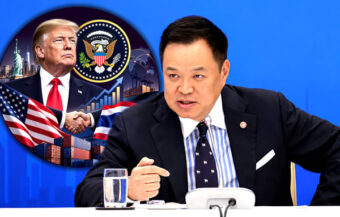
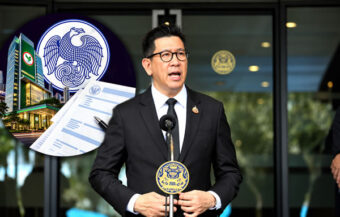
Hard-boiled Wall Street investors put PM Anutin and his team on the spot over Thailand’s economy, ageing workforce and US-China balance. Funds controlling over US$40 trillion join talks as PIMCO pushes for a role in data-centre finance and dollar-denominated debt. Meanwhile, Thailand sealed a New York Stock Exchange deal.
In the last few days, Prime Minister Anutin Charnvirakul and his economic team faced a grilling from hard-boiled Wall Street investors demanding answers, not windy sales pitches. Funds controlling over US$40 trillion pressed ministers on Thailand’s US-China balance, fiscal discipline, ageing workforce and investment prospects. Meanwhile, PIMCO explored data-centre financing and possible dollar debt, while Google pushed ahead with its US$1 billion investment. Thailand also secured a landmark SET-NYSE agreement. Yet behind the high-powered meetings, Wall Street wanted evidence that Thailand can deliver growth, skilled workers and the infrastructure needed for its ambitious AI and data-centre push.
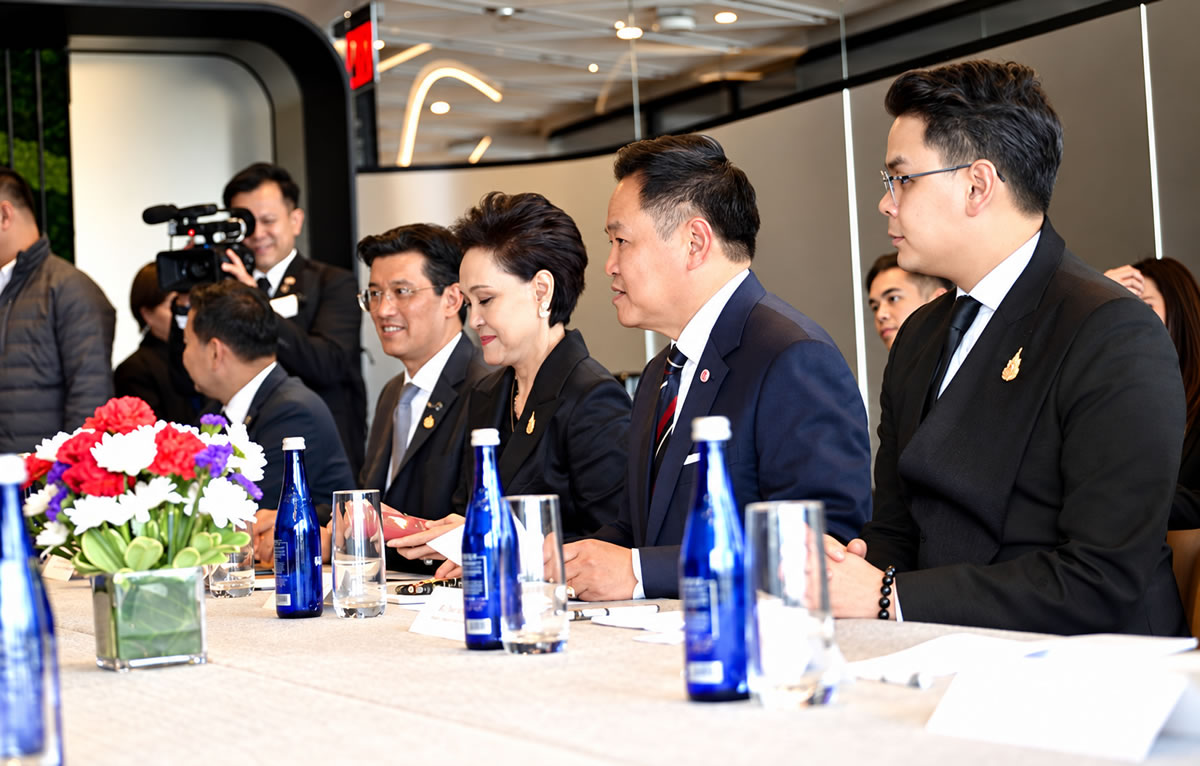
Prime Minister Anutin Charnvirakul has taken Thailand’s investment drive directly to Wall Street and America’s biggest technology companies. His New York campaign ran alongside United Nations engagements from September 22 to September 24. Yet the economic programme extended well beyond diplomacy. Ministers met global funds, banks and companies while pitching Thailand as an ASEAN investment base.
Deputy Prime Minister and Commerce Minister Suphajee Suthumpun took a central role in the economic offensive. Digital Economy and Society Minister Chaichanok Chidchob handled much of the technology agenda.
Deputy Prime Minister and Foreign Minister Sihasak Phuangketkeow also joined important engagements. Thai capital-market executives accompanied the delegation during meetings with major financial institutions.
Anutin takes Thailand’s investment pitch to Wall Street as US funds question its global economic stance
The government targeted advanced electronics, artificial intelligence, data centres, energy and agri-food industries. In parallel, it sought greater international capital access for Thai companies. Ministers also promoted Thailand’s established industrial clusters, suppliers and transport networks. However, the New York meetings produced different levels of interest and commitment.
The first major push came on September 22 at Bank of America Tower. Anutin arrived with Suphajee, Chaichanok and senior Thai capital-market representatives. About 25 major institutional investors reportedly joined the broader discussions. Those institutions controlled more than US$40 trillion in assets. Participants included BlackRock, Blackstone, Citadel and Fidelity.
Anutin used the gathering to promote Thailand as a regional business and investment base. His presentation stretched beyond the country’s established manufacturing industries. Notably, he highlighted digital technology, AI infrastructure, data centres, food security and the energy transition. He also stressed fiscal discipline and said public debt would remain within Thailand’s statutory ceiling.
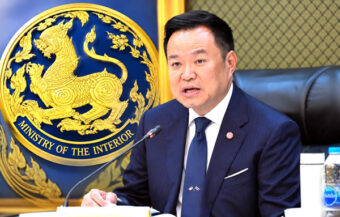
Suphajee then addressed one of the investors’ key questions. They wanted Thailand’s position on relations with Washington and Beijing. She said Bangkok regarded both as major economic powers and important trading partners. Thailand would maintain balanced relations rather than choose between them.
Suphajee tells Wall Street Thailand will balance US-China ties while maintaining strict fiscal discipline
“We are not choosing one side over the other. We want to work with both countries on the basis of balanced relations and mutual benefit,” Suphajee said.
Separately, Suphajee presented Thailand’s economic performance and capital-market developments. She also outlined government measures intended to support growth and new investment. According to her, leading American financial institutions viewed Thailand as a distinctive Asian market.
“Investors are interested in Thailand because the country’s economic performance and fundamentals have improved, including an upgrade to Thailand’s credit rating,” Suphajee said. “The performance of the Thai capital market has also improved. This gives Thailand an opportunity to present its policies and development direction to investors.”
Fiscal policy formed another part of her presentation. “The government prioritises maintaining fiscal discipline while creating an environment conducive to investment and economic growth,” Suphajee said. She said the approach was intended to strengthen investor confidence and support long-term growth.
Beyond immediate investment questions, the funds examined Thailand’s response to structural economic changes. Energy transition featured prominently. Technology adoption and digitalisation also drew attention. In addition, investors examined how technology could increase productivity and strengthen Thailand’s international competitiveness.
Chaichanok pitches technology and skills as US investors question Thailand’s ageing workforce challenge
Chaichanok took responsibility for much of that digital argument. Investors showed particular interest in data centres and supporting infrastructure. Environmental requirements and sustainability also entered the talks. Thailand therefore promoted closer cooperation between government, companies and other partners.
Chaichanok said further infrastructure investment would be required. Equally, he stressed stronger links with universities. Such cooperation could expand Thailand’s supply of skilled technology workers and deepen domestic knowledge. The stated objective was to strengthen Thailand’s position as an ASEAN technology and investment hub.
Demographics produced another line of questioning. Investors raised Thailand’s ageing population and falling birth rate. Both trends could affect future labour supply. In response, Chaichanok said technology and innovation could improve productivity and counter labour constraints. Thailand would simultaneously need to upgrade workforce skills.
Anutin also held separate talks with Pacific Investment Management Company, or PIMCO. He met chief executive Emmanuel “Manny” Roman and managing director Pramol Dhawan at Bank of America Tower. According to reports surrounding the roadshow, PIMCO manages more than US$2.5 trillion.
The meeting covered global economic and financial conditions and Thailand’s economic outlook. Thailand also presented its strategy for stimulating growth and attracting foreign capital. Industrial policy and longer-term growth formed part of the discussions. Digital infrastructure, data centres and alternative energy were specifically identified as investment opportunities.
PIMCO eyes Thai data-centre financing and dollar debt as Anutin courts one of the world’s biggest funds
Crucially, PIMCO reportedly expressed interest in financing Thai data-centre projects. Possible structures included loans and bonds. It also indicated interest in US dollar-denominated Thai government debt should Thailand issue such bonds.
No financing agreement was announced. Thus, the talks represented potential investment rather than committed capital. Still, they established direct discussions with one of the world’s largest fixed-income investment managers.
Microsoft executives also met Anutin during the New York programme. Artificial intelligence formed part of those discussions. Additionally, both sides discussed digital infrastructure, workforce development and cybersecurity. Thailand thanked Microsoft for supporting its effort to join the OECD.
Bank of America’s international president also held talks with the delegation. The executive highlighted Thailand’s focus on AI, digital technology and clean-energy transition. Bank of America also signalled interest in maintaining a longer-term partnership with Thailand. Its international president was due in Thailand for the IMF-World Bank meetings the following month.
Attention shifted deeper into technology on September 23. Anutin and Chaichanok visited Google’s Pier 57 offices in New York. There, they met Ruth Porat, president and chief investment officer of Alphabet and Google.
Google talks widen into AI, jobs and technology transfer as Thailand pushes its digital investment drive
The discussions built upon Google’s existing US$1 billion investment commitment in Thailand. The programme is worth approximately ฿36 billion. It includes a data centre in Chonburi and a Google Cloud region in Bangkok. However, the US$1 billion commitment predated Anutin’s New York visit.
Instead, the latest meeting concentrated on widening cooperation around those investments. Artificial intelligence and additional digital infrastructure were discussed. More significantly, the talks covered technology transfer, Thai employment and skills development.
Environmental demands also received detailed attention. The two sides discussed renewable energy and systematic water management. Environmental protection and responsible data-centre development were also addressed. Thailand wants the projects to strengthen capacity while creating jobs and transferring technology.
Anutin also raised energy efficiency and the welfare of communities surrounding major data centres. He described such facilities as essential infrastructure for AI and the digital economy. At the same time, Thailand sought Google’s experience in developing environmentally responsible standards.
For its part, Google said its Chonburi investment was already proceeding inside the Eastern Economic Corridor. Porat also outlined plans for an “Open Data” institute aimed at developing skilled workers. The initiative would offer opportunities for Thai people and start-ups. She reaffirmed Google’s intention to remain a long-term partner in Thailand.
Data-centre demands come into focus as Anutin broadens US investment drive to more than 20 companies
The discussions came as Thailand examined the heavy infrastructure requirements surrounding hyperscale data centres. Electricity supply is one major issue. Water consumption is another. Consequently, the government wants investment to deliver wider economic benefits alongside physical infrastructure.
Later that day, Anutin held a working lunch with executives from Brookfield. The official programme confirmed the meeting after his Google visit and Thai community engagement. However, no detailed investment outcome from the Brookfield talks was published in the supplied material.
The investment drive widened again that evening. Anutin addressed a gala dinner jointly hosted by the U.S.-ASEAN Business Council and U.S. Chamber of Commerce. Sihasak joined him, while more than 20 leading American companies attended.
The dinner was co-hosted by USABC president and chief executive Brian McFeeters. U.S. Chamber chief international affairs officer Joshua Walker also co-hosted. Michael DeSombre, US Assistant Secretary of State for East Asian and Pacific Affairs, attended as well.
Companies identified in related discussions included Apple, Chevron, Glenfarne Group and PepsiCo. ServiceNow, Siemens Healthineers and Western Digital were also involved. Consequently, Thailand’s pitch reached companies spanning technology, energy, manufacturing, healthcare and consumer industries.
Anutin targets five US investment sectors as Thailand and NYSE sign wide-ranging capital-market agreement
Anutin used the gathering to identify five priority investment areas. Advanced electronics was one. Artificial intelligence and the wider digital economy were also targeted. Energy and agri-food industries completed the group.
The prime minister argued that additional investment could move Thai production higher within global value chains. Alongside this, Thailand-US trade negotiations entered the discussions. Anutin said progress towards an agreement should create greater predictability for companies operating between both countries.
The trade talks are particularly relevant for companies producing in Thailand for American markets. Trading conditions can directly affect production and investment decisions. Accordingly, the negotiations formed part of Thailand’s wider New York investment pitch.
The campaign produced its clearest signed institutional agreement on September 24. Anutin visited the New York Stock Exchange and joined its opening-bell ceremony. During the visit, the Stock Exchange of Thailand and NYSE signed a memorandum of understanding. Anutin witnessed the agreement.
The pact covers five areas of cooperation. One involves possible dual listings between Thailand and New York. Another covers development and cross-listing of exchange-traded funds. The exchanges will also cooperate on market data and index products.
NYSE deal opens new capital routes before Anutin pitches Thailand’s industrial ecosystem to Jefferies
Additionally, the agreement covers ESG products and services. Both exchanges will exchange information and expertise. The arrangement could provide larger Thai companies with another route into American institutional capital.
Foreign businesses investing in Thailand could also benefit. Such companies could potentially raise capital through Thailand under the BOI-to-IPO programme. The agreement therefore links Thailand’s capital-market development directly with its foreign-investment strategy.
Soon afterwards, Anutin moved to another investor gathering organised through Jefferies. The meeting began at 10.15 am New York time at Lever House. There, the prime minister presented Thailand’s established industrial ecosystem as a central selling point.
Anutin told investors they would not need to construct supply chains from scratch. Thailand already has manufacturing clusters, suppliers and transport infrastructure. Furthermore, those industries are integrated into international production networks.
Against that backdrop, he promoted Thailand as a Southeast Asian operating base. AI infrastructure became another major element of the presentation. Global AI development is increasing demand for data storage and high-speed transmission. It is also increasing electricity and digital-infrastructure requirements.
Anutin cites ฿1.37tn investment surge as Thai officials make their case for returning global capital
Anutin argued that Thailand could capture higher-value investment from that expansion. To support his case, he cited recent foreign investment-promotion applications. They reached ฿1.37 trillion during the first half of 2026. That represented an 80% year-on-year increase.
Capital-market flows provided another important figure during the roadshow. FETCO chairman Paiboon Nalinthrangkool said roughly ฿500 billion had left Thailand during the previous three years. Around ฿50 billion had returned this year.
Paiboon therefore suggested another ฿450 billion could potentially return. That depended on economic growth and investor confidence. Importantly, the ฿450 billion was not money pledged by American investors. Instead, it represented potential returning capital identified by Thailand’s capital-market leadership.
The New York campaign therefore operated across several fronts. Suphajee handled much of the broader economic, trade and capital-market case. Chaichanok concentrated on digital infrastructure, AI, workforce development and technology investment.
Anutin, meanwhile, carried the central investment pitch to global funds and major companies. His argument rested heavily on Thailand’s established manufacturing ecosystem and ASEAN position. Food security, clean energy and digital infrastructure provided additional investment themes.
US drive reaches major funds and technology groups while Thailand’s investment outcomes remain mixed
The delegation also used Thailand’s recent investment figures to strengthen that case. Foreign promotion applications reached ฿1.37 trillion in the first half. Meanwhile, officials highlighted stronger capital-market performance and recent improvements in Thailand’s economic standing.
By the end of the US leg, Thailand had reached an unusually broad group of international investors. About 25 major institutions joined the wider Bank of America discussions. PIMCO held separate talks with Anutin, while Microsoft executives also met him.
Google then held direct talks with Anutin and Chaichanok. Brookfield executives met the prime minister over a working lunch. Jefferies subsequently brought another investor group into the programme.
Beyond Wall Street, more than 20 American companies attended the US business organisations’ dinner. The three-day programme therefore connected Thailand with financial, technology, energy, industrial, healthcare and consumer businesses.
Yet the financial outcomes remained clearly divided. The SET-NYSE memorandum was a newly signed institutional agreement. Google’s US$1 billion investment was substantial but already committed before the trip.
PIMCO, Wall Street funds and Microsoft stop short of new investment pledges as New York roadshow concludes
PIMCO’s interest created another possible financing channel. It covered data-centre loans or bonds and potential dollar-denominated Thai sovereign debt. However, no new PIMCO transaction was announced during the New York programme.
Likewise, no fresh investment amounts emerged from discussions involving BlackRock, Blackstone, Citadel or Fidelity. Microsoft announced no new investment figure. Neither did the Jefferies gathering produce a publicly announced commitment.
The US$40 trillion figure also requires that distinction. It represented assets controlled by institutions involved in the investor discussions. It was not capital promised to Thailand.
Similarly, Paiboon’s ฿450 billion figure was not an American investment pledge. It represented capital that could potentially return after substantial foreign outflows during the previous three years.
Anutin completed the New York programme after his United Nations engagements on September 24. At 5 pm, he was scheduled as Thailand’s eighth speaker in the UNGA81 General Debate. The programme allotted him about 15 minutes.
Anutin wraps up New York programme with UN meetings before taking Thailand’s investment roadshow to London
Before that address, he also had meetings scheduled with leaders from Bhutan, Armenia and Bangladesh. A meeting with the United Nations Secretary-General was included as well.
The investment campaign then shifted immediately to London. Anutin and his delegation left New York on September 24 and arrived in Britain the following morning.
Prime Minister Anutin Charnvirakul formally summoned by parliament over local government exam scandal
Anutin heads to New York but no sign yet of news on the US Thai trade deal as problems simmer at home
On September 25, the programme included British financial and services businesses. Meetings were also scheduled with the City of London’s leadership and the Thai-UK Business Council. In addition, the delegation was due to meet UBS, Virgin Atlantic and Rolls-Royce.
The London programme extends the capital-market roadshow begun in New York. Thai exchange executives are also participating in meetings with institutional investors through UBS. The delegation is scheduled to leave Britain on September 26 and arrive in Thailand on September 27.
Join the Thai News forum, follow Thai Examiner on Facebook here
Follow Thai Examiner on Google here
Receive all our stories as they come out on Telegram here
Follow Thai Examiner here
Further reading:
PM Anutin laughs off what political pundits see as rising threats to the stability of his government
Opposition alleging a potential whitewash by Election Commission on Friday over Senate election case
Ex PM and Democrat Party leader urges politicians implicated in Senate Collusion files to come clean