Let foreigners own what they pay for, Senator Prathum Wongsawat demands. She says Thailand’s 49:51 rules fuel nominee firms, hide grey capital and open the door to tax avoidance, extortion and corruption. Put up 100%, she says, own 100%.
Thailand’s widening war on foreign nominee firms has triggered a dramatic counterproposal from Chonburi Senator Prathum Wongsawat. Let foreigners who provide 100% of the capital own 100% of the company. She says current 49:51 rules can fuel nominee structures, conceal ownership, aid tax avoidance and open doors to corruption. Instead, ownership should follow the money, turning “grey capital” into “white capital”. Prathum also wants major investment linked to permanent residence and potentially citizenship. Her intervention comes as crackdowns spread across Phuket, Koh Samui, Koh Phangan, Koh Tao and Pattaya, while the government defends Thai control of sensitive sectors.
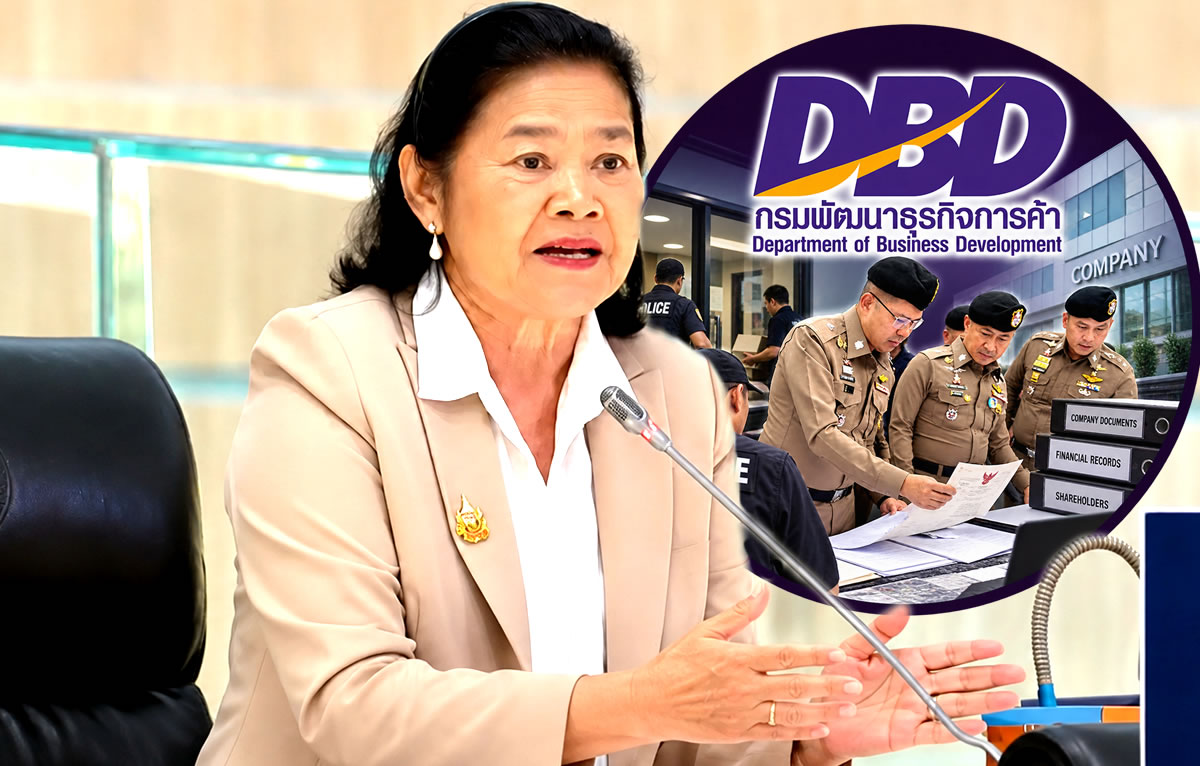
A Thai senator has proposed 100% foreign ownership as Thailand widens its crackdown on nominee companies and foreign grey capital. Chonburi Senator Prathum Wongsawat says ownership should reflect the money actually invested. Under her plan, foreigners providing all capital could legally own the entire business. She argues that current restrictions can instead help create the nominee structures now facing investigation.
Prathum raised the proposal during a Senate meeting on September 1. She was discussing nominee businesses and grey foreign capital operating in Thailand. Notably, she questioned whether repeated enforcement campaigns had tackled the problem’s underlying causes. Instead, she pointed directly towards weaknesses and loopholes within existing ownership rules.
Thailand benefits from foreign investment, Prathum told the Senate. However, she questioned arrangements limiting foreign ownership while requiring majority Thai shareholdings. Under the structure she addressed, foreign investors can hold 49%. Thai shareholders must hold the remaining 51%.
Foreign investors can fund entire firms while Thai shareholders retain the legal majority on paper
Yet the registered shareholding can differ sharply from the financial reality behind a company. Prathum said some businesses are financed entirely by foreign investors. Nevertheless, Thai shareholders may still appear as majority owners on company documents. In practice, the foreign investor can provide every baht while legally remaining the minority shareholder.
Prathum questioned why investors would willingly surrender control after financing an entire operation. As a result, she argued, some foreigners seek ways around the ownership restrictions. These arrangements can include Thai nominee shareholders. She also referred to false Thai identities and false addresses used to circumvent legal requirements.
In turn, such structures can obscure the actual source of investment and effective company control. Prathum linked those practices with grey capital and tax avoidance. Separately, she said opaque arrangements create opportunities for officials to demand illicit payments. The resulting system can therefore conceal both ownership and the money behind the business.
Her proposed answer is much more direct. Ownership would follow the proportion of capital genuinely invested. Accordingly, a foreigner providing 70% of the money could own 70% of the company. An investor providing 90% could legally own 90%.
Prathum says full foreign ownership would expose real investors and turn grey capital into white capital
Most significantly, somebody providing all the investment could own 100% of the business. That would remove the need for a paper Thai majority in those circumstances. Instead, company records would identify the real investor from the beginning. Prathum described that process as turning “grey capital” into “white capital”.
The senator also linked greater transparency with taxation and enforcement. If genuine ownership appeared openly, regulators could identify the investor immediately. Likewise, company responsibilities could be attached to the declared owners. Prathum argues this would reduce the incentive to hide investment through artificial shareholding structures.
On another front, she went well beyond company ownership. Prathum proposed defined investment thresholds linked to permanent residence in Thailand. Furthermore, sufficiently large investments could potentially provide a route towards Thai citizenship. Clear rules would govern the required capital and qualifying conditions.
Under that approach, substantial foreign investors would know the requirements before committing their money. Meanwhile, state agencies would have a clear record of their status and investment. Prathum argued that transparent rules could also reduce opportunities for corruption and extortion. Investors operating legally would have less exposure to officials demanding illicit payments.
Her proposals are particularly notable because of her own commercial background. Prathum is a Chonburi businesswoman with experience in Pattaya and Jomtien’s tourism and hotel industries. She entered the current Senate through Thailand’s 2024 selection process. Specifically, she was selected through Group 11 for tourism and related occupations.
Russian investment experience shapes Prathum’s push to make ownership reflect money invested
Before entering the Senate, Prathum had been involved in hotel and tourism businesses around Pattaya and Jomtien. She has also invested overseas. In particular, she has business investment experience in Russia. That experience featured directly in her argument before fellow senators.
Prathum said foreign investors in Russia could own shares matching the money they invested. She said she personally owned 100% of a business there despite being foreign. Consequently, she contrasted that system with Thailand’s requirement for majority Thai ownership in restricted activities. Her central question concerned who actually supplied the investment.
If a foreigner provided all the capital, she argued, ownership should reflect that fact. Conversely, mixed investment should produce a corresponding division of shares. The company register would then show the economic reality. There would be no need to construct an artificial majority merely to satisfy a ceiling.
This was not Prathum’s first intervention on the subject. Earlier, she raised substantially the same ownership argument in May. Her September remarks therefore represent a renewed policy push. They also come during a much broader government campaign against nominee companies.
Government nominee crackdown widens as Prathum argues current laws help create the problem
That crackdown has increasingly focused on Thailand’s major tourism destinations and foreign investment centres. Phuket, Koh Samui, Koh Phangan, Koh Tao and Pattaya have all faced intensified scrutiny. Investigations cover company ownership, landholdings, restricted occupations and illegal foreign employment. Officials are also examining whether Thai shareholders genuinely finance and control businesses.
Prime Minister Anutin Charnvirakul highlighted the issue during a visit to Koh Phangan in May. He criticised businesses that appeared 51% Thai-owned while their actual direction remained entirely foreign. Since then, effective control has become a central issue within nominee investigations. Government agencies are increasingly looking beyond the names recorded on corporate documents.
Prathum’s argument approaches that same problem from another direction. She accepts that nominee structures and concealed foreign control exist. However, she argues that ownership restrictions can help produce those arrangements. Foreign investors providing the money may still require Thai majority shareholders.
Consequently, the formal ownership can disguise the underlying investment. Prathum wants that contradiction removed at the point of registration. Under her approach, the investor supplying the capital would hold the corresponding legal ownership. The state would then know who financed and controlled the business.
Koh Samui, Koh Phangan and Koh Tao investigations reveal the scale of Thailand’s nominee crackdown
The current enforcement figures show the scale of government scrutiny. On Koh Samui, officials reviewed 12,906 companies during the broader enforcement campaign. Among them, 8,254 had foreign shareholders. Another 875 were flagged for closer examination.
That work produced 60 cases involving 59 companies and 88 suspects. In addition, 37 land plots came under review. Their combined value was estimated at about ฿1.2 billion. The investigations form part of a broader focus on foreign-linked property and business structures.
Koh Phangan has faced similar attention. Revenue officials examined 110 entities during one part of the campaign. Separately, a land review flagged 112 entities above the relevant threshold. The island has become a particular focus because of extensive foreign investment and business activity.
Koh Tao has also faced enforcement operations. In August, six foreign diving instructors were arrested during one operation. One was British and five were Spanish. Three Myanmar workers were also arrested. Earlier in 2026, the island had already recorded 47 foreign arrests.
Phuket has produced another large investigation. More than 100 companies were scrutinised during an August enforcement operation. Those businesses had combined revenue exceeding ฿5 billion. Eventually, 16 people were prosecuted.
Phuket and Pattaya cases widen scrutiny as Prathum presses for ownership rules based on real capital
Ten of those prosecuted were Thai. The remaining six were foreign nationals. They included two Canadians, three Russians and one Kazakhstani. Thus, investigators are examining both foreign investors and the Thai participants behind suspected structures.
Pattaya has also become part of the widening campaign. In August, investigators examined a suspected Israeli-linked nominee business network. Assets involved were worth several hundred million baht. The case brought the foreign ownership issue directly into Prathum’s home province.
The senator’s proposal therefore comes during an unusually intense enforcement period. However, she is not simply calling for stronger inspections. She wants the ownership framework itself reconsidered. Her approach would legalise genuine foreign ownership where foreigners provide the corresponding investment.
At the same time, her position differs sharply from recent government policy in sensitive industries. Digital Economy and Society Minister Chaichanok Chidchob recently addressed SpaceX’s proposed Starlink operations. The government would not permit a wholly foreign-owned Thai telecommunications operation.
Instead, Chaichanok backed a 51% Thai and 49% foreign ownership structure. Competition concerns formed part of the government’s position. Data issues were also cited. Additionally, national security considerations were raised.
Starlink stance highlights government support for Thai control while Prathum proposes a broader model
That case shows Thai majority ownership remains important within strategically sensitive sectors. By contrast, Prathum is proposing a far broader principle for foreign investment. She says ownership should correspond with actual capital. Her intervention therefore cuts across a central feature of Thailand’s existing investment regime.
Still, full foreign ownership is not completely absent from Thailand. Existing arrangements already permit 100% foreign ownership in certain circumstances and sectors. Specified aviation maintenance and manufacturing businesses have previously been opened under conditions. Other licensing and investment arrangements can also allow full foreign ownership.
Prathum’s proposal, however, reaches further than those existing exceptions. She wants investment itself to determine the shareholding. A foreigner providing 60% would hold 60%. Another providing every baht could hold everything.
In parallel, Thai capital would continue to be reflected in the registered ownership. If Thai investors supplied half the money, they could hold half the shares. The arrangement would therefore record the true capital structure. Prathum argues this would remove incentives for artificial ownership agreements.
That proposal strikes directly at a recurring feature of nominee investigations. A company can appear majority Thai-owned while foreigners provide most or all financing. Moreover, effective control may remain with the foreign investor. Such cases require investigators to look beyond formal corporate records.
Prathum wants company records to show real foreign control while residence and citizenship stay proposals
Prathum wants the records themselves to show that position from the outset. As part of this, the foreign investor would be visible to regulators. The source of capital would also be easier to identify. In her argument, transparency would replace concealed ownership rather than merely punish it later.
The proposed residency system follows the same logic. Instead of leaving major investors without a defined long-term route, Thailand would publish clear requirements. Those reaching a prescribed threshold could qualify for residence. At another level, they could potentially qualify for citizenship.
However, Prathum has not specified an approved investment figure. No permanent residence threshold arising from her proposal is currently in force. Likewise, Thailand has adopted no new citizenship threshold from her Senate intervention. Existing immigration and nationality rules remain unchanged.
Nor has Thailand approved her proposed ownership system. The 49:51 restrictions remain applicable where existing law requires them. The nationwide nominee crackdown is also continuing. Prathum’s comments remain a policy proposal made on the Senate floor.
Importantly, she has not introduced a bill abolishing the Foreign Business Act. No such legislation is presently attached to her remarks. Her intervention instead introduces an alternative approach into the wider policy debate. It questions whether enforcement alone can remove nominee structures while ownership restrictions remain intact.
Prathum’s Pattaya business background gives her ownership proposal a direct commercial perspective
Her background gives the proposal an unusual commercial dimension. Chonburi contains one of Thailand’s largest international tourism economies. Pattaya alone hosts extensive foreign investment, businesses and property interests. The wider eastern seaboard also contains major industrial and investment centres.
Prathum developed her business career within that environment. In August 2024, she also joined an inspection of Pattaya’s Walking Street. Politicians, officials and police participated. The inspection focused on issues involving tourists and local businesses.
Within the Senate, Prathum now sits on the Foreign Affairs Committee. She has participated in official meetings involving foreign diplomatic representatives. Yet her latest intervention focuses squarely on Thailand’s domestic treatment of overseas investors.
The policy clash is increasingly clear. The government is searching for hidden foreign control behind Thai majority shareholdings. Prathum instead wants certain foreign ownership brought openly onto company records. Both positions address the same nominee problem from markedly different starting points.
For enforcement agencies, the present task is identifying whether Thai shareholders are genuine investors. They must also establish whether foreigners actually finance or control businesses. Prathum’s system would remove that question where full foreign investment was permitted. The declared ownership would already match the actual capital.
Proposed system would put foreign investors on company records while existing enforcement continues
That would represent a substantial departure from the current structure in restricted activities. It would also place foreign investors directly within Thailand’s corporate records. In addition, taxation and regulatory obligations could follow the declared ownership. The investor’s identity would no longer depend upon tracing hidden control.
Prathum also says this could reduce opportunities for illicit payments. Investors using concealed structures can become exposed to officials seeking improper benefits, she argued. By comparison, published rules would define the investor’s legal position. The company’s ownership would no longer depend upon nominee arrangements.
For now, however, Thailand remains committed to its existing enforcement drive. Investigations continue across tourist islands, resort cities and other foreign investment centres. Officials are pursuing suspected nominee shareholding, landholding and illegal work. Thai majority requirements also remain intact across restricted sectors.
Prathum offers Senate a direct alternative as nominee crackdown continues under existing ownership rules
Against that backdrop, Prathum has placed a stark alternative before the Senate. She wants ownership to follow capital rather than a predetermined nationality ratio. If foreigners supply part of the investment, they would own that proportion. If they supply everything, they could own everything.
Her wider proposal would also link substantial investment with residence and potentially citizenship. Again, no such measures have been adopted. No bill implementing them is before the country under her proposal. Still, the senator has now put both ideas firmly into the debate.
Thailand’s stiff restrictions on small foreign investors a significant problem for its daring OECD aspirations
Crackdown on foreign nominee firms and business concerns moves into Krabi with 1,000 firms hot listed
Crackdown turned nightmare for foreign owners with plan to treat nominee schemes as money laundering
The principle behind her argument remains simple. Company records should identify who actually supplied the money. Ownership should then correspond with that investment. Prathum says this would expose foreign capital rather than hide it behind Thai nominees.
In her formulation, the objective is to replace concealed structures from the beginning. Foreign investment would enter openly under clear ownership rules. The investor would be identifiable, while the shareholding would match the money invested. She describes that change as turning “grey capital” into “white capital”.
Join the Thai News forum, follow Thai Examiner on Facebook here
Follow Thai Examiner on Google here
Receive all our stories as they come out on Telegram here
Follow Thai Examiner here
Further reading:
Tax and welfare revolution as Thailand moves ahead with Negative Income Tax that expands reporting
Thumbs up from economic gurus for 2027 Negative Income Tax plan. It’s a game-changer for progress
Expert warns foreign tourism has become Thailand’s curse, fueling inertia and a widespread malaise