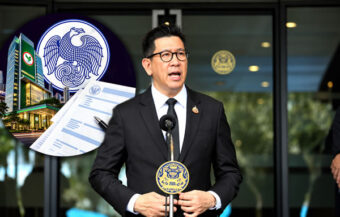
Thailand produces archival proof after Miss Universe Cambodia used a historic 1906 photo of Thai women in a Cambodian clothing presentation. Culture Minister Sabeeda demands an apology and correction while keeping possible legal action firmly on the table.
Thailand’s Culture Minister Sabeeda Thaised has stepped into a growing heritage row after Miss Universe Cambodia used a 1906 photograph of Thai women to portray Cambodian historical clothing. Bangkok says its identifying seal was removed. Ms Sabeeda has produced archival evidence, demanded a correction and apology, and warned of possible legal action. The dispute comes just months before UNESCO considers Thailand’s traditional national dress for global cultural recognition.

Thailand’s Culture Minister Sabeeda Thaised has personally stepped into a growing dispute over a historic Thai photograph used in Cambodia. On Monday, she called a high-level press conference at the National Archives of Thailand in Bangkok. Senior Culture Ministry, Fine Arts Department and National Archives officials joined her. Together, they produced the original evidence behind Thailand’s formal complaint.
At issue is a photograph taken in Kamphaeng Phet in 1906. It shows Thai women during the reign of King Chulalongkorn, Rama V. However, Miss Universe Cambodia 2026 used the image during a presentation about Cambodian historical clothing. Thailand says the Fine Arts Department’s identifying seal was also removed.
In response, Ms Sabeeda has demanded corrections and proper attribution from the Cambodian pageant organisers. Thailand also expects an apology. Furthermore, the Fine Arts Department wants the original material used to produce the Cambodian presentation. If no correction follows, the minister says legal action remains available.
Thailand’s UNESCO Chud Thai campaign raises stakes as Cambodia uses a documented 1906 Thai photograph
The intervention comes at a critical time for Thailand’s international promotion of national dress. This December, Thailand expects UNESCO to consider Chud Thai for global cultural heritage recognition. Accordingly, Bangkok is documenting and promoting the historical development of Thai clothing. The disputed photograph provides part of that documentary record.
Thailand has submitted “Chud Thai: The Knowledge, Craftsmanship and Practices of the Thai National Costume” to UNESCO. It seeks inscription on the Representative List of the Intangible Cultural Heritage of Humanity. Against that backdrop, historical provenance has assumed greater importance for the Culture Ministry.
The dispute began during the preliminary round of Miss Universe Cambodia 2026 on September 18. Organisers screened a presentation covering Cambodian clothing and cultural history. Subsequently, Thai officials examined the material and identified images originating from Thailand. One photograph immediately drew particular attention.
The picture shows women photographed in Kamphaeng Phet, in northern-central Thailand. It was taken there in 1906 during the reign of King Chulalongkorn. Significantly, Thailand possesses the original archival record and its documented provenance.
“The photograph is of a woman from Kamphaeng Phet, taken in Kamphaeng Phet in 1906,” Ms Sabeeda said. She confirmed that it dated from the reign of King Chulalongkorn, Rama V.
UNESCO-listed archive establishes the 1906 photograph’s Thai provenance and historical significance
“It was preserved in the Vajiravudh Library before being registered as a Memory of the World by UNESCO in 2017,” she added.
The photograph belongs to Thailand’s Royal Photographic Glass Plate Negatives and Original Prints Collection. The collection contains more than 35,000 glass-plate negatives and approximately 50,000 photographic prints. These records span the period between 1855 and 1935.
Notably, UNESCO placed the collection on its Memory of the World International Register in 2017. The designation gives the wider collection international recognition as a significant documentary record. Therefore, Thailand can establish the disputed photograph’s provenance through its national archival holdings.
The women pictured wear clothing associated with Thailand during that period. Their dress includes chong kraben lower garments and fitted long-sleeved blouses. They also wear sabai-style shoulder cloths and distinctive short dok krathum hairstyles.
As a result, the photograph provides a dated visual record of women’s clothing in Siam. Its value to Thailand extends beyond the appearance of individual garments. The date, subjects, location and archival history can all be established.
Missing Fine Arts Department seal strengthens Thailand’s complaint over the Cambodian pageant image
Yet the version shown in Cambodia lacked another important feature. The original photograph bears the Fine Arts Department’s identifying seal or watermark. According to the Culture Ministry, that identification was absent from the image presented by Miss Universe Cambodia.
For that reason, officials reject treating the controversy simply as confusion over an unidentified photograph. The ministry says the image was used without correctly identifying its Thai source. Consequently, viewers could believe the photograph documented Cambodian historical clothing.
Ms Sabeeda has now ordered a formal response. Thailand wants the organisers to stop disseminating the disputed information and correct the presentation. In addition, the ministry wants the photograph properly attributed to its Thai archival source.
As part of this, the Fine Arts Department and National Archives are preparing documentation for the Cambodian organisers. Officials will establish the image’s date, location and archival history. They will also set a timeframe for corrective action.
Failure to make those changes could trigger further measures. Ms Sabeeda has explicitly reserved Thailand’s right to consider legal action through appropriate channels. The Fine Arts Department also maintains rights over the relevant archival information and image.
Sabeeda vows decisive action but seeks to keep the dispute away from a Thai-Cambodian confrontation
“As the Minister of Culture, and as a Thai citizen, along with the executives of the Ministry of Culture, we love and cherish Thai culture no less than anyone else,” Ms Sabeeda said.
“What we will do is take serious and decisive action. The Ministry of Culture will not let this slide,” she added.
Even so, the minister has carefully defined the scope of Thailand’s response. Bangkok does not presently want the controversy elevated into a dispute between both governments. Miss Universe Cambodia is a private organisation, rather than the Cambodian state.
Accordingly, Thailand’s first actions are directed at the pageant organisers. The government will use established channels while formally presenting its evidence. Meanwhile, Ms Sabeeda wants the historical record corrected without turning the case into a bilateral confrontation.
“From now on, the Ministry of Culture will proceed through appropriate channels,” Ms Sabeeda said. “The first step will be to pursue diplomatic means to issue a warning.”
“Currently, we don’t want this to become a state-to-state issue, but in cases where the private sector has distorted information…”
Therefore, she said warnings were necessary. However, continued inaction could lead Thailand to consider further legal measures.
The minister’s intervention also comes during the decisive stage of Thailand’s UNESCO campaign. The government has spent considerable effort establishing the international profile of Chud Thai. December’s expected consideration now puts additional attention on the documentary history supporting that campaign.
Thailand puts evidence before emotion as December’s UNESCO decision on Chud Thai moves ever closer
Importantly, Ms Sabeeda directly connected her handling of the Cambodian dispute with the approaching UNESCO decision. She said Thailand must rely on evidence rather than emotion while protecting its submission.
“Currently, the Ministry of Culture is deeply concerned, but we cannot act on emotions and feelings,” Ms Sabeeda said.
“We must exercise patience and restraint to ensure the successful registration of Thai traditional clothing as an intangible cultural heritage of humanity by UNESCO within this December.”
“Therefore, any actions taken must be prudent, cautious, and based on clear and complete facts and evidence,” she added.
In parallel, Thailand has been promoting its traditional clothing internationally through exhibitions and cultural programmes. The Culture Ministry has taken Thai clothing to the Netherlands and France. More recently, it staged a presentation in Japan.
According to Ms Sabeeda, the Japanese promotion attracted significant interest. She said Japanese audiences were receptive to Thai culture and its use in cultural diplomacy. Meanwhile, the ministry plans to expand international understanding of Thai clothing’s historical development.
The Foreign Ministry and Thailand’s overseas diplomatic network are also involved. Thai traditional clothing is showcased at Thai festivals held in different countries. Thus, the promotion extends beyond programmes operated directly by the Culture Ministry.
Thailand expands its global promotion of Chud Thai through diplomacy, overseas exhibitions and museums
Separately, museums provide another platform for documenting and displaying Thailand’s cultural heritage. The Queen Sirikit Museum of Textiles presents royal Thai costumes and their development. The government also uses international museum exchanges to display Thai cultural objects.
Ms Sabeeda cited cultural cooperation between Thailand and South Korea. Thai artefacts have been presented at the National Museum of Korea in Seoul. Such exhibitions form another part of the government’s international cultural programme.
“We use every platform to communicate about Thai clothing; we are not complacent,” Ms Sabeeda said.
Central to the programme are the eight formal styles of Chud Thai Phra Ratcha Niyom. They include Ruean Ton, Chitralada, Amarin, Boromphiman, Dusit, Chakri, Siwalai and Chakkraphat. Their modern development is closely associated with Queen Sirikit, the Queen Mother.
Alongside those modern styles, the Culture Ministry is documenting earlier Thai clothing traditions. Historical photographs provide evidence of how women dressed before the modern formal styles developed. The Kamphaeng Phet image is one such record.
On another front, the ministry intends to accelerate publication of information tracing that development. Officials want foreign audiences to understand the origins and progression of Thai national clothing. The government says that information will rely on archival and academic evidence.
Eight formal Chud Thai styles anchor campaign as ministry documents earlier Thai clothing traditions
The present dispute is also narrower than a general claim over similar Southeast Asian clothing. Thailand and Cambodia both possess long-established clothing traditions. Across the region, cultures interacted extensively over many centuries.
As a consequence, similar wrapped garments, textiles and shoulder cloths appear in several regional traditions. Cambodia also possesses substantial documented textile heritage. UNESCO, for example, inscribed Cambodia’s Krama on its Representative List in 2024.
Likewise, UNESCO cultural heritage recognition does not provide exclusive ownership over an entire cultural tradition. Thailand has previously acknowledged that distinction. The current complaint instead concerns one specific photograph with an established provenance.
In this case, Thailand can identify the photograph’s location, year and historical setting. It also possesses the image within an official national collection. Most significantly, officials say its Fine Arts Department identification disappeared from the Cambodian version.
That distinction gives Bangkok’s complaint a precise documentary basis. Thailand is not relying on whether garments simply look Thai or Cambodian. Instead, officials are pointing to a specific photograph and its archival record.
Ms Sabeeda also said Thailand does not object to foreigners wearing Thai traditional clothing. On the contrary, she said such interest could help spread Thai culture internationally. Nevertheless, she insisted that Thailand must receive proper attribution when its historical material is used.
Thailand narrows complaint to one documented photograph rather than shared clothing traditions
The Culture Ministry says it holds extensive information supporting the history of Thai clothing. It is also prepared to provide that material to organisations seeking accurate information. Hence, the government intends to increase its international dissemination of historical records.
Another piece of evidence comes from an ASEAN national costume exhibition held in 2019. At that event, Thailand selected the Chitlada dress to represent its national costume. Cambodia, by comparison, presented the Sampot.
Ms Sabeeda said those selections documented how both countries represented their respective national clothing at the time. Chitlada remains one of Thailand’s eight formal Chud Thai Phra Ratcha Niyom styles. The Sampot has its own established place within Cambodian culture.
The 2019 exhibition therefore provides another official reference point for the Culture Ministry. It also supports the ministry’s emphasis on clearly identified national traditions. However, the immediate dispute remains centred on the 1906 photograph.
Beyond heritage policy, traditional Thai clothing also feeds into the country’s broader cultural economy. Textiles involve craftspeople, producers and designers. Additionally, traditional clothing appears in tourism, fashion, international exhibitions and cultural events.
ASEAN exhibition records distinct Thai and Cambodian national costumes as Bangkok builds its case
International recognition consequently carries significance beyond historical scholarship. The government has invested considerable institutional resources in promoting Chud Thai overseas. December’s UNESCO consideration represents the next major stage in that effort.
Meanwhile, the Cambodian controversy has emerged less than three months before that expected decision. It involves precisely the type of historical evidence Thailand is using to document its clothing traditions. That timing has brought the issue directly to ministerial level.
The National Archives and Fine Arts Department now form the evidential core of Thailand’s response. They hold the records establishing the disputed photograph’s provenance. The Culture Ministry will use those records in its formal communication with the organisers.
Next, the organisers will receive a deadline to correct the presentation. Thailand wants the image’s source acknowledged and the historical information amended. It also expects the Fine Arts Department’s rights over the material to be recognised.
Should the organisers refuse, Ms Sabeeda has kept further action open. However, Bangkok will initially keep its response focused on the private pageant organisation. The minister has specifically sought to avoid turning it into a state-to-state dispute.
UNESCO decision nears as Thailand sets deadline for Cambodian organisers to correct disputed image
At the same time, Thailand will continue promoting Chud Thai internationally before December. The government plans further dissemination of archival evidence and information about its development. Its diplomatic network will continue supporting those efforts overseas.
The evidence displayed in Bangkok on Monday remains central to the immediate case. The photograph was taken in Kamphaeng Phet in 1906 during King Chulalongkorn’s reign. It subsequently became part of Thailand’s national photographic holdings.
Thai star Lisa hits big time in US with ‘SaWaDiKa’ shooting into the Hot 100 before a Jimmy Fallon spot
Apple’s Lampoonish vision of Thailand generates a backlash among offended commentators in Bangkok
Later, the wider collection gained UNESCO Memory of the World recognition in 2017. Moreover, the original photograph carries Fine Arts Department identification. Thailand says that identification was removed from the image shown during Miss Universe Cambodia.
The dispute has therefore moved into formal government channels. Ms Sabeeda has ordered a protest, demanded corrections and requested the original material. Legal measures remain possible if those demands are ignored.
Finally, the Culture Minister was asked whether Thailand expected the Cambodian pageant organisers to issue a formal apology.
“We do expect that,” Ms Sabeeda said.
Join the Thai News forum, follow Thai Examiner on Facebook here
Follow Thai Examiner on Google here
Receive all our stories as they come out on Telegram here
Follow Thai Examiner here
Further reading:
Thailand is the beating heart of new media genre. Short online mini shows, billions of viewing hours
Unprotected sex stream on Facebook overnight stuns Thailand. Government orders robust police action
Tourist police track down Danish Romeo who went missing from his family and switched off Facebook
Body of crazed German man who refused to take his meds but instead smoked cannabis, found at home
Visa to be revoked as crazy pot smoking German is charged following Nakhon Ratchasima clinic terror
Loony pot-smoking German who terrorises dentist clinics on the run in Nakhon Ratchasima. Arrested
29-year-old Indian tourist jumped to his death in Bangkok’s Sukhumvit area. Cannabis found in room