Thailand’s cannabis dream is being rolled back as ministers weigh new laws, inspectors raid shops and businesses face closure. Four years after decriminalisation spawned 11,000 outlets, doctors want the drug banned again and a billion-dollar industry is fighting for survival.
Thailand’s cannabis industry is heading for a showdown as ministers draft new laws, regulators unleash nationwide inspections and businesses face suspension or permanent closure under the toughest rules since decriminalisation in 2022. Four years after becoming Asia’s first nation to remove cannabis from its narcotics list, Thailand is rapidly dismantling the free-for-all market that spawned more than 11,000 outlets, while doctors and community groups push for a return to prohibition and industry operators fight to save a sector worth more than US$1 billion.

Thailand’s cannabis industry is facing its toughest regulatory squeeze since the plant was removed from the narcotics list in June 2022. New penalties, stricter licensing rules and nationwide inspections are reshaping the sector.
Meanwhile, ministers are examining fresh legislation that could determine the industry’s future. At the same time, doctors, public health advocates and community groups continue demanding stronger restrictions.
Some want cannabis returned fully to the narcotics list. Four years after decriminalisation, the country’s cannabis experiment has entered a far more restrictive phase.
New penalty regime signals tougher enforcement as Thailand moves deeper into cannabis regulation overhaul
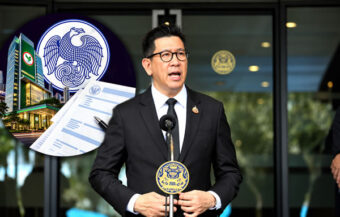
The latest shift came on Monday when the Department of Thai Traditional and Alternative Medicine (DTAM) unveiled detailed penalty guidelines for cannabis businesses. The measures fall under the Ministry of Public Health’s Controlled Herbal Product (Cannabis) 2025 regulations.
According to Deputy Director-General Dr Thewan Thaneerat, the framework is intended to standardise enforcement nationwide. Consequently, cannabis operators now face clearly defined penalties for a broad range of violations.
Under the new rules, businesses can face a 30-day licence suspension for failing to maintain mandatory records. Those records include PorThor 27 forms covering cannabis sources and stock levels. They also include PorThor 28 forms detailing sales, distribution and processing activities.
In addition, operators can be punished for incomplete reports, missing documentation and licensing breaches. Businesses may also face sanctions for selling products that fail to meet required standards. Likewise, commercial advertising of cannabis products can trigger enforcement action.
Licence revocations and protected groups are central to the government’s stricter cannabis controls
The harshest penalties target more serious offences. Businesses risk permanent licence revocation if they sell cannabis to protected groups. Those groups include people under 20 years old, students, pregnant women and breastfeeding mothers.
Separately, authorities can revoke licences for allowing on-site consumption. The same applies to online sales and vending machine sales. Operators also risk closure if they submit false information or operate in prohibited locations.
Those locations include temples, dormitories and public parks. Notably, repeat offenders face increasingly severe sanctions. Suspension periods can accumulate to 90 days. However, repeating the same offence can trigger immediate licence revocation.
The tougher penalties reflect a remarkable policy reversal.
On June 9, 2022, Thailand became the first country in Asia to decriminalise cannabis. Cannabis and hemp were removed from the Category 5 narcotics list. The move was championed by then Public Health Minister Anutin Charnvirakul.
At the time, officials promoted cannabis as both a medical opportunity and an economic engine. Farmers were encouraged to participate. Investors entered the market. Entrepreneurs rushed to establish new businesses. The government also sought to position Thailand as a regional cannabis hub.
Rapid growth after decriminalisation fuelled fears over access, enforcement and public consumption
However, decriminalisation arrived before a comprehensive regulatory framework had been completed. As a result, cannabis businesses expanded at extraordinary speed. Thousands of dispensaries opened across Bangkok, Phuket, Pattaya, Chiang Mai and other tourism centres.
While the policy officially focused on medical use, recreational consumption became increasingly visible. Enforcement struggled to keep pace with the industry’s growth. Consequently, concerns emerged almost immediately among medical professionals and community organisations.
By 2025, more than 11,000 licensed cannabis outlets were operating nationwide. That expansion transformed city centres, tourist districts and commercial areas. Cannabis shops became common sights in major destinations.
Meanwhile, medical groups warned that cannabis products were becoming increasingly accessible to young people. Public health campaigners argued that safeguards had failed to keep pace with commercial growth. Complaints also mounted about public consumption. Residents additionally raised concerns about dispensaries operating near schools and residential communities.
Political pressure and public health concerns drove a major shift towards medical-only cannabis use
Political pressure subsequently intensified. Throughout 2023 and 2024, calls for tighter controls became louder. The Pheu Thai Party campaigned on promises to restrict cannabis to medical use.
Then Prime Minister Srettha Thavisin repeatedly argued that recreational cannabis had created social problems. In response, cannabis operators warned against reversing the policy. Industry representatives said the sector was worth more than US$1 billion. They also argued that thousands of businesses and farmers depended on cannabis-related income.
A major turning point arrived in June 2025. The Ministry of Public Health reclassified cannabis flowers as a controlled herb. At the same time, new restrictions limited access to medical purposes. Consumers were required to obtain prescriptions from approved practitioners.
Advertising restrictions were strengthened. Recreational sales also came under greater scrutiny. As part of this effort, regulators moved to tighten oversight across the supply chain. The government made clear that it intended to dismantle the free-for-all environment that had emerged after 2022.
New regulations and inspections tighten oversight as authorities target medical cannabis compliance
Further tightening followed in April 2026. New ministerial regulations increased licensing requirements for cannabis flower businesses. Reporting obligations also expanded. Compliance standards became stricter.
In turn, cannabis operators faced greater regulatory scrutiny. Officials said the objective was a tightly controlled supply chain centred on recognised medical use. Open commercial sales were no longer the focus of policy.
On another front, enforcement activity accelerated sharply. According to DTAM, authorities recently inspected more than 1,247 cannabis establishments nationwide. The inspections resulted in arrests, licence suspensions and the seizure of suspicious items.
Officials said the operation was designed to ensure cannabis products were being sold only for medical and treatment purposes. Deputy Government Spokesperson Ploytalay Laksameesangjan said the Ministry of Public Health had instructed agencies to strengthen monitoring of cannabis-related businesses throughout the country.
Complaint investigations and nationwide inspections reveal growing pressure on cannabis operators
In parallel, DTAM’s Medical Cannabis Information and Coordination Centre reported receiving 209 enquiries during May. Most involved licensing matters and training programmes. According to the department, 187 enquiries were answered immediately. Public satisfaction was reported at 93.26%. While modest in scale, the figures illustrated the growing administrative burden surrounding the industry.
Authorities have also expanded complaint investigations. Between May 1 and June 12, DTAM received 73 reports of suspected cannabis violations through the Traffy Fondue platform. Five cases have already been resolved.
Another five remain under active investigation. Meanwhile, enforcement teams continue pursuing complaints linked to suspected regulatory breaches.
Health-sector publication Hfocus reported that DTAM Deputy Director-General Dr Thewan Thaneerat and Medical Cannabis Division Director Dr Peeracha Kukasemkij recently outlined several enforcement operations. According to the report, officials inspected multiple locations on June 11. One case involved approximately 1.255 kilograms of cannabis in Pak Kret. The cannabis was allegedly being prepared for shipment to the United Kingdom.
Debate over recriminalisation intensifies as the government prepares long-term cannabis legislation
Elsewhere, authorities carried out follow-up inspections at three Don Mueang businesses whose licences had previously been suspended. Officials also inspected three cannabis shops in Bangkok’s Watthana and Sathon districts following complaints.
Those inspections formed part of a wider compliance campaign. Regulators have repeatedly stated that cannabis should be used primarily for medical and health-related purposes under existing rules.
The inspection campaign comes as policymakers continue reassessing cannabis policy. Although cannabis businesses proliferated following decriminalisation, pressure for tighter controls has continued to grow. Doctors’ organisations, anti-drug campaigners and community groups remain among the strongest critics of the current system.
They argue that cannabis should be returned fully to the narcotics list. According to those groups, only full recriminalisation can address public health concerns and reduce youth access.
Cannabis growers, retailers and industry advocates continue to oppose that approach. Instead, they support tighter regulation rather than prohibition.
Industry representatives argue that cannabis supports farmers, generates business activity and provides recognised medical benefits. Consequently, the debate remains deeply polarised despite the government’s increasingly restrictive direction.
Thailand approaches a decisive crossroads as lawmakers consider the future legal status of cannabis
Today, Thailand stands at a critical point in the evolution of its cannabis policy. The unrestricted environment that followed decriminalisation is steadily disappearing. Instead, stronger enforcement, tighter licensing rules and more intrusive oversight are taking its place.
Meanwhile, ministers are considering comprehensive legislation that would define cannabis’s long-term legal status. The proposed framework would establish permanent rules covering cultivation, sales and medical use.
Health Minister Somsak launches regulatory blitz to outlaw non-medical cannabis use within 40 days
Cannabis entrepreneur embraces new Public Health regulations with ‘budtenders’ and medical support
Nevertheless, significant questions remain unresolved. A return to the free-for-all conditions seen after 2022 appears increasingly unlikely. Equally, a complete return to narcotics status remains politically contentious. What is clear is that regulators are tightening their grip on the industry. Inspections are increasing.
Penalties are escalating. Compliance demands are expanding. As lawmakers examine new legislation, the future of cannabis remains one of Thailand’s most closely watched political, commercial and regulatory battles.
Join the Thai News forum, follow Thai Examiner on Facebook here
Receive all our stories as they come out on Telegram here
Follow Thai Examiner here
Further reading:
Health Minister Somsak launches regulatory blitz to outlaw non-medical cannabis use within 40 days
Buriram cannabis factory raided for illegal Vietnamese staff as drugs czar declares a new regime
UK ambassador meets top Thai officials to hear about plans to rein in cannabis as smuggling surges
UK holiday maker to Thailand lands in Heathrow Airport London with £1 million worth of cannabis
Dark web Xanax counterfeiting gang managed from Thailand smashed in the UK with 10 people convicted
Unlikely rags to riches convict star arrested again in Thailand over online gambling promotion