Flood chaos hits Suvarnabhumi as passengers wait six hours for luggage and others leave Bangkok without their bags. Thai Airways flight carrying Asian Games athletes departs eight hours late, while Don Mueang remains open and operating normally, too.
Bangkok’s flood emergency slammed into international air travel on Sunday as baggage chaos gripped Suvarnabhumi Airport. Passengers waited up to six hours for luggage, while others flew overseas leaving their checked bags behind. A Thai Airways flight carrying Asian Games athletes finally left almost eight hours late. Floodwaters stopped ground crews reaching work, while broken baggage carts worsened the mounting backlog. Both Bangkok airports remained open, with Don Mueang largely operating normally. However, flooded roads, severe weather and transport disruption continued hitting journeys and threatening flight schedules
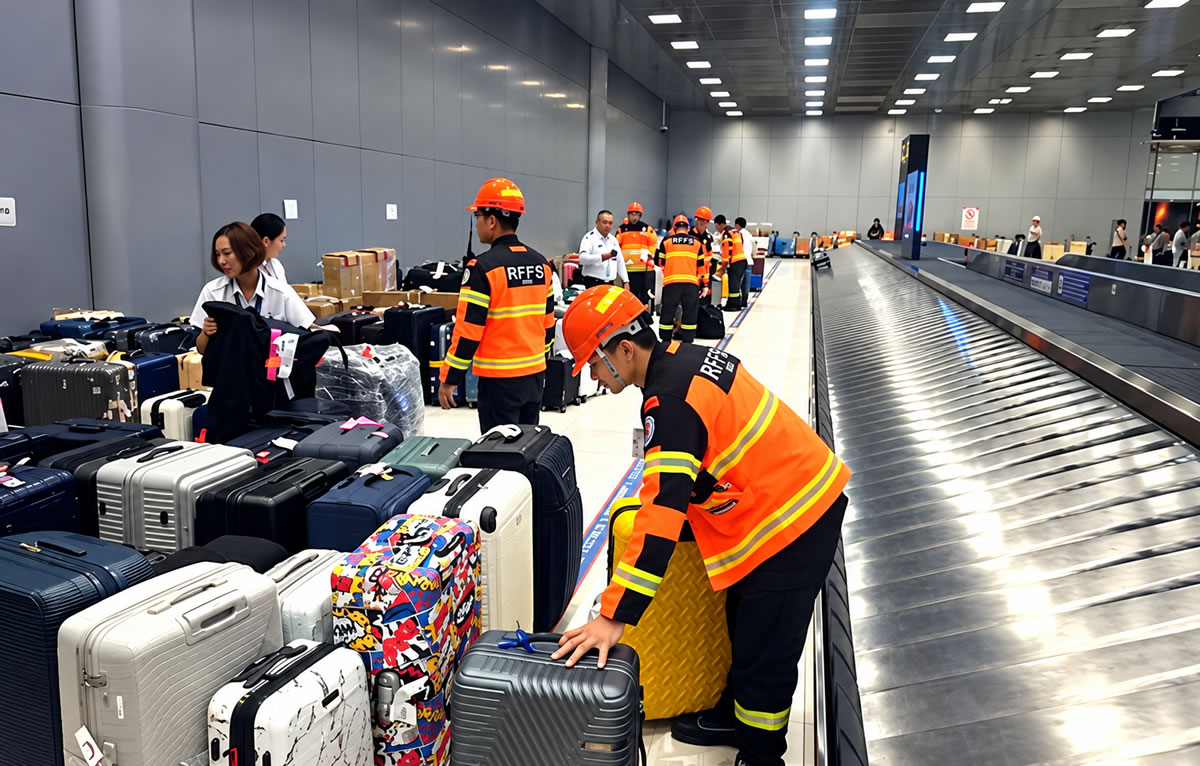
Severe Bangkok flooding disrupted international travel at Suvarnabhumi Airport over the weekend, causing baggage backlogs and significant flight delays. Both of the capital’s main airports remained open on Sunday, September 27.
However, the sharpest disruption centred on Thai Airways ground operations at Suvarnabhumi. Flooding prevented some employees from reaching work. At the same time, baggage equipment failures compounded the shortage.
As a result, luggage accumulated while some international passengers waited hours at baggage reclaim. Suvarnabhumi acknowledged complaints involving delayed departures and exceptionally long baggage waits. The disruption began on Saturday, September 26, and continued into Sunday. Notably, baggage from several flights was either left behind or remained outstanding. Separate reports put some baggage waits at five to six hours. The airport itself gave no maximum waiting time.
Passengers leave Bangkok without bags as Thai Airways flight to Nagoya suffers an eight-hour delay
The disruption also spread beyond arriving passengers. Some travellers departed Thailand while their checked luggage remained at Suvarnabhumi. Separately, one Vietnamese passenger reported that her flight eventually departed around two hours late. Her baggage and luggage belonging to several other passengers remained in Bangkok. The airline told passengers that their bags would follow on another flight. By midday Sunday, the Vietnamese passenger reported that her luggage had still not arrived.
Meanwhile, one Thai Airways international departure suffered a delay of nearly eight hours. Flight TG644 was scheduled to leave Suvarnabhumi for Nagoya at 12.05 am on Sunday. The aircraft was carrying Thai athletes travelling to Japan for the Asian Games. Flood-related staffing problems prevented normal loading of luggage and sporting equipment. Consequently, passengers remained at the departure gate through the night and into Sunday morning.
At 6.40 am, passengers were reportedly still waiting at the gate. Their scheduled departure had passed more than six hours earlier. Eventually, TG644 departed at around 8 am. The aircraft therefore left almost eight hours behind schedule. The case provided one of the clearest examples of the operational disruption.
Yet Suvarnabhumi itself remained fully operational. There was no general runway closure or suspension of international flights. Instead, the problems were concentrated in ground handling, baggage movements and individual departures. Thai Airways was particularly affected because some ground-handling employees could not reach work. In parallel, several baggage carts were out of service.
Staff shortages and broken baggage carts deepen Suvarnabhumi disruption as luggage piles up at airport
Those two pressures hit the airline simultaneously during the wider Bangkok flooding emergency. Ground crews faced problems unloading luggage from arriving aircraft and loading bags onto departing services. Accordingly, some passengers travelled overseas while their checked baggage stayed in Bangkok. Others arriving at Suvarnabhumi faced prolonged waits around baggage carousels.
In response, Suvarnabhumi ordered urgent measures to clear the backlog and restore baggage operations. Additional Thai Airways ground-handling personnel were deployed to affected operations. Defective baggage carts were also ordered repaired. Furthermore, replacement equipment was being brought into service.
As part of this response, airport officials ordered better baggage information for waiting passengers. Baggage-status details were to appear on terminal screens inside reclaim areas. Additional personnel were also assigned to help passengers trace delayed luggage. The measures followed complaints from travellers caught in the growing backlog.
Thai Airways international passengers whose luggage failed to arrive were asked to complete delayed-baggage reports. For assistance, the airline provided three Suvarnabhumi international Lost and Found telephone numbers. They are 02-134-5453, 02-134-5454 and 02-134-5455. Additionally, passengers can contact the Thai Airways main centre on 02-356-1111.
Suvarnabhumi orders more staff and baggage equipment as flooding disrupts passenger journeys to airport
The airport disruption developed during extensive flooding across Bangkok and surrounding areas. Flooded roads also complicated journeys for passengers and airport workers heading towards Suvarnabhumi. Thus, the disruption could begin well before travellers reached the terminal. Journey times through affected areas became another risk for passengers attempting to catch international departures.
On another front, conditions at Don Mueang International Airport were substantially better on Sunday. Don Mueang said arriving and departing flight operations remained open and functioning normally. No comparable baggage-handling breakdown had been reported there. Even so, flooding across northern Bangkok complicated passenger journeys to and from the airport.
Images showing extensive flooding near Don Mueang circulated widely during the emergency. Subsequently, Airports of Thailand clarified the location shown in some of those pictures. AOT said serious flooding pictured online was inside the Royal Thai Air Force’s Wing 6 area. The images therefore did not show flooding across Don Mueang’s commercial aviation facilities.
Crucially, AOT said the airport’s commercial apron and operational areas remained usable. Commercial aircraft continued arriving and departing despite flooding elsewhere in Bangkok. The airport was not flooded sufficiently to force commercial operations to stop. Still, normal airport operations did not mean every individual flight was precisely on schedule.
Don Mueang remains operational despite nearby flooding as severe weather threatens flight delays
The Civil Aviation Authority of Thailand warned that continuing severe weather could cause individual flight delays. Changing weather conditions could also force airlines to adjust schedules. Accordingly, the warning covered services using Bangkok’s airports while unstable conditions persisted. Passengers were urged to check individual flights rather than rely solely on general airport status.
At Don Mueang, the more immediate problem involved reaching or leaving the airport. Flooding and congestion affected surrounding roads. For that reason, Don Mueang advised passengers to consider using the elevated Don Mueang Tollway. Bangkok’s Red Line railway also provided an alternative while surface roads remained affected.
Airport bus services A1 through A4 continued operating during the disruption. Nevertheless, passengers were warned that buses could face minor delays because of road conditions. Don Mueang also reported that its metered-taxi service was temporarily unavailable. That created another complication for passengers arriving at the airport.
Despite those transport problems, no general suspension of commercial flights was reported at Don Mueang. The distinction between airport closure, flight delays and baggage disruption remained important. Neither Suvarnabhumi nor Don Mueang International Airport was closed. Nor was there a wholesale suspension of international aviation because of the flooding.
Both Bangkok airports remain open but Suvarnabhumi suffers serious baggage and ground disruption
AOT said runways and aircraft operating areas remained available. It also reported no general flood-driven cancellations caused by unusable airport operating areas. By contrast, Suvarnabhumi was experiencing a significant ground-level operational disruption. That disruption was particularly visible across Thai Airways baggage and ground-handling operations.
Flooding prevented some employees from reaching work during a critical period. Simultaneously, baggage equipment was unavailable. Bags accumulated and passengers waited considerably longer than normal. Some travellers reportedly spent five to six hours waiting for luggage. Others left Bangkok while their checked baggage remained behind.
Flight delays varied between individual services. Most dramatically, TG644 to Nagoya departed almost eight hours after its scheduled departure. Suvarnabhumi therefore could not be described as operating entirely to schedule on Sunday. However, available reports did not show every airline or departure suffering comparable disruption.
Rather, Thai Airways ground operations were particularly affected by the combined staffing and equipment problems. Don Mueang faced no reported equivalent baggage crisis. Commercial flights continued there despite flooding elsewhere across northern Bangkok. Nonetheless, individual services remained vulnerable to severe weather and possible schedule changes.
Airlines offer travel flexibility as CAAT warns passengers to check flights before setting out for travel
Against that backdrop, CAAT urged passengers to check flight status directly with their airlines before travelling. Passengers also faced uncertainty before reaching either airport. Flooded roads and heavy congestion increased journey times across affected parts of Bangkok. For some travellers, road access presented a major additional obstacle.
Airlines also began introducing special arrangements for passengers affected by the flooding. Thai AirAsia and Thai AirAsia X were among carriers offering additional flexibility. Likewise, Nok Air, Thai Lion Air and Thai Airways introduced measures for affected travellers. Depending on airline conditions, passengers could change travel dates or retain ticket value.
Thai Airways introduced specific arrangements covering eligible passengers travelling between September 26 and September 29. Under those measures, eligible passengers could make one travel-date change without the normal fee. The concession coincided with continuing baggage and ground-handling problems at Suvarnabhumi.
Beyond those measures, severe weather remained capable of producing further individual flight delays. CAAT warned that adverse conditions could continue affecting schedules. Suvarnabhumi passengers therefore faced two distinct areas of disruption. The first involved travelling through flooded and congested roads. The second involved operations after reaching the terminal.
Thai Airways passengers face baggage delays as flooded roads add hours to journeys to Suvarnabhumi
For Thai Airways passengers, the second risk was already clearly visible. Ground-handling shortages affected baggage movements and aircraft preparation. Moreover, defective baggage carts reduced the equipment available to clear accumulated luggage. The resulting backlog affected both passengers arriving in Thailand and travellers departing overseas.
International passengers were advised to reach the terminal at least three hours before scheduled departure. Importantly, those three hours did not include the journey to Suvarnabhumi. Travellers crossing flooded parts of Bangkok could require substantially more time. Total journey planning therefore needed to account for road conditions before passengers reached the airport.
At Don Mueang, travellers faced similar uncertainty across surrounding roads. Commercial airport operations, though, remained largely normal. The Red Line offered an alternative for passengers seeking to avoid affected roads. Similarly, the elevated Don Mueang Tollway provided another route to the terminal.
Bus passengers faced a different problem. Airport services continued, but road congestion could slow their journeys. Arriving travellers also lost access temporarily to Don Mueang’s metered-taxi service. Even with those difficulties, the airport reported no baggage crisis comparable to Suvarnabhumi.
Bangkok airports remain open as Suvarnabhumi baggage crisis contrasts with operations at Don Mueang
By Sunday, conditions at Bangkok’s two principal airports were therefore sharply different. Both remained open and continued handling arriving and departing aircraft. Suvarnabhumi, however, faced a substantial baggage backlog involving Thai Airways ground operations. Don Mueang continued commercial operations without a comparable baggage breakdown.
At Suvarnabhumi, some international passengers reportedly waited five to six hours for their bags. Other passengers departed Thailand while checked luggage remained in Bangkok. More strikingly, TG644 to Nagoya left almost eight hours late. Flood-related staffing shortages had disrupted loading of luggage and sporting equipment.
Suvarnabhumi moved to deploy more ground staff and repair baggage equipment. Replacement equipment was also being brought into service. In addition, airport officials ordered better baggage information and more assistance inside reclaim areas. Those steps targeted both the physical backlog and passengers waiting for information.
Don Mueang, in contrast, kept its commercial apron and operational areas usable despite nearby flooding. Its main immediate problems involved road access and onward transport. Metered taxis were temporarily unavailable, while airport buses faced possible delays. Yet aircraft continued using the airport.
Bangkok airports stay operational but Suvarnabhumi baggage disruption hits international passengers
Overall, both Bangkok airports remained operational during the flooding emergency. Their problems, however, were materially different. Don Mueang faced difficult access and possible weather-related flight delays. Suvarnabhumi faced those wider risks alongside a significant Thai Airways baggage-handling disruption.
Flooding tragedy in Samut Prakan near Bangkok. Two die from electrocution after family car is submerged
Bangkok flooding eases as front moves to Myanmar but Governor warns city needs 2-3 days to recover
For international travellers, that distinction was increasingly visible inside Suvarnabhumi itself. Bags remained behind, reclaim waits stretched for hours and some departures suffered serious delays.
Outside both airports, flooded roads added another layer of disruption. Bangkok’s aviation gateways remained open, but the flooding was already disrupting passenger journeys from road to baggage carousel.
Join the Thai News forum, follow Thai Examiner on Facebook here
Follow Thai Examiner on Google here
Receive all our stories as they come out on Telegram here
Follow Thai Examiner here
Further reading:
Engineers work through night after Sunday’s fire on Bangkok’s Blue Line saw more damage than thought
Italian Thai boss and 16 others arrested on Thursday charged with Auditor General building deaths
Arrested man linked with Chatuchak building collapse now tells police he is a Chinese state employee
Prime Minister orders arrests over the Chatuchak Auditor General building disaster within seven days
Chinese steel firm linked to Chatuchak disaster faces DSI probes. Minister cancels investment status