Prime Minister Anutin Charnvirakul visited London seeking investment as Thailand’s trade deficit balloons to USD 37.84 billion. China runs a USD 47.3 billion surplus while Thai exports to America surge 48.7% and the US trade deal remains unfinished.
Prime Minister Anutin Charnvirakul hit London seeking British investment as Thailand’s trade figures flashed a major warning. Imports have soared 36.1%, blowing the eight-month deficit out to USD37.84 billion despite booming exports. China alone ran a USD 47.3 billion surplus with Thailand, while Thai exports to America surged 48.7% in August. The dramatic trade split comes as Washington tightens scrutiny of Chinese inputs and rules of origin. Yet Prime Minister Anutin left New York without sealing Thailand’s crucial reciprocal trade deal with the US.
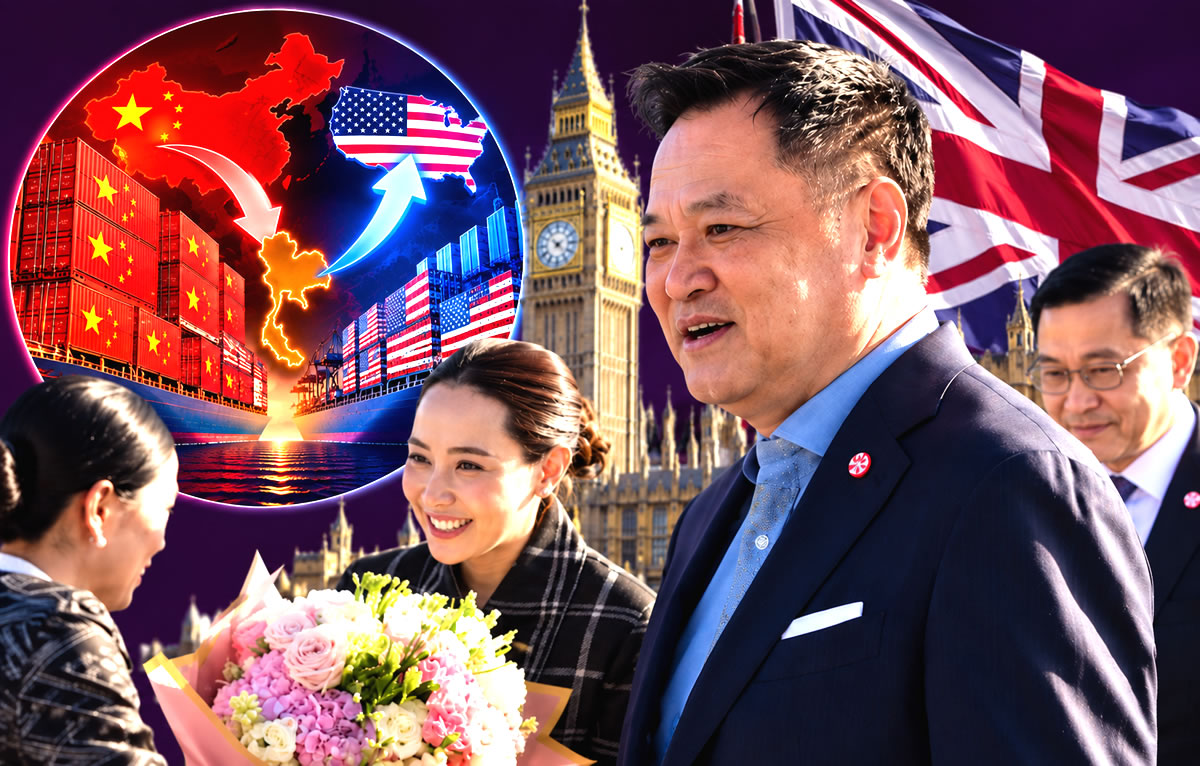
Prime Minister Anutin Charnvirakul arrived in London on Friday with Thailand’s ballooning trade deficit providing a stark economic backdrop. His short British visit seeks stronger commercial ties and fresh investment.
Yet new figures show imports growing almost twice as fast as already booming exports. Thailand accumulated a USD 37.84 billion trade deficit during the first eight months of 2026. Meanwhile, Chinese shipments into Thailand are surging as Thai exports to the United States accelerate. The shifting pattern comes as Bangkok still awaits its final reciprocal trade agreement with Washington.
Prime Minister Anutin arrived in London at 9.35 am local time on September 25 after leaving New York. Britain marks the final leg of his September 20–27 overseas mission. Previously, he visited Japan before travelling to the United States. Prime Minister’s Office spokesman Ekkapop Pianpiset said British business representatives were ready to meet him immediately. The London programme focused on investment, finance, aviation, tourism and bilateral trade.
New York trip ends without US trade deal as Thailand’s eight-month deficit reaches USD37.84 billion
Before London, Prime Minister Anutin spent several days pursuing economic and diplomatic objectives in New York. There, he attended the United Nations General Assembly and met major investors. He also rang the opening bell at the New York Stock Exchange. Stock Exchange of Thailand executives joined the delegation for the capital markets programme. Afterwards, Prime Minister Anutin said financial institutions viewed investment in Thailand positively.
However, the Prime Minister left America without announcing the long-awaited final US-Thai reciprocal trade agreement. Instead, negotiations remained unfinished as he crossed the Atlantic. That delay coincides with a dramatic change in Thailand’s international trade accounts. Fresh Commerce Ministry figures reveal the scale of the shift.
During January-August, Thailand exported USD266.15 billion of goods. That represented strong growth of 18.9% from the corresponding period last year. By contrast, imports surged 36.1% to USD303.99 billion. Consequently, Thailand accumulated a USD37.84 billion trade deficit within eight months. In baht terms, the gap reached approximately ฿1.335 trillion.
Crucially, collapsing exports did not produce the deficit. Thai exports are instead expanding at a rapid pace. Imports, however, are accelerating considerably faster. August exposed that widening gap particularly clearly. Exports jumped 24.3% year-on-year to USD34.62 billion. That marked their strongest annual growth for 56 months.
Imports outpace booming exports as China runs a huge USD47.3 billion trade surplus with Thailand
Even so, imports reached USD37.10 billion during August. Thailand therefore recorded another monthly deficit of USD2.48 billion. Notably, August became the country’s eleventh consecutive month with a trade deficit. Strong export growth has consequently failed to close the expanding gap between exports and imports.
At the centre of that export surge is the United States. It is now Thailand’s largest export market. Thai shipments to America jumped another 48.7% year-on-year during August. In comparison, exports to China increased 15.5%. On another front, Chinese shipments moving into Thailand have expanded substantially.
Chinese customs figures provide a striking measure of that bilateral imbalance. China exported USD83.3 billion of goods to Thailand during January-August. Conversely, it imported only USD36 billion from Thailand. Beijing’s figures therefore produced a USD47.3 billion Chinese trade surplus with Thailand across eight months.
August maintained the same pattern. China exported USD11.3 billion of goods to Thailand during the month. In the opposite direction, it imported approximately USD5 billion from Thailand. Chinese exports to Thailand therefore exceeded imports from the kingdom by more than two-to-one.
Chinese machinery shipments surge sharply as Washington focuses on rules of origin and trade diversion
There is, however, an important statistical qualification. Chinese and Thai customs figures use different compilation methods. Accordingly, Beijing’s bilateral numbers cannot simply be added to Thailand’s Commerce Ministry totals. Still, both sets of data reveal a pronounced change in Thailand’s international trading relationships.
Thailand is importing substantially more goods from China. Simultaneously, its exports to the United States are expanding at an exceptional rate. The composition of Chinese exports provides further context. Electrical machinery and equipment represented China’s largest export category to Thailand during August. Machinery and mechanical appliances formed another major category.
As a result, substantial Chinese shipments comprise machinery, components and intermediate products used across Thailand’s industrial economy. The figures themselves do not establish transshipment or trade circumvention. Nevertheless, the flows coincide with Washington’s increased focus on rules of origin and Chinese inputs entering third-country supply chains.
Separately, US trade policy has increasingly targeted Chinese industrial overcapacity and trade diversion. China itself recorded a USD 805.5 billion global trade surplus during January-August. Against this backdrop, Thailand’s rising Chinese imports coincide with exceptionally strong export growth towards the United States.
Washington examines Chinese inputs as Bangkok’s reciprocal trade negotiations still remain unfinished
In parallel, Washington is examining rules governing the origin and local content of imported products. Those rules determine whether goods qualify for agreed tariff treatment. They also become significant when imported components enter products subsequently manufactured and exported from another country.
The available trade figures do not establish how much Chinese material enters Thai products subsequently exported to America. Nor do the figures establish circumvention. Nonetheless, the simultaneous trade movements are substantial. Thailand is buying far more from China while selling considerably more to the United States.
At the same time, Bangkok and Washington are still negotiating their reciprocal trade arrangements. Earlier this month, the agreement appeared close to completion. Deputy Prime Minister and Commerce Minister Suphajee Suthumpun gave an upbeat assessment on September 8. She said the principal issues had been settled and negotiations had reached final wording.
As part of this process, a telephone conversation between Prime Minister Anutin and US President Donald Trump was proposed. The call was expected to help conclude matters. Subsequently, however, the anticipated timetable slipped.
New US condition delays trade deal as Prime Minister Anutin shifts his economic mission to London
On September 20, Prime Minister Anutin revealed that Washington had introduced an additional condition. Thereafter, Thai officials acknowledged they could no longer specify when the agreement would be completed. Prime Minister Anutin then travelled to America during his three-country overseas mission. Despite that visit, no final reciprocal trade agreement was announced before his departure.
Instead, his American programme delivered extensive investor discussions and a separate capital markets agreement. The Stock Exchange of Thailand signed a five-part memorandum with the New York Stock Exchange on September 24. It covers dual listings, cross-listed exchange-traded funds, market data, indices and ESG products. Prime Minister Anutin also rang the NYSE opening bell during the visit.
Importantly, the SET-NYSE memorandum is separate from the unfinished government-to-government reciprocal trade negotiations. Prime Minister Anutin subsequently left New York for London. There, his economic programme shifted towards British investment and bilateral commercial cooperation.
Upon arrival, his programme opened with talks involving Matt Western MP, the UK trade envoy for Thailand. Prime Minister Anutin also met Mark Gooding OBE, director-general for Asia-Pacific strategy and relations. Further meetings were scheduled with Matthew Davies, director-general for trade strategy and relations.
London meetings target British investment in AI, data centres, healthcare and clean energy sectors
Additionally, David Thomas, minister at the British Embassy in Thailand, joined the programme. Rupert Goodman, chairman of the Thai-UK Business Council, was another participant. Together, the meetings brought British government, trade and business representatives into the Prime Minister’s London roadshow.
Later, Prime Minister Anutin was scheduled to deliver a speech and attend an afternoon reception. Representatives from Britain’s public and private sectors were invited. The event was designed to present Thailand’s investment potential and strengthen business confidence. Furthermore, Bangkok wants to widen commercial links between Thailand and Britain.
Another round of talks involved executives from UBS Group AG, Virgin Atlantic and Rolls-Royce. Those discussions aimed to expand cooperation and establish additional business connections. For its part, Thailand is promoting investment across several targeted industries. They include artificial intelligence, data centres, healthcare and clean energy.
Prime Minister’s Office spokesman Ekkapop Pianpiset described London as another step in promoting Thailand internationally. He said the meetings sought to build confidence and expand cooperation. Moreover, the government wants new trade and investment opportunities. Mr Ekkapop said it wanted the discussions to produce concrete economic results.
Thailand’s trade deficit deepens as imports surge 36.1% despite exceptionally strong export growth
Behind those investment pitches, Thailand’s latest trade figures present a markedly different economic challenge. The country is not suffering from weak overseas sales. Rather, exports increased almost one-fifth during the first eight months. August exports alone surged almost one-quarter from a year earlier.
Imports, though, are expanding much faster. They climbed 36.1% to almost USD304 billion between January and August. Hence, powerful export growth failed to prevent Thailand’s trade balance moving heavily into deficit. The resulting USD37.84 billion shortfall accumulated within only eight months.
Furthermore, the deficit has persisted month after month. August represented the eleventh consecutive monthly shortfall. During that month, exports reached USD34.62 billion following their 24.3% jump. Imports nevertheless reached USD37.10 billion. Another USD2.48 billion was therefore added to the cumulative deficit.
Beyond the headline deficit, the geographical split is increasingly pronounced. China is sending substantially more goods into Thailand than it receives from the kingdom. Chinese statistics put Beijing’s bilateral surplus with Thailand at USD 47.3 billion during January-August. Meanwhile, Thailand is selling sharply increasing volumes of goods to America.
US exports surge 48.7% as Thailand’s widening trade imbalance with China becomes increasingly stark
Thai exports to the United States jumped 48.7% year-on-year during August. Exports to China rose only 15.5% over the same period. At the same time, China shipped USD11.3 billion of goods into Thailand during August. It imported approximately USD5 billion from the kingdom.
Those figures place Thailand between sharply contrasting trade flows involving the world’s two largest economies. China is running a large bilateral surplus with Thailand. America, meanwhile, has become Thailand’s largest export market. Washington is also negotiating new reciprocal trade terms with Bangkok.
More broadly, China’s worldwide trade surplus reached USD 805.5 billion during the first eight months. That figure provides the international backdrop to Thailand’s rising imports from China. Meanwhile, Bangkok’s exports to America continue growing at an exceptionally fast pace.
Against this setting, the unfinished US-Thai agreement remains a major unresolved element of the government’s trade agenda. Earlier expectations pointed towards an agreement approaching completion. Yet Washington’s additional condition altered that timetable. No final agreement emerged during Prime Minister Anutin’s subsequent visit to America.
Prime Minister Anutin ends three-country investment drive with Thailand’s trade deficit still rising
Instead, the Prime Minister continued his overseas investment drive. Japan provided the first leg of the journey. Next came the United States, where diplomacy, capital markets and investment dominated the programme. Finally, Britain became the last stop before his return to Bangkok.
In London, the government again concentrated on attracting foreign capital and strengthening commercial relationships. Talks involved British officials, financiers and major aviation and engineering companies. Thailand also promoted opportunities in technology, healthcare, energy and data infrastructure.
Yet the latest trade numbers provide a harder backdrop to the entire three-country roadshow. Thailand exported USD266.15 billion during the first eight months. Against that, the country imported USD303.99 billion. The difference produced a USD37.84 billion deficit despite export growth of 18.9%.
Meanwhile, Chinese figures show an even sharper bilateral imbalance. Beijing recorded a USD47.3 billion surplus with Thailand during January-August. During August alone, Chinese exports to Thailand exceeded USD11 billion. At the same time, Thailand’s exports to America were growing almost 49% year-on-year.
Prime Minister Anutin ends three-country investment drive with Thailand’s trade deficit still rising
Prime Minister Anutin’s London programme therefore closes an intensive week of overseas economic diplomacy. The delegation was due to leave Britain on September 26. Prime Minister Anutin was then scheduled to arrive in Bangkok at 7 am on Sunday, September 27.
He returns with Thailand’s exports growing rapidly but imports expanding considerably faster. As a consequence, the country carries a USD 37.84 billion trade deficit after only eight months. China’s bilateral surplus with Thailand has simultaneously widened sharply. Thai exports to America, meanwhile, continue surging.
Oil fund bleeds nearly 5 billion baht a week as the government struggles to cope with Middle East crisis
Anutin heads to New York but no sign yet of news on the US Thai trade deal as problems simmer at home
Most immediately, Bangkok still has no announced final reciprocal trade agreement with Washington. The additional US condition remains part of unfinished negotiations. Prime Minister Anutin therefore returns from Japan, America and Britain with Thailand’s changing trade balance firmly in view.
Join the Thai News forum, follow Thai Examiner on Facebook here
Follow Thai Examiner on Google here
Receive all our stories as they come out on Telegram here
Follow Thai Examiner here
Further reading:
Something gone wrong in the business world as confidence plummets to a three year low in survey
Now the government’s crackdown targets unlicensed hotels. Five managers arrested in Phuket raids
Top Bhumjaithai Party figure defends the party’s position on cannabis. Only supported medical use