Bank of Thailand keeps its rate at 1% as two economies pull apart. Technology-driven and artificial intelligence projects attract capital but spread few gains, while SMEs lose loans, households cut spending and rising inflation adds further pressure.
Thailand’s central bank unanimously held its policy rate at 1.00% on Wednesday as a dangerous economic divide widened. Import-heavy technology investment is surging, while SMEs lose credit and hard-pressed households cut spending. Meanwhile, inflation is set to rise as Middle East turmoil, trade protectionism and Federal Reserve uncertainty buffet the baht.
The Bank of Thailand kept its policy interest rate unchanged at 1.00% on Wednesday amid deep economic imbalances. Growth remains low, weak and uneven across sectors. Notably, private investment is increasingly concentrated in technology and artificial intelligence projects. These projects depend heavily on imports and produce limited benefits across the wider economy.
At the same time, small and medium-sized enterprise lending remains in contraction. Financial institutions are still cautious about lending to higher-risk borrowers. By contrast, large companies continue securing credit for investment and working capital. This split has left smaller businesses facing restricted financing, fierce competition and weak domestic demand.
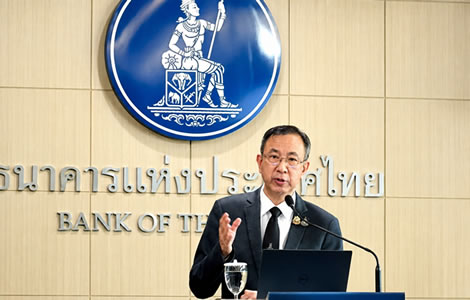
Don Nakornthap, secretary of the Monetary Policy Committee, announced the decision after its August 26 meeting. Every committee member supported maintaining the rate at 1.00% per year. In response, the committee retained an accommodative monetary position designed to support the economic recovery. Targeted financial measures will continue assisting vulnerable borrowers and potentially viable SMEs.
Technology and artificial intelligence investment rises but delivers limited gains across Thailand
Thailand continues to receive momentum from the global technology and artificial intelligence cycles. As a result, goods exports and private investment have performed better than previously expected. These gains should support economic activity during 2026 and 2027. Overall growth projections remain close to the committee’s previous estimates.
However, the composition of growth has become increasingly unbalanced. Technology and artificial intelligence projects require substantial imported machinery, equipment and other inputs. Consequently, their expansion provides only limited support for domestic companies, workers and households. Stronger headline investment has not produced an equally broad domestic recovery.
More significantly, the investment surge creates relatively little widespread employment or wealth across the economy. Capital is flowing towards large, technology-driven projects with limited domestic reach. Their high import content also restricts benefits for local supply chains. Thus, stronger investment figures conceal continuing weakness throughout much of the economy.
Meanwhile, private consumption is expected to grow more slowly than previously forecast. Households remain cautious as their living costs increase. This restraint is weakening domestic demand and reducing sales among consumer-facing businesses. Hence, stronger exports have not generated comparable momentum across local markets.
SME credit contracts as large corporations secure most new lending for investment and working capital
For SMEs, the pressure extends beyond weak consumer spending. Many businesses face intense competition and difficulties adapting to changing economic conditions. In parallel, their access to bank financing continues to tighten. SME credit contracted even as total lending across the financial system expanded.
Large companies accounted for most of that overall loan growth. Some corporate borrowing reflected a new wave of investment. Even so, most large-company loans were used for working capital. The figures therefore show stronger credit access among major businesses, rather than broad borrowing growth.
Elsewhere, financial institutions remained cautious when assessing applications from riskier borrowers. That caution has disproportionately affected smaller companies. Overall loan quality remained stable during the reporting period. Still, the committee said SME credit quality required continued monitoring.
Vulnerable households present another area of concern. Their future debt repayment capacity will also require close scrutiny. Accordingly, banks were encouraged to increase support through targeted financial measures. That assistance should reach vulnerable customers and SMEs considered capable of remaining viable.
Committee holds its monetary framework as inflation is forecast to rise again through early next year
As part of this approach, the committee maintained its broader monetary framework. That framework seeks price stability, sustainable growth and financial system stability. Targeted measures address specific credit problems within that structure. The committee therefore avoided changing the general interest-rate setting.
“The Committee believes that the accommodative monetary policy, coupled with targeted monetary measures, is contributing to economic recovery,” it said. “Therefore, it deems it appropriate to maintain the policy interest rate at its current level of 1.00%, which is deemed suitable to support economic recovery. While inflation is projected to rise temporarily due to supply-side factors, the trend and risks of inflation in the coming period will need to be monitored.”
On inflation, the committee lowered its forecasts for both 2026 and 2027. Lower global energy prices drove much of that revision. Core inflation was also revised slightly below previous estimates. Specifically, business costs passed into consumer prices more slowly than expected.
Nevertheless, headline inflation is projected to rise during the remainder of 2026. The increase should continue through the first quarter of 2027. Supply-side pressures will drive that temporary movement. These include El Niño and the gradual transfer of costs into prices.
Inflation risks persist as Middle East conflict hits the baht while Thai bond yields remain stable
Afterwards, inflation is expected to return to low levels. Thailand’s economy continues expanding below its potential. Domestic demand also remains weak. Taken together, those conditions should limit persistent underlying price pressure.
A weak comparison base will also influence future inflation readings. Medium-term inflation expectations remain anchored within the official target range. Even with that stability, the committee identified several risks requiring close attention. Future pricing conditions could change as external pressures develop.
In particular, the continuing Middle East conflict remains a major source of uncertainty. International trade protectionism presents another risk to exports, investment and production. Separately, the committee will monitor how businesses transfer rising costs to customers. It will also track movements in medium-term inflation expectations.
On another front, international developments affected Thailand’s financial markets. Don said the baht fluctuated against the United States dollar. Currency movements followed changes in the Middle East conflict. Market expectations surrounding United States monetary policy also influenced the baht.
Investors continued assessing the United States Federal Reserve’s future policy direction. Thai bond yields, however, remained stable during the period. In comparison, government bond yields increased across several major economies. Domestic yields therefore avoided the upward movements recorded abroad.
Credit and investment divide widens as households cut spending and smaller companies lose bank loans
Within Thailand, credit data exposed the economy’s widening divide. Large corporations retained access to loans for investment and daily operations. Smaller companies faced continued contraction in bank lending. Total credit growth therefore concealed sharply different financing conditions between borrowers.
Likewise, the investment figures showed a concentration of economic momentum. Technology-linked exports and private investment continued outperforming earlier expectations. Yet these sectors rely heavily on imported inputs. Their growth consequently produces only limited gains for the broader domestic economy.
For households, the immediate problem remains rising living costs. Consumers have responded by spending more cautiously. Slower consumption has weakened demand for businesses outside the leading technology sectors. In turn, those conditions have increased the pressure on SMEs.
For smaller companies, financing and commercial pressures are arriving together. Banks remain reluctant to lend to higher-risk borrowers. Simultaneously, SMEs must respond to intense competition and changing market conditions. Their ability to repay existing debt could weaken if those pressures continue.
Committee backs targeted support as weak consumption and shrinking SME credit divide the economy
Against this background, the committee retained the 1.00% rate unanimously. Members judged that the existing setting remained suitable for the recovery. Rather than alter the policy rate, they backed targeted assistance for distressed borrowers. Potentially viable SMEs remain a central focus of those measures.
Looking ahead, the committee will monitor economic growth, inflation and international risks. It will also examine loan quality and household repayment capacity. Furthermore, business pricing decisions will remain under review. Currency movements and global bond-market conditions will form part of that assessment.
Crackdown on smaller foreign investors in Thailand has wider implications for external investment going forward
GDP growth flounders. Deeply disturbing underlying data. Real economy in retreat. 1.1 trillion deficit
For now, Thailand’s headline growth forecasts remain broadly unchanged. Beneath them, however, the economic structure remains weak and uneven. Technology investment and goods exports are providing momentum. Domestic consumption, SME lending and wider wealth creation remain under pressure.
Ultimately, the decision reflects two sharply different economic pictures. Large, technology-driven projects are expanding and drawing private investment. Outside those sectors, households remain cautious and smaller businesses face shrinking credit. The policy rate stays at 1.00% while that divide persists.
Join the Thai News forum, follow Thai Examiner on Facebook here
Receive all our stories as they come out on Telegram here
Follow Thai Examiner here
Further reading:
Drive against foreign owned property and business on Koh Samui and Koh Phangan now targets leases
International reservations system used by hotels targeted in latest Koh Phangan swoop by ministers
Anutin visits Koh Phangan as nominee crackdown shows 68% of firms with foreign ownership links
Blitzkrieg on foreign firms and enterprises on Koh Phangan continues with French owned resort busted
Russian-Chinese Koh Phangan alliance to sell drugs to foreigners. Accused entered Thailand illegally
Crackdown aimed at upending foreign business trade moves from Koh Phangan to Phuket. Four arrested
Crackdown to wipe out foreign business abuses and ownership on Koh Phangan & Koh Samui intensifies