Anutin and Foreign Minister Sihasak return from Russia after high-stakes talks on energy, trade and space technology as Moscow targets ASEAN’s 680 million consumers. The summit unfolded under the shadow of a major Ukrainian attack on Moscow.
Prime Minister Anutin Charnvirakul and Foreign Minister Sihasak Phuangketkeow returned from Russia on Friday after placing Thailand at the heart of Moscow’s push into Southeast Asia. The Russia-ASEAN Summit in Kazan focused on expanding ฿65 billion in bilateral trade, securing future energy supplies and advancing space and technology cooperation. The visit unfolded amid a major Ukrainian attack on Moscow and highlighted Thailand’s growing role as a gateway to a 680-million-strong ASEAN market and a key partner in Russia’s drive for deeper regional ties.
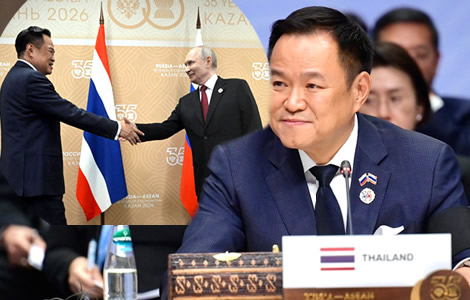
Prime Minister Anutin Charnvirakul and Foreign Minister Sihasak Phuangketkeow were due back in Bangkok on Friday morning after attending the Russia-ASEAN Summit in Kazan.
The visit placed Thailand at the centre of discussions on trade, energy, technology and regional cooperation. It also came as Russia stepped up efforts to strengthen economic ties across Southeast Asia. However, the summit concluded amid heightened security concerns following an intensive Ukrainian attack on Moscow on Thursday.
Although Kazan lies more than 700 kilometres from the Russian capital, developments were closely monitored by foreign delegations. There were no reports of any threat to the Thai delegation. Even so, the attack drew attention because senior ASEAN representatives were present in Russia.
Later on Friday, Mr Anutin and his entourage were expected to resume duties at Government House.
Russia turns to Southeast Asia as Thailand emerges as a key gateway to expanding ASEAN markets
The summit reflected a broader shift in Russia’s international engagement. As Moscow seeks stronger economic partnerships in Asia, ASEAN has become a growing priority. The ten-member bloc represents more than 680 million people.
Moreover, it remains one of the world’s fastest-growing economic regions. Consequently, ASEAN has become increasingly important to Russia’s trade and investment strategy.
Thailand occupies a central place within that approach. As one of ASEAN’s largest economies, the kingdom serves as a major commercial hub. It is also a founding member of the regional grouping. For that reason, Russian policymakers increasingly view Thailand as a gateway to wider Southeast Asian markets.
In turn, Thailand benefits from maintaining access to a major global power seeking deeper regional engagement.
Economic cooperation dominated much of the agenda in Kazan. Bilateral trade between Thailand and Russia reached approximately US$2 billion, or about ฿65 billion, in 2024. While the figure remains modest compared with Thailand’s largest trading partners, it continues to grow.
Trade worth ฿65 billion fuels hopes for broader investment and deeper commercial cooperation
More importantly, officials from both countries see substantial room for expansion. As part of those efforts, discussions focused on manufacturing, agriculture, logistics and technology.
Trade was only one component of a much wider agenda. Investment opportunities also featured prominently. Russian officials have repeatedly identified Southeast Asia as a region offering long-term growth potential. Thailand’s infrastructure, industrial capacity and regional connectivity strengthen its appeal.
Accordingly, the summit examined ways to increase commercial activity and deepen economic links.
Energy emerged as another major theme. Russia remains among the world’s largest producers of oil and natural gas. It also possesses extensive expertise in energy infrastructure and related technologies.
Meanwhile, energy demand continues to rise across Southeast Asia. Governments throughout the region face increasing pressure to secure reliable supplies. Against that backdrop, energy cooperation has assumed greater strategic importance.
Energy security moves centre stage as Russia promotes expertise in fuel and infrastructure sectors
For Thailand, energy resilience remains a key economic objective. Therefore, discussions extended beyond commodities alone. Delegates examined opportunities involving infrastructure, technology and long-term cooperation.
Such issues have become increasingly important as economies expand and industrial demand grows. In response, governments are placing greater emphasis on stable energy partnerships.
Notably, space cooperation attracted significant attention. Russia maintains one of the world’s most advanced space programmes. Its capabilities include launch systems, satellite development and scientific research.
At the same time, ASEAN countries are investing more heavily in space-related technologies. Satellite networks now support telecommunications, navigation and weather forecasting across the region.
In parallel, satellite systems play a growing role in disaster management and environmental monitoring. They are also increasingly important for agriculture and infrastructure planning.
As a result, cooperation in space technology is emerging as a practical area of engagement. The subject featured prominently in discussions involving future scientific and technological cooperation.
Space technology joins energy and trade as a major focus of Russia-Asean summit discussions
Food security represented another important topic. Thailand remains one of the world’s leading agricultural exporters. Russia, meanwhile, is a major producer of grain and agricultural commodities.
Consequently, both countries share an interest in maintaining resilient food supply chains. Delegates therefore examined opportunities involving agricultural technology, logistics and production efficiency.
On another front, transport connectivity received considerable attention. Efficient logistics remain essential for expanding trade. Improved transport links can reduce costs and strengthen commercial relationships.
Therefore, discussions included measures designed to improve connectivity between Russia and Southeast Asian markets. Such improvements are viewed as critical to future trade growth.
The summit also demonstrated how Russia’s relationship with ASEAN has evolved. Historically, cooperation centred on diplomatic engagement. Today, economic issues dominate much of the agenda.
Trade, technology, infrastructure and investment now sit alongside traditional foreign policy concerns. As a result, summits increasingly focus on practical outcomes rather than ceremonial diplomacy.
Nearly 130 years of relations continue through trade, tourism, science and diplomatic engagement
Thailand’s participation was also shaped by a long diplomatic history. Formal relations between Thailand and Russia date back to 1897. That year, King Chulalongkorn, Rama V, visited Russia during a landmark European tour. During the visit, he established a close relationship with Tsar Nicholas II. At the time, Siam faced mounting pressure from competing colonial powers.
The relationship later developed through major political changes. Diplomatic ties were renewed with the Soviet Union in 1941.
Subsequently, Thailand recognised the Russian Federation as the successor state to the Soviet Union in 1991. As a consequence, bilateral relations have continued through imperial Russia, the Soviet era and the modern Russian Federation.
Today, cooperation extends well beyond diplomacy. Tourism remains one of the strongest links between the two countries. Russian visitors have long ranked among Thailand’s most important European tourist groups. Phuket, Pattaya, Krabi and Koh Samui remain particularly popular destinations.
Furthermore, tourism flows have recovered strongly in recent years, reinforcing broader economic ties.
Separately, education, science and technology cooperation have continued to expand. These sectors now complement traditional trade and tourism links. Together, they provide additional foundations for bilateral engagement.
The relationship therefore rests on both historical ties and contemporary economic interests.
Anutin expected to meet Putin as Thailand pursues energy supplies and reassures Russian visitors
The presence of both Prime Minister Anutin and Foreign Minister Sihasak reflected the importance Bangkok attaches to relations with Moscow. Equally, it demonstrated Thailand’s commitment to active international engagement through both bilateral and multilateral channels.
For Russia, the summit marked another step towards deeper integration with Southeast Asian economies. For ASEAN members, it provided direct engagement on issues affecting trade, energy, technology and economic development.
PM Anutin flies to Asean-Russia Summit. Expected to have talks with Putin as Thailand seeks oil supplies
Minister assures Russians Thailand is safe and that they are high value tourists after Moscow’s warning
Despite security concerns in Moscow, summit activities proceeded as planned. Delegations completed meetings before preparing for their return journeys.
By Friday morning, attention had shifted back to Bangkok. Prime Minister Anutin and Foreign Minister Sihasak were expected to resume official duties following a summit focused on trade expansion, energy security, space cooperation and one of Thailand’s oldest diplomatic relationships.
Join the Thai News forum, follow Thai Examiner on Facebook here
Receive all our stories as they come out on Telegram here
Follow Thai Examiner here
Further reading:
Thailand closes its doors to dodgy foreigners and tourists who abuse their welcome through crime
60-day visa regime to be ended confirms Minister responding to rising industry security concerns
Tourism boss warns Thailand it is facing a Chinese blacklist if another security controversy erupts
Visa waiver scheme questioned with another China Crisis for foreign tourism driven by security fears
Tourism cryptocurrency sandbox payment plan is bound to face stiff opposition from the central bank